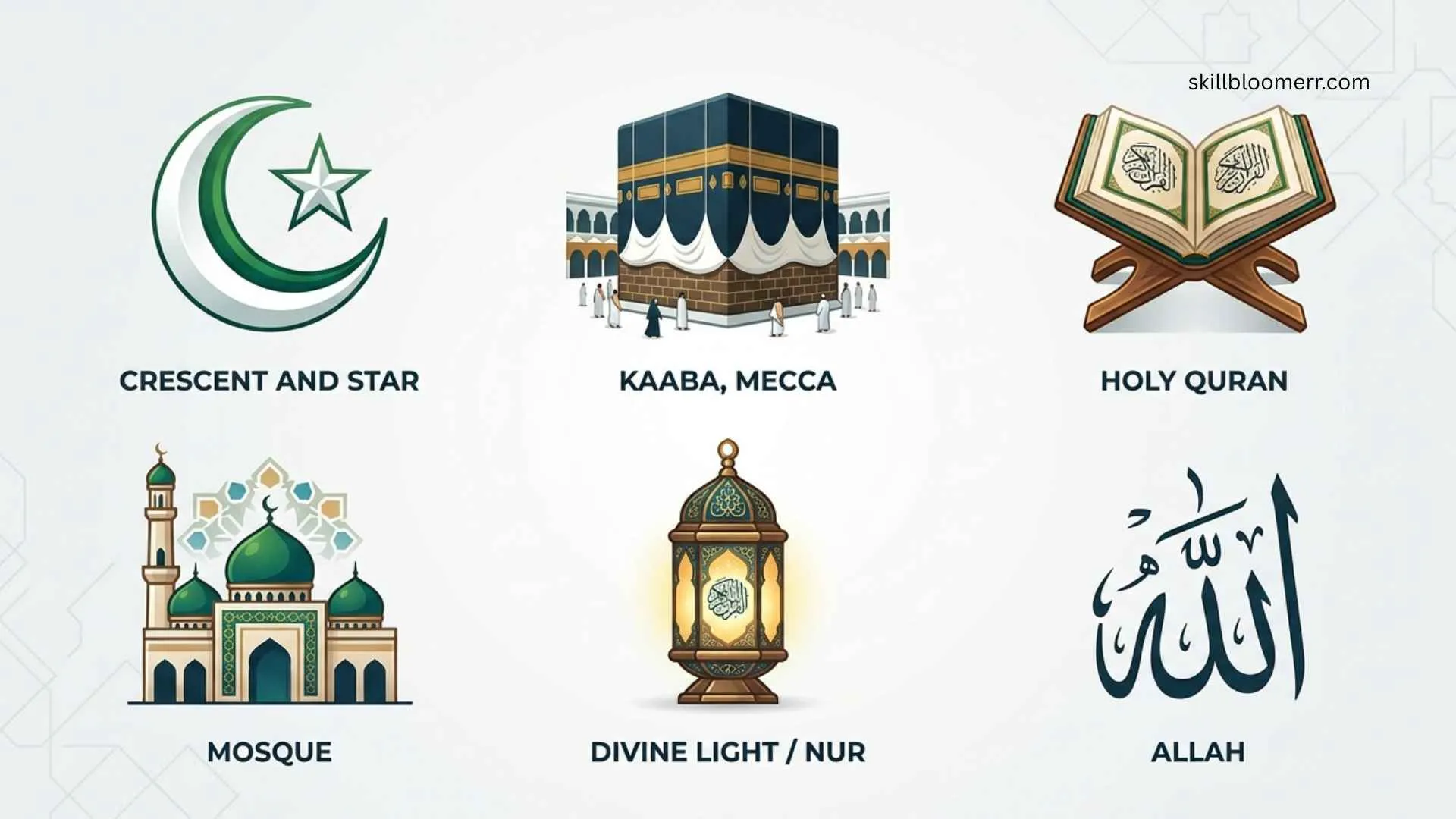
Islamic religious symbols represent deep spiritual ideas, cultural traditions, historical experiences, and connections to Islamic faith. While Islam does not have an official universal symbol comparable to some other religions, many symbols have become associated with Muslim identity, worship, art, and heritage across different regions.
From the crescent moon and star seen on flags and mosques to Arabic calligraphy featuring sacred phrases, Islamic religious symbols appear in architecture, manuscripts, jewelry, clothing, and cultural expressions around the world.
Understanding these symbols requires looking at their historical development, religious context, and the different meanings Muslims attach to them.
This guide explores the most recognized Islamic religious symbols, their origins, interpretations, cultural importance, and common misconceptions. It explains how these symbols developed and why their meanings can vary between communities and regions.
Quick Meaning of Islamic Religious Symbols
Islamic religious symbols are visual signs, artistic elements, and cultural representations connected with Islam, Muslim identity, and Islamic traditions. Some symbols express faith concepts such as devotion to Allah, spirituality, guidance, unity, and remembrance, while others developed through history and culture rather than directly from Islamic teachings.
Symbol Overview Table
| Symbol Name | Primary Meaning | Category | Origin | Civilization or Culture | First Known Use | Common Usage | Modern Meaning |
| Crescent and Star | Muslim identity, tradition, guidance | Cultural Symbol | Developed through historical Islamic civilizations | Ottoman and broader Muslim cultures | Associated strongly during later Islamic history | Flags, architecture, artwork | Cultural representation of Islam |
| Shahada Calligraphy | Declaration of Islamic faith | Religious Symbol | Early Islamic tradition | Islamic civilization | 7th century CE | Mosques, manuscripts, decorations | Faith and belief in Allah |
| Allah Calligraphy | Name of God in Islam | Spiritual Symbol | Arabic language tradition | Muslim communities worldwide | Early Islamic period | Art, prayer spaces, jewelry | Divine presence and remembrance |
| Kaaba Representation | Unity and direction of worship | Sacred Symbol | Arabian Peninsula | Islamic tradition | Before and during early Islam | Art, pilgrimage references | Spiritual unity |
| Quranic Calligraphy | Divine revelation and guidance | Religious Art | Islamic manuscript tradition | Islamic civilization | 7th century CE onward | Mosques, books, decoration | Knowledge and spirituality |
What Do Islamic Religious Symbols Mean?
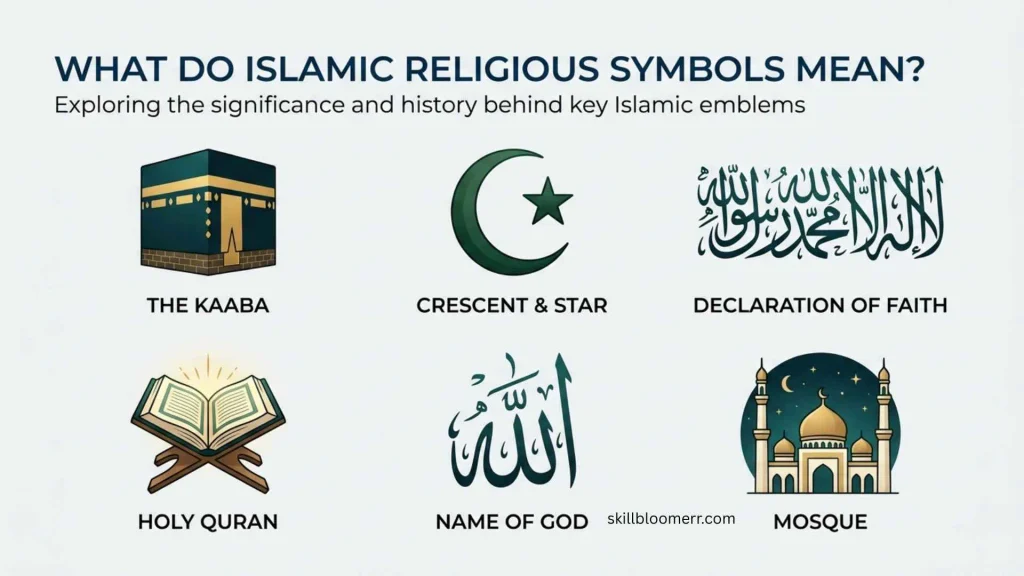
Islamic religious symbols carry different meanings depending on whether they are religious teachings, cultural traditions, or artistic expressions. Unlike some faith traditions that use one central emblem, Islam has a variety of symbols connected with belief, history, and community identity.
The most important meaning behind many Islamic symbols is the relationship between humans and Allah. Symbols often represent ideas such as:
- Faith and devotion
- Spiritual guidance
- Unity among Muslims
- Respect for Islamic teachings
- Connection with Islamic history
- Remembrance of religious values
However, it is important to understand that many commonly recognized Islamic symbols are cultural rather than officially prescribed religious signs.
For example, the crescent and star are widely recognized around the world as symbols connected with Islam, but they are not mentioned as a required symbol in the Quran or Islamic teachings. Their association developed through historical Muslim empires, especially the Ottoman Empire.
History and Origin of Islamic Religious Symbols
Islamic religious symbols developed through centuries of religious practice, artistic traditions, and cultural exchange. The early Muslim community focused more on written revelation, worship practices, and ethical teachings than on visual religious symbols.
Early Islamic Period and Symbol Development
During the early centuries of Islam, Muslims generally avoided using religious images that could resemble forms of idol worship. Instead, Islamic expression developed through:
- Arabic calligraphy
- Geometric patterns
- Architecture
- Quranic inscriptions
- Decorative arts
The written word became one of the most powerful forms of Islamic religious expression. Arabic calligraphy allowed Muslims to represent sacred concepts while maintaining respect for Islamic beliefs about worship.
Development of the Crescent and Star Symbol
The crescent and star became associated with Muslim societies gradually over time. The symbol existed in some ancient cultures before Islam, including regions influenced by Byzantine and Persian traditions.
Its connection with Islamic identity became stronger during later Muslim empires, particularly the Ottoman Empire. The Ottoman flag used a crescent and star design, and because of the empire’s global influence, the symbol became widely connected with Muslim culture.
Today, many countries with Muslim-majority populations include the crescent and star on national flags, although meanings differ from country to country.
Growth of Islamic Calligraphy as Sacred Expression
Arabic calligraphy became a major feature of Islamic art because it allowed artists to beautifully display Quranic verses and religious phrases.
Common forms include:
- Kufic script
- Naskh script
- Thuluth script
- Diwani script
These styles transformed Arabic writing into a visual art form used in mosques, manuscripts, and decorative objects.
Symbolism and Interpretation
Islamic religious symbols often communicate ideas beyond their physical appearance. Their meanings can include spiritual, cultural, and emotional dimensions.
Crescent Symbolism
The crescent is often connected with:
- Timekeeping through the lunar calendar
- Islamic months and festivals
- Renewal and growth
- Cultural identity
The Islamic calendar is based on the phases of the moon, making lunar imagery naturally meaningful within Muslim societies.
The beginning of Ramadan, Eid celebrations, and other important Islamic dates are determined through lunar observation or calculation, which contributes to the cultural importance of the moon.
Calligraphy Symbolism
Islamic calligraphy represents more than decoration. It reflects:
- Respect for divine revelation
- The importance of knowledge
- Beauty in language
- Spiritual reflection
Words such as “Allah,” Quranic verses, and phrases like “Bismillah” (In the name of Allah) are frequently written in artistic forms.
Geometric Pattern Symbolism
Islamic geometric designs are often associated with:
- Order
- Balance
- Infinity
- Harmony in creation
These patterns appear in mosques, carpets, tiles, and manuscripts. Their repeated structures reflect ideas of mathematical precision and artistic discipline.
Cultural Significance of Islamic Religious Symbols
Islamic symbols have different meanings across regions because Muslim cultures developed in diverse historical environments.
From the Middle East and North Africa to South Asia, Southeast Asia, and Europe, communities have adapted Islamic artistic traditions according to local languages, materials, and customs.
Middle Eastern Traditions
In many Middle Eastern cultures, Islamic symbolism appears through:
- Mosque architecture
- Arabic calligraphy
- Quranic decoration
- Traditional crafts
The emphasis is often placed on written religious expressions rather than human or animal imagery in sacred spaces.
South Asian Islamic Traditions
Countries such as Pakistan, India, and Bangladesh developed unique Islamic artistic styles influenced by Persian, Central Asian, and local traditions.
Examples include:
- Elaborate mosque designs
- Decorative calligraphy
- Islamic architecture with regional artistic elements
Ottoman and Turkish Influence
The Ottoman Empire played a major role in spreading certain Islamic visual traditions. The crescent and star became especially recognizable because of Ottoman flags, military symbols, and architecture.
However, Ottoman symbolism represents one historical tradition among many and does not define all Islamic communities.
Religious or Spiritual Meaning of Islamic Religious Symbols
Islamic religious symbols often carry spiritual meanings connected with faith, worship, remembrance, and the relationship between humans and Allah. However, Islam traditionally places greater emphasis on beliefs, actions, and worship practices than on visual symbols.
The Shahada and Its Spiritual Importance
The Shahada is the Islamic declaration of faith:
“There is no god but Allah, and Muhammad is the Messenger of Allah.”
It represents the foundation of Islamic belief and expresses the central concept of Tawhid, the oneness of Allah.
The Shahada symbolizes:
- Belief in one God
- Acceptance of Prophet Muhammad as Allah’s messenger
- Commitment to Islamic faith
- Spiritual identity among Muslims
The phrase appears in many forms of Islamic art and architecture, but Muslims generally understand the words themselves as sacred rather than treating the written form as an object of worship.
The Name of Allah as a Sacred Symbol
Arabic calligraphy of the word “Allah” is one of the most recognizable expressions of Islamic spirituality. It is commonly found in:
- Mosques
- Islamic artwork
- Homes
- Jewelry
- Educational materials
The symbol represents remembrance of God and encourages reflection on divine qualities such as mercy, wisdom, and compassion.
The Kaaba as a Symbol of Unity
The Kaaba in Mecca is the direction Muslims face during daily prayers, known as the Qiblah. It is also the central location of the annual Hajj pilgrimage.
The Kaaba symbolizes:
- Unity of Muslims worldwide
- Equality before Allah
- Connection with Prophet Ibrahim (Abraham) and Islamic tradition
- Spiritual devotion
Although images of the Kaaba are sometimes used symbolically, Muslims do not worship the structure itself. It serves as a focal point for prayer and pilgrimage.
Quranic Verses and Spiritual Expression
Quranic calligraphy represents the importance of revelation and guidance in Islam.
Verses displayed in Islamic spaces often remind believers of:
- Faith
- Patience
- Gratitude
- Justice
- Mercy
- Responsibility
The artistic presentation of Quranic text reflects the Islamic appreciation for knowledge, language, and beauty.
Where Islamic Religious Symbols Are Used
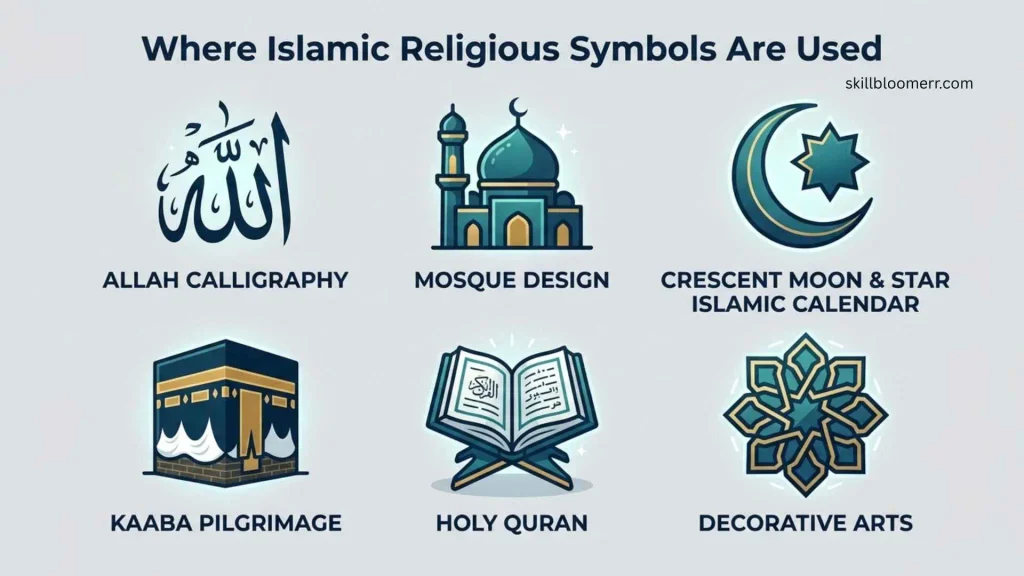
Islamic religious symbols appear in many areas of religious life, culture, and artistic expression. Their use depends on local traditions and individual interpretations.
Mosques and Religious Architecture
Mosques often feature:
- Arabic calligraphy
- Geometric patterns
- Quranic inscriptions
- Decorative motifs
Examples include famous Islamic architectural landmarks such as:
- The Dome of the Rock in Jerusalem
- The Blue Mosque in Istanbul
- Historic mosques throughout Cairo, Damascus, and other Islamic cities
Islamic architecture commonly emphasizes patterns, writing, and structure rather than religious statues or human figures.
Flags and National Identity
The crescent and star appear on several national flags, including those of countries with Muslim-majority populations.
Examples include:
- Turkey
- Pakistan
- Algeria
- Tunisia
- Azerbaijan
However, the presence of these symbols on a flag does not always mean the country follows one specific interpretation of Islam. National symbols often combine religious, historical, and political meanings.
Jewelry and Personal Items
Islamic-inspired designs appear in:
- Necklaces
- Rings
- Pendants
- Clothing
- Home decorations
Common examples include:
- Crescent designs
- Arabic calligraphy
- Ayat (Quranic verses)
- Geometric Islamic patterns
Some people wear these items as cultural expressions, while others use them as reminders of faith.
Books and Manuscripts
Islamic manuscripts have historically used symbolic artistic elements, including:
- Decorative borders
- Gold illumination
- Calligraphic designs
- Geometric artwork
The Quran has a particularly important role in Islamic manuscript traditions, where careful writing and decoration demonstrate respect for the sacred text.
Tattoos and Modern Art
Islamic symbols sometimes appear in modern artwork and tattoos. However, attitudes toward tattoos and religious imagery vary among Muslim communities.
Some Muslims view religious phrases or Quranic text in tattoos as inappropriate because sacred words should be treated with special respect. Others may use non-religious cultural designs inspired by Islamic art.
Understanding personal and cultural context is important when interpreting these uses.
Common Variations of Islamic Religious Symbols
Islamic symbols have developed many regional and artistic variations throughout history.
Crescent and Star Variations
The crescent and star may appear with different:
- Star numbers
- Crescent directions
- Colors
- Artistic styles
Common designs include:
- A five-pointed star inside a crescent
- A star positioned beside the crescent
- Decorative crescent shapes in mosque designs
Different cultures attach different meanings to these variations.
Arabic Calligraphy Styles
Arabic writing has many artistic forms, including:
Kufic Script
Kufic is one of the oldest Arabic calligraphy styles. It is known for:
- Straight lines
- Strong geometric shapes
- Monumental appearance
It was widely used in early Quran manuscripts and Islamic architecture.
Thuluth Script
Thuluth is recognized for:
- Large curved letters
- Decorative appearance
- Use in mosque decoration
It became especially popular for architectural inscriptions.
Diwani Script
Diwani developed during the Ottoman period and is known for:
- Elegant curves
- Complex letter connections
- Decorative qualities
Islamic Geometric Patterns
Islamic patterns vary by region and artistic tradition.
Common styles include:
- Eight-pointed stars
- Interlocking shapes
- Repeating symmetrical designs
- Arabesque patterns
These designs often represent balance, harmony, and the beauty of creation.
Common Misconceptions About Islamic Religious Symbols
Many misunderstandings exist about Islamic symbols because people often confuse cultural traditions with religious requirements.
Misconception 1: The Crescent and Star Is an Official Islamic Symbol
The crescent and star is widely recognized as connected with Islam, but Islam does not have one official symbol required for all Muslims.
Its popularity comes mainly from historical and cultural developments.
Misconception 2: Muslims Worship Symbols
Muslims do not worship symbols such as the crescent, Kaaba, or calligraphy.
In Islamic belief, worship is directed only toward Allah. Symbols serve as reminders, expressions of identity, or artistic representations.
Misconception 3: All Islamic Symbols Have the Same Meaning Everywhere
Islamic cultures exist across many regions, languages, and histories.
A symbol may represent:
- Religion in one context
- National identity in another
- Cultural heritage elsewhere
Meanings depend on location and usage.
Misconception 4: Islamic Art Avoids All Images
Islamic art is diverse. While many religious spaces avoid human and animal imagery, Islamic cultures have produced many forms of visual creativity, including:
- Architecture
- Calligraphy
- Textiles
- Ceramics
- Manuscript illustration
The style varies depending on region and purpose.
Interesting Facts About Islamic Religious Symbols
Islamic religious symbols have developed through centuries of faith, art, history, and cultural exchange. These facts show how symbols connected with Islam carry meanings beyond simple visual designs.
1. Islam Does Not Have One Official Universal Symbol
Unlike some religions that use a single central emblem, Islam does not have an officially required symbol recognized by all Muslims. Many commonly known symbols developed through history, culture, and artistic traditions rather than direct religious instructions.
2. The Crescent and Star Predates Islam
The crescent and star design existed in some ancient civilizations before Islam, including cultures influenced by Mesopotamian, Byzantine, and Persian traditions. Its later association with Muslim societies developed gradually, especially through historical empires such as the Ottoman Empire.
3. Arabic Calligraphy Became a Major Islamic Art Form
Because of the importance of the Quran in Islam, Arabic writing developed into one of the most respected forms of artistic expression. Skilled calligraphers created detailed designs that transformed words into visual works of art.
4. The Islamic Calendar Is Connected to Lunar Symbolism
The Islamic calendar follows the phases of the moon. Important events such as Ramadan, Eid al-Fitr, and Eid al-Adha are connected with lunar months, which helps explain why moon imagery has cultural significance in many Muslim communities.
5. Geometric Patterns Reflect Mathematical Ideas
Islamic geometric designs often use repeating shapes, symmetry, and complex patterns. These artistic methods demonstrate ideas of balance, order, and precision while creating visually complex decorations.
6. Calligraphy Can Carry Religious Meaning Without Images
Islamic traditions often emphasize written expressions of faith. A beautifully written Quranic verse or the name of Allah can communicate spiritual meaning through language rather than visual representation.
7. The Kaaba Represents Global Muslim Unity
The Kaaba in Mecca is one of the most recognizable structures associated with Islam. Muslims around the world face the Kaaba during prayer, symbolizing unity despite differences in nationality, language, and culture.
8. Islamic Symbols Vary Across Regions
A symbol used in Indonesia may have a different cultural context from the same symbol used in Morocco, Turkey, or Pakistan. Local history influences how communities understand and display Islamic symbols.
9. Islamic Art Influenced Global Design
Islamic patterns and calligraphy influenced architecture, textiles, ceramics, and decorative arts beyond Muslim-majority regions. Historical trade and cultural exchange helped spread these artistic traditions worldwide.
10. Colors Can Have Different Cultural Meanings
Colors often associated with Islamic cultures, such as green, white, black, and gold, may carry different meanings depending on historical and regional context. No single color has one universal meaning for all Muslims.
Related Symbols in Islamic Culture and Tradition
Islamic religious symbols are connected with many other signs, concepts, and artistic elements that express faith and cultural identity.
The Bismillah Symbol
“Bismillah” means “In the name of Allah.” It is a phrase commonly used by Muslims before beginning important activities.
It represents:
- Seeking Allah’s blessing
- Beginning with good intentions
- Remembering God in daily life
It appears in calligraphy, manuscripts, and decorative artwork.
The 99 Names of Allah
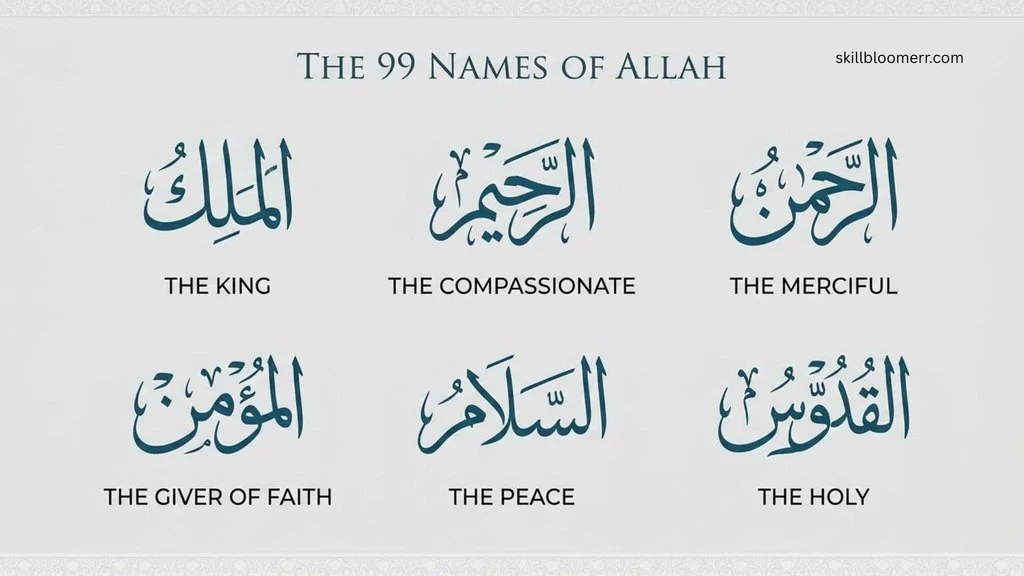
The 99 Names of Allah represent qualities and attributes associated with God in Islamic tradition.
Examples include:
- Ar-Rahman (The Most Merciful)
- Al-Hakim (The All-Wise)
- Al-Wadud (The Loving)
These names are often displayed in calligraphy as reminders of spiritual reflection.
The Hand of Fatima (Hamsa)
The Hamsa, also called the Hand of Fatima in many Muslim cultures, is a hand-shaped symbol found in parts of North Africa and the Middle East.
It is associated culturally with:
- Protection
- Blessings
- Good fortune
However, interpretations vary, and it is not considered a required Islamic religious symbol by all Muslims.
The Arabic Letter “Allah”
The written form of “Allah” is frequently used in Islamic art. It represents the central belief in one God and serves as a reminder of faith.
The Mihrab
The mihrab is a niche in a mosque wall that indicates the direction of Mecca.
It symbolizes:
- Direction in worship
- Connection between worshippers and the sacred center of Islam
- The importance of prayer
Frequently Asked Questions About Islamic Religious Symbols
What are the most common Islamic religious symbols?
The most recognized Islamic symbols include the crescent and star, Arabic calligraphy, the Shahada, the name of Allah, Quranic inscriptions, and representations of the Kaaba. However, Islam does not have one official symbol used universally by all Muslims.
Is the crescent and star an Islamic religious symbol?
The crescent and star is commonly associated with Islam and Muslim identity, but it is primarily a historical and cultural symbol rather than a required religious emblem. Its association became stronger through Muslim empires, especially the Ottoman Empire.
Does Islam have an official symbol?
No, Islam does not have an official universal symbol. Islamic faith is based on beliefs, worship, ethics, and religious practices rather than a specific visual emblem. Different Muslim communities may use different cultural symbols.
What does Arabic calligraphy symbolize in Islam?
Arabic calligraphy symbolizes respect for language, knowledge, and divine revelation. It became especially important because the Quran was revealed in Arabic, making beautiful writing a meaningful form of Islamic artistic expression.
Why is the crescent associated with Islam?
The crescent became connected with Muslim societies through historical developments rather than early Islamic teachings. Its association grew because of its use by powerful Muslim civilizations and later national identities.
What does the Kaaba symbolize in Islam?
The Kaaba symbolizes unity, devotion, and the central direction of Islamic prayer. Muslims around the world face the Kaaba during daily prayers, making it a powerful symbol of spiritual connection.
Are Islamic symbols used only in religious places?
No. Islamic symbols appear in many settings, including mosques, homes, books, clothing, artwork, architecture, flags, and cultural objects. Their meaning depends on how and where they are used.
What does the color green mean in Islamic culture?
Green has historical and cultural associations with Islam in many communities, but it does not have one fixed meaning for all Muslims. It may represent nature, paradise, renewal, or historical traditions depending on context.
Can non-Muslims use Islamic symbols?
The use of Islamic symbols depends on context and intention. Religious symbols should be treated respectfully, especially when they contain sacred phrases or Quranic text. Cultural understanding is important when using such imagery.
Are Islamic symbols mentioned in the Quran?
Some concepts represented by symbols, such as belief in Allah and the importance of prayer, are central to Islam. However, many commonly recognized visual symbols, such as the crescent and star, are not specifically mentioned in the Quran.
Key Takeaways
- Islamic religious symbols represent faith, history, culture, and artistic expression.
- Islam does not have one official symbol shared by all Muslims.
- The crescent and star is mainly a historical and cultural symbol.
- Arabic calligraphy became one of the most important forms of Islamic art.
- The Kaaba represents unity and the direction of Muslim prayer.
- Islamic symbols can have different meanings across regions and communities.
- Religious symbols should be understood through historical and cultural context.
- Many Islamic artistic traditions focus on writing, geometry, and architecture.
- Symbols connected with Islam are often reminders of faith rather than objects of worship.
- Understanding context is essential when interpreting Islamic symbols.
Conclusion
Islamic religious symbols reflect a rich relationship between faith, history, language, and culture. From Arabic calligraphy and Quranic inscriptions to the crescent and star, these symbols reveal how Muslim communities have expressed spiritual ideas and cultural identity throughout centuries.
While some symbols are widely recognized around the world, their meanings are not always the same everywhere. Understanding Islamic symbols requires looking beyond appearances and considering historical development, religious beliefs, and regional traditions.
Whether found in mosques, artwork, architecture, books, or cultural objects, Islamic religious symbols continue to represent devotion, unity, remembrance, and the diverse heritage of Muslim communities worldwide.

I’m Nathaniel Brooks, an educational writer who loves exploring ideas and making useful knowledge accessible to everyone. I write for SkillBloomerr with a focus on clear explanations, practical tips, and meaningful learning. My goal is to help readers discover something valuable every time they visit the site.
Books: Learn Something New and The Practical Knowledge Handbook
 Ethan Calloway
 Olivia Hartwell