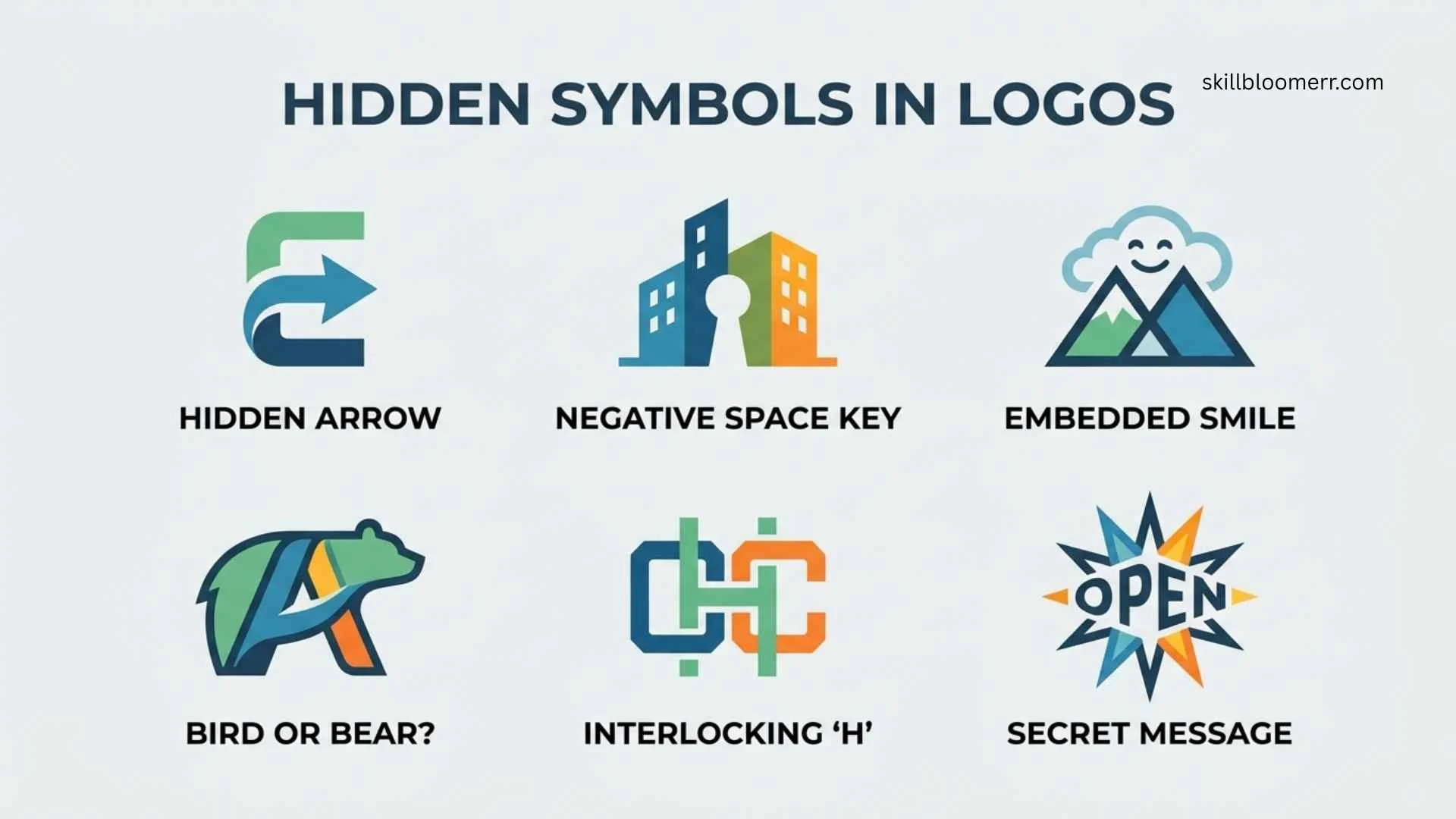
Hidden symbols in logos are visual elements that designers use to communicate deeper meanings, brand values, history, or emotional messages without using words. Many logos appear simple at first glance, but they often contain clever details that represent a company’s identity, mission, or story.
From hidden arrows and clever shapes to meaningful colors and negative space, logos can contain messages that viewers discover over time. You may see these designs on products, websites, packaging, advertisements, technology platforms, and everyday objects.
Understanding hidden symbols in logos helps you see branding differently. This guide explores famous examples, explains how hidden meanings work, and reveals why companies use visual symbolism to create stronger connections with customers.
Quick Meaning of Hidden Symbols in Logos
Hidden symbols in logos are secret or subtle visual messages placed inside a logo’s design. These symbols may appear through shapes, colors, spacing, or negative space and often communicate a brand’s values, history, purpose, or personality without being immediately noticeable.
Symbol Overview Table
| Symbol Element | Primary Meaning | Category | Origin | Common Usage | Modern Meaning | Related Concepts |
| Hidden Shapes | Secret messages and ideas | Graphic Design | Modern branding | Company logos | Creativity and identity | Visual symbolism |
| Negative Space | Hidden images using empty areas | Design Technique | 20th-century design | Brand marks | Intelligence and discovery | Gestalt psychology |
| Arrows | Movement, direction, progress | Symbolic Design | Ancient visual communication | Business logos | Growth and speed | Navigation symbols |
| Animals | Strength, trust, freedom | Cultural Symbolism | Ancient civilizations | Brand identities | Personality and values | Heraldry |
| Colors | Emotions and associations | Color Psychology | Human perception | Marketing | Brand recognition | Visual communication |
What Do Hidden Symbols in Logos Mean?
Hidden symbols in logos represent ideas that a company wants customers to remember. Instead of directly explaining a message, designers use visual clues that encourage people to think and discover.
A successful hidden symbol can create a memorable experience. When people notice a secret detail inside a logo, they often feel a stronger connection because they have uncovered something special.
For example, a logo may include:
- An arrow representing movement or progress
- A hidden letter showing company initials
- An animal symbolizing strength or trust
- A shape representing community or connection
- A design element connected to the company’s history
These hidden meanings are not always obvious. Some are intentional design choices, while others may develop through cultural interpretation.
History and Origin of Hidden Logo Symbols
Early Use of Symbolic Branding
The use of symbols in identification goes back thousands of years. Ancient civilizations used marks, seals, and emblems to represent ownership, authority, and identity.
Ancient Egyptians used symbolic images such as the ankh, scarab, and eye symbols to communicate spiritual and cultural ideas. Roman families used personal emblems, while medieval European groups used coats of arms to represent heritage and loyalty.
Although modern corporate logos developed much later, they follow the same basic principle: using images to communicate meaning.
Development of Modern Logo Design
During the Industrial Revolution, companies needed recognizable marks to distinguish their products. Logos became important tools for building trust and recognition.
In the 20th century, graphic designers began using psychology, geometry, and visual storytelling to create more meaningful brand identities.
Modern logo designers often use:
- Minimal shapes
- Hidden imagery
- Balanced layouts
- Symbolic colors
- Visual illusions
These techniques allow a simple logo to communicate complex ideas.
Famous Examples of Hidden Symbols in Logos
Amazon Logo: The Hidden Smile and Arrow
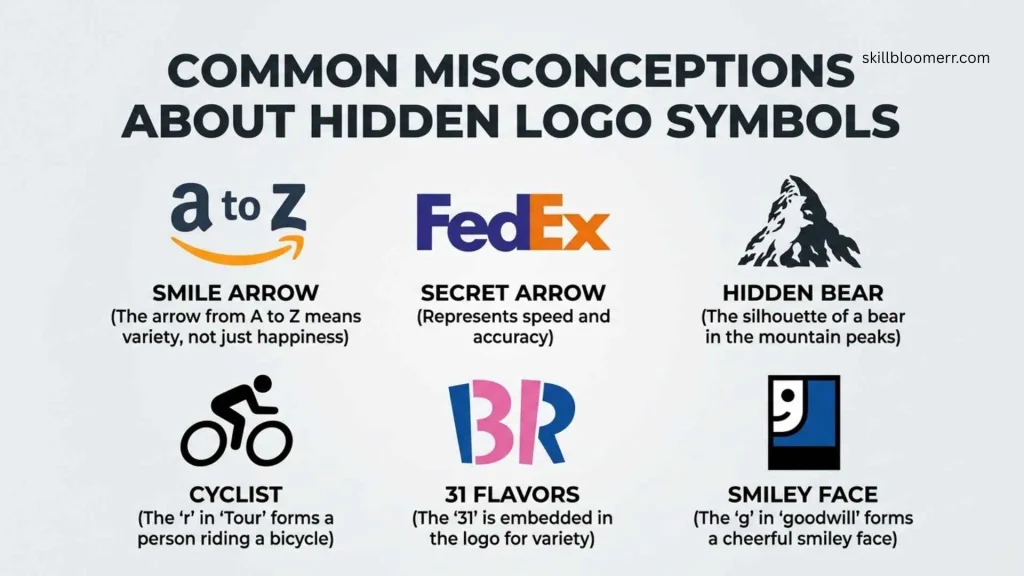
The Amazon logo contains an arrow running from the letter “A” to the letter “Z.” This represents the company selling a wide range of products from A to Z.
The curved arrow also resembles a smile, suggesting customer satisfaction and a positive shopping experience.
The symbol communicates two ideas:
- Product variety
- Customer happiness
FedEx Logo: The Hidden Arrow
The FedEx logo contains one of the most famous examples of negative space symbolism.
Between the letters “E” and “x,” an arrow is formed by the empty space. The arrow represents:
- Speed
- Direction
- Delivery movement
- Forward progress
Many people do not notice it immediately, which makes discovering the symbol memorable.
Baskin-Robbins Logo: The Hidden Number 31
The Baskin-Robbins logo uses parts of the letters “B” and “R” to create the number 31.
The number represents the company’s original idea of offering 31 ice cream flavors, one for every day of the month.
This hidden message connects the logo directly to the brand’s history.
Toblerone Logo: The Hidden Bear
The Toblerone logo features a mountain design inspired by the Matterhorn in Switzerland.
Inside the mountain shape, there is a hidden bear. The bear represents Bern, Switzerland, where the chocolate company originated.
The symbol connects the product with its geographic roots.
BMW Logo: The Aviation Connection
A common interpretation of the BMW logo connects its design with aircraft propellers because of the company’s early history in aircraft engines.
However, BMW has stated that the logo’s colors and design are primarily connected to Bavarian heritage.
This example shows why researching official explanations is important because popular interpretations are not always accurate.
Symbolism and Interpretation of Hidden Logo Designs
Hidden symbols can have different meanings depending on culture, industry, and personal interpretation.
Traditional Symbolism
Traditional symbols often represent universal ideas:
| Symbol | Common Meaning |
| Circle | Unity, completeness, protection |
| Triangle | Strength, stability, direction |
| Arrow | Progress, movement |
| Tree | Growth, life, connection |
| Bird | Freedom, vision |
| Shield | Security, trust |
Modern Brand Interpretation
Companies use hidden symbols to communicate:
- Innovation
- Reliability
- Creativity
- Quality
- Community
- Speed
- Environmental responsibility
A technology company may use geometric designs to suggest innovation, while a nature-focused company may use leaves or natural forms.
Psychological Interpretation
Hidden symbols work because humans naturally search for patterns and meanings.
This concept connects with Gestalt psychology, which explains how people organize visual information and recognize complete forms from simple elements.
A hidden symbol can create:
- Curiosity
- Satisfaction
- Memory reinforcement
- Emotional connection
Cultural Significance of Logo Symbols
Symbols do not have identical meanings everywhere. A design element that feels positive in one culture may have a different interpretation elsewhere.
Western Symbolism
In many Western cultures:
- Eagles represent freedom and strength
- Lions represent courage and leadership
- Blue represents trust and professionalism
- Green represents nature and growth
Asian Symbolism
Many Asian cultures place importance on:
- Balance
- Harmony
- Prosperity
- Spiritual connections
Colors and shapes can carry meanings related to luck, success, and tradition.
Global Branding Challenges
International companies must carefully consider symbolism before launching designs worldwide.
A symbol that works in one market may create confusion in another because meanings are influenced by:
- History
- Religion
- Language
- Social customs
Religious or Spiritual Meaning of Logo Symbols
Some logos use symbols that have historical connections with religion or spirituality. However, companies usually adapt these symbols for broader meanings.
Examples include:
- Circles representing unity or eternity
- Light imagery representing knowledge or hope
- Trees representing life and growth
- Wings representing freedom or transcendence
A symbol’s meaning depends on context. A shape used in a logo does not automatically carry the same meaning as it does in a religious setting.
Scientific or Technical Meaning of Logo Symbols
Hidden symbols in logos are mainly related to design and communication rather than science. However, some principles behind them connect with technical fields.
Psychology and Visual Processing
Designers use principles from:
- Cognitive psychology
- Visual perception
- Pattern recognition
- Color psychology
Geometry in Logo Design
Many logos rely on:
- Symmetry
- Proportion
- Mathematical shapes
- Balanced spacing
Geometric designs help logos remain recognizable across different sizes and platforms.
Where Hidden Symbols in Logos Are Used
Hidden logo symbols appear across many industries.
Technology
Technology brands often use:
- Abstract shapes
- Digital references
- Connected forms
These suggest innovation and progress.
Food and Beverage
Food brands frequently use hidden symbols related to:
- Ingredients
- Heritage
- Quality
- Flavor
Automotive Industry
Car logos often include symbols representing:
- Speed
- Engineering
- Luxury
- Tradition
Entertainment and Media
Entertainment companies use symbols to create emotional recognition and memorable identities.
Clothing and Fashion
Fashion logos often use minimal symbols to communicate:
- Elegance
- Exclusivity
- Style
Common Variations of Hidden Logo Symbols
Negative Space Designs
Negative space uses empty areas to create additional images.
Examples:
- Hidden arrows
- Hidden letters
- Hidden objects
Letter-Based Symbols
Designers combine letters to create:
- Initials
- Numbers
- Shapes
Cultural Symbols
Some logos include:
- Historical references
- National elements
- Traditional patterns
Abstract Symbols
Abstract logos communicate ideas without showing recognizable objects.
Common Misconceptions About Hidden Logo Symbols
Not Every Detail Has a Secret Meaning
People sometimes create explanations for logo elements that designers never intended.
A logo should be interpreted using reliable information from the company or designer whenever possible.
Popular Interpretations Can Be Incorrect
Some famous logo explanations spread online even when they are not officially confirmed.
Simple Logos Can Still Have Deep Meaning
A logo does not need a hidden message to be effective. Simplicity itself can create recognition and emotional impact.
Interesting Facts About Hidden Symbols in Logos
- Hidden symbols often improve brand memory
Discovering a secret element can make a logo more memorable. - Negative space is one of the most popular design techniques
Designers use empty areas creatively to hide meaningful shapes. - Some hidden symbols are discovered years after a logo launches
Viewers may notice details long after a brand becomes famous. - Colors can communicate messages without words
Companies carefully select colors based on emotional associations. - Logo redesigns can change symbolic meanings
Companies update logos to reflect new goals or audiences. - Hidden messages are common in minimalist design
Simple logos often depend on clever visual ideas. - Symbols can create emotional trust
Familiar imagery helps customers recognize brands quickly. - A logo must work at many sizes
Hidden details must remain effective on websites, packaging, and small screens. - Designers consider cultural meanings before global launches
International brands research symbolism carefully. - A good logo communicates before people read anything
Visual recognition often happens faster than written information.
Related Symbols and Concepts
Brand Symbols
Brand symbols are visual elements that represent companies and organizations.
Emblems
Emblems combine images and text to represent identity or authority.
Icons
Icons are simplified images designed for quick recognition.
Pictograms
Pictograms communicate ideas through simple visual images.
Heraldic Symbols
Heraldry uses symbols such as animals, shields, and colors to represent families or organizations.
Frequently Asked Questions
Why do companies hide symbols in logos?
Companies use hidden symbols to communicate additional messages, create curiosity, and make their brands more memorable. A hidden element can represent company history, values, products, or goals without making the design complicated.
What is the most famous hidden symbol in a logo?
The FedEx hidden arrow is one of the most famous examples. The arrow between the letters represents speed and movement, matching the company’s delivery mission.
Are all hidden logo meanings intentional?
No. Some meanings are officially created by designers, while others are interpretations made by viewers. Reliable explanations usually come from company statements or design documentation.
Why are hidden symbols effective?
Hidden symbols encourage people to interact with a logo. When someone discovers a secret detail, the experience can create stronger memory and emotional connection.
How do designers create hidden symbols?
Designers use techniques such as negative space, shape combinations, typography, color choices, and visual balance to include additional meanings.
Can hidden symbols change meaning over time?
Yes. Cultural changes, redesigns, and new audiences can influence how people understand a logo.
Do colors count as hidden symbols?
Yes. Colors can communicate ideas such as trust, excitement, nature, luxury, or technology even when no specific image is included.
Why do minimalist logos often contain hidden meanings?
Minimalist designs rely on fewer elements, so each shape, line, and space can carry more importance.
Are hidden symbols used only by large companies?
No. Small businesses, organizations, and personal brands also use symbolic logo designs to communicate identity.
How can I find hidden meanings in logos?
Look carefully at shapes, empty spaces, letters, colors, and historical connections. Also check official brand explanations to separate facts from assumptions.
Key Takeaways
- Hidden symbols in logos communicate ideas without using words.
- Negative space is a common technique for creating secret images.
- Famous examples include Amazon, FedEx, Baskin-Robbins, and Toblerone.
- Logo meanings can depend on culture, history, and context.
- Not every interpretation found online is officially confirmed.
- Effective logos combine simplicity, symbolism, and recognition.
- Symbols help brands create emotional connections with audiences.
Conclusion
Hidden symbols in logos reveal how powerful visual communication can be. A simple design may contain stories about a company’s history, values, products, or purpose. From hidden arrows to meaningful shapes, these details show that logos are more than decorations.
Understanding hidden symbols in logos allows you to look at everyday brands with a deeper perspective. Whether found in technology, food, fashion, or entertainment, these visual messages demonstrate how design can communicate powerful ideas in a single image.

I’m Ethan Calloway, an English writer and lifelong learner who enjoys turning complex ideas into clear, practical content. At SkillBloomerr, I focus on useful topics that help readers build knowledge, improve their skills, and feel more confident in everyday learning. I believe good writing should be simple, engaging, and genuinely helpful.
Books: The Everyday Learning Guide and Build Better Skills
 Olivia Hartwell
 Nathaniel Brooks