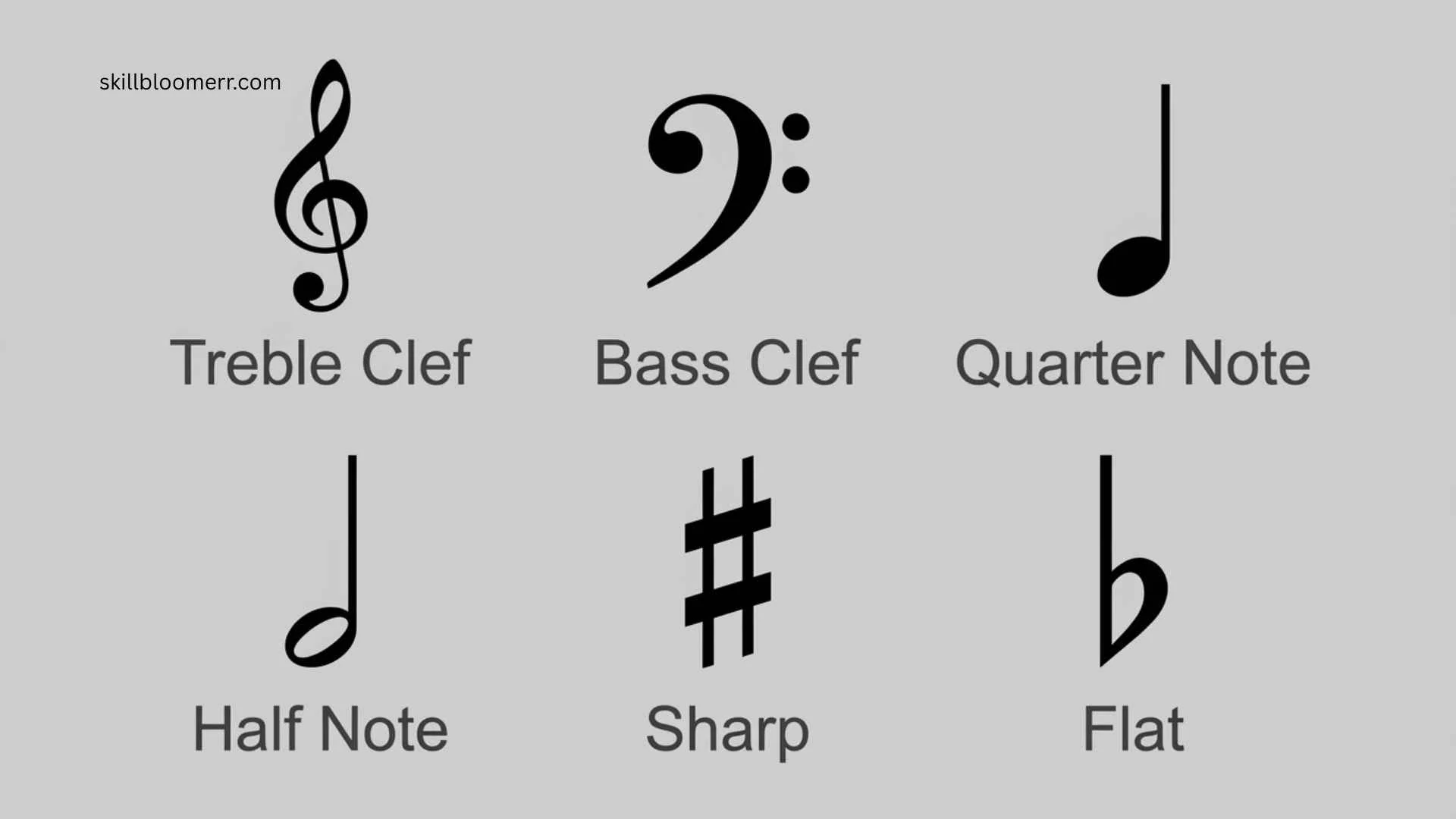
Music sheet symbols are the visual language that allows musicians to read, understand, and perform a piece of music. These symbols show everything from pitch and rhythm to expression, timing, and performance style. Whether you see them in piano books, orchestral scores, guitar tabs, choir arrangements, or digital music software, each mark carries important information.
Learning music notation symbols helps beginners understand how composers communicate ideas without words. A small sign such as a sharp, rest, clef, or dynamic marking can completely change how a musician plays a note or phrase.
This guide explains the most common music sheet symbols, their meanings, history, uses, variations, and the role they play in modern music.
Quick Meaning of Music Sheet Symbols
Music sheet symbols are written signs used in musical notation to represent sounds, silence, rhythm, pitch, speed, volume, and expression. They create a universal system that allows musicians around the world to read and perform the same musical composition accurately.
Music Sheet Symbols Overview Table
| Symbol Name | Primary Meaning | Category | Origin | Common Usage |
| Treble Clef | Shows higher musical notes | Clef | Medieval Europe | Piano, violin, flute |
| Bass Clef | Shows lower musical notes | Clef | Medieval Europe | Cello, bass, left piano hand |
| Sharp (#) | Raises a note by a half step | Pitch Symbol | Western Music Theory | Changing note pitch |
| Flat (♭) | Lowers a note by a half step | Pitch Symbol | Western Music Theory | Changing note pitch |
| Natural (♮) | Cancels sharp or flat | Pitch Symbol | Western Music Theory | Restoring original pitch |
| Quarter Note | Represents one beat in common time | Rhythm Symbol | Western Notation | Measuring rhythm |
| Rest | Represents silence | Rhythm Symbol | Western Notation | Musical pauses |
| Time Signature | Shows beats per measure | Rhythm Symbol | Western Notation | Organizing rhythm |
| Dynamic Markings | Control loudness | Expression Symbol | Italian Music Tradition | Performance style |
| Repeat Sign | Shows repeated sections | Navigation Symbol | Western Notation | Score organization |
What Do Music Sheet Symbols Mean?
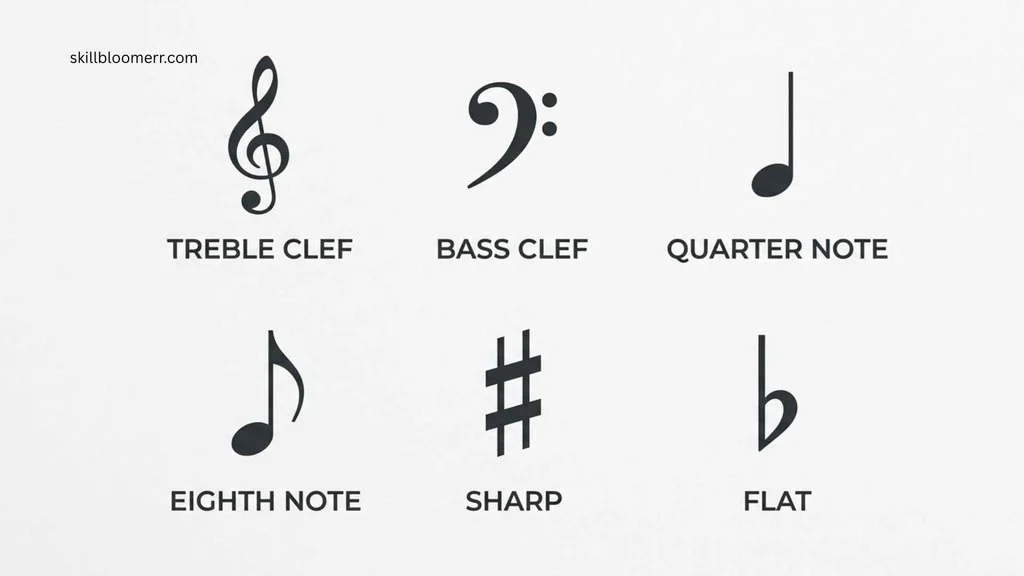
Music sheet symbols represent different elements of a musical performance. They tell musicians which notes to play, how long to hold them, how loudly to perform them, and how to express the music.
Unlike written language, musical notation does not use ordinary letters and sentences. Instead, composers use a combination of symbols placed on a staff, which consists of five horizontal lines and four spaces.
The most important categories of music symbols include:
- Pitch symbols
- Rhythm symbols
- Tempo markings
- Dynamic symbols
- Expression markings
- Articulation symbols
- Navigation symbols
Together, these symbols create a complete instruction system for musicians.
History and Origin of Music Sheet Symbols
Early Forms of Musical Notation
The history of music notation began thousands of years ago. Ancient civilizations, including the Greeks, used early systems to record melodies, although these systems were different from modern notation.
Ancient Greek musical symbols helped preserve information about melodies, but they did not provide the detailed rhythm and expression instructions found in today’s sheet music.
Development of Modern Musical Notation
Modern Western music notation developed mainly during the medieval period in Europe. Monks used early symbols called neumes to record Gregorian chants.
Over time, these symbols became more precise. The introduction of staff notation by medieval music theorists helped musicians identify exact pitches.
The five-line staff system eventually became the foundation of modern sheet music.
Symbolism and Interpretation of Music Sheet Symbols
Music sheet symbols do more than represent technical information. They also guide emotional expression and artistic interpretation.
Traditional Meaning
Traditionally, symbols provide exact instructions:
- Notes show what pitch to play.
- Rests show when to remain silent.
- Tempo markings show speed.
- Dynamics show volume changes.
Modern Interpretation
Today, musicians often interpret symbols creatively. Two performers may read the same musical score but express it differently through timing, emotion, and style.
For example, a composer may write “piano” (soft), but the performer decides how gentle or emotional that softness should sound.
Psychological Meaning
Music symbols act as a bridge between written instructions and human emotion. They allow composers to communicate feelings such as excitement, sadness, tension, or peace.
Cultural Significance of Music Sheet Symbols
Music notation has influenced cultures worldwide by creating a shared language for musical communication.
Western Musical Tradition
Western classical music heavily depends on written notation. Composers such as Johann Sebastian Bach, Wolfgang Amadeus Mozart, and Ludwig van Beethoven used musical symbols to preserve their works.
Global Influence
Many cultures have adopted Western notation systems while also maintaining traditional methods of recording music.
For example:
- Indian classical music often uses systems such as sargam.
- Chinese traditional music has used unique notation methods.
- Japanese music has developed specialized recording techniques.
Different cultures show that music can be documented in many ways while serving the same purpose: preserving sound.
Religious and Spiritual Meaning of Music Symbols
Music symbols have played an important role in religious traditions.
Sacred music in Christianity, Judaism, Islam, Hinduism, and other traditions has often relied on written or memorized systems to preserve prayers, chants, and spiritual songs.
Gregorian chant notation, for example, helped preserve religious melodies used in medieval Christian worship.
Music symbols themselves are not usually considered sacred objects, but they support the preservation of spiritual and ceremonial music.
Scientific and Technical Meaning of Music Symbols
Music notation has strong connections with mathematics and acoustics.
Mathematical Use
Rhythm symbols represent divisions of time. Notes and rests follow mathematical relationships:
- Whole notes contain longer durations.
- Half notes divide musical time.
- Quarter notes create smaller rhythmic units.
Scientific Connection
Pitch symbols relate to sound frequency. Higher notes represent faster sound vibrations, while lower notes represent slower vibrations.
Digital Technology
Modern music software uses digital versions of traditional notation symbols. Programs for composition and recording convert written symbols into playable audio.
Examples include:
- Digital audio workstations
- Music notation software
- Electronic keyboards
- Learning applications
Where Music Sheet Symbols Are Used
Music notation symbols appear in many areas:
Books and Printed Scores
Traditional sheet music uses symbols to preserve compositions for musicians.
Education
Music teachers use notation symbols to teach:
- Reading skills
- Rhythm
- Melody
- Harmony
Technology
Digital platforms display musical symbols in:
- Music apps
- Online lessons
- Composition programs
Professional Performance
Orchestras, bands, choirs, and solo performers rely on sheet music symbols during rehearsals and performances.
Common Variations of Music Sheet Symbols
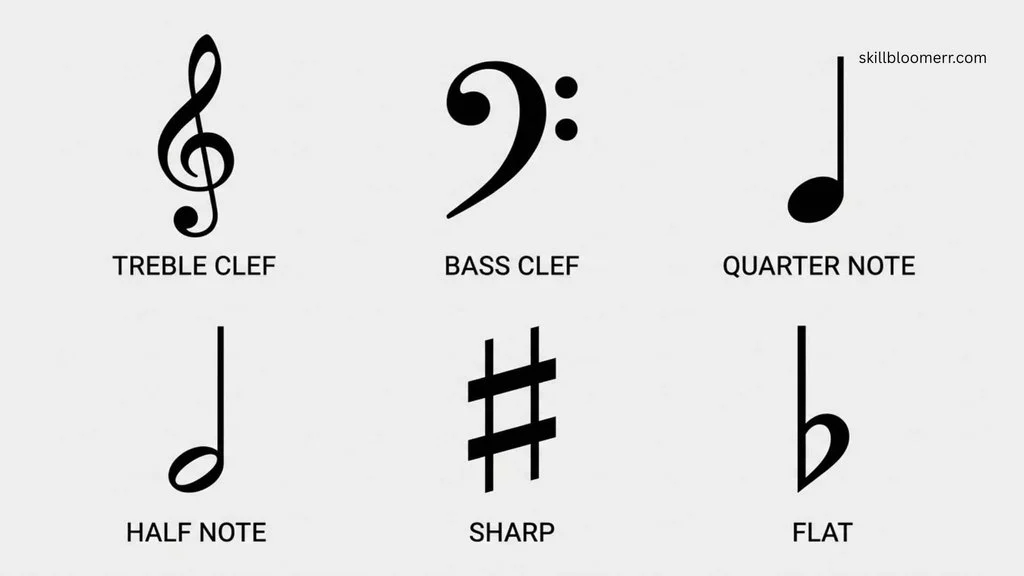
Music symbols can appear in different styles depending on the country, period, or software.
Historical Variations
Older manuscripts may use different versions of clefs, notes, and markings.
Modern Digital Variations
Computer software may display symbols differently while keeping the same meaning.
Genre Variations
Different musical styles may use additional symbols.
Examples:
- Jazz charts may use chord symbols.
- Guitar music may include tablature.
- Percussion music may use specialized notation.
Common Misconceptions About Music Sheet Symbols
Myth: Every Music Symbol Has Only One Meaning
Many symbols have basic meanings but can be interpreted differently depending on context.
Myth: Sheet Music Symbols Are Only for Classical Music
Modern musicians in pop, jazz, film, and electronic music also use notation systems.
Myth: You Must Read Music Before Playing an Instrument
Reading notation is helpful, but some musicians learn through listening, imitation, or other systems.
Interesting Facts About Music Sheet Symbols
- The modern staff system uses five lines because it provides enough space to represent common musical ranges.
- The treble clef originally developed from the letter “G,” showing the location of the G note.
- The bass clef evolved from the letter “F,” marking the position of the F note.
- Italian words are commonly used for musical instructions because Italian composers greatly influenced European music traditions.
- A rest symbol can be just as important as a note because silence creates musical structure.
- Music notation allows musicians who have never met to perform the same composition.
- Some modern composers create experimental symbols to represent unusual sounds.
- Musical notation combines art and mathematics by connecting creativity with precise timing.
- Digital music programs have made writing and sharing musical scores easier worldwide.
- Many famous compositions survive today because musicians preserved them through written notation.
Related Symbols in Music
Clefs
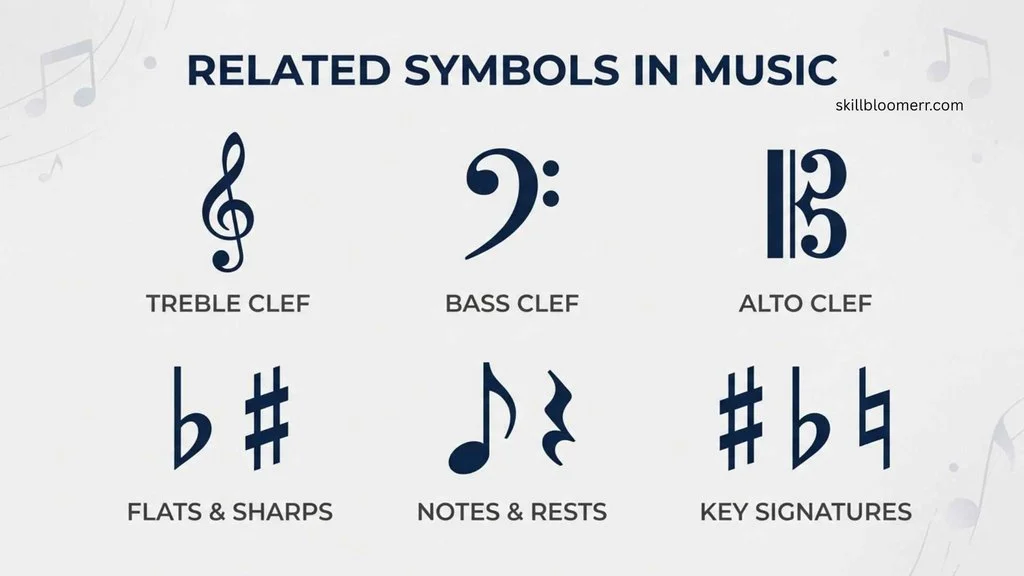
Clefs identify the pitch range of notes.
Common types include:
- Treble clef
- Bass clef
- Alto clef
- Tenor clef
Notes
Notes represent musical sounds and their duration.
Common note types include:
- Whole notes
- Half notes
- Quarter notes
- Eighth notes
Dynamics
Dynamic symbols control volume.
Examples:
- p = soft
- f = loud
- crescendo = gradually louder
Articulation Marks
These symbols show how notes should be played.
Examples:
- Staccato = short and separated
- Legato = smooth and connected
Frequently Asked Questions
What are the most important music sheet symbols to learn first?
Beginners should start with clefs, notes, rests, time signatures, key signatures, and basic dynamics. These symbols provide the foundation needed to read simple musical pieces.
Why are music symbols important?
Music symbols allow composers and performers to communicate accurately. Without them, preserving complex musical ideas across generations would be much more difficult.
Are music sheet symbols universal?
Many music symbols are internationally recognized, especially within Western music. However, some cultures use different notation systems for traditional music.
What does a sharp symbol mean in music?
A sharp symbol raises a note by one semitone. For example, placing a sharp before C changes it to C sharp, which is slightly higher in pitch.
What does a flat symbol mean?
A flat lowers a note by one semitone. It changes the pitch to a lower version of the original note.
Do singers use music sheet symbols?
Yes. Singers use sheet music to understand melody, rhythm, lyrics, harmony, and expression instructions.
Can beginners understand music notation?
Yes. Anyone can learn music notation with practice. Most beginners start with basic symbols and gradually learn more advanced markings.
Are music symbols used in digital music?
Yes. Modern software uses traditional notation symbols and digital formats to create, edit, and share music.
Key Takeaways
- Music sheet symbols create a universal language for musicians.
- Symbols communicate pitch, rhythm, speed, volume, and expression.
- Modern notation developed from ancient and medieval systems.
- Different cultures have unique approaches to recording music.
- Musical symbols connect creativity with mathematics and science.
- Learning basic notation helps musicians read and perform music more confidently.
Conclusion
Music sheet symbols are the foundation of written music. They allow composers to preserve ideas and help performers understand exactly how a piece should be played. From simple notes and rests to complex expression markings, every symbol has a purpose.
Understanding music sheet symbols opens the door to deeper musical knowledge, whether someone is learning an instrument, studying composition, or exploring the history of music. These small marks represent centuries of human creativity and continue to connect musicians around the world.

I’m Olivia Hartwell, a writer passionate about learning, personal growth, and practical education. I enjoy researching new ideas and sharing them in a way that feels easy to understand and useful. Through my work with SkillBloomerr, I aim to give readers reliable information they can apply in real life.
Books: Small Steps, Big Growth and The Curious Mind
 Ethan Calloway
 Nathaniel Brooks