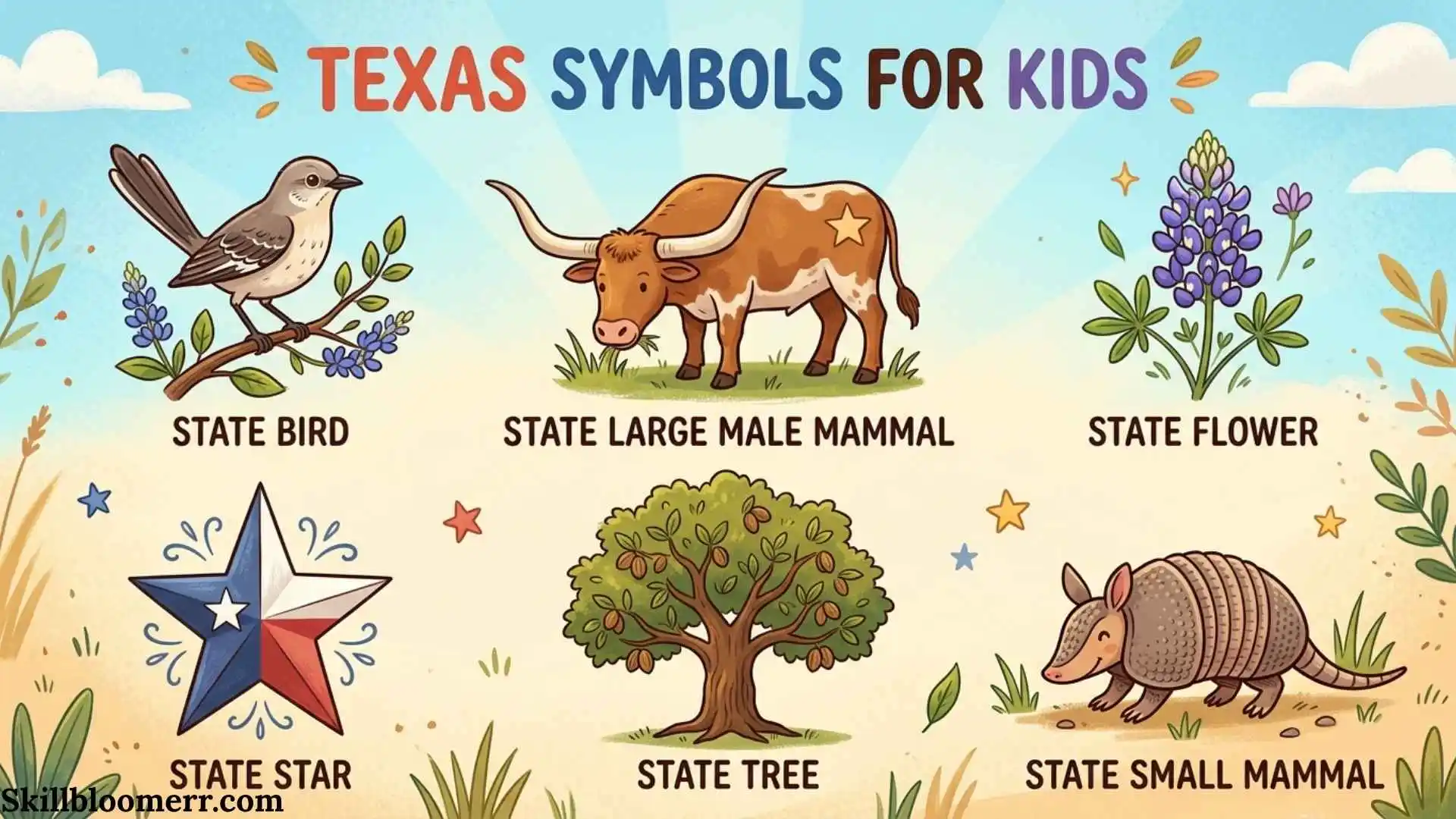
Texas is famous for its rich history, unique culture, and larger-than-life traditions. One of the best ways for children to learn about the Lone Star State is by exploring its official state symbols. These symbols represent Texas’s wildlife, plants, history, geography, and the people who have shaped the state over hundreds of years.
Learning about Texas symbols for kids makes social studies, history, and science more exciting. Students often encounter these symbols in classrooms, state museums, nature parks, textbooks, school projects, and Texas Independence Day celebrations. From the proud Lone Star Flag to the colorful bluebonnet and the mighty pecan tree, every symbol tells an important story about Texas and why it is special.
If you’re a student, teacher, homeschool parent, or simply curious about the Lone Star State, this guide explains the meaning, history, and importance of Texas’s most famous symbols in a fun and easy to understand way.
Texas Symbols for Kids: (Quick Meaning)
Texas symbols for kids are official state emblems chosen to represent Texas’s history, nature, culture, and values. They help children understand what makes the state unique while teaching important lessons about wildlife, geography, conservation, and Texas pride.
Symbol Overview Table
| Feature | Details |
| Symbol Name | Official Symbols of Texas |
| Primary Meaning | Represent Texas’s history, nature, and identity |
| Category | State Symbols |
| Origin | Officially designated by the Texas Legislature |
| Culture | Texan and American |
| Common Usage | Education, government, tourism, celebrations |
| Modern Meaning | State pride, heritage, conservation, learning |
| Emoji Equivalent | ⭐ 🌸 🤠 🐦 🌳 |
| Related Symbols | Texas Flag, Texas Seal, Texas Bluebonnet, Texas Longhorn, Mockingbird |
What Do Texas Symbols Mean?
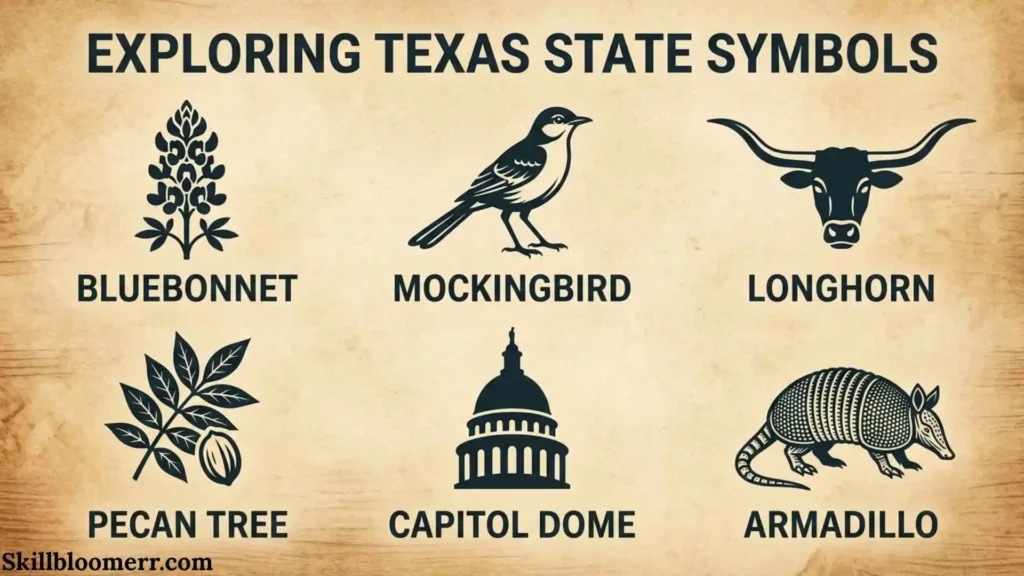
Texas symbols are official objects, animals, plants, songs, and flags that represent different parts of the state’s identity. Instead of choosing symbols randomly, lawmakers selected items that have historical, cultural, environmental, or economic importance.
For children, these symbols make learning about Texas much more interesting. Rather than memorizing dates and facts, students can connect history with real animals, flowers, birds, and landmarks they may see in everyday life.
For example:
- The Lone Star Flag reminds Texans of independence and unity.
- The Bluebonnet represents the beauty of spring across Texas.
- The Northern Mockingbird shows courage because it protects its nest from much larger birds.
- The Pecan Tree reflects Texas agriculture and natural resources.
- The Texas Longhorn honors the state’s ranching history.
Each official symbol tells part of the larger story of Texas.
Why Do States Have Official Symbols?
Every U.S. state has official symbols to celebrate what makes it unique.
These symbols help:
- Teach children about local history.
- Protect native wildlife and plants.
- Celebrate cultural traditions.
- Encourage state pride.
- Preserve important parts of nature.
Texas has one of the largest collections of official state symbols because of its diverse landscapes, wildlife, and rich history.
Learning Through Symbols
Symbols make difficult topics easier to understand.
For example:
- Learning about the Bluebonnet teaches children about native wildflowers.
- Learning about the Longhorn introduces ranching and cattle history.
- Learning about the Mockingbird encourages bird conservation.
- Learning about the Pecan Tree explains how agriculture supports Texas communities.
Instead of simply reading history, children see how nature and people are connected.
History and Origin
Texas did not adopt all of its symbols at once. Over many decades, the Texas Legislature officially recognized different plants, animals, flags, songs, and historical emblems.
Many symbols were selected because they had already become popular among Texans before becoming official.
The Story Behind the Lone Star
The Lone Star is the most recognizable symbol of Texas.
Long before Texas became the 28th state in 1845, it was an independent nation known as the Republic of Texas. During this time, the single white star became a symbol of freedom, independence, and determination.
Today, the Lone Star appears on:
- The Texas state flag
- Government buildings
- State seals
- Road signs
- Schools
- Sports uniforms
- Souvenirs
Because of this famous symbol, Texas is often called The Lone Star State.
How the Bluebonnet Became the State Flower
Every spring, millions of bluebonnets bloom across Texas highways and fields, creating beautiful blue landscapes.
The bluebonnet became the official state flower in 1901 after public interest grew in protecting native wildflowers.
Children often associate bluebonnets with:
- Springtime
- Family photographs
- Nature walks
- Texas history
- Wildflower conservation
Today, Texans are encouraged not to damage or unnecessarily pick wildflowers growing on public lands.
The Northern Mockingbird
The Northern Mockingbird became the state bird in 1927.
It earned this honor because it is:
- Found throughout Texas
- Friendly around people
- Excellent at singing
- Able to imitate many other bird calls
A mockingbird can mimic dozens even hundreds of different sounds during its lifetime. This remarkable ability makes it one of North America’s most fascinating songbirds.
The Texas Longhorn
Few animals symbolize Texas better than the Longhorn.
Descended from cattle brought by Spanish explorers centuries ago, the Texas Longhorn adapted to harsh climates, long cattle drives, and open grasslands.
Its distinctive curved horns make it easy to recognize.
The Longhorn represents:
- Courage
- Strength
- Independence
- Ranching traditions
- Western heritage
Today, Longhorns are raised on ranches across Texas and are popular attractions at fairs and historical sites.
The Pecan Tree
The pecan tree became the official state tree because it grows naturally across much of Texas.
Pecan trees provide:
- Shade
- Wildlife habitat
- Delicious nuts
- Valuable wood
Pecans are used in many Texas recipes, especially pecan pie, one of the state’s best-known desserts.
Some pecan trees can live for more than 300 years, making them living connections to Texas history.
Symbolism and Interpretation
Texas symbols represent much more than their physical appearance. Each one carries meanings that reflect the state’s history, values, and environment.
The Meaning of the Lone Star
The single white star stands for:
- Independence
- Unity
- Hope
- Leadership
- Freedom
Although Texas is now part of the United States, the Lone Star continues to remind people of the state’s independent spirit and strong identity.
What the Bluebonnet Symbolizes
The bluebonnet represents:
- Natural beauty
- New beginnings
- Spring
- Hope
- Growth
For many families, seeing bluebonnets bloom marks the arrival of warmer weather and outdoor adventures.
The Meaning of the Mockingbird
The mockingbird symbolizes:
- Joy
- Intelligence
- Adaptability
- Protection
- Creativity
Despite its small size, it bravely defends its nest against much larger animals, teaching children about courage and determination.
What the Longhorn Represents
The Texas Longhorn symbolizes:
- Hard work
- Endurance
- Survival
- Strength
- Texas heritage
Its history reminds children that perseverance and resilience are important qualities both in nature and in everyday life.
The Pecan Tree’s Symbolism
The pecan tree stands for:
- Generosity
- Family traditions
- Abundance
- Stability
- Long life
Because pecan trees produce food for both people and wildlife, they remind Texans of the importance of caring for natural resources.
Positive Meanings Shared by Texas Symbols
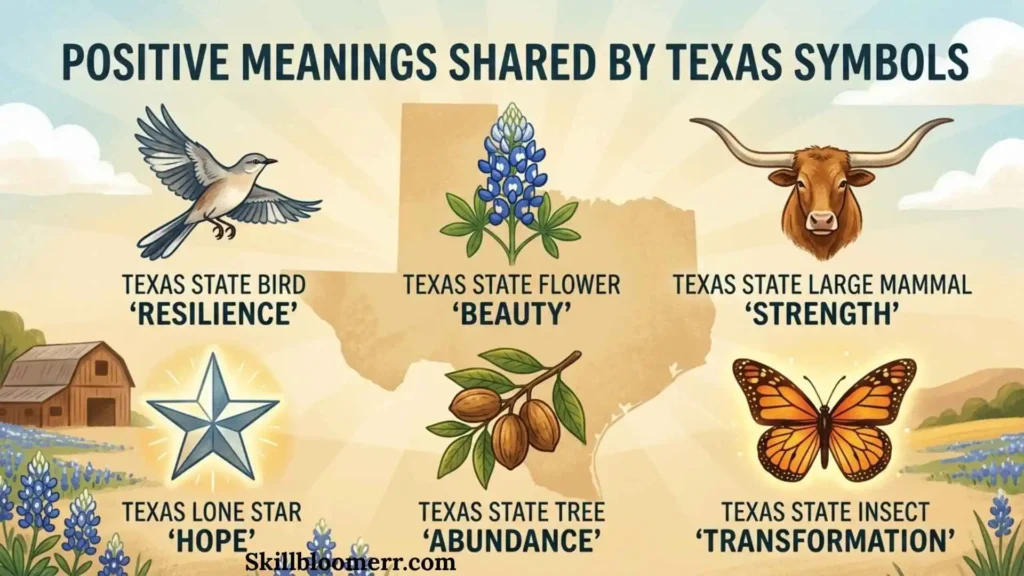
Although each symbol has its own story, many share common themes:
- Pride in home
- Respect for nature
- Courage during challenges
- Appreciation of history
- Community spirit
- Responsibility for protecting wildlife
- Love of learning
These shared meanings help children understand why state symbols are more than just pictures in a textbook—they represent the values and traditions that continue to shape Texas today.
Cultural Significance
Texas symbols help connect people of all ages to the state’s past and present. They are more than official emblems—they appear in everyday life, community events, classrooms, and public spaces. For children, these symbols provide a simple way to understand how geography, history, and culture come together.
How Schools Use Texas Symbols
Texas symbols are an important part of elementary education. Students often learn about them through:
- Social studies lessons
- State history projects
- Science and nature units
- Coloring activities
- Classroom posters
- School presentations
- Field trips to museums and state parks
Teachers use these symbols because they help children remember important facts while encouraging curiosity about their home state.
Texas Symbols in Community Celebrations
Many official symbols appear during public events and festivals, including:
- Texas Independence Day celebrations
- State fairs
- Rodeos
- Wildflower festivals
- Nature programs
- School parades
- Local history events
The Texas flag is proudly displayed at government buildings, schools, and sporting events, while bluebonnets often decorate parks and highways during spring.
Respecting Nature Through State Symbols
Many Texas symbols remind children that protecting nature is everyone’s responsibility.
For example:
- Birds need safe nesting areas.
- Wildflowers should not be damaged.
- Trees provide homes for wildlife.
- Rivers and lakes should stay clean.
Learning about these symbols encourages children to become good environmental stewards.
Religious or Spiritual Meaning
Unlike many ancient cultural symbols, Texas state symbols do not have official religious or spiritual meanings. They were chosen to represent the state’s natural beauty, history, wildlife, agriculture, and heritage rather than any particular faith or belief system.
However, some Texans may personally associate certain symbols with gratitude, hope, or appreciation for nature. These are individual interpretations rather than official meanings recognized by the State of Texas.
Scientific or Technical Meaning
Several Texas symbols also have scientific importance, making them useful in science classrooms.
Bluebonnet
The bluebonnet belongs to the Lupinus genus, a group of flowering plants that help improve soil quality by adding nitrogen. This natural process supports healthy ecosystems and benefits other plants.
Northern Mockingbird
The Northern Mockingbird is famous for its ability to imitate many different bird songs and sounds. Scientists study mockingbirds to better understand bird communication, learning behavior, and territorial defense.
Pecan Tree
The pecan tree is native to North America and plays an important role in forest ecosystems. It provides food for birds, squirrels, deer, and many other animals while also producing one of the world’s most valuable edible nuts.
Texas Longhorn
The Texas Longhorn is known for its remarkable adaptability. It can survive in hot temperatures, travel long distances, and thrive in challenging environments. Scientists and ranchers have studied the breed for its genetic diversity and resilience.
Where Texas Symbols Are Used
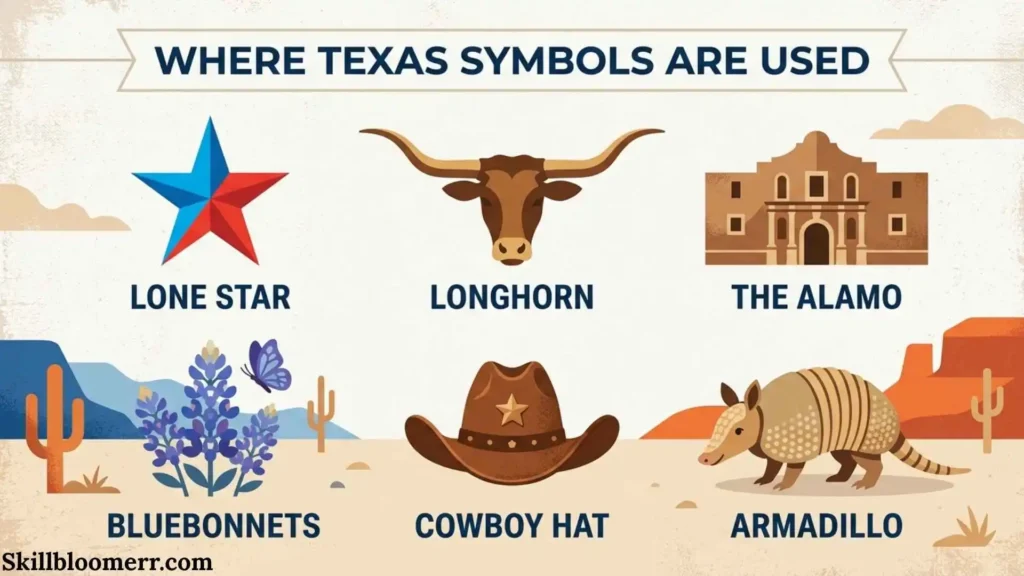
Texas symbols appear in many places across the state and beyond.
Education
Schools use official symbols in:
- Textbooks
- Classroom decorations
- Student worksheets
- Educational games
- History lessons
Government
Official symbols are displayed on:
- State publications
- Government websites
- Official documents
- Public buildings
- Visitor centers
Tourism
Visitors encounter Texas symbols at:
- State parks
- Museums
- Historic sites
- Welcome centers
- Gift shops
- Travel brochures
Art and Design
Artists frequently include Texas symbols in:
- Paintings
- Sculptures
- Murals
- Children’s books
- Educational illustrations
- Public artwork
Clothing and Souvenirs
Popular items featuring Texas symbols include:
- T-shirts
- Hats
- Backpacks
- Stickers
- Magnets
- Keychains
- Postcards
Sports and Community Pride
Many schools, colleges, and local organizations use Texas-inspired symbols, especially the Lone Star and Longhorn, to celebrate state pride.
Common Variations
Although official Texas symbols have recognized designs or species, they may appear in different artistic styles.
The Lone Star
The Lone Star may be shown as:
- A simple white star
- A gold decorative star
- A rustic Western-style star
- A modern graphic design
Regardless of its appearance, it still represents Texas.
Bluebonnets
Several species of bluebonnets grow in Texas. While they vary slightly in size and color, all belong to the same general group of native wildflowers.
Texas Flags
The proportions and materials of the Texas flag may differ, but every official version includes:
- One vertical blue stripe
- One white horizontal stripe
- One red horizontal stripe
- A single white star
Artistic Interpretations
Children’s books, classroom posters, and artwork often simplify Texas symbols using bright colors and cartoon-style illustrations, making them easier for young learners to recognize.
Common Misconceptions
“The Longhorn Is the State Animal”
Not exactly. Texas has several official state animals, including the Texas Longhorn (large mammal) and the nine-banded armadillo (small mammal). Different categories recognize different animals.
“Bluebonnets Grow Only in Texas”
Bluebonnets naturally grow in several parts of North America, but Texas is famous for its spectacular spring displays and has adopted the bluebonnet as its official state flower.
“The Lone Star Means Texas Stands Alone Today”
The Lone Star honors the state’s history as an independent republic. Today, Texas is one of the fifty states in the United States.
“Mockingbirds Only Copy Birds”
Mockingbirds can imitate many sounds besides bird songs, including car alarms, frogs, insects, and even some mechanical noises.
“All Texas Symbols Are Very Old”
Some symbols have represented Texas for generations, while others were officially designated much more recently by the Texas Legislature.
Interesting Facts
- Texas has dozens of official state symbols. Besides animals and flowers, Texas also has official foods, songs, trees, and even a state dish.
- Bluebonnet season attracts visitors from around the world. Every spring, people travel across Texas to photograph fields of blooming bluebonnets.
- A mockingbird can learn hundreds of songs. This impressive ability helps it communicate and defend its territory.
- Texas Longhorn horns can span more than six feet. Their distinctive horns make them one of the world’s most recognizable cattle breeds.
- Pecan trees can produce nuts for generations. Mature trees may continue producing pecans for many decades.
- The Texas flag can fly at the same height as the U.S. flag. Like all state flags, it follows the U.S. Flag Code when displayed together with the national flag.
- The Lone Star appears almost everywhere in Texas. You’ll see it on road signs, government buildings, businesses, schools, and sports logos.
- Children often learn Texas symbols before studying detailed state history. Symbols provide an engaging introduction to geography, science, and culture.
- Many Texas symbols support conservation education. Learning about native wildlife encourages students to protect local habitats.
- Texas symbols continue to grow over time. The Texas Legislature occasionally designates new official symbols that reflect the state’s heritage and natural diversity.
Related Symbols
| Symbol | How It Relates |
| Texas State Flag | Features the famous Lone Star. |
| Great Seal of Texas | Official government emblem showing the Lone Star surrounded by olive and oak branches. |
| Texas Bluebonnet | Represents spring, beauty, and native plants. |
| Northern Mockingbird | Official state bird known for its remarkable songs. |
| Texas Longhorn | Represents ranching history and perseverance. |
| Pecan Tree | Symbolizes agriculture, abundance, and longevity. |
| Nine-Banded Armadillo | Official small state mammal that reflects Texas wildlife. |
| Guadalupe Bass | Official state fish representing Texas rivers and freshwater habitats. |
Frequently Asked Questions
What are Texas symbols for kids?
Texas symbols are official plants, animals, flags, songs, and other emblems chosen to represent the state’s history, culture, geography, and natural resources. They help children learn about Texas in an engaging and memorable way.
Why does Texas have so many official symbols?
Texas has a rich natural environment and a unique history. Official symbols recognize important parts of the state’s identity, from native wildlife and flowers to historical traditions and cultural achievements.
What is the most famous Texas symbol?
The Lone Star is the best-known symbol of Texas. It appears on the state flag and represents independence, unity, and the state’s nickname, “The Lone Star State.”
Why is the bluebonnet important?
The bluebonnet is the official state flower because it grows naturally across Texas and creates beautiful spring landscapes. It also highlights the importance of protecting native wildflowers.
What does the mockingbird represent?
The Northern Mockingbird represents courage, intelligence, adaptability, and creativity. It is admired for its ability to imitate many different sounds and defend its nest.
Is the Texas Longhorn only found in Texas?
No. Texas Longhorns are raised in many parts of the United States today, but the breed developed in Texas and remains one of the state’s strongest historical symbols.
Why do schools teach Texas symbols?
Learning state symbols helps students understand history, geography, science, and conservation while building appreciation for their state’s heritage.
Are Texas symbols protected?
Many native plants and animals connected to Texas symbols are protected through conservation efforts and environmental laws. Respecting wildlife and natural habitats helps preserve these symbols for future generations.
Key Takeaways
- Texas symbols represent the state’s history, culture, wildlife, and natural beauty.
- The Lone Star is the most recognizable symbol of Texas.
- The bluebonnet is the official state flower and blooms each spring.
- The Northern Mockingbird is famous for copying many different sounds.
- The Texas Longhorn reflects the state’s ranching heritage and resilience.
- The pecan tree symbolizes agriculture, abundance, and long life.
- State symbols help children learn about history, science, geography, and conservation.
- Respecting these symbols encourages pride in Texas and care for the environment.
Conclusion
Texas symbols tell the story of a state known for its independence, diverse landscapes, and strong traditions. From the shining Lone Star to the colorful bluebonnet, every official symbol helps children understand what makes Texas unique.
By learning about these symbols, kids gain a deeper appreciation for history, nature, and the people who have shaped the Lone Star State. Whether explored in a classroom, museum, or family road trip, Texas symbols for kids make learning both meaningful and memorable.
References
- Texas Legislature Online – Official state symbols and legislative designations.
- Texas State Library and Archives Commission – Texas history and state emblems.
- Texas Parks and Wildlife Department – Native plants, wildlife, and conservation resources.
- Encyclopaedia Britannica – Articles on Texas history, geography, and natural features.
- National Park Service – Educational resources on Texas history and ecology.
- U.S. Department of Agriculture (USDA) – Information on pecan trees and native plant species.
- Cornell Lab of Ornithology – Northern Mockingbird species guide.
- Smithsonian Institution – Educational resources on American history, wildlife, and culture.

I’m Ethan Calloway, an English writer and lifelong learner who enjoys turning complex ideas into clear, practical content. At SkillBloomerr, I focus on useful topics that help readers build knowledge, improve their skills, and feel more confident in everyday learning. I believe good writing should be simple, engaging, and genuinely helpful.
Books: The Everyday Learning Guide and Build Better Skills
 Charlotte Winslow
 Nathaniel Brooks
[…] Also Check This Post: 53+ Texas Symbols for Kids: The Complete Beginner’s Guide […]