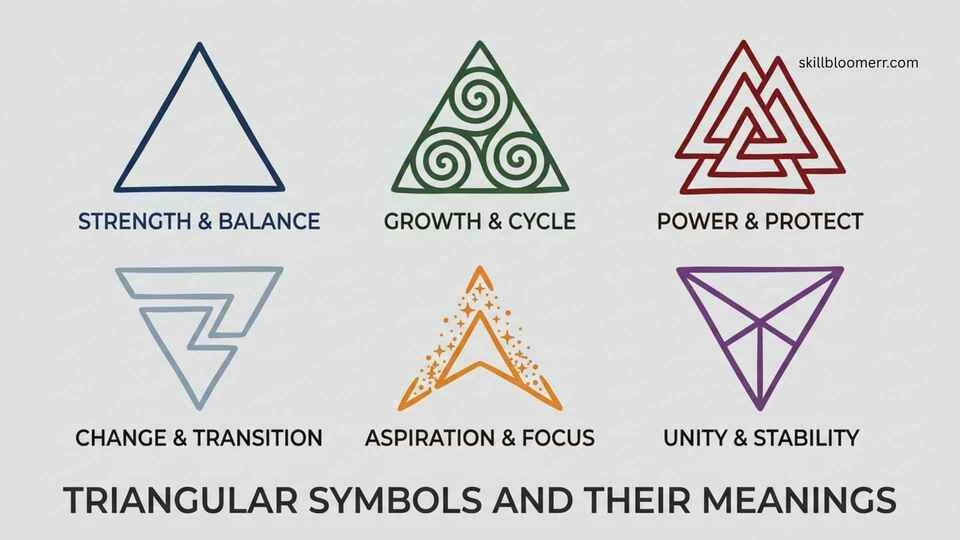
Triangular symbols have fascinated people for thousands of years because a simple three-sided shape can communicate powerful ideas about nature, spirituality, balance, strength, and transformation. From ancient temples and sacred manuscripts to modern logos, warning signs, mathematics, architecture, and tattoos, triangle-based symbols appear in nearly every culture and field of knowledge.
The meanings of triangular symbols are not universal. Their interpretation often depends on their orientation, cultural background, historical period, and the context in which they appear. An upward-pointing triangle may represent stability, fire, or masculine energy in one tradition, while a downward-pointing triangle may symbolize water, femininity, intuition, or receptivity in another. Some triangular designs carry religious significance, while others are used in science, engineering, navigation, or graphic design.
This guide explores the history, symbolism, cultural importance, spiritual meanings, scientific uses, and modern applications of triangular symbols and their meanings. Whether you encounter a triangle in artwork, jewelry, a tattoo, a religious text, or a warning sign, understanding its background provides a richer appreciation of one of humanity’s oldest geometric symbols.
Triangular Symbols and Their Meanings: (Quick Meaning)
Triangular symbols generally represent stability, balance, unity, change, strength, and the connection between three related elements. Depending on their orientation and cultural context, they may symbolize fire, water, harmony, spirituality, protection, creativity, enlightenment, or transformation, making them among the world’s most versatile and enduring symbolic shapes.
Symbol Overview
| Feature | Details |
| Symbol Name | Triangle or Triangular Symbol |
| Primary Meaning | Balance, strength, unity, transformation |
| Category | Geometric Symbol |
| Origin | Prehistoric geometric art |
| First Known Use | Prehistoric rock art (over 5,000 years ago) |
| Associated Cultures | Egyptian, Greek, Celtic, Hindu, Buddhist, Christian, Norse, Indigenous cultures |
| Common Uses | Religion, mathematics, architecture, warning signs, logos, jewelry, tattoos |
| Modern Meaning | Stability, innovation, growth, connection, sustainability |
| Unicode | △ (U+25B3), ▲ (U+25B2), ▽ (U+25BD), ▼ (U+25BC) |
| Emoji Equivalent | 🔺 🔻 |
| Related Symbols | Circle, Square, Triskelion, Star of David, Pyramid, Triquetra |
What Do Triangular Symbols Mean?
Triangular symbols primarily represent the power of three connected elements forming a complete whole. Unlike shapes with many sides, a triangle is the simplest geometric figure capable of creating a stable enclosed structure. This mathematical property strongly influenced how civilizations interpreted the symbol throughout history.
The Power of Three
Across cultures, the number three often represents completeness. Many belief systems organize important ideas into groups of three, making the triangle a natural visual representation of wholeness.
Examples include:
- Birth, life, and death
- Past, present, and future
- Mind, body, and spirit
- Beginning, middle, and end
- Heaven, earth, and humanity
Because each corner supports the others, the triangle became a symbol of interconnectedness rather than isolated ideas.
Stability and Strength
From an engineering perspective, the triangle is one of the strongest structural shapes. Bridges, roof trusses, transmission towers, cranes, and skyscrapers rely heavily on triangular frameworks because they resist deformation under pressure.
This practical strength influenced symbolic meaning. As a result, triangles came to represent:
- Reliability
- Security
- Endurance
- Foundation
- Resilience
Ancient builders may not have described these properties using modern engineering terms, but they clearly recognized the triangle’s exceptional stability in architecture.
Balance Through Unity
Unlike symbols focused on a single concept, triangles often express balance among multiple forces.
For example:
- Logic balanced with emotion
- Action balanced with wisdom
- Material life balanced with spiritual purpose
Rather than suggesting that opposing forces compete, the triangle illustrates how different elements can work together to create harmony.
Direction and Movement
The orientation of a triangle significantly affects its symbolic meaning.
An upward-pointing triangle naturally draws the eye toward the sky, leading many traditions to associate it with:
- Growth
- Ambition
- Fire
- Spiritual ascent
- Hope
- Achievement
Conversely, a downward-pointing triangle directs attention downward and is frequently linked with:
- Water
- Reflection
- Intuition
- Fertility
- Emotional depth
- Receptivity
This directional quality makes triangular symbols uniquely expressive compared to circles or squares.
History and Origin
Triangular symbols are among humanity’s oldest geometric designs. Their history stretches from prehistoric cave art to today’s digital icons, demonstrating remarkable continuity despite changing cultures and beliefs.
Prehistoric Beginnings
Archaeologists have discovered triangular motifs carved into rocks, pottery, bone tools, and cave walls dating back thousands of years. While the exact meanings remain uncertain, researchers believe these shapes likely served practical, decorative, or symbolic purposes.
Some prehistoric triangles may have represented:
- Mountains
- Human figures
- Arrowheads
- Shelters
- Fertility symbols
- Natural landscapes
Simple geometric forms were easier to carve into stone than detailed images, making triangles common in early artistic traditions.
Ancient Egypt
Ancient Egyptian civilization elevated triangular geometry to monumental importance through pyramid construction.
Although a pyramid is a three-dimensional structure rather than a flat triangle, each visible side forms a triangle pointing upward. This architectural choice reinforced beliefs about:
- Ascending to the heavens
- Divine kingship
- Eternal life
- Cosmic order
- Solar worship
The pyramid’s enduring shape also symbolized permanence, reflecting the Egyptians’ desire to preserve the pharaoh’s legacy for eternity.
Mesopotamia
In Mesopotamian cultures, geometric patterns—including triangles—appeared in seals, temple decorations, textiles, and ceramics. Rather than carrying one fixed meaning, triangles often contributed to larger decorative systems representing order, protection, or divine authority.
Repeated triangular motifs also appeared in woven fabrics and architectural borders, demonstrating both artistic and symbolic value.
Ancient Greece
Greek philosophers transformed geometry into a philosophical discipline.
Thinkers such as Pythagoras and later Plato believed geometric forms reflected universal truths. The triangle became associated with mathematical perfection, proportion, and the hidden structure of reality.
Later philosophical traditions linked geometric shapes to the classical elements, further expanding the symbolic importance of triangles.
India and Sacred Geometry
Ancient Indian traditions gave triangles profound spiritual meaning.
In Hindu philosophy:
- An upward triangle often symbolizes Agni (fire), aspiration, and masculine creative energy.
- A downward triangle commonly represents water, feminine energy, receptivity, and the divine feminine.
These triangles appear prominently in Yantras, sacred geometric diagrams used during meditation and ritual practice. The interlocking upward and downward triangles found in the Sri Yantra symbolize the union of complementary cosmic forces.
Celtic Traditions
Celtic art frequently incorporated triangular patterns into intricate knotwork, stone carvings, illuminated manuscripts, and jewelry.
While many people associate Celtic symbolism with the Triquetra, the underlying triangular form reflects recurring themes of:
- Unity
- Eternity
- Nature’s cycles
- Family bonds
- Spiritual continuity
Rather than representing a single doctrine, these motifs emphasized the interconnectedness of life.
Medieval Europe
During the Middle Ages, triangular imagery became closely associated with Christian theology.
Artists often enclosed an eye within a triangle to symbolize divine omniscience and the unity of the Holy Trinity—Father, Son, and Holy Spirit. Triangular compositions also appeared in stained glass windows, church architecture, illuminated manuscripts, and religious paintings to direct attention toward heaven and express sacred order.
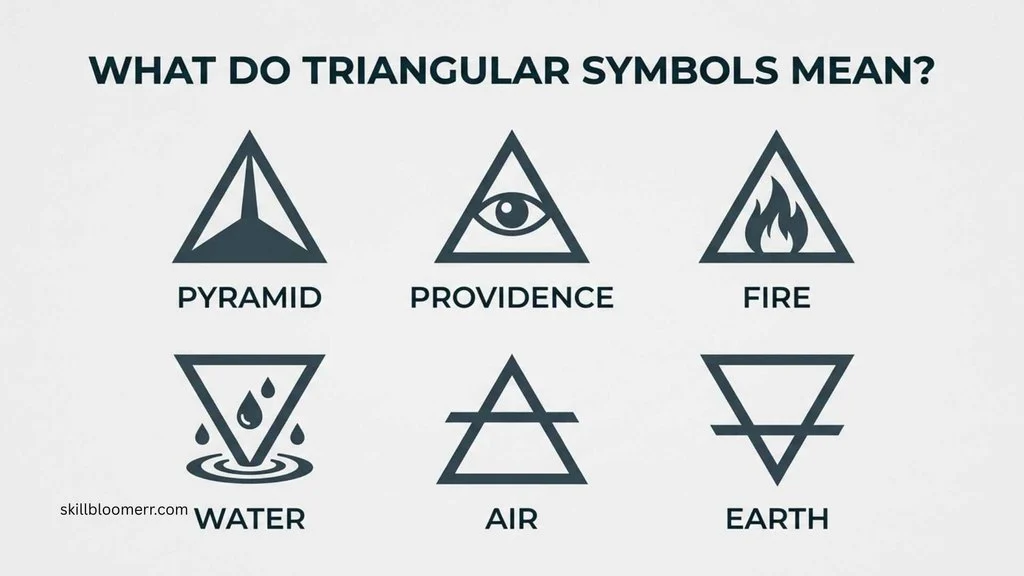
At the same time, alchemists adopted simple triangles as visual shorthand for the four classical elements. An upward-pointing triangle represented fire, while the same triangle crossed by a horizontal line signified air. A downward-pointing triangle represents water, and with a horizontal line, earth. These elemental symbols later influenced Western esoteric traditions and continue to appear in modern books on symbolism and sacred geometry.
Today, triangular symbols remain just as relevant as they were in ancient civilizations. Their meanings have expanded beyond religion and philosophy to include science, technology, design, engineering, branding, and everyday communication, demonstrating the enduring powcontinue
Symbolism and Interpretation
Triangular symbols are interpreted in many ways because they combine a simple geometric shape with deep philosophical, spiritual, and practical ideas. While the exact meaning depends on culture and context, several themes appear consistently across civilizations.
Unity in Diversity
One of the most common interpretations is that a triangle represents three separate parts forming a complete whole.
Unlike a straight line, which connects only two points, a triangle creates an enclosed space through the relationship of three corners. This has made it a lasting symbol of cooperation, balance, and interdependence.
Examples include:
- Mind, body, and spirit
- Creator, creation, and humanity
- Thought, emotion, and action
- Knowledge, wisdom, and understanding
- Past, present, and future
The message is that each element is important, but true strength comes from their connection.
Stability and Foundation
A triangle is the simplest rigid polygon in geometry. If pressure is applied to a square, it can easily deform into a parallelogram unless reinforced. A triangle, however, naturally holds its shape.
Because of this property, many cultures associate triangular symbols with:
- Strong foundations
- Reliability
- Endurance
- Security
- Confidence
- Determination
Modern architects and engineers continue to rely on triangular frameworks because they distribute weight efficiently.
Growth and Achievement
An upward-pointing triangle naturally directs attention toward the sky.
Psychologically, people often associate upward movement with:
- Progress
- Hope
- Success
- Higher knowledge
- Ambition
- Personal development
This explains why many educational institutions, businesses, and technology companies incorporate triangular shapes into their logos to communicate innovation and forward movement.
Balance Between Opposites
Some traditions emphasize the relationship between two opposite triangles rather than one alone.
An upward triangle may symbolize:
- Fire
- Light
- Spirit
- Masculinity
- Activity
A downward triangle may represent:
- Water
- Matter
- Femininity
- Intuition
- Receptivity
When these triangles overlap, they illustrate harmony rather than conflict. Instead of opposing one another, each completes the other.
Transformation
Triangles often appear during periods of transition because they suggest movement from one state to another.
For example, they may symbolize:
- Personal growth
- Spiritual awakening
- Education
- Emotional healing
- Life changes
- Creative evolution
This is one reason triangle tattoos are frequently chosen to represent overcoming adversity or beginning a new chapter in life.
Protection
In many ancient societies, geometric shapes were believed to possess protective qualities.
Triangular arrangements appeared on:
- Shields
- Jewelry
- Temulets
- Buildings
- Ceremonial objects
- Doorways
Rather than acting as magical objects by themselves, these symbols reflected cultural beliefs that order and harmony could help guard against chaos or misfortune.
Psychological Interpretation
Modern psychology generally does not assign universal meanings to geometric shapes, but researchers in visual perception and design recognize that people often associate triangles with energy and direction.
Compared with circles, which appear soft and welcoming, triangles can communicate:
- Focus
- Precision
- Alertness
- Action
- Leadership
- Change
Because sharp angles naturally attract attention, designers frequently use triangular elements to emphasize important information.
Cultural Significance
Triangular symbols have developed unique meanings in different parts of the world. While certain themes overlap, every culture has interpreted the triangle through its own beliefs, traditions, and history.
Ancient Egyptian Culture
In Ancient Egypt, the triangle became closely connected with the pyramid, one of the world’s most recognizable architectural achievements.
The pyramid symbolized:
- Eternal life
- Resurrection
- Royal authority
- The soul’s journey toward the heavens
- Divine protection
Although Egyptians did not worship the triangle itself, its form became inseparable from ideas about immortality and cosmic order.
Greek Philosophy
Greek philosophers viewed geometry as a reflection of universal truth.
The triangle represented:
- Mathematical perfection
- Logical reasoning
- Harmony
- Natural order
- Balance
Schools influenced by Pythagorean philosophy believed geometric relationships revealed hidden patterns governing the universe.
Celtic Traditions
Celtic art frequently features triangular arrangements within knotwork and sacred designs.
Common symbolic themes include:
- Family unity
- Eternal cycles
- Nature
- Spiritual continuity
- Life’s interconnectedness
The emphasis was less on the triangle alone and more on how repeating triangular forms created endless patterns without beginning or end.
Hindu Culture
In Hindu traditions, triangles play a central role in sacred geometry.
An upward triangle commonly represents:
- Fire
- Spiritual ascent
- Shiva
- Dynamic energy
A downward triangle often symbolizes:
- Water
- Shakti
- Fertility
- Creation
- Divine feminine energy
The famous Sri Yantra combines multiple interlocking triangles to express the unity of masculine and feminine cosmic principles.
Buddhist Traditions
Buddhist symbolism uses triangular forms less frequently than circles or lotus imagery, yet triangles still appear in mandalas and sacred diagrams.
They may represent:
- Enlightenment
- The Three Jewels
- Meditation
- Wisdom
- Compassion
- Ethical living
The geometric precision encourages focus and contemplation during spiritual practice.
Native American Traditions
Many Indigenous peoples of North America incorporated triangular shapes into textiles, beadwork, pottery, and basket weaving.
Depending on the community, triangles could represent:
- Mountains
- Arrowheads
- Family
- Protection
- Animal tracks
- Natural landscapes
Because Native American cultures are highly diverse, no single interpretation applies universally.
East Asian Traditions
In Chinese and Japanese design, triangles are generally appreciated more for their visual balance than for a single symbolic meaning.
They often suggest:
- Harmony
- Direction
- Strength
- Natural forms
- Mountains
- Stability
Triangular compositions frequently appear in gardens, architecture, and traditional painting.
Modern Western Culture
Today, triangular symbols have become highly versatile.
Modern interpretations include:
- Innovation
- Technology
- Sustainability
- Leadership
- Creativity
- Environmental awareness
- Progress
- Achievement
Companies often choose triangular logos because they communicate movement and confidence without relying on words.
Religious or Spiritual Meaning
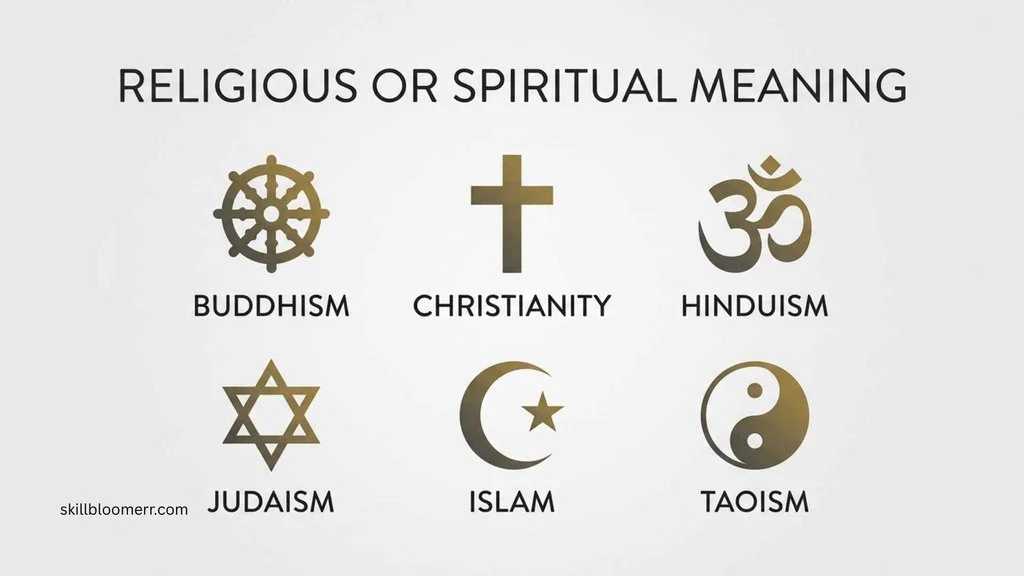
Triangles hold profound religious significance across many faiths. While interpretations differ, they consistently express relationships between divine principles rather than representing a single deity or doctrine.
Christianity
In Christian art, the triangle is one of the best-known symbols of the Holy Trinity.
Its three sides represent:
- God the Father
- God the Son
- God the Holy Spirit
The equal sides emphasize that each person of the Trinity shares the same divine nature.
During the Renaissance and later centuries, artists frequently enclosed the Eye of Providence within a triangle to symbolize God’s omniscience and constant presence.
Hinduism
Few religions employ triangles as extensively as Hinduism.
In sacred diagrams called Yantras:
- Upward triangles represent masculine creative force.
- Downward triangles symbolize feminine creative energy.
- Interlocking triangles express cosmic balance.
The Sri Yantra, composed of nine interlocking triangles, is among the most revered geometric symbols in Hindu spiritual practice. It is used during meditation as a visual representation of the universe and the relationship between the individual soul and ultimate reality.
Buddhism
Although the lotus and Dharma Wheel are more prominent Buddhist symbols, triangles also appear in tantric traditions and mandalas.
They may symbolize:
- Wisdom
- Meditation
- Spiritual discipline
- Enlightenment
- The Three Jewels:
- Buddha
- Dharma
- Sangha
Their geometric simplicity helps practitioners focus the mind during contemplation.
Judaism
Triangles are most famously associated with the Star of David.
Although the star consists of two overlapping triangles rather than one, many interpretations suggest they represent:
- Heaven and earth
- God and humanity
- Spiritual and physical existence
- Divine protection
These meanings developed gradually over centuries and vary among Jewish scholars and communities.
Western Esoteric Traditions
Alchemy, Hermetic philosophy, and later esoteric traditions adopted simple triangles to represent the classical elements:
| Triangle | Element |
| ▲ | Fire |
| ▼ | Water |
| ▲ with horizontal line | Air |
| ▼ with horizontal line | Earth |
These symbols appeared in alchemical manuscripts to describe transformation, natural philosophy, and the relationships between material substances.
Modern Spirituality
In contemporary spiritual practices, triangular symbols are often interpreted more broadly.
Common meanings include:
- Personal transformation
- Higher consciousness
- Inner balance
- Manifestation
- Energy alignment
- Self-discovery
While these interpretations are popular in modern spiritual communities, they are generally symbolic rather than tied to historical religious doctrine.
Scientific or Technical Meaning
Triangular symbols are not limited to culture and spirituality. They also play essential roles in mathematics, engineering, chemistry, technology, and public safety because of their clarity and structural efficiency.
Mathematics
In mathematics, the uppercase Greek letter Delta (Δ) resembles a triangle and has several important uses.
It commonly represents:
- Change in a quantity
- Difference between values
- Finite increments
- Geometric notation
The lowercase delta (δ) often denotes small changes or variations, especially in calculus and physics.
Triangles themselves are also fundamental to geometry, where they are used to study angles, congruence, similarity, and trigonometry.
Engineering and Architecture
Triangles are considered one of the strongest structural shapes because they resist distortion.
For this reason, they are widely used in:
- Roof trusses
- Bridges
- Communication towers
- Steel frameworks
- Cranes
- Space frames
- Bicycle frames
Engineers rely on triangular designs to distribute loads efficiently and improve structural stability.
Chemistry
Alchemy’s triangular elemental symbols later influenced the visual language of chemistry, although modern chemistry now relies primarily on standardized chemical symbols and formulas.
Historical manuscripts often used triangles to denote fire, water, air, and earth before the development of modern scientific notation.
Road Safety and Public Warnings
One of the most familiar modern uses of triangular symbols is in warning signs.
Examples include:
- General hazard signs
- Electrical danger
- Slippery roads
- Biological hazards (within triangular warning borders in some standards)
- Construction zones
The sharp angles naturally attract attention, making triangles effective for communicating caution quickly.
er of one of humanity’s most recognizable geometric forms.
Where the Symbol Is Used
Triangular symbols appear in almost every aspect of modern life. Their combination of visual simplicity, structural stability, and symbolic depth makes them useful in fields ranging from religion and science to branding and transportation. While their meaning changes depending on the setting, they almost always communicate an idea quickly and effectively.
Architecture
Triangles have been used in architecture for thousands of years because they provide both beauty and structural strength.
Examples include:
- Ancient Egyptian pyramids
- Greek temple pediments
- Gothic cathedral roofs
- Modern steel skyscrapers
- Suspension bridges
- Roof trusses in residential homes
Architects use triangular forms because they evenly distribute weight and resist deformation, making buildings safer and more durable.
Religious Buildings
Many places of worship incorporate triangular designs into their architecture and decoration.
Examples include:
- Church stained-glass windows
- Temple carvings
- Sacred geometric floor patterns
- Shrine decorations
- Altars
- Meditation spaces
In these settings, the triangle often represents divine unity, spiritual elevation, or harmony between heaven and earth.
Mathematics and Education
Students encounter triangles from an early age because they are one of geometry’s fundamental shapes.
They are used in:
- Geometry textbooks
- Trigonometry
- Engineering diagrams
- Architectural drawings
- Surveying
- Navigation
- Computer graphics
Beyond basic geometry, triangular principles are essential in advanced fields such as structural engineering, robotics, and computer-aided design (CAD).
Science
Scientific disciplines use triangular symbols in several ways.
Examples include:
- Delta (Δ) representing change in mathematics and physics
- Laboratory safety labels
- Geological diagrams
- Vector illustrations
- Optical systems
- Scientific charts
Their simple form allows scientists to communicate complex concepts efficiently.
Road Signs and Public Safety
One of the most recognizable modern uses of triangular symbols is in traffic and safety signage.
Common examples include:
- Yield signs (in many countries)
- General warning signs
- Hazard notifications
- Construction warnings
- Electrical danger signs
- Chemical hazard labels
Because people naturally notice sharp angles, triangles are ideal for alerting individuals to potential risks.
Corporate Logos
Many organizations use triangular designs to communicate strength, progress, and innovation.
A triangle can suggest:
- Growth
- Leadership
- Stability
- Collaboration
- Precision
- Future thinking
Technology companies, engineering firms, consulting businesses, and educational institutions often incorporate triangles into their visual identity because the shape conveys confidence and direction.
Jewelry
Triangle-shaped jewelry has become increasingly popular due to its minimalist appearance and symbolic meaning.
Common pieces include:
- Necklaces
- Earrings
- Rings
- Bracelets
- Pendants
Some people wear triangular jewelry as a reminder of balance or personal growth, while others simply appreciate its clean geometric design.
Tattoos
Triangle tattoos are among the most meaningful geometric tattoo designs.
Popular interpretations include:
- Personal transformation
- Family unity
- Spiritual growth
- Overcoming hardship
- Strength during adversity
- New beginnings
Many tattoo artists customize triangle designs by combining them with mountains, forests, animals, flowers, celestial bodies, or sacred geometric patterns to create highly personal artwork.
Art and Graphic Design
Artists frequently use triangles to guide the viewer’s eye through a composition.
Triangular arrangements help create:
- Balance
- Movement
- Focus
- Depth
- Visual hierarchy
Painters from the Renaissance often arranged important figures within triangular compositions to create harmony and stability in their works.
Digital Interfaces
Modern technology also relies on triangular symbols.
Examples include:
- Play buttons on media players
- Navigation arrows
- Dropdown indicators
- Cursor icons
- Expand and collapse menus
These familiar icons demonstrate how a simple triangle continues to communicate direction and action in the digital age.
Common Variations
Although all triangular symbols share three sides and three corners, small design changes can significantly alter their meaning.
Upward-Pointing Triangle (▲)
This is one of the oldest and most widely recognized triangular symbols.
It commonly represents:
- Fire
- Aspiration
- Courage
- Masculine energy
- Leadership
- Spiritual ascent
- Achievement
Its upward direction naturally conveys movement toward higher goals.
Downward-Pointing Triangle (▼)
Reversing the triangle creates a very different symbolic impression.
Common meanings include:
- Water
- Femininity
- Intuition
- Reflection
- Compassion
- Receptivity
- Emotional depth
Rather than suggesting weakness, many traditions interpret the downward triangle as representing nurturing and creative potential.
Double Triangle
Two separate triangles may appear side by side or one above the other.
Depending on context, they can symbolize:
- Partnership
- Balance
- Duality
- Cooperation
- Complementary forces
Designers often use paired triangles to suggest interaction between two related ideas.
Interlocking Triangles
Overlapping upward and downward triangles create one of the world’s most recognizable geometric patterns.
Possible meanings include:
- Balance between opposites
- Heaven and earth
- Spirit and matter
- Divine union
- Cosmic harmony
This design appears in sacred geometry, religious symbolism, and decorative art across multiple cultures.
Hollow Triangle
An outline rather than a filled triangle often communicates openness and simplicity.
Modern interpretations include:
- Possibility
- Transparency
- Creativity
- Minimalism
- Exploration
Graphic designers frequently prefer hollow triangles for clean, contemporary branding.
Filled Triangle
A solid triangle appears visually stronger and more assertive.
It often represents:
- Confidence
- Determination
- Action
- Stability
- Strength
Because filled shapes attract more attention, they are commonly used in warning signs and interface icons.
Triangular Patterns
Repeating triangles create intricate geometric designs found in:
- Quilts
- Pottery
- Textiles
- Islamic art
- Indigenous weaving
- Mosaic floors
Rather than emphasizing one triangle, these patterns often symbolize continuity, rhythm, and the interconnectedness of life.
Common Misconceptions
Because triangles appear in so many cultures, misconceptions are common. Understanding these myths helps avoid oversimplified interpretations.
Misconception 1: Every Triangle Has the Same Meaning
This is incorrect.
A triangle’s meaning depends on its:
- Orientation
- Culture
- Historical period
- Religious tradition
- Artistic context
- Intended purpose
There is no single universal definition.
Misconception 2: Triangles Are Always Religious Symbols
Many triangular symbols have no religious meaning whatsoever.
For example:
- Traffic signs
- Engineering diagrams
- Company logos
- Computer icons
- Mathematical notation
These uses are practical rather than spiritual.
Misconception 3: An Upside-Down Triangle Is Always Negative
Popular culture sometimes portrays the downward triangle as a negative or sinister symbol.
Historically, this is inaccurate.
Many traditions associate it with:
- Water
- Fertility
- Compassion
- Feminine energy
- Wisdom
- Receptivity
Its meaning is often complementary rather than opposite in a negative sense.
Misconception 4: Triangle Tattoos Always Represent Secret Societies
Triangle tattoos have become fashionable because they are simple, elegant, and meaningful.
Most wearers choose them to represent:
- Family
- Personal growth
- Balance
- Adventure
- Nature
- Important life experiences
They rarely indicate membership in any organization.
Misconception 5: Every Triangle Represents the Illuminati
Internet speculation has led some people to associate any triangle with conspiracy theories.
In reality, triangles have been used for thousands of years in:
- Mathematics
- Architecture
- Ancient religions
- Art
- Engineering
- Navigation
Most triangular symbols have no connection to modern conspiracy narratives.
Misconception 6: Triangles Are Only Ancient Symbols
Although triangles have ancient origins, they remain highly relevant today.
Modern applications include:
- Digital design
- Mobile apps
- Corporate branding
- Engineering
- Product packaging
- Environmental symbols
- User interface design
They continue to evolve alongside contemporary visual communication.
Interesting Facts About Triangular Symbols
1. The triangle is the strongest basic geometric shape.
Engineers rely on triangular frameworks because they naturally resist bending and maintain stability under heavy loads.
2. Triangles appear in nearly every major civilization.
From prehistoric rock carvings to modern skyscrapers, triangular forms have remained remarkably consistent across cultures separated by thousands of miles and centuries of history.
3. Ancient builders understood triangle stability without modern mathematics.
Long before formal engineering existed, civilizations instinctively used triangular forms in architecture because they observed their durability.
4. The pyramid demonstrates the symbolic power of triangles.
Although pyramids are three-dimensional structures, each face forms a triangle pointing skyward, reinforcing ideas of permanence and spiritual ascent.
5. Modern media players use triangles every day.
The familiar “Play” button is a right-pointing triangle, proving that ancient geometric symbolism still shapes contemporary technology.
6. Triangles guide the viewer’s attention in art.
Many famous paintings use invisible triangular compositions to direct the eye toward the most important figures or objects.
7. Overlapping triangles can represent harmony.
Across different traditions, interlocking triangles often symbolize the union of complementary forces rather than conflict.
8. Triangles communicate quickly.
Because the human eye notices pointed shapes rapidly, triangles are widely used for warnings, navigation, and directional cues.
9. Simple triangles can have dozens of meanings.
Their interpretation changes according to orientation, color, culture, surrounding symbols, and historical context.
10. The triangle remains one of the world’s most timeless symbols.
Few geometric shapes have maintained such widespread practical and symbolic importance from prehistoric times to the digital era.
Related Symbols
Triangular symbols belong to a broader family of geometric and sacred symbols that express ideas such as balance, unity, protection, eternity, and transformation. Understanding these related symbols helps place the triangle within a wider symbolic tradition.
Circle
The circle symbolizes eternity, wholeness, perfection, and infinity because it has no beginning or end.
How it differs from the triangle:
- The circle emphasizes unity and completeness.
- Triangle emphasizes balance between three connected elements.
- Circles often represent cycles, while triangles suggest structure and direction.
Square
The square traditionally represents stability, order, honesty, and the physical world.
Difference:
- Squares symbolize permanence and practicality.
- Triangles symbolize growth, energy, and transformation.
- Squares feel grounded; triangles feel dynamic.
Pyramid
A pyramid is a three-dimensional structure built from triangular faces.
It commonly represents:
- Eternity
- Spiritual ascent
- Royal authority
- Strength
- Achievement
Although related to triangles, a pyramid carries additional meanings connected to architecture and ancient civilizations.
Star of David
The Star of David consists of two interlocking triangles.
Common interpretations include:
- Divine protection
- Balance between heaven and earth
- Spiritual and physical existence
- Unity
Unlike a single triangle, it expresses harmony through opposing yet complementary forms.
Triquetra
The Triquetra, sometimes called the Trinity Knot, is an ancient three-cornered knot found in Celtic art.
It represents:
- Eternity
- Unity
- The interconnectedness of life
- Threefold concepts such as life, death, and rebirth
Its flowing design differs from the straight geometric lines of a triangle but conveys similar ideas about the power of three.
Hexagram
A hexagram is created by overlapping two triangles.
It has appeared in:
- Sacred geometry
- Religious symbolism
- Alchemy
- Philosophy
Depending on the tradition, it may symbolize balance, cosmic order, protection, or the relationship between the spiritual and material worlds.
Mandalas
Many sacred mandalas include triangular patterns arranged around a central point.
Triangles within mandalas often symbolize:
- Transformation
- Focus
- Spiritual ascent
- Meditation
- Universal harmony
Unlike a single triangle, mandalas use many geometric forms together to represent the cosmos.
Arrowhead
Arrowheads are visually similar to triangles but carry a different symbolic meaning.
They usually represent:
- Direction
- Courage
- Movement
- Protection
- Purpose
While a triangle often symbolizes abstract concepts, an arrowhead usually conveys action and intent.
Frequently Asked Questions
What do triangular symbols generally mean?
Triangular symbols commonly represent balance, unity, strength, transformation, and the relationship between three connected ideas. Their exact meaning depends on their orientation and cultural context. Throughout history, triangles have symbolized everything from spiritual growth and divine harmony to engineering stability and mathematical precision.
What does an upward-pointing triangle symbolize?
An upward-pointing triangle is widely associated with aspiration, fire, courage, spiritual elevation, and progress. In many traditions, it also represents masculine energy, determination, and the pursuit of higher knowledge. Its upward direction naturally conveys movement toward goals and personal growth.
What does a downward-pointing triangle mean?
A downward-pointing triangle typically symbolizes water, intuition, femininity, compassion, fertility, and emotional depth. Contrary to common misconceptions, it is not inherently negative. Many spiritual traditions view it as a symbol of receptivity, creativity, and nurturing energy.
Why are triangles considered powerful symbols?
Triangles are powerful because they combine mathematical stability with rich symbolic meaning. They are the simplest geometric shape capable of forming a rigid structure, making them a natural symbol of strength and balance. Their connection to the number three also gives them philosophical and spiritual significance across many cultures.
Why are triangles used in warning signs?
Triangles attract attention because their sharp angles stand out visually. Safety organizations around the world use triangular signs to communicate hazards, caution, or the need for awareness. Their simple, recognizable shape allows people to understand warnings quickly, even from a distance.
What do triangle tattoos usually represent?
Triangle tattoos often symbolize personal growth, resilience, family, balance, or important life transitions. Some people choose them for spiritual reasons, while others appreciate their minimalist appearance. The meaning is usually personal rather than universal and may be customized through additional design elements.
Are triangular symbols connected to religion?
Yes, many religions use triangular symbols, but their meanings vary. Christianity associates the triangle with the Holy Trinity, Hinduism uses triangles in sacred yantras, Buddhism incorporates them into certain mandalas, and Jewish symbolism includes overlapping triangles in the Star of David. However, not every triangle has religious significance.
What is the difference between a triangle and a pyramid symbol?
A triangle is a two-dimensional geometric shape with three sides, while a pyramid is a three-dimensional structure composed of triangular faces. Symbolically, triangles often represent balance and unity, whereas pyramids emphasize permanence, spiritual ascent, and monumental achievement.
Are triangular symbols still relevant today?
Absolutely. Triangular symbols remain important in architecture, engineering, graphic design, branding, mathematics, digital interfaces, road safety, and art. Their timeless combination of simplicity, strength, and adaptability ensures they continue to communicate meaningful ideas in modern society.
Key Takeaways
- Triangular symbols are among humanity’s oldest and most enduring geometric symbols.
- They commonly represent balance, unity, strength, stability, and transformation.
- The orientation of a triangle significantly influences its symbolic meaning.
- Upward-pointing triangles often symbolize aspiration, fire, and spiritual growth.
- Downward-pointing triangles are frequently associated with water, intuition, and feminine energy.
- Triangles hold important roles in religion, sacred geometry, mathematics, engineering, and architecture.
- Their structural strength makes them essential in modern construction and design.
- Many common misconceptions arise from assuming every triangle has the same meaning.
- Today, triangular symbols remain widely used in logos, tattoos, warning signs, digital interfaces, jewelry, and public communication.
- Understanding the cultural and historical context is the key to interpreting any triangular symbol accurately.
Conclusion
Triangular symbols have remained meaningful for thousands of years because they combine mathematical simplicity with remarkable symbolic depth. From prehistoric carvings and ancient temples to scientific diagrams, architectural masterpieces, and modern technology, the triangle continues to represent ideas that resonate across cultures and generations.
Although no single interpretation applies to every triangular symbol, recurring themes—such as balance, strength, unity, transformation, protection, and spiritual aspiration—appear throughout history. The symbol’s versatility allows it to adapt to religious traditions, philosophical systems, artistic expression, engineering, and everyday communication without losing its essential character.
Whether encountered in sacred geometry, a road sign, a company logo, a piece of jewelry, or a tattoo, understanding triangular symbols and their meanings reveals why this simple three-sided figure remains one of the most influential and recognizable symbols in human civilization.

I’m Nathaniel Brooks, an educational writer who loves exploring ideas and making useful knowledge accessible to everyone. I write for SkillBloomerr with a focus on clear explanations, practical tips, and meaningful learning. My goal is to help readers discover something valuable every time they visit the site.
Books: Learn Something New and The Practical Knowledge Handbook
 Charlotte Winslow
 Ethan Calloway