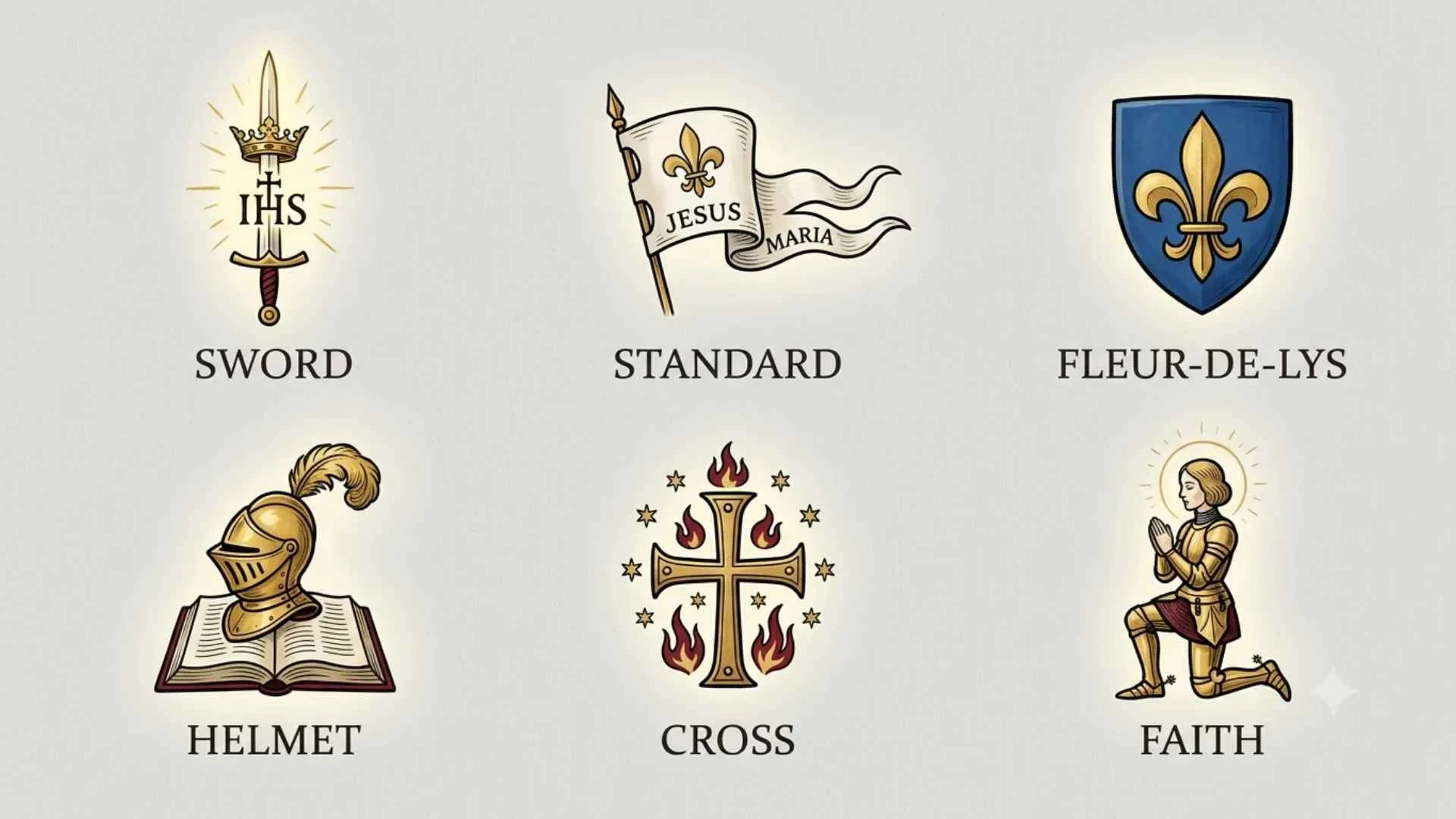
Joan of Arc symbols represent courage, faith, sacrifice, leadership, and unwavering devotion to a greater purpose. These symbols developed around the life of Joan of Arc, the young French heroine who became a military leader during the Hundred Years’ War and later a Catholic saint. Her armor, sword, banner, and fleur-de-lis remain powerful images connected with bravery and conviction.
People encounter Joan of Arc symbols in historical paintings, religious artwork, statues, books, films, museums, churches, and French cultural traditions. Each symbol tells part of Joan’s story, from her belief in divine guidance to her role in defending France.
Understanding the meaning behind these symbols reveals why Joan of Arc continues to inspire people around the world. Her imagery represents more than medieval history; it reflects universal themes of courage, justice, faith, and standing firm in difficult times.
Quick Meaning of Joan of Arc Symbols
Joan of Arc symbols represent faith, bravery, purity, patriotism, and sacrifice. The most important symbols connected with Joan include her armor, sword, military banner, and fleur-de-lis. Together, they symbolize a young woman’s courage, religious devotion, leadership, and determination to follow her mission despite overwhelming challenges.
Symbol Overview Table
| Symbol Name | Primary Meaning | Category | Origin | Culture | Historical Period | Common Usage | Modern Meaning |
| Armor of Joan of Arc | Courage, protection, warrior spirit | Military Symbol | Medieval France | French/European | 15th century | Statues, paintings, history books | Strength and resilience |
| Sword | Justice, defense, divine mission | Weapon Symbol | Medieval Europe | Christian and French traditions | 1400s | Art, monuments, literature | Courage and moral action |
| White Banner | Faith, guidance, spiritual purpose | Religious Symbol | France | Catholic tradition | 15th century | Churches, paintings, historical art | Hope and inspiration |
| Fleur-de-lis | French identity, royalty, purity | Heraldic Symbol | Medieval Europe | French culture | Middle Ages | Flags, coats of arms, artwork | Heritage and national pride |
| Armor and Banner Combination | Leadership and protection | Historical Symbol | France | Global culture | 15th century | Films, statues, books | Heroic leadership |
| Saint Joan Image | Holiness and sacrifice | Religious Symbol | France | Christianity | Modern era | Religious artwork | Spiritual courage |
What Do Joan of Arc Symbols Mean?
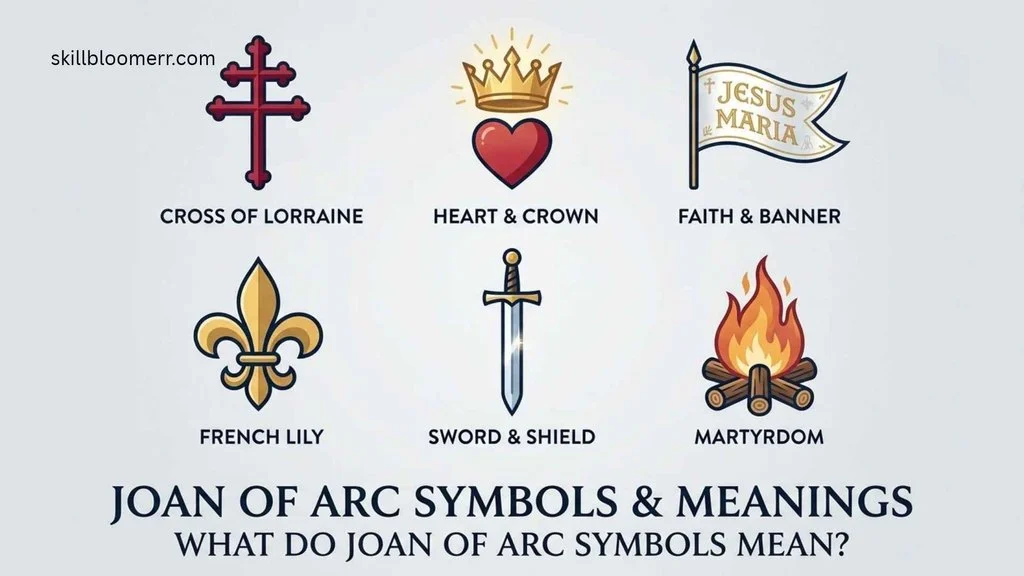
Joan of Arc symbols represent the values associated with Joan’s life and legacy. Although Joan did not create a symbolic system herself, later generations developed recognizable images based on important objects and events from her story.
These symbols communicate several important ideas:
- Faith: Joan believed her actions were guided by divine instruction.
- Courage: She faced war, political conflict, and persecution at a young age.
- Leadership: She inspired soldiers and influenced French history.
- Sacrifice: Her execution transformed her into a symbol of devotion and conviction.
- Identity: Her image became connected with French national history.
The meaning of each symbol depends on the context. A religious painting may emphasize Joan’s holiness, while a historical monument may highlight her bravery as a national figure.
History and Origin of Joan of Arc Symbols
Joan of Arc’s Life and Historical Background
Joan of Arc was born around 1412 in Domrémy, France, during the Hundred Years’ War, a long conflict between England and France over political control and the French throne.
According to historical records, Joan claimed that saints had appeared to her and encouraged her to support Charles VII, the French heir to the throne. Despite being a teenage peasant girl, she gained the attention of French leaders and became involved in military campaigns.
Her most famous achievement was helping French forces during the Siege of Orléans in 1429. This victory became a turning point in the conflict and strengthened French morale.
Joan was captured by enemy forces in 1430 and later tried for heresy. She was executed in Rouen in 1431 at approximately nineteen years old. A later investigation cleared her name, and the Catholic Church canonized her as Saint Joan of Arc in 1920.
Development of Her Symbolic Legacy
During Joan’s lifetime, objects such as armor, weapons, and banners had practical purposes. Over time, these objects gained deeper symbolic meanings.
Artists and historians transformed these items into representations of:
- Heroism
- Religious devotion
- National identity
- Female strength
- Moral courage
Joan’s symbolic image evolved from a medieval military figure into a global symbol of determination.
Symbolism and Interpretation
Armor Symbolism
Joan’s armor is one of the most recognizable symbols connected with her story.
In medieval society, armor represented:
- Military authority
- Protection
- Strength
- Readiness for battle
Joan wearing armor was especially meaningful because women rarely appeared as battlefield leaders during the Middle Ages. Her armor challenged traditional expectations and became a symbol of courage beyond social limitations.
Today, Joan’s armor represents inner strength, confidence, and the ability to face difficult challenges.
Sword Symbolism
The sword associated with Joan of Arc represents action, justice, and defense.
In religious and historical symbolism, swords often represent:
- Truth
- Protection
- Judgment
- Spiritual struggle
For Joan, the sword symbolized her commitment to defend France and fulfill what she believed was her divine mission.
Modern interpretations often view the sword as a symbol of standing against injustice rather than promoting violence.
Banner Symbolism
Joan’s banner was one of the most meaningful objects connected with her military campaigns.
Historical descriptions explain that Joan carried a white banner decorated with Christian imagery. Unlike ordinary military flags, her banner represented both battlefield identity and spiritual purpose.
The banner symbolizes:
- Faith
- Divine guidance
- Hope
- Unity
- Moral commitment
Many artworks show Joan holding her banner because it represents the connection between her beliefs and her leadership.
Fleur-de-lis Symbolism
The fleur-de-lis is a historic French symbol often associated with Joan of Arc.
Its traditional meanings include:
- French royalty
- Purity
- Honor
- Heritage
- Loyalty
The fleur-de-lis existed before Joan’s lifetime, but it became connected with her because she supported the French monarchy and became a major figure in French history.
Cultural Significance of Joan of Arc Symbols
Meaning in French Culture
In France, Joan of Arc remains an important national symbol. She represents courage, independence, and the defense of French identity.
Her symbols appear in:
- Public monuments
- Historical celebrations
- Schools
- Museums
- Literature
- National artwork
Different groups have interpreted Joan differently throughout history. Some focus on her patriotism, while others emphasize her religious devotion.
Meaning in Christian Culture
For Christians, especially Catholics, Joan’s symbols represent faith and obedience to spiritual guidance.
Her religious imagery often includes:
- A halo
- Crosses
- Prayerful poses
- Angelic figures
These symbols focus on Joan as a saint and martyr rather than only a historical warrior.
Global Cultural Meaning
Around the world, Joan of Arc symbols have become connected with broader human values:
- Courage during hardship
- Following personal beliefs
- Fighting for justice
- Breaking social barriers
Many writers and artists use Joan as an example of someone who remained committed despite opposition.
Religious or Spiritual Meaning
Joan of Arc as a Catholic Saint
Joan of Arc was canonized by the Catholic Church in 1920. She is recognized as a saint and martyr.
Her spiritual symbolism focuses on:
- Faith in God
- Listening to conscience
- Courage through belief
- Sacrifice for a higher purpose
Her feast day is celebrated on May 30.
Spiritual Lessons Associated With Joan’s Symbols
Many people interpret Joan’s symbols as reminders to:
- Remain strong during difficult moments
- Trust personal convictions
- Serve others
- Act with courage and integrity
These interpretations extend beyond religious communities and are often used in personal development discussions.
Where Joan of Arc Symbols Are Used
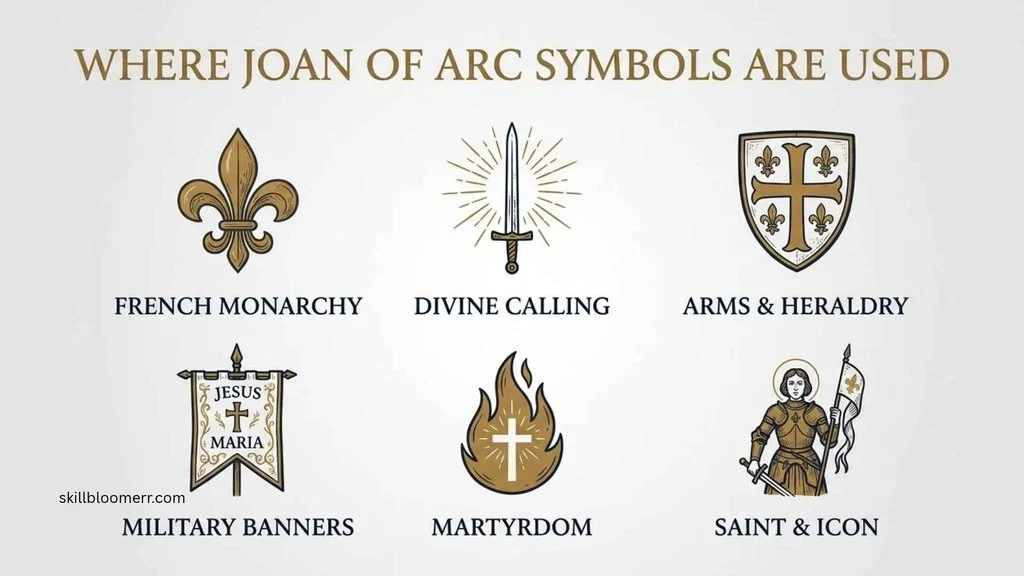
Historical Books and Education
Joan’s symbols appear in:
- History textbooks
- Academic research
- Museums
- Documentaries
They help students understand medieval France and the Hundred Years’ War.
Religious Artwork
Churches and religious artists often portray Joan with:
- Armor
- Sword
- Banner
- Halo
These images emphasize her sainthood and devotion.
Statues and Monuments
Many monuments show Joan:
- Riding a horse
- Wearing armor
- Holding a sword
- Carrying her banner
These designs highlight leadership and bravery.
Films and Popular Culture
Movies, television shows, and novels often use Joan’s traditional symbols to quickly communicate her identity.
Armor suggests a warrior.
A banner suggests faith.
A sword suggests courage.
Jewelry and Tattoos
Modern uses of Joan of Arc symbols include:
- Pendants
- Rings
- Tattoos
- Decorative artwork
People often choose these symbols to represent strength, resilience, and personal courage.
Common Variations of Joan of Arc Symbols
Warrior Joan
This design usually shows Joan wearing armor and holding a sword.
Meaning:
- Strength
- Leadership
- Protection
- Determination
Saint Joan
This version presents Joan with religious elements.
Common features:
- Halo
- Cross
- Prayer
- Angelic imagery
Meaning:
- Faith
- Holiness
- Spiritual devotion
National Hero Joan
This interpretation focuses on Joan as a symbol of France.
Meaning:
- Patriotism
- Unity
- National pride
Modern Empowerment Symbol
Some modern interpretations view Joan as a symbol of female leadership.
Meaning:
- Independence
- Breaking barriers
- Confidence
Common Misconceptions About Joan of Arc Symbols
Joan Created the Fleur-de-lis Symbol
This is incorrect. The fleur-de-lis was already used as a French symbol before Joan’s lifetime.
Joan Was a Medieval Knight
Joan wore armor and led soldiers, but she was not officially a knight in the traditional feudal system.
Her Symbols Are Only Religious
Joan’s symbols have religious meanings, but they also represent history, leadership, and cultural identity.
Joan’s Sword Represents Violence
The sword is often interpreted symbolically as justice, protection, and courage rather than simple warfare.
Interesting Facts About Joan of Arc Symbols
- Joan’s banner was more important to her than her sword.
Historical accounts suggest Joan valued her banner highly because it represented her faith and mission. - Joan’s armor changed how people viewed female leadership.
Her image challenged medieval expectations about women’s roles. - Joan became a symbol long after her death.
Her reputation continued growing centuries after her execution. - Joan was only a teenager when she became famous.
Her young age makes her historical influence especially remarkable. - The fleur-de-lis connection is cultural rather than personal.
The symbol represents France broadly, not something Joan personally created. - Joan’s image appears worldwide.
Statues and artworks dedicated to her exist in many countries. - Her symbols combine military and spiritual meanings.
Few historical figures are represented through both battlefield and religious imagery. - Joan became a symbol of resilience.
Many people use her story as an example of perseverance under pressure. - She is remembered differently across cultures.
Some emphasize her sainthood, while others focus on her role as a national heroine. - Joan’s symbols continue appearing in modern media.
Films, books, and artwork continue adapting her traditional imagery.
Related Symbols

Cross Symbol
The cross is connected with Joan’s religious identity and represents Christian faith and sacrifice.
Lion Symbol
Like Joan’s imagery, the lion often represents courage, leadership, and strength.
Sword Symbol
The sword appears in many cultures as a symbol of justice and protection.
Shield Symbol
Shields represent defense, protection, and bravery, similar to the meaning associated with Joan’s armor.
Fleur-de-lis Symbol
The fleur-de-lis connects Joan’s story with French history and monarchy.
Frequently Asked Questions
What is the most important Joan of Arc symbol?
The most important Joan of Arc symbols are her banner, armor, and sword. Her banner is often considered especially meaningful because it represented her faith and mission. Her armor represents courage, while her sword symbolizes defense and justice.
What does Joan of Arc’s armor symbolize?
Joan of Arc’s armor symbolizes courage, protection, and leadership. Because Joan was a young woman leading soldiers during the Middle Ages, her armor also represents breaking social expectations and demonstrating strength.
Why is Joan of Arc associated with the fleur-de-lis?
Joan of Arc is associated with the fleur-de-lis because it was a major symbol of France during the period when she defended the French crown. The symbol represents French identity, royalty, and heritage.
What does Joan of Arc’s banner represent?
Joan’s banner represents faith, divine guidance, and hope. It was not only a military flag but also a symbol of the spiritual purpose she believed guided her actions.
Is Joan of Arc a religious symbol?
Yes, Joan of Arc is a religious symbol for many Christians because she is recognized as a Catholic saint. However, she is also a historical and cultural symbol representing courage and leadership.
What does Joan of Arc’s sword mean?
Joan’s sword symbolizes courage, justice, and defense. It represents her willingness to fight for her beliefs and protect what she considered a righteous cause.
Why is Joan of Arc important today?
Joan of Arc remains important because her story represents courage, determination, and commitment to personal beliefs. People around the world continue to study her as a historical, religious, and cultural figure.
Are Joan of Arc symbols used in tattoos?
Yes, Joan of Arc symbols are used in tattoos to represent strength, faith, independence, resilience, and overcoming challenges.
What colors are associated with Joan of Arc?
White is commonly associated with Joan because of her banner and ideas of purity. Gold, silver, and blue may also appear in artwork connected with French identity and religious imagery.
Is Joan of Arc a symbol of female empowerment?
Many modern interpretations view Joan of Arc as a symbol of female empowerment because she achieved military leadership and historical influence during a period when women had limited public authority.
Key Takeaways
- Joan of Arc symbols represent courage, faith, sacrifice, and leadership.
- Her armor symbolizes strength and protection.
- Her sword represents justice and defense.
- Her banner represents religious devotion and hope.
- The fleur-de-lis connects her story with French identity.
- Joan’s symbols have both religious and cultural meanings.
- Her legacy continues through art, literature, monuments, and popular culture.
- Different communities interpret her symbols in different ways.
Conclusion
Joan of Arc symbols continue to inspire people because they represent more than medieval history. Her armor, sword, banner, and associated French symbols tell a story of courage, faith, and determination in the face of overwhelming challenges.
From religious artwork to national monuments, these symbols preserve the memory of a young woman who changed history through conviction and bravery. Whether viewed as a saint, a military leader, or a cultural hero, Joan of Arc remains a powerful symbol of strength and purpose.

I’m Nathaniel Brooks, an educational writer who loves exploring ideas and making useful knowledge accessible to everyone. I write for SkillBloomerr with a focus on clear explanations, practical tips, and meaningful learning. My goal is to help readers discover something valuable every time they visit the site.
Books: Learn Something New and The Practical Knowledge Handbook
 Olivia Hartwell