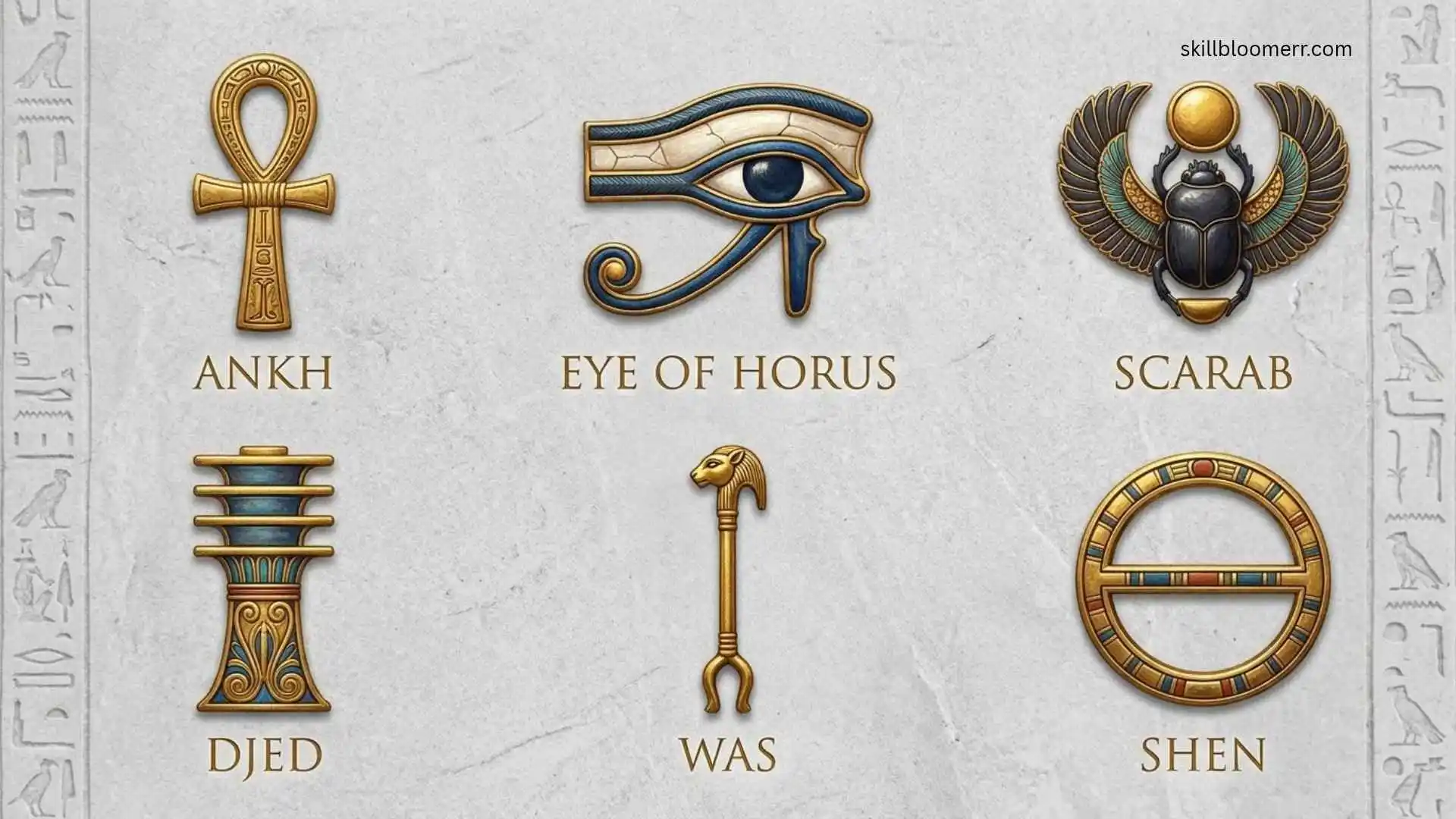
The symbols of ancient Egypt represent one of the world’s most fascinating visual languages. For thousands of years, Egyptians used symbols to express ideas about life, death, gods, protection, power, creation, and the universe.
These symbols appeared on temple walls, tombs, jewelry, papyrus scrolls, statues, and everyday objects.
From the famous Ankh symbol of life to the powerful Eye of Horus, ancient Egyptian symbols were not simply decorations. Each design carried deep religious, cultural, and philosophical meanings connected to Egyptian beliefs about harmony, immortality, and the relationship between humans and the divine.
Today, people still encounter these symbols in museums, books, movies, tattoos, jewelry, artwork, and modern spiritual practices.
Understanding the symbols of ancient Egypt helps reveal how one of history’s greatest civilizations viewed existence, nature, and the mysteries of life.
Quick Meaning of Symbols of Ancient Egypt
The symbols of ancient Egypt were visual representations of important ideas such as life, protection, eternity, power, balance, and spiritual transformation. They were created by ancient Egyptians to communicate religious beliefs, honor gods, protect the dead, and explain the connection between the physical and spiritual worlds.
Symbol Overview Table
| Symbol Name | Primary Meaning | Category | Origin | Civilization or Culture | First Known Use | Common Usage | Modern Meaning |
| Ankh | Life and immortality | Religious symbol | Ancient Egypt | Egyptian civilization | Early Dynastic Period | Temples, tombs, jewelry | Life, vitality, spirituality |
| Eye of Horus | Protection, healing, restoration | Protective symbol | Ancient Egypt | Egyptian mythology | Old Kingdom | Amulets, artwork | Safety and awareness |
| Eye of Ra | Divine power and protection | Solar symbol | Ancient Egypt | Egyptian religion | Ancient Egyptian kingdoms | Royal and religious art | Strength and authority |
| Scarab Beetle | Rebirth and transformation | Nature symbol | Ancient Egypt | Egyptian culture | Middle Kingdom and earlier | Jewelry, burial items | Renewal and change |
| Djed Pillar | Stability and endurance | Sacred symbol | Ancient Egypt | Egyptian religion | Early Egyptian periods | Temples and ceremonies | Strength and balance |
| Was Scepter | Power and authority | Royal symbol | Ancient Egypt | Pharaoh culture | Ancient kingdoms | Royal imagery | Leadership |
| Lotus Flower | Creation and rebirth | Nature symbol | Ancient Egypt | Egyptian mythology | Ancient Egyptian art | Temples and decorations | Growth and renewal |
| Shen Ring | Eternity and protection | Royal symbol | Ancient Egypt | Egyptian civilization | Old Kingdom | Cartouches and royal art | Infinite protection |
| Feather of Ma’at | Truth and justice | Spiritual symbol | Ancient Egypt | Egyptian philosophy | Ancient Egyptian religion | Judgment scenes | Balance and morality |
What Do the Symbols of Ancient Egypt Mean?
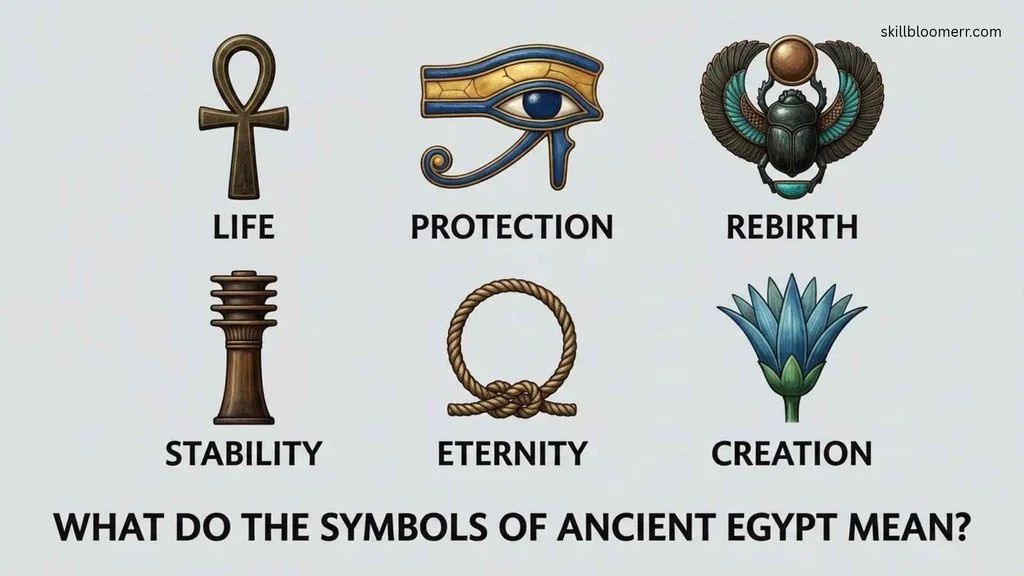
The symbols of ancient Egypt represent the beliefs, values, and worldview of Egyptian society. Unlike modern logos, these symbols were connected to religion, mythology, government, and daily life.
Ancient Egyptians believed that symbols had real spiritual power. A carved image was not only a representation of an idea; it could help activate or preserve that idea. For example, placing an Ankh near a person was believed to connect them with life energy, while protective symbols placed in tombs helped guard the deceased.
Many Egyptian symbols focused on several central themes:
- Life and immortality
- Protection from danger
- Connection with gods
- Balance and order
- Rebirth after death
- Royal authority
- Cosmic harmony
The Egyptians viewed the universe as a carefully balanced system. Symbols helped communicate and maintain this balance, known as Ma’at, which represented truth, justice, order, and harmony.
Major Symbols of Ancient Egypt and Their Meanings
The Ankh: The Symbol of Life
The Ankh is one of the most recognizable symbols of ancient Egypt. It appears as a cross with a loop at the top and is often called the “key of life.”
Meaning of the Ankh
The Ankh represented:
- Physical life
- Eternal life
- Immortality
- Divine energy
- The connection between male and female principles
Egyptian gods are frequently shown holding the Ankh, especially in temple carvings. The symbol suggested that gods had the power to give and sustain life.
Historical Use
The Ankh appeared in:
- Temple inscriptions
- Tomb paintings
- Religious ceremonies
- Royal artwork
- Jewelry
Pharaohs were often depicted receiving the Ankh from gods as a symbol of divine approval.
Modern Interpretation
Today, the Ankh is commonly associated with:
- Spiritual awakening
- African heritage
- Personal growth
- Eternal existence
It is frequently used in necklaces, tattoos, and modern artwork.
The Eye of Horus: Protection and Healing
The Eye of Horus is one of the most famous symbols from Egyptian mythology. It represents protection, health, restoration, and spiritual awareness.
Mythological Origin
According to Egyptian mythology, Horus lost his eye during a battle with Set, the god associated with chaos and conflict. The eye was later restored, making it a powerful symbol of healing and recovery.
Traditional Meanings
The Eye of Horus symbolized:
- Protection against evil
- Healing after injury
- Strength
- Royal power
- Good health
Ancient Egyptians often used it as an amulet to protect the wearer.
Modern Meaning
Today, the Eye of Horus is often interpreted as:
- Awareness
- Protection
- Inner wisdom
- Spiritual insight
It is popular in jewelry and tattoo designs.
The Eye of Ra: Solar Power and Divine Authority
The Eye of Ra represents the powerful protective force of the sun god Ra.
Difference Between Eye of Horus and Eye of Ra
Although they look similar, they have different meanings:
| Eye of Horus | Eye of Ra |
| Healing and restoration | Power and destruction |
| Connected with Horus | Connected with Ra |
| Personal protection | Divine authority |
| Recovery and balance | Solar energy |
The Eye of Ra could represent the fierce protective side of the sun god, capable of defeating enemies and maintaining cosmic order.
The Scarab Beetle: Rebirth and Transformation
The scarab beetle was a powerful symbol because Egyptians observed the beetle rolling balls of dung across the ground, which they connected with the movement of the sun.
Symbolic Meaning
The scarab represented:
- Creation
- Renewal
- Rebirth
- Transformation
- Eternal existence
The Egyptian god Khepri, associated with the rising sun, was often represented as a scarab beetle.
Use in Ancient Egypt
Scarab amulets were placed:
- On mummies
- In tombs
- In jewelry
- On seals
They were believed to provide protection and support rebirth in the afterlife.
The Djed Pillar: Stability and Strength
The Djed pillar symbolized stability and endurance.
Religious Importance
The Djed was connected with Osiris, the god of the afterlife. Egyptians believed it represented the backbone of Osiris and the stability of life itself.
Symbolic Meaning
The Djed represented:
- Strength
- Permanence
- Balance
- Resurrection
It appeared in temples and religious ceremonies, especially those connected with renewal.
The Feather of Ma’at: Truth and Cosmic Balance
The feather of Ma’at represented truth, justice, and harmony.
Role in the Afterlife
Ancient Egyptians believed that after death, a person’s heart was weighed against the feather of Ma’at.
If the heart balanced with the feather, the person was considered worthy of entering the afterlife.
Meaning Today
The feather remains a symbol of:
- Honesty
- Fairness
- Moral responsibility
- Balance
History and Origin of Ancient Egyptian Symbols
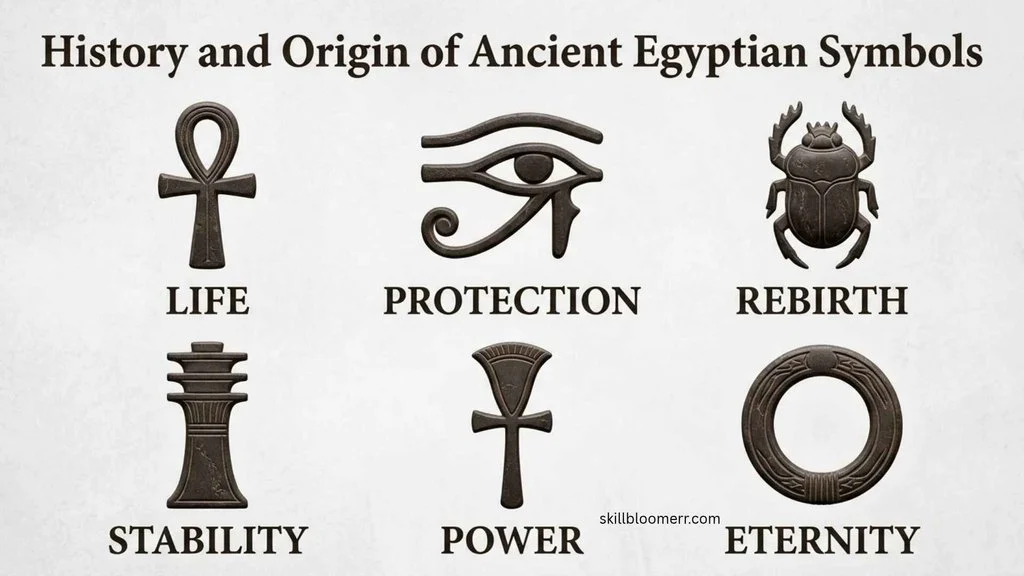
Ancient Egyptian symbols developed over more than 3,000 years of civilization. Their origins can be traced back to prehistoric Egyptian communities before the unification of Egypt around 3100 BCE.
Early Egyptians used images of animals, natural objects, and simple shapes to communicate ideas. Over time, these images became part of the Egyptian writing system known as hieroglyphics.
Development Through Egyptian History
Ancient Egyptian symbols evolved during several major periods:
Early Dynastic Period
Symbols became connected with kingship, religion, and government.
Old Kingdom
Large pyramid complexes and temples used symbols to express beliefs about death and the afterlife.
Middle Kingdom
Symbolic traditions expanded through literature, art, and religious practices.
New Kingdom
Symbols reached their greatest artistic development through temples, royal tombs, and religious monuments.
Late Period
Many traditional symbols continued even as foreign influences entered Egypt.
Symbolism and Interpretation
Ancient Egyptian symbols had multiple layers of meaning. A single symbol could represent a physical object, a religious idea, and a philosophical concept at the same time.
Traditional Meanings
Ancient Egyptians used symbols to represent:
- Gods and goddesses
- Natural forces
- Human qualities
- Spiritual concepts
- Royal authority
Modern Meanings
Modern audiences often interpret Egyptian symbols differently. Many people view them as:
- Spiritual icons
- Historical artwork
- Cultural symbols
- Personal expressions
However, modern interpretations do not always match ancient Egyptian beliefs.
Psychological Interpretation
Symbols work because humans naturally connect images with ideas. A circle may suggest eternity, while a rising sun may suggest renewal. Egyptian symbols used these universal ideas to communicate powerful concepts.
Cultural Significance of Egyptian Symbols
Ancient Egyptian symbols influenced art, architecture, religion, and writing for thousands of years.
Egyptian Society
Symbols appeared everywhere:
- Temples
- Palaces
- Tombs
- Clothing
- Jewelry
- Tools
They connected everyday life with religious beliefs.
Influence on Later Cultures
Egyptian symbols influenced:
- Greek and Roman writers
- European artists
- Archaeological studies
- Modern popular culture
Many Egyptian designs remain recognizable worldwide.
Religious and Spiritual Meaning
Religion was central to ancient Egyptian symbolism. Egyptians believed that gods controlled natural forces and that humans could maintain harmony through proper rituals.
Connection With Egyptian Gods
Many symbols were connected with specific deities:
| Symbol | Associated Deity | Meaning |
| Ankh | Isis, Osiris, many gods | Life |
| Eye of Horus | Horus | Protection |
| Scarab | Khepri | Rebirth |
| Djed | Osiris | Resurrection |
| Was Scepter | Various gods | Power |
Afterlife Beliefs
A major purpose of Egyptian symbols was supporting the journey after death. Tomb symbols were designed to protect, guide, and provide eternal benefits for the deceased.
Where Ancient Egyptian Symbols Are Used Today
Ancient Egyptian symbols continue to appear in many areas.
Jewelry
Ankh necklaces, scarab rings, and Eye of Horus bracelets remain popular worldwide.
Tattoos
People often choose Egyptian symbols because of meanings related to:
- Protection
- Strength
- Life
- Spiritual identity
Art and Design
Artists use Egyptian symbols in:
- Paintings
- Architecture
- Fashion
- Graphic design
Movies and Literature
Egyptian symbols frequently appear in stories about:
- Archaeology
- Mythology
- Ancient civilizations
- Fantasy worlds
Common Variations of Egyptian Symbols
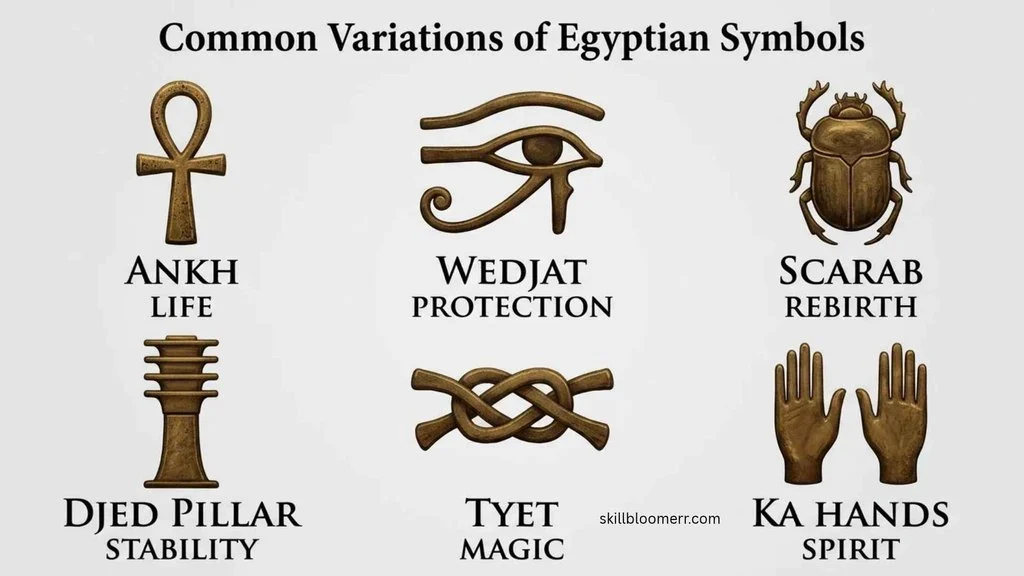
Egyptian symbols changed depending on the time period, location, and artistic style.
Artistic Variations
Differences may include:
- Size
- Shape
- Decorative details
- Materials used
Regional Variations
Different temples and communities sometimes emphasized different meanings.
Modern Adaptations
Modern versions may simplify traditional designs for:
- Logos
- Jewelry
- Digital artwork
Common Misconceptions About Ancient Egyptian Symbols
Misconception 1: All Egyptian Symbols Were Magical
While many symbols had religious importance, not every symbol was considered a magical object.
Misconception 2: The Eye of Horus and Eye of Ra Are the Same
They are related but represent different concepts in Egyptian mythology.
Misconception 3: Egyptian Symbols Had Only One Meaning
Many symbols had several meanings depending on context.
Misconception 4: Modern Meanings Are Always Ancient Meanings
Modern spiritual interpretations may differ from historical Egyptian beliefs.
Interesting Facts About Ancient Egyptian Symbols
- The Ankh appears in thousands of Egyptian artworks because life was one of the civilization’s strongest religious themes.
- Egyptian hieroglyphs combined pictures and sounds, allowing symbols to function as both images and writing.
- Scarab amulets were placed on mummies because Egyptians associated them with renewal after death.
- The Eye of Horus was sometimes connected with measurements in ancient Egyptian mathematics.
- The Djed pillar was used in ceremonies symbolizing stability and renewal.
- Egyptian symbols survived because they were carved into durable materials such as stone.
- Pharaohs used symbols to demonstrate their connection with gods.
- Many Egyptian symbols remain popular more than 3,000 years after their creation.
- Ancient Egyptian artists carefully followed symbolic rules when creating religious artwork.
- Museums around the world preserve thousands of objects containing Egyptian symbols.
Related Symbols
Greek Symbols
Greek symbols often represented mythology and philosophy but developed separately from Egyptian traditions.
Norse Symbols
Norse symbols such as runes also connected writing with spiritual ideas.
Celtic Symbols
Celtic symbols frequently represented nature, cycles, and spirituality.
Mesopotamian Symbols
Ancient Mesopotamian cultures also used symbols to represent gods and cosmic ideas.
Frequently Asked Questions
What is the most famous symbol of ancient Egypt?
The Ankh is probably the most famous Egyptian symbol. It represents life, immortality, and the connection between humans and divine forces. It appears frequently in ancient artwork and remains popular today.
What does the Eye of Horus symbolize?
The Eye of Horus symbolizes protection, healing, restoration, and spiritual awareness. Ancient Egyptians used it as a protective amulet and connected it with the myth of Horus recovering his lost eye.
What is the Egyptian symbol for eternal life?
The Ankh is the primary Egyptian symbol associated with eternal life. It represents both earthly existence and the continuation of life after death.
Why did Egyptians use symbols?
Egyptians used symbols to communicate religious beliefs, record information, honor gods, protect the dead, and express ideas about the universe.
Are Egyptian symbols religious?
Many Egyptian symbols had religious meanings, especially those connected with gods, temples, and the afterlife. However, some were also used in everyday objects and decoration.
What does the scarab symbol mean?
The scarab symbolizes rebirth, transformation, and renewal. Egyptians connected it with the rising sun and the god Khepri.
Are Egyptian tattoos culturally accurate?
Some Egyptian tattoos use historically accurate designs, while others combine modern interpretations with ancient imagery. Understanding the original meaning helps create more respectful use.
What is the Egyptian symbol for protection?
The Eye of Horus is one of the strongest protective symbols in ancient Egyptian culture. It was used in amulets and artwork for safety and healing.
Key Takeaways
- Ancient Egyptian symbols represented life, protection, power, and spiritual ideas.
- The Ankh symbolizes life and immortality.
- The Eye of Horus represents healing and protection.
- Scarabs represent rebirth and transformation.
- Ma’at represents truth, justice, and balance.
- Egyptian symbols were deeply connected with religion and mythology.
- Many ancient symbols remain meaningful today.
- Modern interpretations may differ from original Egyptian beliefs.
Conclusion
The symbols of ancient Egypt reveal the beliefs, creativity, and spiritual vision of one of history’s greatest civilizations. These symbols were more than artistic designs; they carried messages about life, death, protection, balance, and humanity’s connection with the universe.
From the Ankh’s message of eternal life to the Eye of Horus’s promise of protection, Egyptian symbols continue to inspire people around the world. Their lasting influence shows how powerful visual language can be across thousands of years.

I’m Nathaniel Brooks, an educational writer who loves exploring ideas and making useful knowledge accessible to everyone. I write for SkillBloomerr with a focus on clear explanations, practical tips, and meaningful learning. My goal is to help readers discover something valuable every time they visit the site.
Books: Learn Something New and The Practical Knowledge Handbook
 Olivia Hartwell