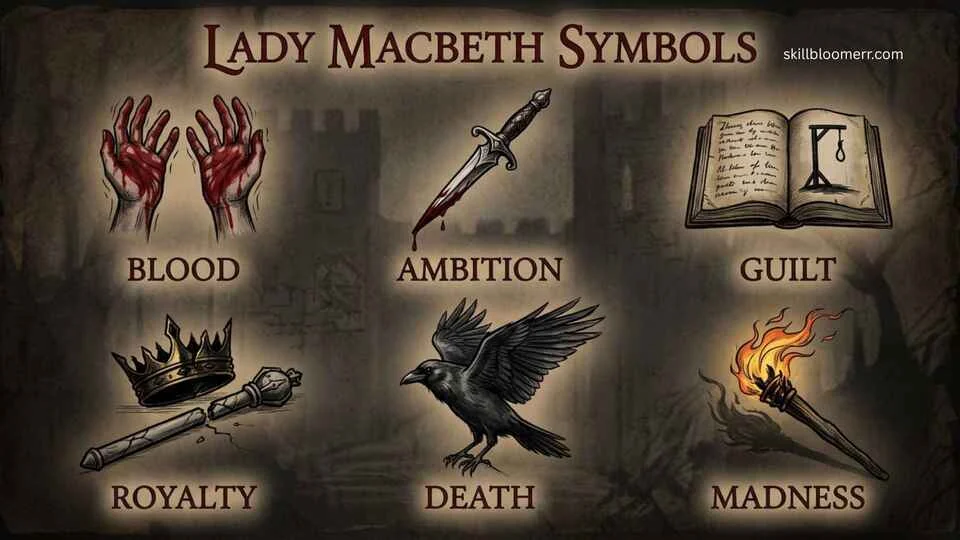
Lady Macbeth is one of the most memorable characters in English literature because she embodies ambition, guilt, manipulation, and psychological collapse. Throughout William Shakespeare’s Macbeth, she is associated with powerful symbols that reveal her changing state of mind rather than simply decorating the story.
Readers encounter these symbols in classrooms, literary criticism, theater productions, films, and examinations because they help explain her motivations and the play’s deeper themes.
Understanding Lady Macbeth symbols provides insight into Shakespeare’s exploration of power, morality, conscience, gender expectations, and the consequences of unchecked ambition. Each recurring image—from blood to darkness—serves as a window into her psychological transformation.
Quick Meaning of lady macbeth symbols:
Lady Macbeth’s symbols primarily represent ambition, guilt, conscience, moral corruption, psychological conflict, and the destructive pursuit of power. Shakespeare uses recurring images such as blood, darkness, sleep, light, and handwashing to illustrate her rise from determined conspirator to a guilt-ridden woman whose conscience ultimately destroys her.
Symbol Overview Table
| Field | Information |
| Symbol Name | Lady Macbeth Symbols |
| Primary Meaning | Ambition, guilt, conscience, moral corruption |
| Category | Literary symbolism |
| Origin | Macbeth by William Shakespeare |
| First Appearance | Early 17th century (written c. 1606) |
| Literary Period | Jacobean Literature |
| Culture | English Renaissance |
| Creator | William Shakespeare |
| Common Usage | Literary analysis, education, theater |
| Modern Meaning | Psychological guilt, destructive ambition, moral conflict |
| Related Symbols | Blood, darkness, sleep, candle, hands, crown, raven, washing |
What Do Lady Macbeth Symbols Mean?
Lady Macbeth’s symbols communicate emotional and psychological truths rather than literal objects. Shakespeare repeatedly uses visual imagery to reveal what characters cannot openly express.
Unlike symbols that remain fixed, Lady Macbeth’s symbolic world evolves throughout the play. Early symbols reflect confidence and determination, while later ones reveal fear, regret, and mental collapse.
Her symbolic journey follows a clear progression:
- Ambition motivates action.
- Darkness conceals crime.
- Blood represents guilt.
- Sleep symbolizes innocence.
- Handwashing reflects psychological torment.
- Light becomes a search for safety.
These changing symbols illustrate one of literature’s greatest examples of internal transformation.
History and Origin
Lady Macbeth’s symbolism originates in Shakespeare’s Macbeth, believed to have been written around 1606 during the reign of King James I.
Although Lady Macbeth herself was inspired by historical figures found in Raphael Holinshed’s Chronicles, Shakespeare dramatically expanded her psychological complexity through symbolism.
Jacobean audiences understood many of these symbols immediately.
Blood
Blood traditionally symbolized life, sacrifice, violence, and divine justice.
Shakespeare transformed blood into something more personal: an inescapable reminder of guilt.
Darkness
Darkness had long represented evil, secrecy, temptation, and sin in European literature.
Lady Macbeth deliberately embraces darkness before Duncan’s murder.
Sleep
In classical and Christian traditions, sleep represented innocence, peace, and divine blessing.
Macbeth’s crime permanently disrupts natural sleep, making it one of the play’s central symbolic ideas.
Symbolism and Interpretation
Blood
Blood is Lady Macbeth’s most famous symbol.
Initially, she believes murder is merely a practical act.
After Duncan’s death, she dismisses Macbeth’s fears by saying that “a little water clears us of this deed.”
Later, however, blood becomes invisible yet impossible to remove.
Her sleepwalking scene dramatically reverses her earlier confidence.
Imaginary blood stains reveal psychological rather than physical guilt.
Blood therefore symbolizes:
- Murder
- Conscience
- Permanent guilt
- Moral responsibility
- Psychological trauma
Hands
Hands symbolize personal responsibility.
Lady Macbeth physically participates in Duncan’s murder by placing the bloody daggers near the guards.
Later she obsessively rubs her hands while imagining blood that no one else can see.
The hands become evidence that actions cannot be undone.
Darkness
Lady Macbeth repeatedly calls upon darkness.
She wishes at night to hide her intentions.
Darkness symbolizes:
- Concealed evil
- Moral blindness
- Secrecy
- Rejection of divine judgment
Ironically, darkness cannot protect her from her own conscience.
Sleep
Sleep symbolizes innocence and emotional peace.
After Duncan’s murder, Macbeth hears that he has “murdered sleep.”
Lady Macbeth later loses the very thing she once ignored.
Her sleepwalking demonstrates that guilt invades even unconsciousness.
Light and the Candle
During her sleepwalking scene, Lady Macbeth insists on carrying a candle.
This seemingly simple object becomes deeply symbolic.
The candle represents:
- Safety
- Truth
- Hope
- A desire to escape overwhelming darkness
The woman who once demanded darkness eventually fears it.
The Raven
Before Duncan arrives, Lady Macbeth remarks that the raven is hoarse.
In Renaissance symbolism, ravens often represented:
- Death
- Misfortune
- Ominous prophecy
The bird foreshadows Duncan’s murder.
The Crown
Although Lady Macbeth never physically wears the Scottish crown on stage in every production, kingship symbolizes ultimate ambition.
The crown represents:
- Political power
- Achievement
- Dangerous desire
- The cost of success
Once obtained, it fails to bring happiness.
Cultural Significance
Lady Macbeth’s symbols have become universal literary references.
Western Literary Tradition
In English-speaking countries, “Lady Macbeth” often describes someone consumed by ambition or overwhelming guilt.
The symbolic bloodstains remain one of literature’s most recognizable images.
Theater
Directors interpret symbols differently.
Some productions emphasize:
- Red lighting
- Visible blood
- Candles
- Dark costumes
- Minimalist staging
Others rely almost entirely on dialogue, allowing audiences to imagine the symbolism.
Modern Psychology
Psychologists and literary scholars frequently discuss Lady Macbeth as an example of guilt manifesting through obsessive behavior.
Although fictional, her compulsive handwashing resembles behaviors associated with severe psychological distress, making her a common subject in discussions of literature and mental health.
Religious or Spiritual Meaning
While Lady Macbeth’s symbols are literary rather than religious symbols, Shakespeare draws heavily from Christian moral ideas familiar to Jacobean audiences.
Important spiritual themes include:
Sin
Murder represents a grave moral offense against both divine and human law.
Conscience
Blood symbolizes a conscience that cannot be silenced through physical cleansing.
Judgment
Darkness temporarily hides wrongdoing but cannot prevent eventual moral reckoning.
Damnation
Lady Macbeth fears no earthly punishment at first, yet psychological suffering becomes its own form of judgment.
Where the Symbols Are Used
Lady Macbeth’s symbolism appears in numerous contexts beyond Shakespeare’s original text.
Literature Classes
Students analyze recurring imagery to understand characterization and themes.
Academic Essays
Blood, darkness, and sleep frequently appear in literary criticism.
Theater Productions
Directors use costumes, lighting, props, and staging to reinforce symbolic meanings.
Film Adaptations
Modern adaptations often reinterpret symbolic imagery through cinematography.
Popular Culture
Expressions such as “Lady Macbeth” or “washing one’s hands of guilt” reference the character’s symbolic legacy.
Psychology and Philosophy
Her symbolic decline is discussed in studies of conscience, ethics, and moral responsibility.
Common Variations
Lady Macbeth’s symbols are interpreted differently across productions and scholarly traditions.
Visual Blood
Some performances use realistic blood.
Others avoid visible blood entirely, emphasizing psychological horror instead.
Candles
Some productions give Lady Macbeth a single candle.
Others surround her with numerous lights to emphasize her fear of darkness.
Costume Colors
Common symbolic costume choices include:
- Black for ambition
- Red for guilt
- White for innocence lost
- Gray for psychological decline
Modern Adaptations
Contemporary settings may replace castles with corporate offices or political institutions while preserving the same symbolic meanings.
Common Misconceptions

Lady Macbeth Is Evil Throughout the Entire Play
This oversimplifies her character.
She begins as ruthless but eventually becomes emotionally overwhelmed by guilt.
Blood Represents Only Violence
Blood symbolizes violence initially but later represents conscience and psychological suffering.
Handwashing Is About Cleanliness
The handwashing scene is symbolic.
She attempts to cleanse herself of moral guilt, not physical dirt.
Darkness Always Represents Evil
In Macbeth, darkness often conceals crime, but it also reflects fear, uncertainty, and emotional isolation.
Lady Macbeth Never Feels Remorse
Her sleepwalking scene demonstrates profound guilt even though she rarely admits it openly while awake.
Interesting Facts
- Lady Macbeth never physically kills Duncan on stage. Her symbolic influence is greater than direct action.
- The blood imagery grows stronger as the play progresses. Psychological guilt replaces physical violence.
- The sleepwalking scene has become one of Shakespeare’s most famous dramatic moments. It transforms earlier symbols into emotional tragedy.
- The candle appears only near the end of the play, highlighting Lady Macbeth’s reversal from embracing darkness to fearing it.
- Many stage productions avoid showing excessive blood, relying instead on the audience’s imagination.
- Lady Macbeth speaks some of Shakespeare’s most symbol-rich lines, making her a favorite subject for literary analysis.
- The phrase “Out, damned spot!” refers to imaginary blood rather than a real stain, emphasizing internal guilt.
- Her symbolic transformation occurs faster than Macbeth’s. She collapses psychologically while Macbeth becomes increasingly emotionally numb.
- Directors often change visual symbols without changing Shakespeare’s words, proving the flexibility of literary symbolism.
- Lady Macbeth’s symbols influence modern storytelling, especially in films and novels about ambition, corruption, and guilt.
Related Symbols
| Symbol | Relationship | Difference |
| Blood | Represents guilt | Most closely associated with Lady Macbeth’s conscience |
| Darkness | Conceals evil | Focuses on secrecy rather than remorse |
| Sleep | Symbolizes innocence | Represents peace lost after murder |
| Crown | Represents ambition | Concerns political power rather than morality |
| Dagger | Signals violent intent | More closely associated with Macbeth’s visions |
| Candle | Represents hope and protection | Appears during Lady Macbeth’s psychological decline |
| Raven | Foreshadows death | Functions mainly as an omen |
Frequently Asked Questions
What is the most important symbol associated with Lady Macbeth?
Blood is widely considered Lady Macbeth’s central symbol because it evolves from evidence of murder into a powerful representation of guilt, conscience, and psychological suffering. Her inability to remove imagined blood stains illustrates that moral responsibility cannot be erased through physical actions.
Why does Lady Macbeth keep washing her hands?
Her repeated handwashing symbolizes overwhelming guilt rather than a desire for physical cleanliness. The invisible blood represents a troubled conscience, showing that she cannot escape the emotional consequences of Duncan’s murder.
What does darkness symbolize for Lady Macbeth?
Darkness initially symbolizes secrecy and protection from judgment. Lady Macbeth welcomes it before the murder because she wants evil actions hidden. Later, darkness becomes frightening, prompting her to seek comfort through light.
Why is sleep an important symbol?
Sleep represents innocence, peace, and emotional stability. After Duncan’s murder, natural sleep disappears from the lives of both Macbeth and Lady Macbeth, illustrating how guilt destroys inner peace.
Does Lady Macbeth symbolize feminism?
Interpretations differ. Some critics view her as challenging traditional gender expectations through her desire for political influence, while others argue Shakespeare ultimately portrays the destructive consequences of rejecting moral restraint. The character should be understood within the cultural context of the early seventeenth century.
What does the candle represent?
The candle symbolizes hope, safety, and protection from psychological darkness. During her sleepwalking scene, Lady Macbeth clings to light because she can no longer endure the darkness she once embraced.
Why is the raven mentioned before Duncan’s murder?
The raven functions as an omen of death. In Renaissance symbolism, ravens were commonly linked to mortality and misfortune, making the bird an effective foreshadowing device.
Are Lady Macbeth’s symbols still relevant today?
Yes. Themes of ambition, guilt, moral responsibility, and psychological conflict remain universal. Modern literature, films, and theater continue to adapt these symbols because they effectively portray the emotional cost of unethical choices.
Why do different productions interpret the symbols differently?
Shakespeare’s language leaves room for creative staging. Directors may alter lighting, costumes, props, or visual imagery while preserving the symbolic meaning expressed through the dialogue, allowing each production to emphasize different aspects of Lady Macbeth’s journey.
Key Takeaways
- Lady Macbeth’s symbols reveal her psychological transformation.
- Blood represents guilt more than physical violence.
- Darkness shifts from protection to fear.
- Sleep symbolizes innocence and emotional peace.
- Handwashing reflects an inescapable guilty conscience.
- The candle represents hope and protection against inner darkness.
- The raven foreshadows Duncan’s death.
- The crown symbolizes ambition and the dangerous pursuit of power.
- Shakespeare uses recurring imagery to connect morality with psychological consequences.
- These symbols remain central to literary criticism, theater, and modern interpretations of Macbeth.
Conclusion
Lady Macbeth’s symbolic world is one of Shakespeare’s greatest achievements in character development. Through recurring images of blood, darkness, sleep, hands, candles, ravens, and the crown, he transforms abstract ideas like ambition, guilt, and conscience into unforgettable dramatic experiences.
Rather than functioning as isolated literary devices, these symbols evolve alongside Lady Macbeth herself, revealing her journey from fearless instigator to tormented soul.
Studying Lady Macbeth symbols not only deepens appreciation of Macbeth but also highlights Shakespeare’s enduring insight into human psychology, moral responsibility, and the lasting consequences of unchecked ambition.

I’m Olivia Hartwell, a writer passionate about learning, personal growth, and practical education. I enjoy researching new ideas and sharing them in a way that feels easy to understand and useful. Through my work with SkillBloomerr, I aim to give readers reliable information they can apply in real life.
Books: Small Steps, Big Growth and The Curious Mind
 Charlotte Winslow
 Ethan Calloway
 Nathaniel Brooks