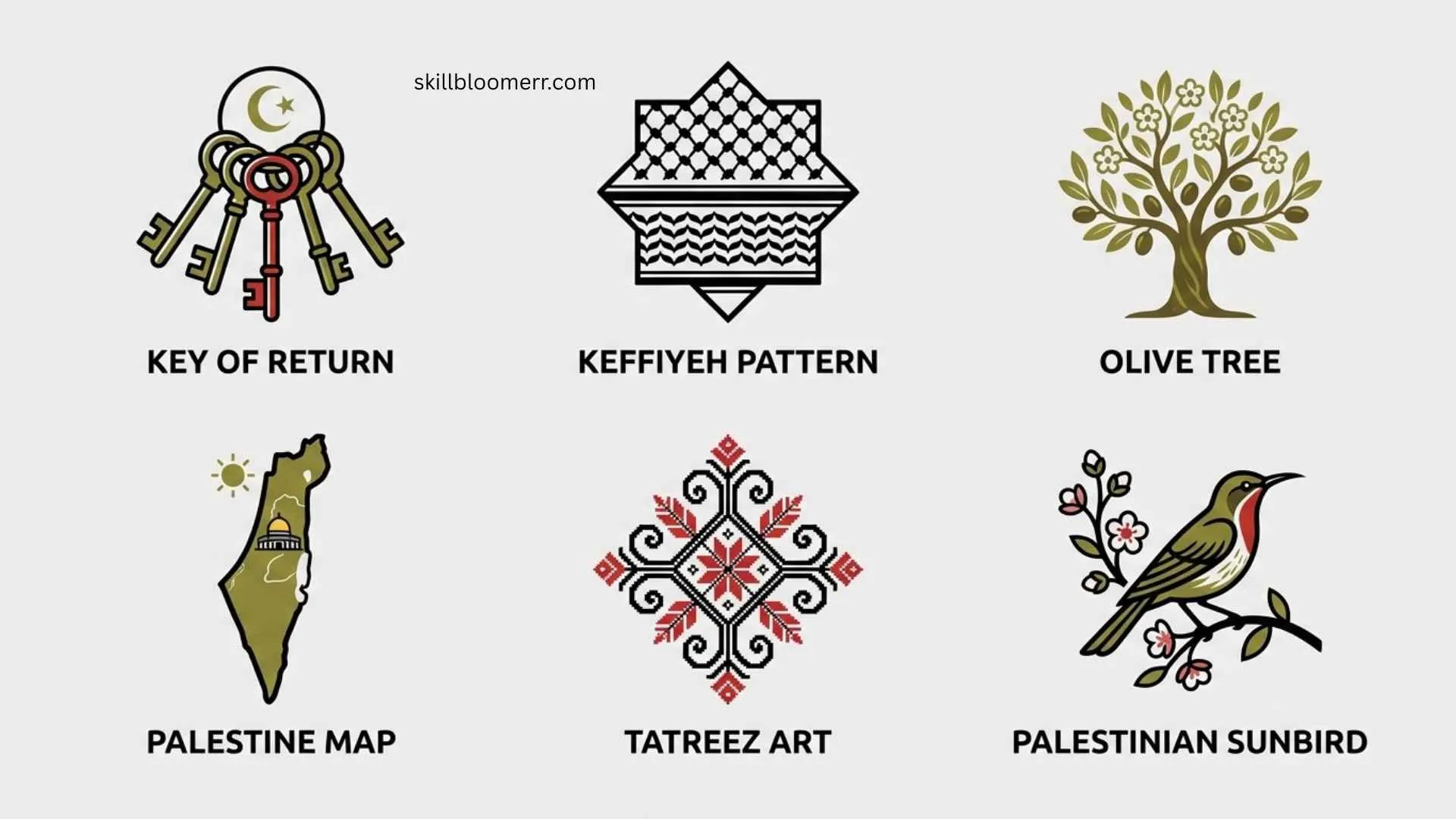
Symbols of Palestine represent a deep connection between people, land, history, culture, and identity. From the Palestinian flag and the keffiyeh to the olive tree and traditional embroidery, these symbols carry meanings shaped by centuries of heritage, resistance, faith, and everyday life.
People encounter Palestinian symbols in many places, including flags, clothing, artwork, literature, architecture, maps, museums, and cultural events. Each symbol tells a story about geography, traditions, family roots, and the relationship between communities and their homeland.
This guide explores the symbols of Palestine, explaining their origins, meanings, cultural importance, religious connections, modern uses, and common interpretations while separating historical facts from personal or political viewpoints.
Quick Meaning of Symbols of Palestine
Symbols of Palestine are visual and cultural signs that express Palestinian identity, heritage, history, and connection to the land. Common examples include the Palestinian flag, olive tree, keffiyeh, Tatreez embroidery, Jerusalem symbols, and the Dome of the Rock. These symbols represent belonging, tradition, memory, and cultural continuity.
Symbol Overview Table
| Symbol Name | Primary Meaning | Category | Origin | Culture | Common Usage | Modern Meaning |
| Palestinian Flag | Identity and national heritage | National Symbol | 20th century | Palestinian culture | Flags, events, art | Unity and recognition |
| Olive Tree | Peace, connection, and endurance | Nature Symbol | Ancient Mediterranean | Levantine culture | Art, stories, agriculture | Heritage and resilience |
| Keffiyeh | Tradition and cultural identity | Clothing Symbol | Ancient Middle Eastern traditions | Palestinian and Arab culture | Clothing, fashion, protests | Cultural pride |
| Tatreez Embroidery | Women’s craftsmanship and regional identity | Folk Art Symbol | Centuries-old Palestinian tradition | Palestinian communities | Dresses, textiles, museums | Heritage preservation |
| Dome of the Rock | Jerusalem and religious heritage | Religious Symbol | 7th century CE | Islamic architecture | Art, photography, architecture | Spiritual connection |
| Key Symbol (Miftah) | Memory and connection to homes | Cultural Symbol | Modern Palestinian tradition | Palestinian communities | Jewelry, artwork | Remembrance |
| Orange Tree | Agriculture and homeland | Nature Symbol | Historical Palestinian farming | Local culture | Literature, art | Land connection |
What Do the Symbols of Palestine Mean?
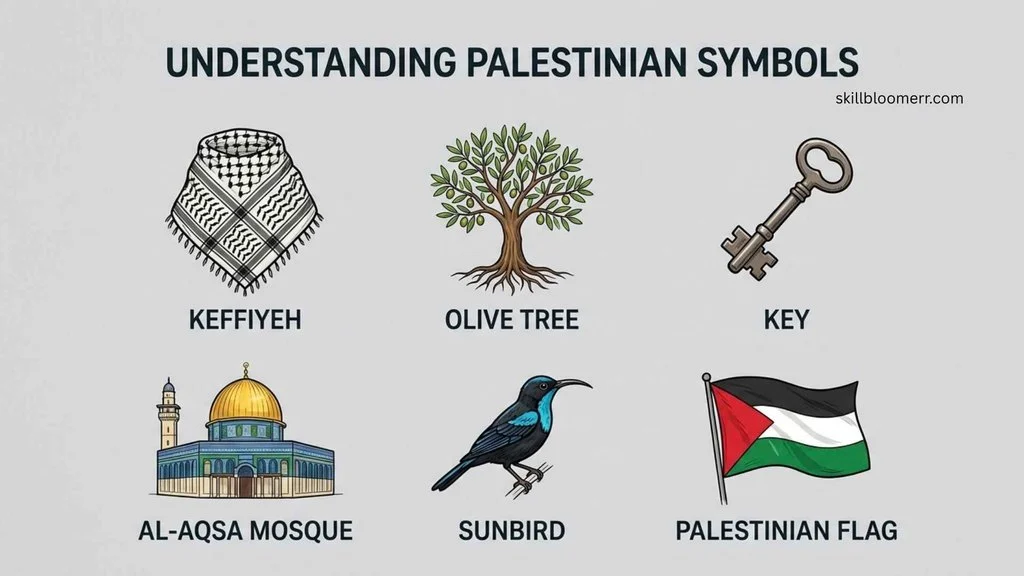
The symbols of Palestine represent different aspects of Palestinian life, including national identity, cultural traditions, religious heritage, and historical memory. While each symbol has its own background, many share a common theme: the relationship between people and place.
These symbols are not limited to political meanings. Many are rooted in everyday life, such as farming, clothing, family traditions, and artistic expression.
The Palestinian Flag Meaning
The Palestinian flag is one of the most recognized symbols of Palestine. It consists of three horizontal colors: black, white, and green, with a red triangle extending from the left side.
The colors are traditionally associated with Arab history and have connections to historical Arab dynasties:
- Black is often linked with the Abbasid period.
- White is associated with the Umayyad period.
- Green is connected with the Fatimid dynasty and is also widely used as a symbol of growth and renewal.
- Red has historical associations with Arab movements and sacrifice.
The flag is commonly used to represent Palestinian identity, cultural pride, and national expression.
The Olive Tree Meaning
The olive tree is one of the oldest and most powerful symbols connected to Palestine. Olive cultivation has existed in the region for thousands of years, making the tree closely connected to agriculture, family traditions, and local economies.
The olive tree often symbolizes:
- Peace
- Stability
- Strength
- Longevity
- Connection to ancestral land
Because olive trees can survive for centuries, many people view them as symbols of endurance and continuity between generations.
The Keffiyeh Meaning
The keffiyeh is a traditional Middle Eastern head covering that became strongly associated with Palestinian cultural identity. Its black-and-white pattern is widely recognized around the world.
Historically, the keffiyeh was practical clothing used by farmers and rural communities to protect against sun, dust, and weather conditions.
Over time, it became a cultural symbol representing:
- Palestinian heritage
- Rural traditions
- Community identity
- Cultural awareness
Today, the keffiyeh appears in fashion, art, and cultural displays worldwide.
Tatreez Embroidery Meaning
Tatreez is a traditional Palestinian embroidery style known for detailed patterns stitched onto clothing, especially the thobe, a traditional dress.
Different embroidery patterns have historically reflected:
- Geographic regions
- Family traditions
- Social identity
- Local landscapes
Tatreez preserves Palestinian stories through colors, shapes, and designs. Many patterns represent flowers, plants, and elements of daily life.
History and Origin of Palestinian Symbols
The history of Palestinian symbols is connected to the long cultural history of the Levant region. Palestine has been home to many civilizations, including the Canaanites, ancient Israelites, Romans, Byzantines, Islamic civilizations, and Ottoman communities.
Because of this long history, Palestinian symbols often combine influences from:
- Ancient Mediterranean traditions
- Arab culture
- Islamic heritage
- Local village customs
- Agricultural practices
Ancient Roots of Palestinian Symbolism
Many symbols connected to Palestine come from the natural environment. The olive tree, for example, has been cultivated in the eastern Mediterranean since ancient times.
Agriculture shaped many cultural expressions because farming was central to village life. Plants, animals, landscapes, and seasonal cycles appeared in:
- Clothing designs
- Folk songs
- Artwork
- Household objects
Development of Modern Palestinian Symbols
Many modern Palestinian symbols developed during the 20th century as cultural identity became increasingly expressed through flags, clothing, and artwork.
The Palestinian flag became an important identity symbol during the modern national movement. Traditional symbols such as the keffiyeh and Tatreez also gained wider recognition internationally.
These symbols continue to evolve while maintaining connections to historical traditions.
Symbolism and Interpretation
Symbols of Palestine can carry different meanings depending on personal experiences, cultural background, and historical understanding.
Traditional Meanings
Traditional interpretations often focus on:
- Family heritage
- Connection to land
- Agricultural traditions
- Community values
- Religious history
For many Palestinians, these symbols represent memories passed through generations.
Modern Meanings
In modern contexts, Palestinian symbols may represent:
- Cultural preservation
- Identity
- Heritage awareness
- Historical remembrance
- Artistic expression
Different individuals and communities may interpret these symbols through their own social and historical experiences.
Positive Symbolism
Many Palestinian symbols are associated with positive ideas such as:
- Peace
- Hope
- Creativity
- Family
- Belonging
- Survival
For example, the olive tree is frequently used as a universal symbol of peace and patience.
Political Interpretations
Some Palestinian symbols have also gained political meanings because of historical events and conflicts in the region.
However, the cultural meaning of these symbols often extends beyond politics. Clothing, embroidery, food traditions, and agricultural symbols remain important expressions of everyday heritage.
Cultural Significance of Palestinian Symbols
Palestinian symbols play an important role in preserving cultural identity. They appear in homes, celebrations, museums, schools, artwork, and international cultural events.
Symbols in Palestinian Daily Life
Traditional symbols are commonly found in:
- Clothing
- Jewelry
- Home decorations
- Handcrafted items
- Festivals
- Cultural exhibitions
These objects often connect younger generations with older family traditions.
Regional Differences
Palestinian culture includes diverse regions such as:
- Jerusalem
- Gaza
- The West Bank
- Galilee
- Coastal areas
Different regions have developed unique patterns, designs, and traditions.
For example, Tatreez embroidery styles may vary depending on the village or region where they originated.
Symbols as Cultural Preservation
Cultural symbols help preserve stories that might otherwise disappear. Through art, clothing, and traditions, communities maintain connections with earlier generations.
Museums, cultural organizations, and artisans continue documenting Palestinian symbols to protect traditional knowledge.
Religious or Spiritual Meaning of Palestinian Symbols
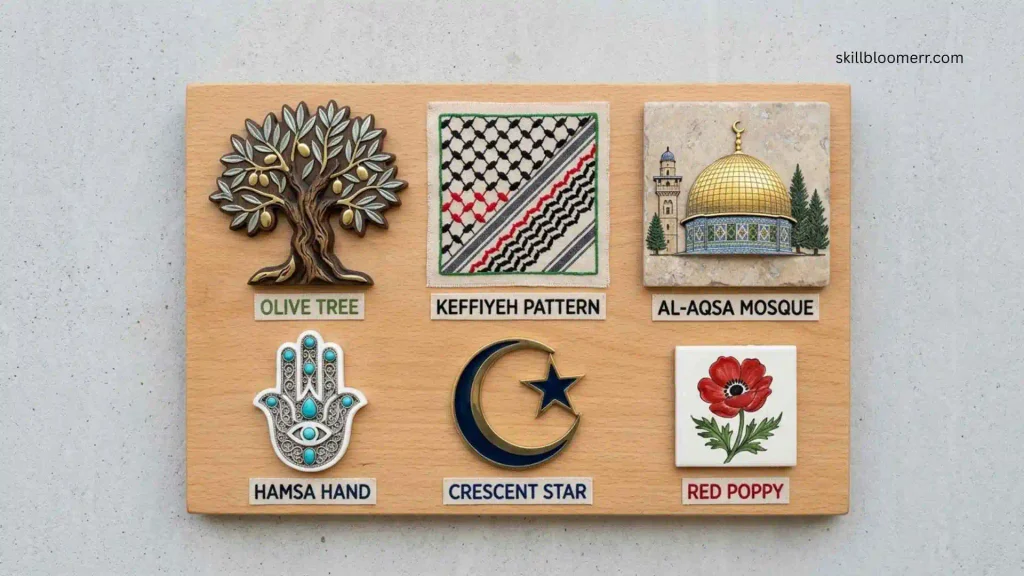
Many symbols associated with Palestine have religious and spiritual importance because the region is considered sacred in Judaism, Christianity, and Islam. The land contains many historical religious sites, making certain symbols meaningful to different faith communities.
It is important to understand that religious meanings can vary depending on tradition, interpretation, and personal belief. A symbol may have cultural importance for one group while carrying a spiritual meaning for another.
Jerusalem as a Sacred Symbol
Jerusalem is one of the most significant religious cities in the world. It holds importance for:
- Islam, because of sites such as the Al-Aqsa Mosque and the Dome of the Rock.
- Christianity, because of its connection to the life and teachings of Jesus.
- Judaism, because of its historical and religious connection to ancient Jewish temples and traditions.
Because of this shared importance, images of Jerusalem often represent faith, history, and spiritual connection.
The Dome of the Rock Symbolism
The Dome of the Rock is an iconic Islamic monument located in Jerusalem. Its golden dome and architectural design have become recognizable symbols connected with the city.
The structure represents:
- Islamic architectural heritage
- Religious history
- The importance of Jerusalem in Islam
- Artistic achievements of early Islamic civilization
Its image appears frequently in Palestinian art, photography, and cultural materials.
The Olive Tree in Religious Traditions
The olive tree has symbolic importance in several Abrahamic religions.
In many religious traditions, olives and olive branches represent:
- Peace
- Blessings
- Prosperity
- Renewal
The olive tree appears in biblical texts and Islamic traditions, contributing to its broader spiritual meaning throughout the Mediterranean region.
The Cross and Christian Heritage
Christian communities in Palestine have a long historical presence. Symbols connected with Christianity, such as the cross, are associated with churches, religious celebrations, and Christian heritage sites.
Palestinian Christian communities have preserved traditions, churches, and religious practices for centuries.
Scientific or Technical Meaning
Symbols of Palestine are mainly cultural, historical, and artistic rather than scientific or technical. They do not generally have meanings in mathematics, engineering, medicine, or technology.
However, some related symbols may have broader uses.
Olive Tree in Environmental Studies
The olive tree has importance in agriculture and environmental studies because it represents one of the oldest cultivated crops in the Mediterranean region.
Researchers study olive trees for:
- Agricultural sustainability
- Climate adaptation
- Traditional farming methods
- Biodiversity
Geographic Representation
Maps and geographic studies may use symbols to represent:
- Palestinian territories
- Historical locations
- Cultural sites
- Archaeological areas
These symbols help researchers, historians, and educators communicate information visually.
Where Palestinian Symbols Are Used
Palestinian symbols appear in many areas of cultural, social, and artistic expression.
National Flags and Public Events
The Palestinian flag is displayed during:
- Cultural celebrations
- Public gatherings
- International events
- Educational programs
Flags often serve as visual expressions of identity and heritage.
Books and Literature
Palestinian symbols appear in:
- Poetry
- Historical writing
- Novels
- Children’s literature
- Academic studies
Writers often use symbols such as olive trees, villages, and traditional clothing to explore themes of memory and belonging.
Art and Visual Culture
Artists use Palestinian symbols in:
- Paintings
- Photography
- Sculptures
- Digital artwork
Common artistic themes include:
- Landscapes
- Jerusalem
- Traditional patterns
- Agricultural scenes
Clothing and Fashion
Traditional clothing remains one of the strongest ways Palestinian symbols are preserved.
Examples include:
- Keffiyeh patterns
- Embroidered dresses
- Handmade accessories
Modern designers often combine traditional patterns with contemporary styles.
Jewelry and Tattoos
Some people use Palestinian symbols in jewelry or tattoos as personal expressions of:
- Heritage
- Family connection
- Cultural identity
- Remembrance
Common designs include:
- Olive branches
- Palestine maps
- Keys
- Traditional embroidery patterns
Architecture and Cultural Spaces
Palestinian symbols can be found in:
- Mosques
- Churches
- Cultural centers
- Museums
- Heritage buildings
Architectural designs often reflect local history and artistic traditions.
Common Variations of Palestinian Symbols
Palestinian symbols appear in many different forms depending on region, artist, purpose, and historical period.
Variations of the Palestinian Flag
The Palestinian flag may appear in different artistic styles:
- Traditional rectangular flag designs
- Artistic illustrations
- Digital versions
- Decorative patterns
While artistic versions may differ, the official design remains consistent.
Variations of the Keffiyeh Pattern
The keffiyeh design can vary in:
- Color
- Pattern size
- Weaving style
The black-and-white pattern is the most internationally recognized, but other colors are also used.
Variations in Tatreez Designs
Tatreez embroidery varies greatly because different Palestinian regions developed their own patterns.
Differences may include:
- Floral designs
- Geometric shapes
- Color combinations
- Stitching techniques
These variations often reveal information about regional identity.
Modern Symbol Adaptations
Contemporary artists frequently reinterpret traditional symbols through:
- Digital art
- Street art
- Graphic design
- Fashion
These adaptations allow ancient traditions to remain relevant for new generations.
Common Misconceptions About Palestinian Symbols
Understanding symbols requires looking at historical and cultural context. Many misunderstandings happen when symbols are viewed only from one perspective.
Misconception 1: All Palestinian Symbols Are Political
Not every Palestinian symbol has a political meaning. Many symbols existed as cultural traditions long before modern political movements.
For example:
- Olive trees are agricultural symbols.
- Embroidery represents craftsmanship.
- Traditional clothing reflects community heritage.
Misconception 2: The Keffiyeh Belongs Only to One Group
The keffiyeh has broader Middle Eastern roots. While it became strongly associated with Palestinian identity, similar styles have existed across different Arab communities.
Misconception 3: Traditional Symbols Are Only Historical Objects
Many people assume traditional symbols belong only to the past. In reality, they continue to be used in modern fashion, education, art, and cultural preservation.
Misconception 4: Symbols Have Only One Meaning
Symbols often have multiple meanings. Their interpretation depends on:
- Historical period
- Cultural background
- Personal experience
- Social context
A symbol can represent heritage for one person and carry additional meanings for another.
Interesting Facts About Palestinian Symbols
1. The Olive Tree Is One of Palestine’s Oldest Cultural Symbols
Olive cultivation has been part of the region’s agricultural history for thousands of years. The tree represents a connection between generations because many olive trees survive for centuries.
2. Tatreez Patterns Can Identify Regions
Traditional embroidery designs often contain regional differences. Historians and cultural researchers study these patterns to understand local traditions.
3. The Keffiyeh Became Globally Recognized
Although it began as practical clothing for farmers and rural communities, the keffiyeh became an internationally recognized cultural symbol.
4. Palestinian Symbols Appear in Multiple Art Forms
Artists use Palestinian symbols in painting, poetry, music, photography, and digital media to communicate stories and emotions.
5. Jerusalem Has Symbolic Importance Across Religions
Jerusalem is significant to three major Abrahamic religions, making it one of the world’s most historically important religious cities.
6. Traditional Embroidery Preserves Social History
Tatreez is not only decorative. Patterns, colors, and designs can reflect family traditions and regional identities.
7. The Key Symbol Represents Memory
The key symbol is often connected with ideas of home, memory, and attachment to family history.
8. Palestinian Symbols Are Used in Cultural Education
Schools, museums, and cultural organizations use these symbols to teach history, art, and heritage.
9. Natural Symbols Are Especially Important
Plants such as olive trees and orange trees reflect the importance of agriculture in Palestinian history and culture.
10. Symbols Continue to Evolve
Modern artists continue creating new interpretations while preserving connections to traditional meanings.
Related Symbols of Palestine
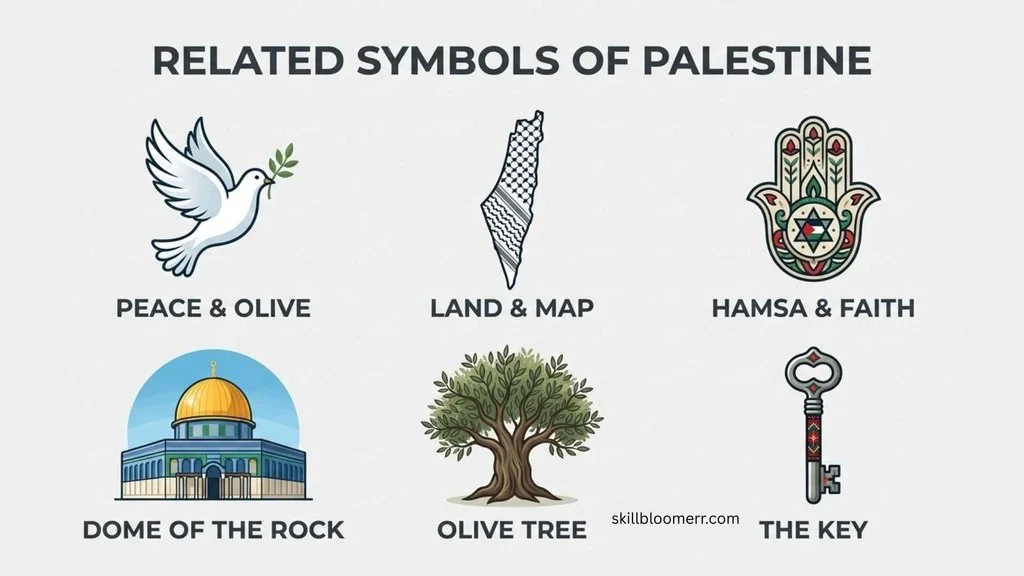
Palestinian symbols are connected with many other cultural, historical, and regional symbols from the wider Middle East and Mediterranean world. Understanding these relationships helps explain how traditions developed and how different communities share similar ideas.
Olive Branch Symbol
The olive branch is closely related to the olive tree symbol. Across many cultures, it represents:
- Peace
- Reconciliation
- Hope
- Renewal
In Palestinian culture, the olive branch also carries a strong connection to farming traditions and ancestral land.
Jerusalem Symbol
Jerusalem is one of the most important symbols connected with Palestine. Images of the city often represent:
- Religious heritage
- Historical memory
- Cultural identity
- Spiritual connection
The Dome of the Rock, the Old City walls, and other landmarks frequently appear in Palestinian artwork.
Map of Palestine Symbol
The map outline of Palestine is often used in artwork, jewelry, clothing, and educational materials.
It commonly represents:
- Connection to homeland
- Geographic identity
- Historical awareness
- Cultural belonging
Different communities may interpret this symbol differently depending on historical and political perspectives.
Key Symbol (Miftah)
The key is a powerful cultural symbol associated with memories of homes, families, and displacement experiences.
It often represents:
- Belonging
- Family history
- Memory
- Connection to places of origin
Keys appear in artwork, sculptures, necklaces, and cultural displays.
Orange Tree Symbol
The orange tree has historical importance in Palestinian agriculture, especially in coastal areas.
It symbolizes:
- Fertility
- Farming traditions
- Economic history
- Connection to the land
Arab Cultural Symbols
Some Palestinian symbols are connected to wider Arab traditions, including:
- Arabic calligraphy
- Traditional clothing
- Geometric patterns
- Agricultural symbols
These shared elements reflect the cultural connections among communities across the Arab world.
Frequently Asked Questions About Symbols of Palestine
What are the most important symbols of Palestine?
The most recognized symbols of Palestine include the Palestinian flag, olive tree, keffiyeh, Tatreez embroidery, Jerusalem landmarks, and the key symbol. Each represents different aspects of identity, culture, history, and connection to the land.
Why is the olive tree an important symbol of Palestine?
The olive tree is important because olive farming has been part of Palestinian agricultural traditions for thousands of years. It represents endurance, peace, family heritage, and a strong relationship between people and the land.
What does the Palestinian flag symbolize?
The Palestinian flag symbolizes Palestinian identity, cultural heritage, and national expression. Its colors are connected to historical Arab traditions, and the flag is widely used during cultural events and public gatherings.
What does the keffiyeh represent in Palestinian culture?
The keffiyeh represents Palestinian cultural identity and traditional life. Originally used as practical clothing by farmers and rural communities, it later became widely recognized as a symbol of heritage and cultural awareness.
What is the meaning of Palestinian embroidery?
Palestinian embroidery, known as Tatreez, represents craftsmanship, regional identity, and cultural preservation. Traditional patterns often reflect local communities, landscapes, and family traditions passed through generations.
Is the olive tree only a Palestinian symbol?
No. The olive tree is important in many Mediterranean and Middle Eastern cultures. However, in Palestinian culture, it has a particularly strong connection to agriculture, family history, and cultural identity.
Why is Jerusalem important in Palestinian symbolism?
Jerusalem is important because of its historical, cultural, and religious significance. The city contains sacred sites important to Judaism, Christianity, and Islam, making it a powerful symbol for many communities.
Are Palestinian symbols only political symbols?
No. Many Palestinian symbols are cultural and historical. While some have gained political meanings over time, symbols such as embroidery, traditional clothing, and olive trees also represent everyday life and heritage.
What does the Palestinian key symbol mean?
The key symbol commonly represents memories of homes, family connections, and attachment to places of origin. It is used in art and cultural expressions to represent remembrance and belonging.
Where can people see Palestinian symbols today?
Palestinian symbols can be found in museums, artwork, clothing, cultural events, books, jewelry, architecture, and educational materials. They continue to appear in both traditional and modern forms.
Key Takeaways
- Symbols of Palestine represent identity, history, culture, and connection to land.
- The Palestinian flag is a major symbol of national and cultural expression.
- The olive tree represents peace, endurance, agriculture, and heritage.
- The keffiyeh reflects traditional clothing and cultural identity.
- Tatreez embroidery preserves regional stories through artistic patterns.
- Jerusalem holds deep historical and religious importance.
- Palestinian symbols appear in art, clothing, literature, architecture, and education.
- Cultural symbols can have different meanings depending on historical and personal perspectives.
- Many Palestinian symbols existed as traditions before gaining modern interpretations.
- Preserving these symbols helps maintain cultural knowledge across generations.
Conclusion
The symbols of Palestine represent much more than simple images or designs. They carry stories of land, family, faith, creativity, and cultural memory. From the olive tree growing across generations to the detailed patterns of Tatreez embroidery, each symbol reflects a connection between people and their heritage.
Understanding Palestinian symbols requires looking at history, culture, religion, and everyday traditions together. These symbols continue to appear in clothing, art, literature, and public life because they help communities preserve their identity and share their stories.
Whether viewed through a cultural, historical, or artistic lens, Palestinian symbols provide insight into one of the world’s most historically rich regions and the traditions that continue to shape its people.

I’m Nathaniel Brooks, an educational writer who loves exploring ideas and making useful knowledge accessible to everyone. I write for SkillBloomerr with a focus on clear explanations, practical tips, and meaningful learning. My goal is to help readers discover something valuable every time they visit the site.
Books: Learn Something New and The Practical Knowledge Handbook
 Ethan Calloway
 Olivia Hartwell