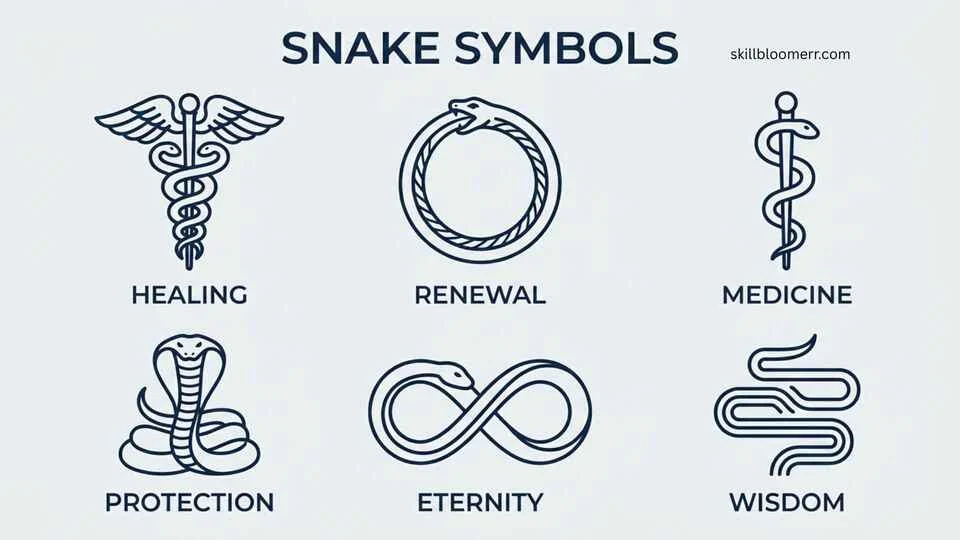
Snake symbols have been used by humans for thousands of years to represent powerful ideas such as transformation, healing, wisdom, protection, danger, and spiritual change. From ancient temples and religious texts to modern tattoos, medical logos, jewelry, and artwork, snakes continue to hold deep symbolic meaning across cultures.
The meaning of snake symbols is not limited to one interpretation. In some traditions, snakes are respected as sacred creatures connected with rebirth and divine knowledge. In others, they represent temptation, fear, or hidden danger. Understanding the context behind a snake symbol helps reveal why this ancient image remains meaningful today.
This guide explains snake symbols and their meanings, including their history, cultural importance, spiritual interpretations, scientific connections, common variations, misconceptions, and modern uses.
Quick Meaning of Snake Symbols
Snake symbols commonly represent transformation, rebirth, healing, wisdom, protection, and hidden knowledge. Because snakes shed their skin, many cultures associate them with renewal and personal growth. However, they may also symbolize danger, temptation, fear, and deception depending on religious, historical, and cultural context.
Symbol Overview Table
| Symbol Field | Details |
| Symbol Name | Snake Symbol / Serpent Symbol |
| Primary Meaning | Transformation, healing, rebirth, wisdom, danger |
| Category | Animal symbolism, spiritual symbol, mythological symbol |
| Origin | Ancient civilizations around the world |
| Earliest Known Use | Prehistoric human cultures and ancient civilizations |
| Major Cultures | Ancient Egypt, Greece, India, China, Mesopotamia, Indigenous American cultures |
| Common Uses | Religion, medicine, mythology, art, tattoos, jewelry, logos |
| Modern Meaning | Change, strength, healing, mystery, personal transformation |
| Scientific Connection | Medical symbols and biological research |
| Emoji Equivalent | 🐍 |
| Related Symbols | Ouroboros, Rod of Asclepius, Caduceus, Dragon symbols |
What Does the Snake Symbol Mean?
Snake symbols have one of the widest ranges of meanings among animal symbols. The interpretation depends on the culture, religion, artwork, and purpose behind the symbol.
The most common meanings include:
- Transformation: Snakes shed their skin, making them powerful symbols of change and renewal.
- Rebirth: The snake represents leaving behind an old state and entering a new phase.
- Healing: The snake is connected with medicine and restoration.
- Wisdom: Many cultures associate snakes with hidden knowledge and intelligence.
- Protection: Some societies viewed snakes as guardians against evil forces.
- Power: Snakes often symbolize strength, mystery, and authority.
- Danger: Venomous snakes also represent fear, threats, and deception.
The snake is considered a dual symbol because it can represent both creation and destruction, healing and harm, wisdom and temptation.
History and Origin of Snake Symbols
Early Human Use of Snake Symbolism
Snake symbolism is among the oldest forms of animal symbolism in human history. Early humans observed snakes closely because they were mysterious creatures that appeared suddenly, moved silently, and lived close to the earth.
Ancient communities often connected snakes with:
- Fertility
- Water sources
- Underground worlds
- Life cycles
- Spiritual forces
- Protection
The snake’s ability to disappear underground and later return may have influenced beliefs about life, death, and rebirth.
Snake Symbols in Ancient Egypt
Ancient Egypt gave snakes an important role in religion, royalty, and mythology.
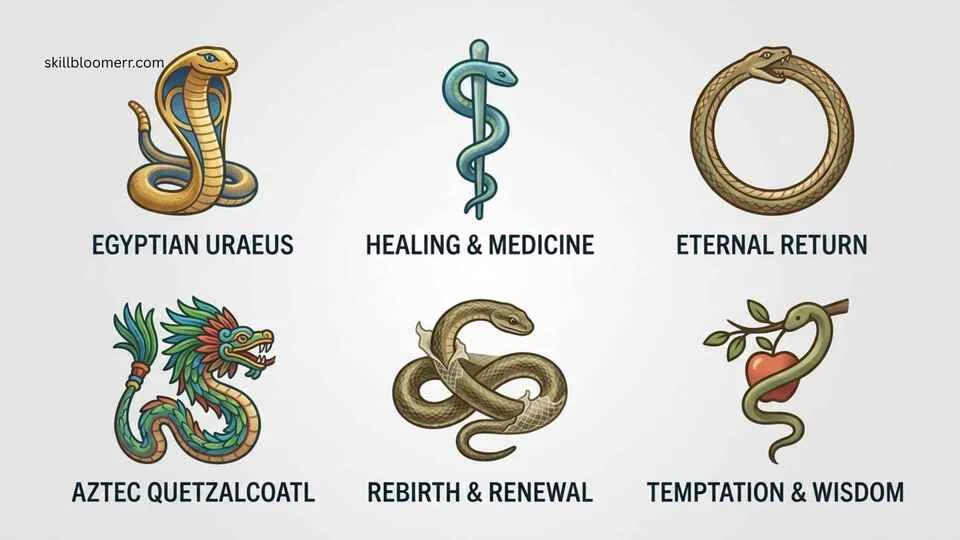
The cobra was especially significant. Egyptian rulers used the uraeus, a raised cobra symbol placed on royal crowns, as a sign of divine authority and protection.
The goddess Wadjet was often represented as a cobra and was associated with:
- Royal protection
- Lower Egypt
- Divine power
- Guardianship
For Egyptians, the snake was not simply a dangerous creature. It could represent both destruction and powerful protection.
Snake Symbols in Ancient Greece
Ancient Greek culture strongly influenced the connection between snakes and healing.
The most famous example is the Rod of Asclepius, a staff with a single snake wrapped around it. Asclepius was the Greek god associated with medicine and healing.
The snake became linked with healthcare because ancient Greeks connected its ability to shed skin with renewal and recovery.
Greek mythology also included negative snake imagery. Medusa, one of the Gorgons, was described with snakes for hair, representing fear and supernatural power.
Snake Symbols in Mesopotamia
Ancient Mesopotamian societies used snake imagery in religious stories and artwork.
Snakes were sometimes connected with:
- Creation stories
- Fertility
- Protection
- Underworld symbolism
- Divine forces
Their ability to move between different environments made them powerful symbols of mystery and hidden knowledge.
Snake Symbols in Ancient India
In Indian traditions, snakes have deep spiritual importance.
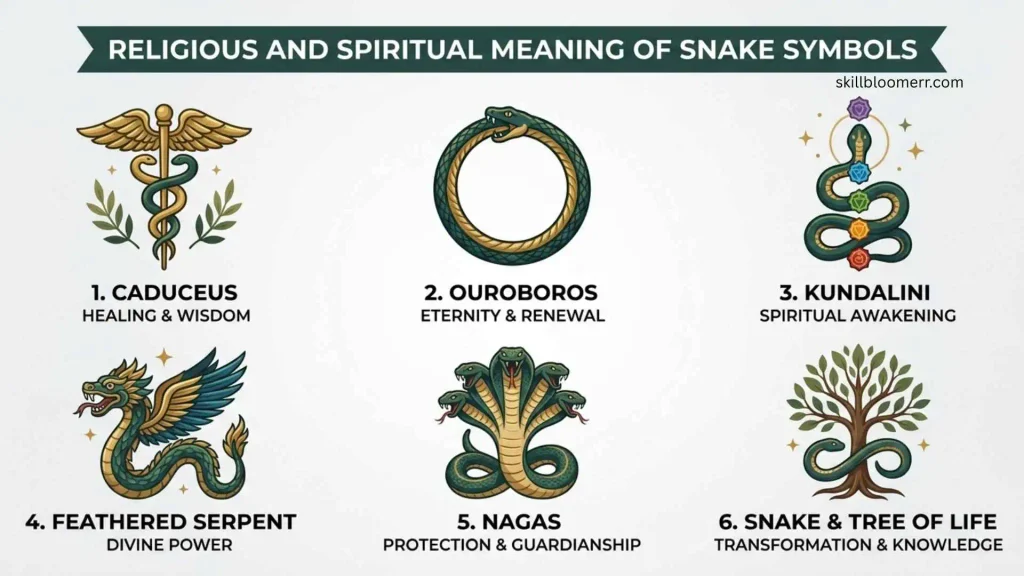
The serpent figure known as Naga appears throughout Hindu and Buddhist traditions. Nagas are often described as powerful beings connected with water, fertility, protection, and spiritual forces.
Snakes are also connected with Kundalini, a spiritual concept describing hidden energy believed to exist within humans.
Symbolism and Interpretation of Snakes
Positive Symbolism of Snake Symbols
Snake symbols often represent positive qualities in many cultures.
Transformation and Personal Growth
The snake shedding its skin is one of the strongest examples of symbolic transformation.
It represents:
- Starting over
- Personal development
- Overcoming difficulties
- Becoming a stronger version of yourself
Many people choose snake imagery because it reflects important life changes.
Healing and Medicine
The snake is one of the most recognizable healing symbols in the world.
The Rod of Asclepius continues to appear in medical organizations and represents:
- Healthcare
- Recovery
- Medical knowledge
- Healing professions
Wisdom and Hidden Knowledge
Because snakes were often viewed as mysterious creatures, many cultures connected them with intelligence and secret knowledge.
Snake symbolism may represent:
- Awareness
- Learning
- Ancient wisdom
- Spiritual understanding
Negative Symbolism of Snake Symbols
Snakes also have darker interpretations.
They may symbolize:
- Betrayal
- Temptation
- Fear
- Deception
- Hidden threats
In many Western traditions, the serpent became associated with temptation because of the story of the serpent in the Garden of Eden.
Psychological Meaning of Snake Symbols
From a psychological perspective, snakes often represent instinct, unconscious fears, and personal transformation.
A snake appearing in dreams, artwork, or personal symbols may represent:
- Change happening in life
- Hidden emotions
- Personal challenges
- Growth through difficult experiences
The meaning depends on the individual’s personal experiences and cultural background.
Cultural Significance of Snake Symbols
Snake Symbolism in Chinese Culture
The snake is one of the twelve animals in the Chinese zodiac.
People born under the Year of the Snake are traditionally associated with:
- Intelligence
- Creativity
- Strategic thinking
- Elegance
- Mystery
In Chinese symbolism, the snake is often viewed as clever rather than frightening.
Snake Symbolism in Native American Cultures
Snake meanings differ among Indigenous cultures of the Americas.
Some traditions associate snakes with:
- Rain
- Fertility
- Earth energy
- Spiritual transformation
The rattlesnake, in particular, has held important symbolic meanings in several Indigenous traditions.
Snake Symbolism in African Traditions
Many African cultures include snakes in mythology and spiritual beliefs.
Snakes may represent:
- Ancestors
- Protection
- Fertility
- Connection between spiritual and physical worlds
The exact meaning depends on the specific culture and tradition.
Snake Symbolism in Western Culture
Western interpretations of snakes often include both positive and negative meanings.
They may represent:
- Medicine
- Wisdom
- Temptation
- Danger
- Transformation
The surrounding context determines the meaning.
Religious and Spiritual Meaning of Snake Symbols
Snake Symbolism in Christianity
Christian interpretations of snakes are complex.
The serpent in the Book of Genesis is associated with temptation and humanity’s fall from paradise.
However, snakes are not always negative in Christian tradition. The bronze serpent created by Moses in the Book of Numbers was connected with healing and protection.
Snake Symbolism in Hinduism
In Hinduism, snakes are often sacred.
The Naga represents:
- Protection
- Spiritual power
- Fertility
- Divine energy
Lord Shiva is commonly depicted with a serpent around his neck, symbolizing control over fear and powerful forces.
Snake Symbolism in Buddhism
In Buddhist traditions, Nagas appear as protectors.
One famous story describes the Naga king Mucalinda protecting Buddha during meditation by shielding him from a storm.
Scientific and Technical Meaning of Snake Symbols
Medical Symbolism
The most important scientific connection of snake symbols is medicine.
The Rod of Asclepius features one snake wrapped around a staff and represents healing.
The Caduceus, which has two snakes and wings, is often associated with medicine today, although historically it represented Hermes and commerce.
Biological Importance of Snakes
In science, snakes are studied as reptiles belonging to the group Serpentes.
Research on snakes helps scientists understand:
- Evolution
- Animal behavior
- Ecosystem balance
- Venom biology
Snake venom research has contributed to medical discoveries, including treatments involving blood pressure and blood clotting.
Where Snake Symbols Are Used
Tattoos and Body Art
Snake tattoos are popular because they can represent:
- Transformation
- Strength
- Protection
- Rebirth
- Mystery
Common designs include:
- Coiled snakes
- Snake and flower combinations
- Ouroboros designs
- Snake eyes
Jewelry and Fashion
Snake imagery appears in rings, necklaces, bracelets, and fashion designs.
It often represents:
- Elegance
- Power
- Mystery
- Personal identity
Medicine and Healthcare
Snake symbols appear in:
- Medical organizations
- Healthcare education
- Professional logos
Literature and Art
Snakes appear frequently in:
- Mythology
- Fantasy stories
- Paintings
- Sculptures
- Religious artwork
Common Variations of Snake Symbols
Ouroboros
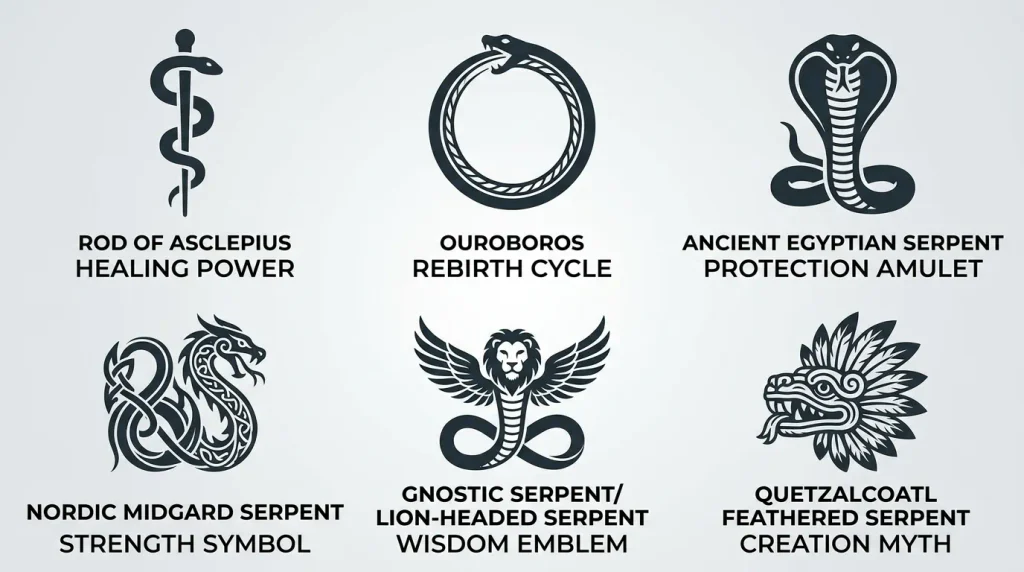
The Ouroboros shows a snake eating its own tail.
It symbolizes:
- Eternity
- Cycles of life
- Renewal
- Infinity
Rod of Asclepius
A single snake wrapped around a staff represents medicine and healing.
Caduceus
Two snakes wrapped around a winged staff represent Hermes and are commonly associated with commerce.
Snake and Dragon Symbols
Both snakes and dragons represent power, mystery, and transformation in many cultures.
Common Misconceptions About Snake Symbols
All Snake Symbols Mean Evil
This is incorrect. Many cultures view snakes as sacred, healing, and protective symbols.
Snake Symbols Have Only One Meaning
Snake meanings change depending on culture, religion, and historical period.
The Caduceus Is the Original Medical Symbol
The Rod of Asclepius is the traditional symbol of medicine. The Caduceus became associated with medicine later in some modern contexts.
Interesting Facts About Snake Symbols
- Snakes are among the oldest symbolic animals used by humans.
- The snake became a symbol of rebirth because it sheds its skin.
- Ancient Egyptian rulers used cobra symbols as protection.
- The Rod of Asclepius remains one of the world’s most recognized healing symbols.
- The Ouroboros represents endless cycles of life.
- Snakes appear in mythology across nearly every continent.
- Snake venom research has helped scientists develop medicines.
- The snake is one of the twelve Chinese zodiac animals.
- Snake tattoos often represent personal transformation.
- Many cultures see snakes as both dangerous and sacred.
Related Symbols
Phoenix Symbol
The phoenix represents rebirth and renewal, similar to the snake shedding its skin.
Dragon Symbol
Dragons share meanings of power, transformation, and supernatural energy.
Tree of Life Symbol
The Tree of Life represents growth, connection, and life cycles.
Eye Symbol
The eye often symbolizes wisdom and protection, which connects with some snake interpretations.
Frequently Asked Questions
What do snake symbols represent?
Snake symbols commonly represent transformation, healing, wisdom, rebirth, and protection. However, they may also represent danger or temptation depending on cultural and religious context.
Why are snakes connected with healing?
Snakes became connected with healing because ancient cultures associated their ability to shed skin with renewal. The Rod of Asclepius later became a major medical symbol.
What does a snake tattoo mean?
A snake tattoo may symbolize personal growth, transformation, strength, protection, wisdom, or overcoming challenges.
Are snake symbols good or bad?
Snake symbols can represent both positive and negative ideas. Their meaning depends on the culture and situation where the symbol appears.
What is the spiritual meaning of a snake?
Spiritually, snakes often represent transformation, awakening, hidden wisdom, and personal change.
What does the Ouroboros symbolize?
The Ouroboros symbolizes eternity, cycles, renewal, and the connection between endings and beginnings.
Why is the snake used in medical symbols?
The snake became a medical symbol through Greek mythology, especially the story of Asclepius, the god of healing.
What does a snake symbolize in Hinduism?
In Hinduism, snakes represent spiritual energy, protection, fertility, and divine power.
What does the snake represent in Christianity?
In Christianity, snakes can represent temptation but also healing, depending on the biblical context.
What is the difference between the Rod of Asclepius and Caduceus?
The Rod of Asclepius has one snake and represents medicine. The Caduceus has two snakes and is historically linked with Hermes.
Key Takeaways
- Snake symbols have existed for thousands of years.
- They represent transformation, healing, wisdom, and rebirth.
- Different cultures interpret snake symbols differently.
- Ancient Egypt, Greece, India, China, and Indigenous cultures gave snakes important meanings.
- The snake remains a powerful symbol in medicine, religion, art, and modern culture.
- Context is essential when interpreting snake symbolism.
Conclusion
Snake symbols and their meanings reveal humanity’s long relationship with nature, mystery, and transformation. Throughout history, snakes have represented healing, wisdom, protection, danger, and spiritual change.
From ancient Egyptian crowns to modern medical logos and personal tattoos, snake symbolism continues to influence how people express ideas about growth, power, and renewal. Understanding the cultural and historical background of snake symbols helps explain why this ancient image remains one of the most meaningful symbols in the world.

I’m Ethan Calloway, an English writer and lifelong learner who enjoys turning complex ideas into clear, practical content. At SkillBloomerr, I focus on useful topics that help readers build knowledge, improve their skills, and feel more confident in everyday learning. I believe good writing should be simple, engaging, and genuinely helpful.
Books: The Everyday Learning Guide and Build Better Skills
 Olivia Hartwell
 Nathaniel Brooks