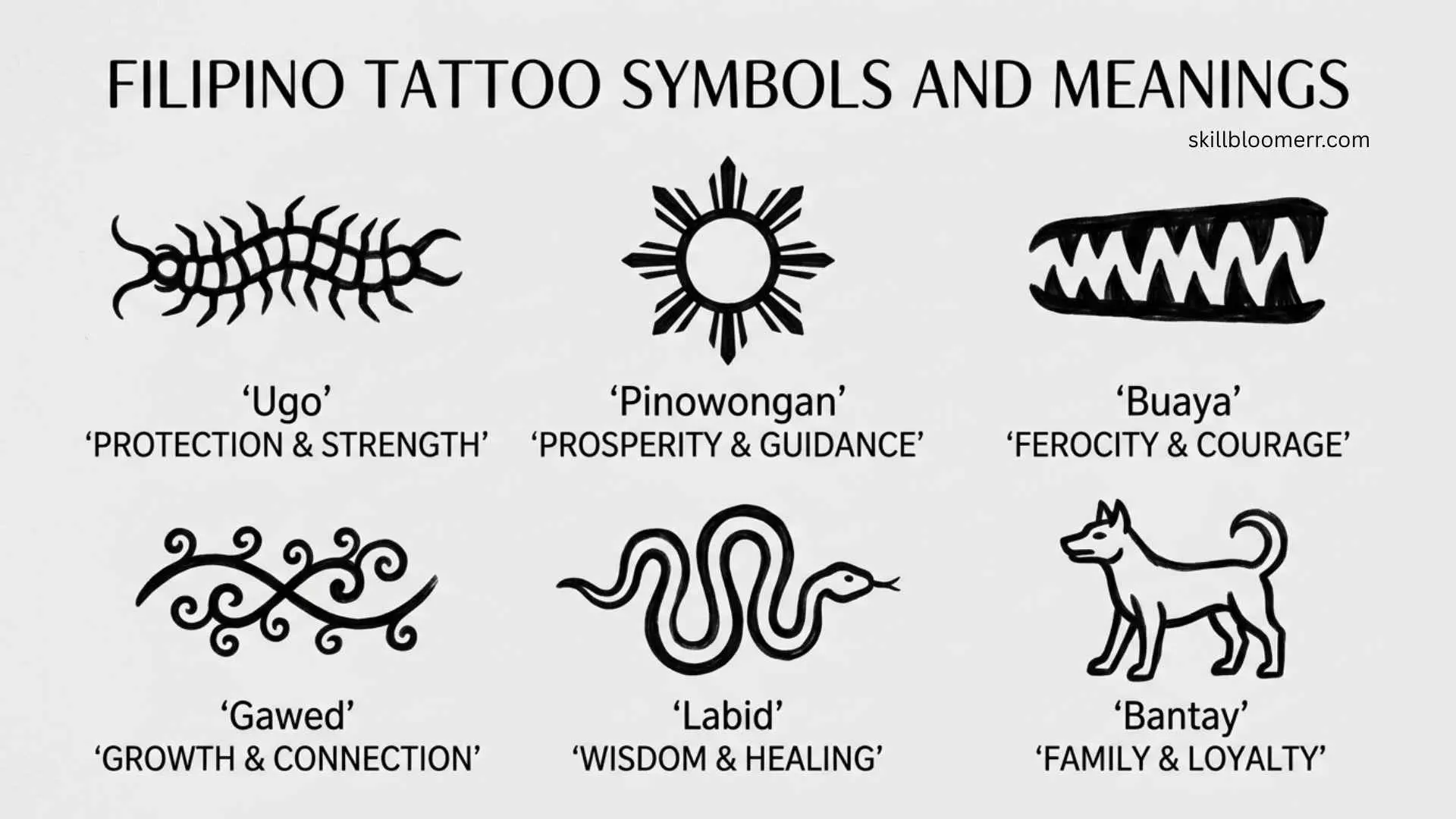
Filipino tattoo symbols and meanings represent one of the richest visual traditions of the Philippines, connecting ancient identity, bravery, spirituality, nature, and community. Long before modern tattoo culture became popular, Indigenous Filipino groups used body markings to record achievements, protect spiritual beliefs, and express personal identity.
Today, Filipino tattoos appear on skin, artwork, jewelry, clothing, and cultural designs around the world. Symbols inspired by the Kalinga, Bontoc, Visayan, and other Indigenous traditions continue to attract people who want tattoos with deeper meaning than simple decoration.
Understanding Filipino tattoo symbols requires looking beyond the designs themselves. Each pattern carries historical connections to ancestors, warriors, nature, social roles, and spiritual beliefs. This guide explores the origins, meanings, variations, and modern importance of traditional Filipino tattoos.
Quick Meaning of Filipino Tattoo Symbols
Filipino tattoo symbols are traditional body art designs from Philippine Indigenous cultures that represent identity, courage, protection, spirituality, ancestry, and connection to nature. Many symbols come from ancient tattoo practices such as the batok tradition, where patterns marked important life events, achievements, and cultural belonging.
Symbol Overview Table
| Field | Details |
| Symbol Name | Filipino Tattoo Symbols |
| Primary Meaning | Identity, courage, ancestry, protection, spirituality |
| Category | Indigenous body art and cultural symbolism |
| Origin | Philippine archipelago |
| Civilization or Culture | Kalinga, Bontoc, Visayan, and other Indigenous Filipino communities |
| Historical Practice | Traditional tattooing known as batok |
| First Known Use | Ancient Philippine societies before Spanish colonization |
| Common Usage | Tattoos, cultural artwork, jewelry, clothing designs |
| Modern Meaning | Heritage, pride, resilience, personal identity |
| Writing System Connection | Related to ancient Baybayin-inspired designs |
| Related Symbols | Sun, waves, ancestors, animals, geometric patterns |
What Do Filipino Tattoo Symbols Mean?
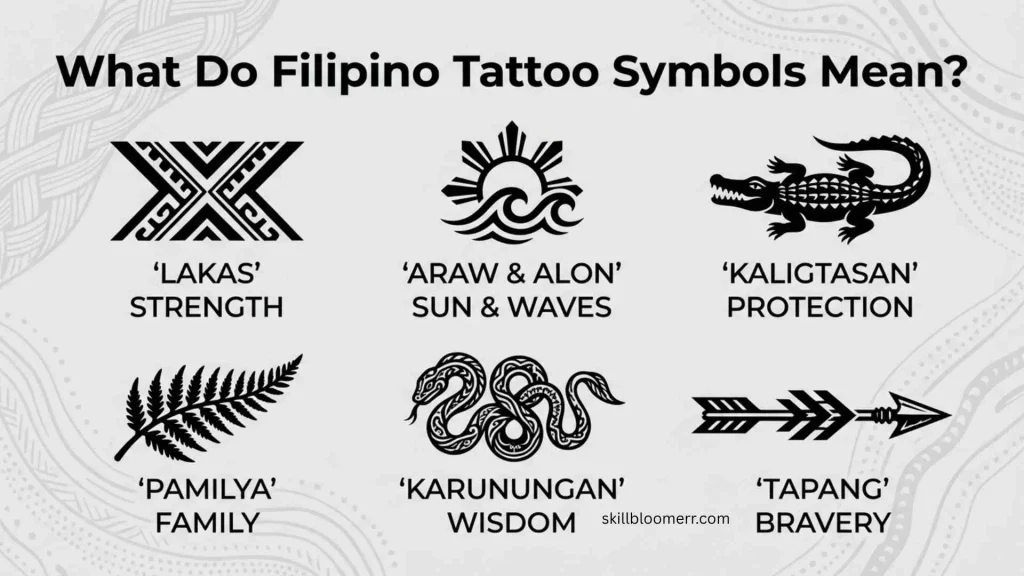
Filipino tattoo symbols traditionally represent a person’s relationship with their community, ancestors, environment, and spiritual beliefs. Unlike many modern tattoos chosen mainly for appearance, traditional Filipino tattoos often carried specific social meanings.
A tattoo could show:
- A warrior’s bravery
- A person’s achievements
- Connection to ancestors
- Protection from spiritual dangers
- Respect for nature
- Community belonging
- Personal transformation
The meaning of a Filipino tattoo depends on the specific design, region, and cultural context. There is no single universal meaning for every symbol because different Indigenous groups developed their own visual languages.
For example, a warrior’s tattoo in the Kalinga community was not simply decoration. It could represent courage, earned status, and participation in important community events.
Modern interpretations often focus on:
- Filipino heritage
- Cultural pride
- Family connections
- Strength and resilience
- Respect for ancestors
However, people choosing these designs should understand their cultural background rather than treating them only as aesthetic patterns.
History and Origin of Filipino Tattoo Traditions
Ancient Roots of Philippine Tattooing
Traditional Filipino tattooing has roots that extend back thousands of years. Early Filipinos practiced body marking as part of social, spiritual, and cultural life.
Spanish explorers who arrived in the Philippines in the 16th century documented heavily tattooed Visayan warriors. The Spanish called the Visayan people “Pintados,” meaning “painted ones,” because of their decorated bodies.
These early accounts provide historical evidence that tattoos were an important part of precolonial Filipino identity.
Traditional tattoos were created using methods such as:
- Hand tapping techniques
- Natural pigments
- Thorn or needle tools
- Soot-based ink
The process was often painful and required skill from specialized tattoo practitioners.
The Batok Tattoo Tradition
The word batok refers to traditional tattooing practices among several Indigenous Filipino groups, especially in Northern Luzon.
Batok was more than body decoration. It was a cultural language that communicated:
- Social position
- Personal accomplishments
- Life experiences
- Spiritual beliefs
Among the Kalinga people, tattooing was historically connected with warrior culture. Men who demonstrated bravery in battle could receive specific markings as symbols of honor.
Women also practiced tattoo traditions, often wearing patterns associated with beauty, identity, and community status.
Colonial Impact on Filipino Tattoos
Spanish colonization greatly affected Indigenous tattoo traditions. Missionaries often viewed tattooing as connected to non-Christian beliefs and discouraged many traditional practices.
Over time:
- Some tattoo traditions declined.
- Certain symbols disappeared.
- Communities preserved others through oral history.
Despite colonial influence, Indigenous tattoo practices survived in several regions, especially among communities that maintained strong cultural traditions.
Symbolism and Interpretation of Filipino Tattoo Designs
Sun Symbol Meaning
The Philippine sun is one of the most recognizable Filipino symbols. It appears on the national flag and represents freedom, independence, and national identity.
In tattoo designs, the sun may symbolize:
- Strength
- Life energy
- Hope
- New beginnings
- Connection to Filipino heritage
The eight rays of the Philippine sun traditionally represent the first provinces that revolted against Spanish colonial rule.
Rice Symbol Meaning
Rice has deep cultural importance in Filipino life because agriculture has shaped many communities for centuries.
Rice-inspired tattoo patterns may represent:
- Prosperity
- Survival
- Gratitude
- Community cooperation
- Connection to the land
For Indigenous groups, farming symbols often reflect respect for nature and ancestral knowledge.
Mountain Symbol Meaning
Mountains appear frequently in Filipino Indigenous artwork because many communities developed strong relationships with mountainous landscapes.
Mountain-inspired tattoos can represent:
- Strength
- Stability
- Protection
- Spiritual connection
- Respect for ancestral lands
For groups living in places like the Cordillera region, mountains are not only geographical features but also important cultural spaces.
Warrior Tattoo Meanings
Traditional warrior tattoos represented achievement and courage.
They could symbolize:
- Fearlessness
- Honor
- Protection of community
- Leadership
- Strength during hardship
Modern wearers often choose warrior-inspired Filipino tattoos to represent personal struggles they have overcome.
Geometric Pattern Meanings
Many traditional Filipino tattoo designs use repeated geometric forms.
Common interpretations include:
- Balance
- Harmony
- Order
- Connection between humans and nature
Geometric patterns were often carefully designed rather than randomly created.
Cultural Significance of Filipino Tattoo Symbols
Kalinga Tattoo Tradition
The Kalinga people of Northern Luzon are among the most recognized groups connected with traditional Filipino tattoo culture.
The Kalinga tattoo tradition became internationally known through artists such as Whang-od Oggay, who preserved the ancient hand-tapped tattoo method.
Traditional Kalinga tattoos often use:
- Geometric patterns
- Animal-inspired forms
- Nature symbols
- Repeated lines and shapes
These designs reflect cultural identity rather than simply artistic style.
Visayan Tattoo Traditions
Visayan tattoo traditions were especially documented during early Spanish encounters.
The Visayans known as the Pintados used tattoos to show:
- Warrior accomplishments
- Social identity
- Personal reputation
Historical descriptions show that tattoos were closely connected with status and community recognition.
Cordillera Indigenous Meanings
Northern Luzon communities developed tattoo traditions connected with:
- Farming
- Ancestry
- Spiritual beliefs
- Community roles
Each group maintained unique styles, showing that Filipino tattoo culture is diverse rather than based on one single tradition.
Religious and Spiritual Meaning of Filipino Tattoos
Traditional Filipino tattoo symbolism often connects with spiritual beliefs about protection, ancestors, and nature.
Before widespread Christianity in the Philippines, many Indigenous communities practiced belief systems involving:
- Ancestral spirits
- Nature beings
- Sacred places
- Ritual traditions
Tattoos could serve as:
- Spiritual protection
- Markers of important life transitions
- Expressions of respect toward ancestors
After Christianity became dominant, many communities adapted their cultural practices while preserving elements of older traditions.
Modern Filipino tattoos may also include Christian symbols, such as:
- Crosses
- Saints
- Religious imagery
This reflects the Philippines’ complex history where Indigenous traditions, Christianity, and modern identity exist together.
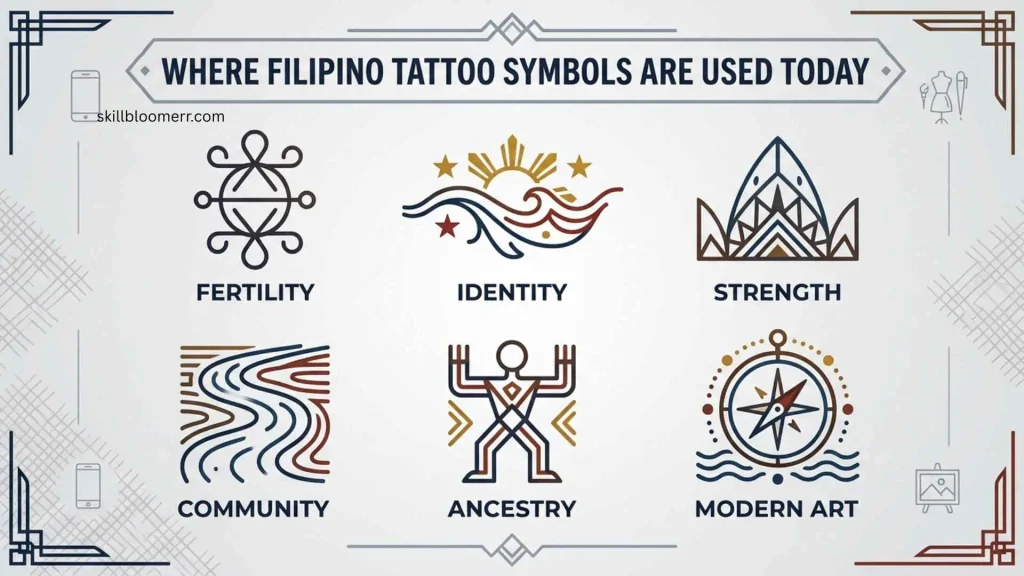
Where Filipino Tattoo Symbols Are Used Today
Tattoos and Body Art
The most common modern use of Filipino symbols is body art.
People choose these designs to represent:
- Filipino ancestry
- Family history
- Cultural pride
- Personal strength
Many Filipino communities worldwide use traditional-inspired tattoos as a way to maintain connections with their heritage.
Fashion and Jewelry
Filipino-inspired symbols appear in:
- Necklaces
- Bracelets
- Clothing designs
- Accessories
These adaptations allow people to celebrate cultural identity in everyday life.
Art and Cultural Education
Artists and historians use Filipino tattoo symbols in:
- Museum exhibitions
- Cultural workshops
- Educational materials
- Contemporary artwork
These uses help preserve knowledge about Indigenous Filipino traditions.
Common Variations of Filipino Tattoo Symbols
Regional Design Variations
Filipino tattoo symbols are not a single style. Different regions of the Philippines developed unique patterns based on their environment, history, and cultural practices.
Some important regional traditions include:
Kalinga Batok Designs
Kalinga tattoos often feature:
- Repeated geometric lines
- Symmetrical patterns
- Nature-inspired elements
- Warrior-related markings
These designs are usually created through traditional hand-tapping methods and reflect deep cultural meaning.
Visayan Pintados Designs
Visayan tattoos historically covered large areas of the body and often displayed complex patterns.
Common themes included:
- Courage
- Social achievement
- Warrior identity
- Community recognition
Bontoc Tattoo Patterns
Bontoc tattoo traditions are known for symbolic geometric designs. Historically, tattoos could represent important achievements, social roles, and personal identity.
Modern Filipino Tattoo Adaptations
Contemporary Filipino tattoo artists often combine traditional symbols with modern styles.
Examples include:
- Traditional patterns mixed with realism
- Filipino symbols combined with portraits
- Ancient designs blended with minimalist tattoo styles
- Cultural symbols paired with personal meanings
Modern adaptations allow people to honor heritage while creating designs that reflect individual stories.
Similar Symbols in Filipino Art
Some Filipino tattoo symbols overlap with other traditional art forms, including:
- Wood carvings
- Textile patterns
- Jewelry designs
- Indigenous decorations
This connection shows that tattoo symbolism was part of a larger Filipino artistic tradition.
Common Misconceptions About Filipino Tattoo Symbols
Misconception 1: All Filipino Tattoos Have the Same Meaning
A common misunderstanding is that every Filipino tattoo symbol has one fixed meaning.
In reality, meanings vary between:
- Indigenous groups
- Geographic regions
- Historical periods
- Individual interpretations
A symbol meaningful in one community may not carry the same meaning elsewhere.
Misconception 2: Traditional Tattoos Were Only for Warriors
Although warrior tattoos are among the most famous examples, tattoo traditions were not limited to men or fighters.
Women also practiced tattooing in many Indigenous communities.
Female tattoos could represent:
- Beauty
- Identity
- Community belonging
- Cultural traditions
Misconception 3: Filipino Tattoos Are Only Decorative
Traditional tattoos were much more than decoration.
They functioned as a visual language that communicated information about a person’s:
- Experiences
- Achievements
- Relationships
- Cultural role
Misconception 4: Any Filipino-Inspired Design Is Traditional
Many modern designs are inspired by Filipino culture but are not historically traditional.
A respectful approach is to understand:
- The origin of the symbol
- The community connected with it
- Its original purpose
Cultural appreciation requires learning, not just copying.
Interesting Facts About Filipino Tattoo Symbols
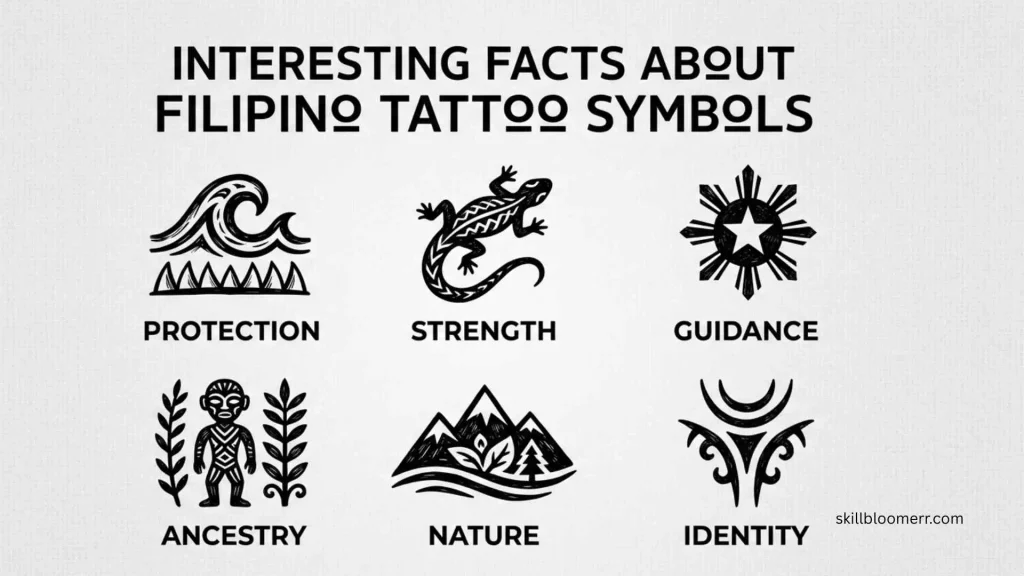
1. The Philippines Has One of Southeast Asia’s Rich Tattoo Histories
Ancient Filipino tattoo traditions are among the oldest documented body-marking practices in Southeast Asia. Historical records from Spanish explorers describe highly tattooed Filipino communities.
This shows that tattoos were deeply integrated into precolonial Filipino society.
2. The Word “Pintados” Came From Tattooed Visayans
Spanish colonizers used the term “Pintados” because many Visayan people had extensive body tattoos.
The name reflects how strongly tattooing shaped outsiders’ impressions of Filipino communities.
3. Traditional Tattoos Were Created Without Modern Machines
Ancient Filipino tattoo artists used hand-tapping methods instead of electric tattoo machines.
The process involved carefully placing pigment under the skin using traditional tools.
4. Tattooing Could Mark Important Life Events
In many Indigenous Filipino communities, tattoos were connected with major milestones.
These could include:
- Achievements
- Coming-of-age experiences
- Social recognition
- Community responsibilities
5. Nature Plays a Major Role in Filipino Symbolism
Many Filipino tattoo designs draw inspiration from the natural world.
Common inspirations include:
- Animals
- Plants
- Mountains
- Rivers
- Celestial objects
Nature was viewed as deeply connected to human life.
6. The Sun Is One of the Most Recognized Filipino Symbols
The Philippine sun represents independence and national identity.
Because of its importance, many people incorporate sun imagery into tattoos celebrating Filipino heritage.
7. Traditional Tattoo Knowledge Was Passed Through Generations
Many Indigenous tattoo traditions survived through oral teaching.
Tattoo practitioners learned techniques, meanings, and cultural rules from previous generations.
8. Hand-Tapped Tattooing Remains Practiced Today
Traditional tattoo methods continue through cultural preservation efforts.
Some artists maintain ancestral techniques while introducing them to new generations.
9. Filipino Tattoo Art Has Gained Global Recognition
Filipino-inspired tattoos are now seen internationally among people interested in Indigenous art, heritage, and cultural storytelling.
10. Tattoos Can Represent Personal Identity Today
Modern Filipino tattoo wearers often use traditional-inspired designs to express:
- Family connections
- Migration experiences
- Cultural pride
- Personal journeys
eRelated Symbols Connected to Filipino Tattoo Cultur
Philippine Sun Symbol
The Philippine sun represents freedom, independence, and national identity.
It differs from Indigenous tattoo symbols because it is a national emblem rather than a specific traditional body marking.
Baybayin Symbols
Baybayin is an ancient Filipino writing system.
Some modern tattoos use Baybayin characters to represent:
- Names
- Words
- Personal messages
However, users should verify meanings carefully because incorrect translations are common.
Anito and Ancestral Symbols
Traditional Filipino spirituality included respect for ancestral spirits known as anito.
Symbols connected with ancestry often represent:
- Guidance
- Protection
- Connection to past generations
Sarimanok Symbol
The Sarimanok is a legendary bird figure from Maranao culture.
It commonly symbolizes:
- Good fortune
- Prosperity
- Cultural heritage
It is not specifically a tattoo symbol but is frequently used in Filipino-inspired artwork.
Okir Designs
Okir refers to decorative patterns from Muslim Filipino communities, especially the Maranao people.
These designs often feature:
- Curved lines
- Plants
- Abstract forms
They represent artistic identity and cultural tradition.
Frequently Asked Questions About Filipino Tattoo Symbols and Meanings
What do Filipino tattoo symbols represent?
Filipino tattoo symbols represent cultural identity, ancestry, courage, spirituality, nature, and personal achievements. Traditional meanings depended on the specific Indigenous group and historical context. Today, many people choose Filipino-inspired tattoos to honor heritage, family connections, and personal experiences.
What is the traditional Filipino tattoo called?
Traditional Filipino tattooing is commonly associated with the word batok, especially among Indigenous groups in Northern Luzon. The term refers to traditional tattoo practices created through hand-tapping techniques using natural pigments and specialized tools.
What does a Filipino warrior tattoo symbolize?
A Filipino warrior tattoo traditionally represented bravery, achievement, and social recognition. In some communities, warrior tattoos showed that a person had completed important challenges or demonstrated courage. Today, these designs often symbolize inner strength and overcoming personal struggles.
Are Filipino tattoos spiritual?
Many traditional Filipino tattoos had spiritual connections involving protection, ancestors, and relationships with nature. However, meanings varied between communities. Modern Filipino tattoos may be cultural, personal, spiritual, or artistic depending on the person wearing them.
What is the meaning of a Filipino sun tattoo?
A Filipino sun tattoo usually represents freedom, hope, strength, and Filipino identity. Because the sun appears on the Philippine national flag, it is often associated with independence and national pride.
Can anyone get a Filipino traditional tattoo?
Anyone can appreciate Filipino tattoo art, but respectful understanding is important. People choosing traditional-inspired designs should learn about their origins and avoid using sacred or culturally significant symbols without understanding their meaning.
Who is the famous Filipino traditional tattoo artist?
Whang-od Oggay is one of the most internationally recognized Filipino traditional tattoo artists. She helped preserve the traditional hand-tapped tattoo method and introduced many people worldwide to Kalinga tattoo culture.
What symbols are commonly used in Filipino tattoos?
Common Filipino-inspired tattoo symbols include the sun, geometric patterns, animals, nature elements, ancestral imagery, and traditional Indigenous designs. The meaning depends on the cultural background of each symbol.
Are Filipino tattoos connected to Baybayin?
Some modern Filipino tattoos incorporate Baybayin characters, but Baybayin is a writing system rather than a traditional tattoo symbol. People should confirm translations carefully because incorrect Baybayin tattoos are common.
Key Takeaways
- Filipino tattoo symbols are connected to ancient Indigenous traditions, identity, and cultural storytelling.
- Traditional Filipino tattoos were known as batok in many communities.
- Tattoos historically represented achievements, bravery, ancestry, and social identity.
- Kalinga, Bontoc, and Visayan traditions developed unique tattoo styles.
- The meaning of each symbol depends on regional and cultural context.
- Filipino tattoo designs often draw inspiration from nature, spirituality, and community values.
- Modern Filipino tattoos can represent heritage, personal growth, and cultural pride.
- Respectful understanding is essential when choosing traditional-inspired designs.
Conclusion
Filipino tattoo symbols and meanings reflect centuries of history, cultural identity, and artistic expression. These designs are more than patterns placed on the skin; they represent stories of ancestors, communities, struggles, achievements, and connections to the natural world.
From Kalinga batok traditions to Visayan Pintados tattoos, Filipino body art preserves important knowledge about precolonial Philippine societies. Today, these symbols continue to inspire people who want tattoos that carry deeper meaning and honor Filipino heritage.
Understanding the history behind Filipino tattoo symbols allows modern audiences to appreciate them with respect. Whether used as personal artwork, cultural expression, or a connection to ancestry, these symbols remain powerful reminders of the Philippines’ rich and diverse traditions.
I’m Nathaniel Brooks, an educational writer who loves exploring ideas and making useful knowledge accessible to everyone. I write for SkillBloomerr with a focus on clear explanations, practical tips, and meaningful learning. My goal is to help readers discover something valuable every time they visit the site.
Books: Learn Something New and The Practical Knowledge Handbook
 Ethan Calloway
 Olivia Hartwell