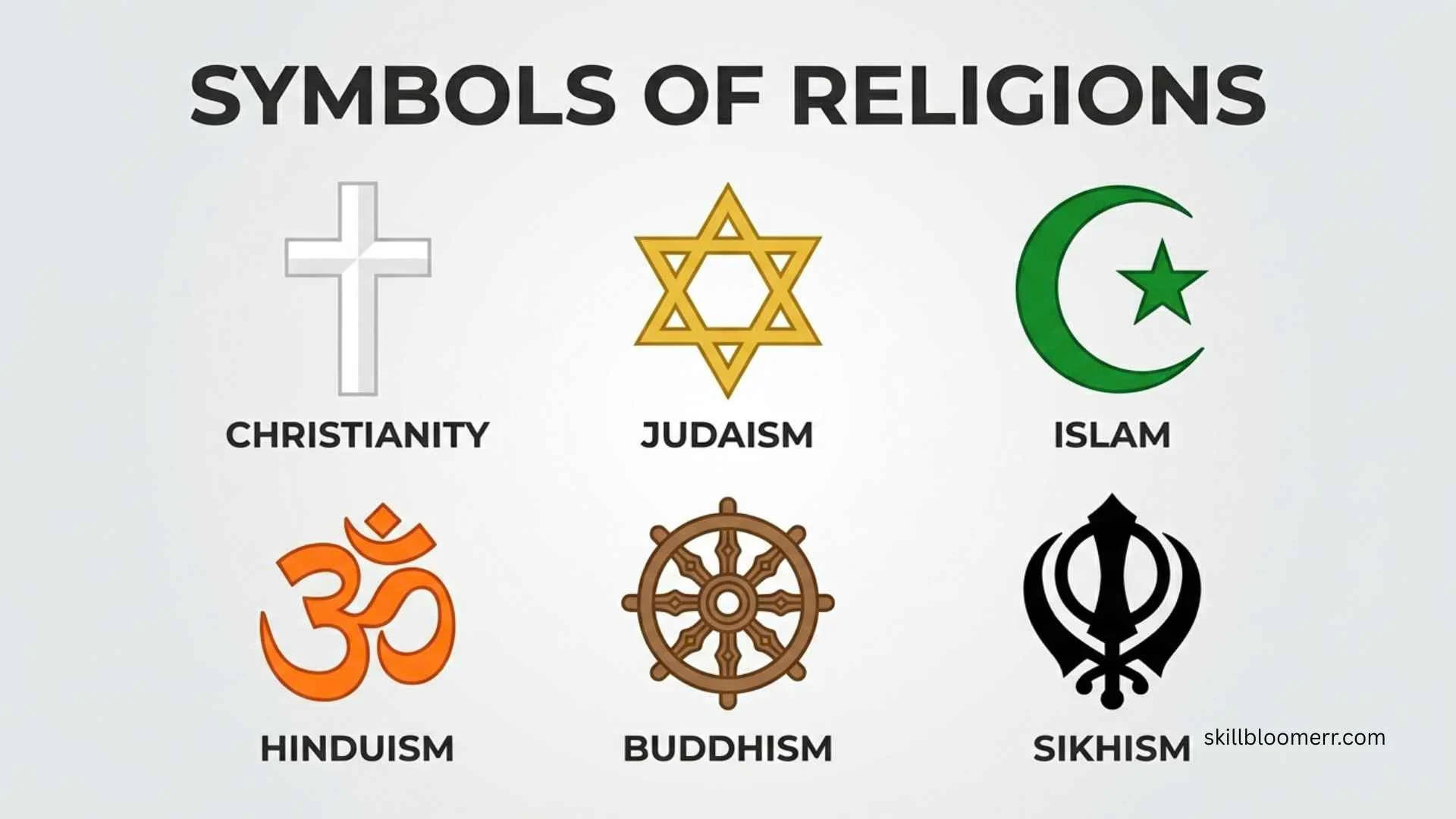
Symbols of religions are powerful visual expressions that represent faith, spiritual beliefs, traditions, and the relationship between humans and the divine. Throughout history, religious communities have used symbols to communicate ideas about creation, life, death, morality, hope, protection, and spiritual growth.
From the Christian cross and Hindu Om symbol to the Buddhist Dharma Wheel and Jewish Star of David, these sacred signs appear in temples, churches, mosques, synagogues, artwork, jewelry, literature, and cultural traditions. Each symbol carries a unique story shaped by history, geography, language, and religious teachings.
Understanding symbols of religions helps people appreciate the diversity of human beliefs and recognize how different cultures use visual language to express their deepest values and spiritual connections.
Quick Meaning of Symbols of Religions
Symbols of religions are sacred images, objects, signs, or designs that represent the beliefs, teachings, history, and spiritual values of a religious tradition. They help followers express faith, remember important teachings, participate in rituals, and connect with their cultural and religious identity.
Symbol Overview Table
| Symbol Name | Primary Meaning | Religion/Culture | Origin | Common Usage | Modern Meaning | Related Symbols |
| Cross | Sacrifice, salvation, resurrection | Christianity | 1st century CE | Churches, jewelry, artwork | Faith and hope | Crucifix, Celtic Cross |
| Om (Aum) | Divine sound and universal consciousness | Hinduism | Ancient India | Meditation, temples, yoga | Spiritual awareness | Lotus, Mandala |
| Crescent and Star | Guidance and cultural identity | Islamic cultures | Ancient Near East associations | Flags, architecture, art | Heritage and identity | Calligraphy, Mosque designs |
| Star of David | Jewish identity and heritage | Judaism | Medieval Jewish tradition | Synagogues, jewelry | Community and faith | Menorah |
| Dharma Wheel | Buddha’s teachings and spiritual path | Buddhism | Ancient India | Temples, statues | Enlightenment and wisdom | Lotus Flower |
| Khanda | Sikh principles and spiritual strength | Sikhism | Punjab region | Gurdwaras, Sikh flags | Equality and courage | Ik Onkar |
| Lotus Flower | Purity and spiritual awakening | Buddhism and Hinduism | Ancient Asia | Religious art and temples | Growth and transformation | Om |
| Ankh | Life and eternity | Ancient Egyptian religion | Ancient Egypt | Tombs, artwork | Immortality and history | Eye of Horus |
| Torii Gate | Sacred space and divine connection | Shinto | Ancient Japan | Shrines and architecture | Spiritual transition | Shinto symbols |
| Yin-Yang | Balance and harmony | Chinese philosophy | Ancient China | Art and philosophy | Balance of opposites | Taoist symbols |
What Do Symbols of Religions Mean?
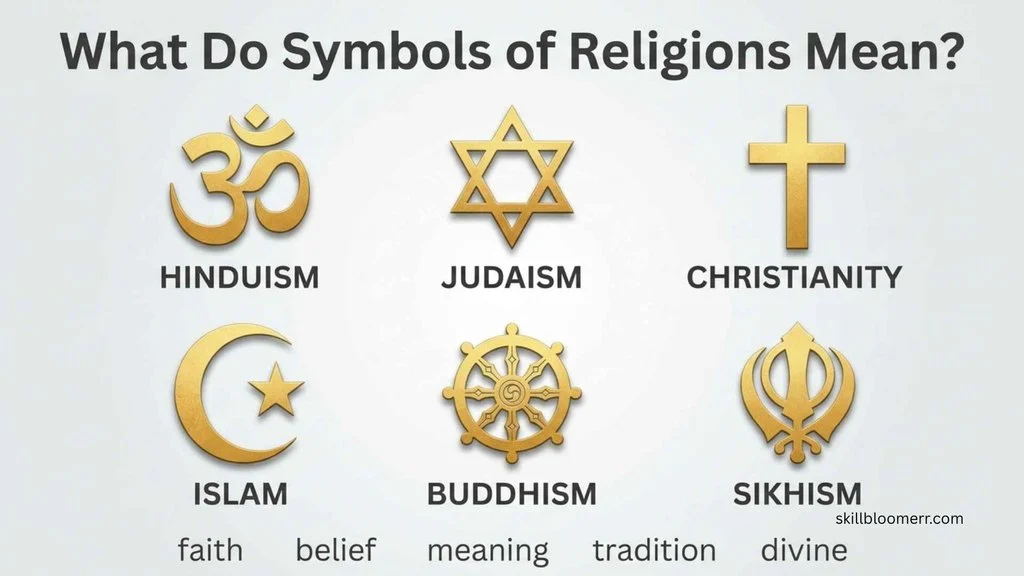
Symbols of religions represent ideas that are often difficult to explain through words alone. They transform complex spiritual concepts into recognizable images that communities can understand and share.
A religious symbol may represent:
- A belief about God or the universe
- A sacred story or historical event
- A moral teaching
- A spiritual practice
- A connection between people and their faith
For example, the cross is more than a simple geometric shape. In Christianity, it represents the crucifixion of Jesus Christ, sacrifice, forgiveness, and the promise of salvation.
The Om symbol in Hinduism represents the sacred sound associated with the universe and ultimate reality. It is commonly used during meditation and spiritual practices because many Hindus consider it a representation of divine consciousness.
Religious symbols often serve three important purposes:
- Teaching: They help communicate religious ideas.
- Identity: They show belonging to a faith community.
- Connection: They create a personal link between believers and spiritual traditions.
History and Origin of Religious Symbols
Religious symbols developed alongside human civilization. Ancient societies used images, objects, and patterns to explain mysteries of existence, nature, life, and death.
Ancient Civilizations and Sacred Symbols
Ancient Egypt created some of the earliest known religious symbols. The ankh represented life and eternity, while the Eye of Horus symbolized protection, healing, and restoration.
In ancient India, Hindu traditions developed symbols such as Om and the lotus flower. These symbols became connected with ideas of spiritual awareness, creation, and enlightenment.
Ancient Buddhist communities used symbols instead of images of Buddha during early periods. The Dharma Wheel became one of the most important representations of Buddha’s teachings and the path toward enlightenment.
Ancient Jewish traditions developed symbols connected to identity, worship, and community. The menorah and later the Star of David became significant representations of Jewish heritage.
Evolution of Religious Symbols Over Time
Religious symbols change as cultures develop. A symbol may begin with a specific religious meaning and later gain additional cultural interpretations.
Examples include:
- The cross became both a religious and cultural symbol.
- The crescent became strongly connected with many Islamic societies.
- The lotus is becoming important across multiple Asian traditions.
- The Star of David became a global symbol of Jewish identity.
Trade, migration, art, and communication allowed religious symbols to spread across continents.
Symbolism and Interpretation
Religious symbols often have multiple layers of meaning. Their interpretation depends on historical background, religious teachings, and cultural context.
Traditional Meanings of Religious Symbols
Traditional meanings are based on religious texts, teachings, and long-established practices.
Examples:
- The Christian cross represents sacrifice and redemption.
- The Dharma Wheel represents the teachings of Buddha.
- The Khanda represents Sikh beliefs about courage, equality, and justice.
- The Om symbol represents spiritual unity and divine consciousness.
Modern Interpretations
Today, religious symbols may represent both faith and cultural identity.
A person may use a religious symbol to express:
- Personal belief
- Family heritage
- Cultural background
- Spiritual connection
- Personal values
However, modern interpretations can sometimes differ from traditional religious meanings.
Psychological Meaning of Religious Symbols
From a psychological perspective, symbols help humans organize ideas, emotions, and experiences. Religious symbols can provide:
- A sense of belonging
- Emotional comfort
- A reminder of personal values
- Connection with a larger community
For many people, seeing a familiar sacred symbol can create feelings of peace, hope, or spiritual reflection.
Cultural Significance of Religious Symbols
Religious symbols influence cultures by shaping art, architecture, traditions, and community identity.
Religious Symbols in Architecture
Sacred buildings often display religious symbols to create meaningful spiritual environments.
Examples include:
- Churches decorated with crosses and Christian artwork.
- Mosques featuring Islamic calligraphy and geometric patterns.
- Hindu temples displaying sacred sculptures and symbols.
- Buddhist temples using lotus imagery and Dharma Wheels.
- Synagogues displaying Jewish symbols such as the Star of David.
Architecture allows religious symbols to become part of shared cultural spaces.
Religious Symbols in Art and Literature
Artists and writers have used religious symbols for centuries to communicate deeper meanings.
Examples:
- Paintings using halos to represent holiness.
- Literature using light as a symbol of divine guidance.
- Sculptures representing spiritual figures and teachings.
Religious symbolism remains an important part of global art history.
Regional Differences in Interpretation
The same symbol may have different meanings depending on location and tradition.
For example:
- The cross has different designs among Catholic, Orthodox, and Protestant Christians.
- The crescent and star have cultural importance in many Muslim societies but are not considered a universal religious requirement.
- Hindu symbols may have different meanings across regional traditions.
Understanding cultural differences prevents misunderstanding and encourages respect.
Religious or Spiritual Meaning of Major Symbols
Christianity: The Cross
The cross is the most recognized symbol of Christianity. It represents the crucifixion of Jesus Christ and carries meanings of sacrifice, forgiveness, salvation, and resurrection.
Different Christian traditions use different forms:
- Latin Cross
- Orthodox Cross
- Celtic Cross
- Crucifix
Each variation reflects different historical developments within Christianity.
Hinduism: Om (Aum)
Om is one of the most sacred symbols in Hinduism. It represents the vibration of the universe and the connection between individual consciousness and ultimate reality.
It is used in:
- Meditation
- Prayer
- Yoga
- Religious ceremonies
Many Hindus consider Om a powerful spiritual sound connected with creation and existence.
Buddhism: Dharma Wheel
The Dharma Wheel, or Dharmachakra, represents the teachings of Buddha and the journey toward enlightenment.
The eight spokes commonly represent the Noble Eightfold Path:
- Right understanding
- Right intention
- Right speech
- Right action
- Right livelihood
- Right effort
- Right mindfulness
- Right concentration
Judaism: Star of David
The Star of David is a widely recognized Jewish symbol. It represents Jewish identity, community, and connection to tradition.
The six-pointed star became increasingly associated with Jewish communities over centuries and is now an important cultural and religious symbol.
Islam: Crescent and Star
The crescent and star are commonly associated with Islamic cultures. The symbol has historical connections with various Muslim societies and appears on several national flags.
It is important to understand that Islamic beliefs are primarily based on the Quran and religious teachings, not on a single universal symbol.
Sikhism: Khanda
The Khanda is a major Sikh symbol representing spiritual strength, justice, and commitment to truth.
Its design includes:
- A double-edged sword representing divine knowledge.
- Two swords representing spiritual and worldly responsibilities.
- A circular weapon representing unity and eternity.
Where Religious Symbols Are Used
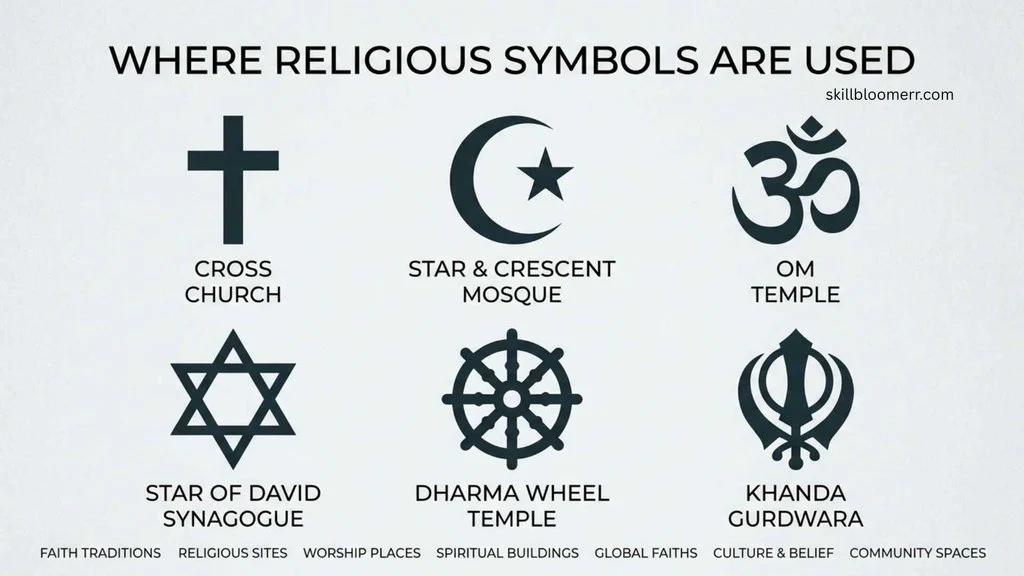
Religious symbols appear in many areas of human life.
Places of Worship
Symbols are commonly found in:
- Churches
- Temples
- Mosques
- Synagogues
- Gurdwaras
- Shrines
They help create sacred environments.
Jewelry and Personal Items
Many people wear religious symbols as:
- Necklaces
- Rings
- Bracelets
- Pendants
These items may represent personal faith or cultural heritage.
Tattoos and Modern Design
Religious symbols are sometimes used in tattoos and artwork. People may choose them because of:
- Spiritual meaning
- Personal experiences
- Cultural connections
- Artistic appeal
However, respectful understanding is important because many symbols are sacred to religious communities.
Flags and National Identity
Some religious symbols appear in national and cultural symbols.
Examples include:
- Crescent symbols on several national flags.
- Cross designs in European and other national flags.
- Religious-inspired imagery in cultural emblems.
Common Variations of Religious Symbols
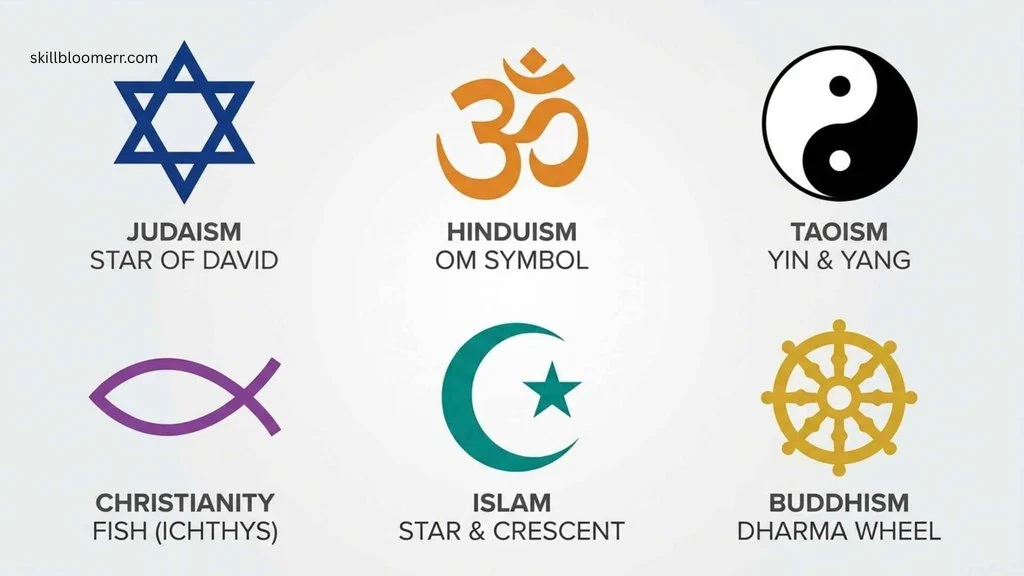
Religious symbols often appear in different forms due to regional and historical changes.
Design Variations
Examples:
- Different styles of crosses represent different Christian traditions.
- Om may appear in different artistic forms.
- Lotus designs vary across Asian cultures.
- Buddhist symbols differ between countries such as India, China, Japan, and Tibet.
Modern Adaptations
Modern artists often redesign traditional symbols for:
- Logos
- Fashion
- Digital artwork
- Educational materials
These adaptations may preserve original meanings or create new interpretations.
Common Misconceptions About Religious Symbols
Misconception 1: Every Religion Has One Official Symbol
Not all religions have one universal symbol. Some traditions use multiple symbols, while others focus more on teachings, practices, or sacred texts.
Misconception 2: Symbols Have the Same Meaning Everywhere
A symbol’s meaning can change depending on culture, history, and religious tradition.
Misconception 3: Symbols Are Only Decorative
Religious symbols often carry deep spiritual, historical, and emotional meanings.
Misconception 4: Modern Use Always Matches Religious Meaning
A symbol used in popular culture may not represent its original religious meaning accurately.
Interesting Facts About Religious Symbols
- The Om symbol has been used for thousands of years in Indian spiritual traditions and remains important in meditation practices today.
- The cross existed as a shape before Christianity, but its Christian meaning developed after the crucifixion of Jesus.
- The lotus flower is meaningful in both Hindu and Buddhist traditions because it represents purity emerging from difficult conditions.
- The Dharma Wheel is one of the earliest Buddhist symbols connected with Buddha’s teachings.
- The ankh is one of the most recognizable symbols from ancient Egyptian civilization.
- The Star of David became widely recognized as a Jewish symbol over centuries of cultural development.
- Religious symbols often appear in architecture because buildings can communicate beliefs visually.
- Many sacred symbols have influenced modern art, fashion, and graphic design.
- Symbols can preserve cultural memory by connecting modern generations with ancient traditions.
- Religious symbols are studied by historians, anthropologists, artists, and scholars to understand human culture.
Related Symbols
Eye of Horus
The Eye of Horus is an ancient Egyptian symbol associated with protection, healing, and restoration.
Menorah
The menorah is a Jewish symbol representing ancient religious traditions and spiritual light.
Mandala
Mandala designs are important in Hindu and Buddhist traditions and represent the universe, balance, and meditation.
Ik Onkar
Ik Onkar is an important Sikh symbol representing the belief in one universal creator.
Tao Symbol
The Tao symbol represents balance, harmony, and the relationship between opposing forces.
Frequently Asked Questions
What are symbols of religions?
Symbols of religions are sacred images, objects, or designs that represent beliefs, teachings, traditions, and spiritual ideas. They help religious communities communicate important concepts such as faith, creation, morality, salvation, enlightenment, and connection with the divine.
Why are religious symbols important?
Religious symbols are important because they preserve history, strengthen community identity, and help believers express spiritual ideas. They provide visual reminders of religious teachings and create connections between individuals and their traditions.
Do all religions use symbols?
Many religions use symbols, but not every religion depends on them equally. Some traditions emphasize sacred texts, practices, or spiritual experiences more than visual symbols.
What is the oldest religious symbol?
Some ancient symbols, such as Egyptian ankh designs and early spiritual markings, date back thousands of years. Determining the single oldest religious symbol is difficult because early human beliefs were often recorded through art and objects rather than written texts.
Can the same symbol have different meanings?
Yes. A symbol’s meaning can change depending on cultural background, historical period, and religious tradition. Understanding context is essential when interpreting religious symbols.
Are religious symbols only used by believers?
Religious symbols are used by believers, historians, artists, researchers, and cultural communities. However, respectful understanding is important because many symbols have sacred importance.
What is the most recognized religious symbol?
The Christian cross is one of the most globally recognized religious symbols, although many other symbols, such as Om, the crescent, and the Star of David, are also widely known.
Why do religions use symbols instead of only words?
Symbols can communicate complex spiritual ideas quickly and emotionally. They allow people to remember teachings, express identity, and connect with traditions across generations.
Can religious symbols change over time?
Yes. Religious symbols often evolve as cultures change. Their core meanings may remain while their designs, uses, and interpretations develop.
How should people interpret religious symbols?
People should study religious symbols through historical, cultural, and religious contexts rather than relying on assumptions. Respectful interpretation requires understanding the traditions behind each symbol.
Key Takeaways
- Religious symbols communicate spiritual beliefs, traditions, and cultural identity.
- Different religions use symbols to represent ideas such as faith, hope, balance, life, and enlightenment.
- Symbols often have multiple meanings depending on historical and cultural context.
- Religious symbols influence architecture, art, literature, and personal expression.
- Understanding symbols helps people appreciate global religious diversity.
- Sacred symbols should be interpreted with respect and awareness of their origins.
Conclusion
Symbols of religions are powerful reminders of humanity’s search for meaning, connection, and understanding. They preserve ancient traditions while continuing to influence modern cultures, art, and personal identity.
From the cross and Om to the Dharma Wheel and Khanda, each symbol carries a unique story shaped by centuries of belief and experience. Learning about these symbols allows people to better understand different religions and the values that guide communities around the world.

I’m Nathaniel Brooks, an educational writer who loves exploring ideas and making useful knowledge accessible to everyone. I write for SkillBloomerr with a focus on clear explanations, practical tips, and meaningful learning. My goal is to help readers discover something valuable every time they visit the site.
Books: Learn Something New and The Practical Knowledge Handbook
 Ethan Calloway
 Olivia Hartwell