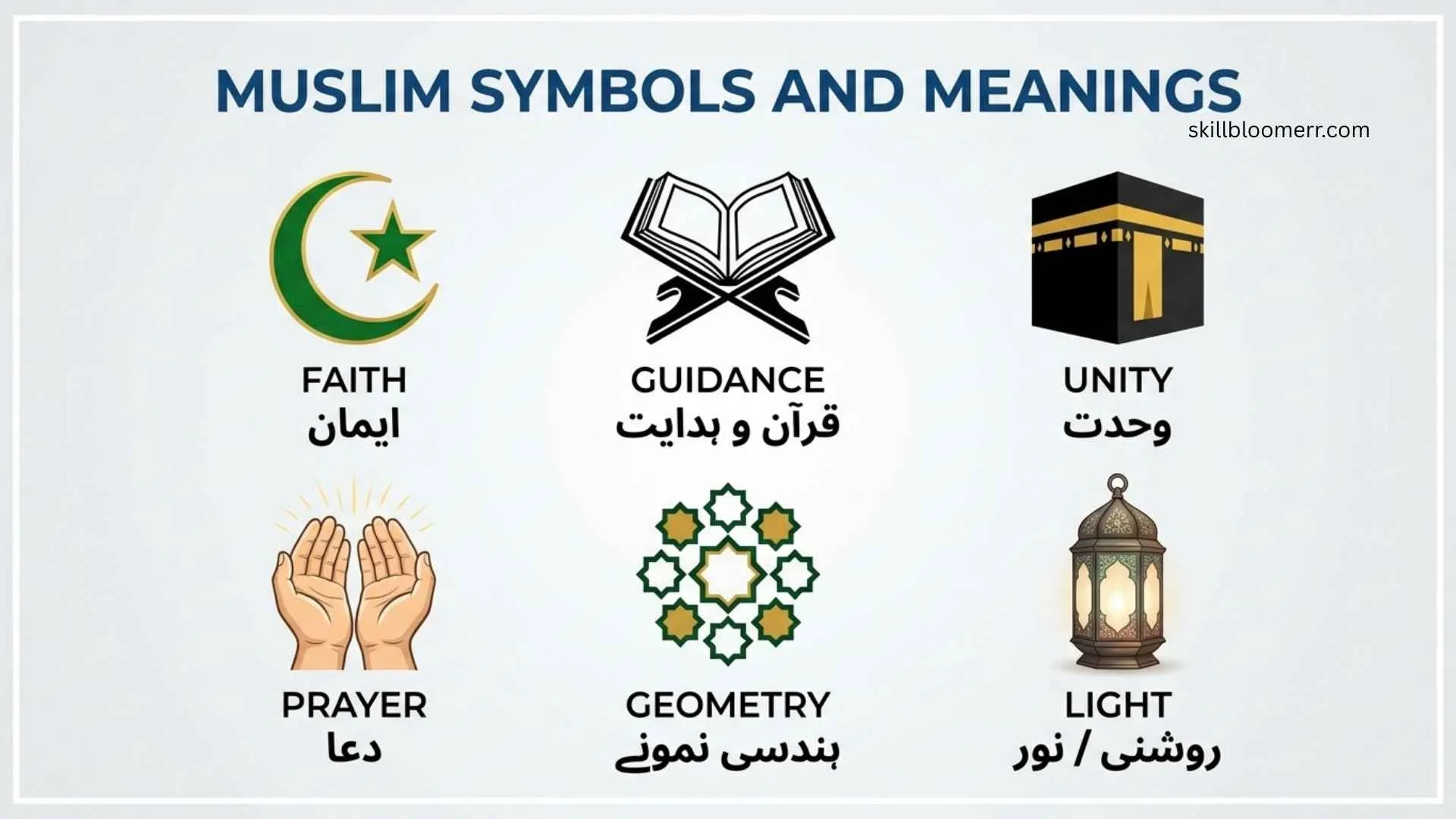
Muslim symbols and meanings explain how Islamic faith, history, art, and cultural identity are expressed through visual signs and traditional designs. Unlike some religions that have one official symbol, Islam does not have a single universal symbol that represents all Muslims. Instead, different symbols have developed across centuries through Islamic civilization, architecture, literature, and cultural traditions.
Many people recognize the crescent moon and star, Arabic calligraphy, the Kaaba, prayer beads, and Islamic geometric patterns as symbols connected with Muslim communities. However, each symbol has its own historical background and meaning. Some represent religious concepts, while others represent cultural heritage, unity, beauty, or artistic expression.
This complete guide explores Muslim symbols and meanings, including their origins, religious importance, cultural interpretations, modern uses, misconceptions, and the deeper ideas behind these important symbols.
Quick Meaning of Muslim Symbols
Muslim symbols are visual representations connected with Islamic culture, history, and spiritual traditions. They include symbols such as the crescent and star, the Kaaba, Arabic calligraphy, prayer beads, and geometric designs. While many are associated with Muslims worldwide, Islam itself does not require followers to use a specific religious symbol.
Symbol Overview Table
| Symbol Name | Primary Meaning | Category | Origin | Culture or Civilization | First Known Use | Common Usage | Modern Meaning | Related Symbols |
| Crescent and Star | Identity, guidance, tradition | Cultural Symbol | Ancient Middle Eastern and Ottoman traditions | Ottoman Empire and Muslim societies | Used before Islam in various cultures | Flags, art, decorations | Muslim cultural identity | Moon, stars, Islamic flags |
| Kaaba | Unity, worship, direction of prayer | Sacred Religious Symbol | Ancient sanctuary in Mecca | Arabian Peninsula, Islamic tradition | Pre-Islamic sanctuary, central Islamic importance after 7th century | Hajj, prayer direction, architecture | Unity of Muslims | Mosque, qibla |
| Arabic Calligraphy | Revelation, knowledge, beauty | Artistic and Religious Symbol | Early Islamic civilization | Arab and Islamic cultures | Developed strongly after the rise of Islam | Quran manuscripts, mosque decoration | Spiritual art and heritage | Quranic writing |
| Tasbih (Prayer Beads) | Remembrance of God | Spiritual Object | Islamic devotional practices | Muslim communities worldwide | Early Islamic centuries | Prayer and reflection | Personal devotion | Dhikr |
| Islamic Geometric Patterns | Harmony, order, infinity | Artistic Symbol | Medieval Islamic art | Middle East, North Africa, Asia | Developed during Islamic artistic expansion | Architecture, carpets, tiles | Creativity and balance | Arabesque designs |
| Green Color | Paradise, renewal, cultural identity | Cultural Symbol | Islamic traditions and history | Many Muslim societies | Historical association with Islam | Flags, clothing, decoration | Hope and spirituality | Nature symbolism |
| Hamsa (Hand Symbol) | Protection in some cultures | Cultural Symbol | Ancient Middle Eastern traditions | Some Muslim, Jewish, and regional cultures | Before Islam | Jewelry and artwork | Protection and good fortune | Eye symbols |
What Do Muslim Symbols Mean?
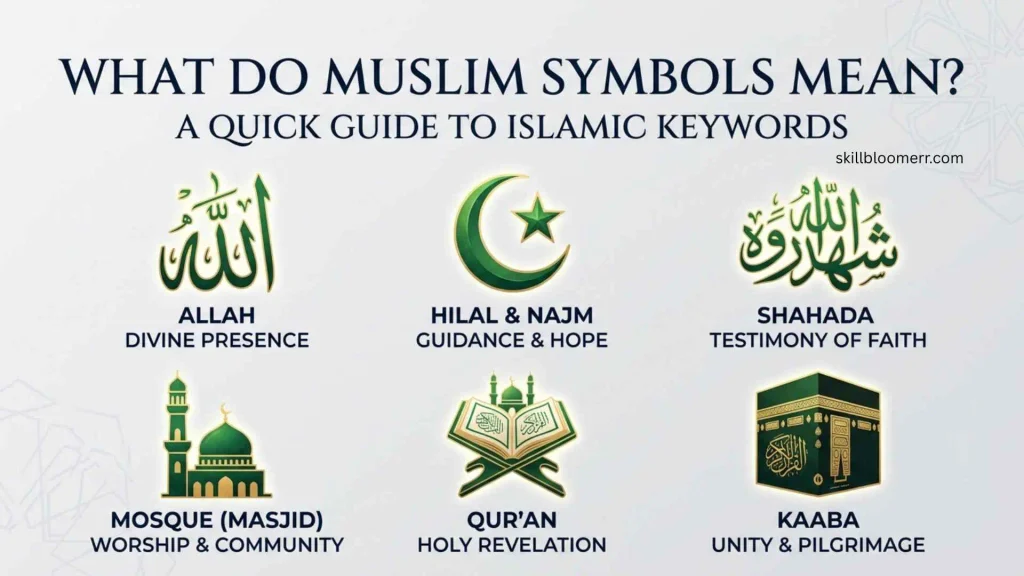
Muslim symbols represent different aspects of Islamic history, beliefs, and cultural expression. Their meanings depend on the symbol itself, the region where it is used, and the historical context behind it.
A symbol in Islamic culture is often a reminder rather than an object of worship. Islam places strong emphasis on belief in one God, prayer, charity, moral behavior, and following religious teachings. Symbols usually support cultural expression and visual communication.
Religious Meaning of Symbols
Some symbols connect directly with Islamic practices:
- The Kaaba represents unity in worship.
- Arabic calligraphy preserves sacred words and Quranic verses.
- Prayer beads help many Muslims practice remembrance of God.
- Mosque architecture reflects Islamic artistic traditions.
Cultural Meaning of Symbols
Other symbols represent Muslim identity and heritage:
- The crescent and star often represent Muslim societies.
- Islamic patterns show artistic traditions.
- Green is commonly connected with cultural and historical associations.
The meaning of a symbol can change depending on location and community.
History and Origin of Muslim Symbols
The history of Muslim symbols developed over more than 1,400 years. Early Muslims did not use one official visual symbol to identify their faith. Instead, Islamic identity was expressed through beliefs, practices, Arabic language, and community traditions.
Symbols in Early Islamic History
During the time of Prophet Muhammad in the 7th century, Muslims used banners and flags for community purposes. These were not considered religious symbols in the modern sense.
The early Islamic community focused on:
- Worship of one God
- Quranic teachings
- Community values
- Ethical behavior
Visual symbols became more common as Islamic civilizations expanded.
Development of Islamic Art
As Muslim civilizations grew across regions including:
- Arabia
- Persia
- North Africa
- Central Asia
- Spain
artists developed unique forms of expression.
Islamic art became known for:
- Detailed calligraphy
- Repeating geometric patterns
- Floral designs
- Architectural decoration
These artistic traditions created many symbols recognized today.
History of the Crescent and Star
The crescent and star is one of the most recognized symbols associated with Muslim societies. However, it is important to understand that it was not created by Islam and is not an official Islamic symbol.
The symbol existed in earlier civilizations and later became strongly associated with the Ottoman Empire. Over time, many Muslim-majority countries adopted variations of the crescent and star on flags and national symbols.
Symbolism and Interpretation
Muslim symbols can have multiple layers of meaning. Their interpretation often depends on religious understanding, cultural background, and personal connection.
Traditional Symbolism
Traditional meanings include:
- Faith
- Guidance
- Unity
- Knowledge
- Spiritual reflection
- Connection with history
Modern Symbolism
Today, Muslim symbols may represent:
- Cultural identity
- Community belonging
- Religious heritage
- Artistic appreciation
- Historical awareness
For many Muslims, these symbols provide a connection between past and present.
Psychological Interpretation
Symbols often influence human emotions because they communicate ideas quickly. A mosque design, Arabic calligraphy, or prayer object can create feelings of:
- Peace
- Belonging
- Respect
- Spiritual connection
The emotional meaning depends on personal experience and cultural background.
Cultural Significance of Muslim Symbols
Islam exists across many cultures, and Muslim symbols reflect this diversity. A symbol may have different meanings in different parts of the world.
Middle Eastern Islamic Traditions
In many Middle Eastern societies, symbols appear in:
- Mosque architecture
- Religious manuscripts
- Traditional decorations
- Islamic artwork
Arabic calligraphy is especially important because Arabic is the language of the Quran.
South Asian Muslim Traditions
In countries such as Pakistan, India, and Bangladesh, Islamic symbols often combine Islamic traditions with local artistic styles.
Examples include:
- Decorative mosque designs
- Islamic embroidery
- Calligraphy paintings
- Architectural patterns
African Muslim Traditions
African Muslim communities have developed unique artistic styles that combine Islamic themes with local cultures.
Examples include:
- Historic mosques
- Traditional crafts
- Decorative patterns
Western Muslim Communities
Muslim communities in Europe and North America often use symbols to express religious identity and cultural heritage.
Modern examples include:
- Islamic art exhibitions
- Educational materials
- Community centers
- Personal jewelry
Religious or Spiritual Meaning
Many Muslim symbols carry spiritual importance, although Islam does not require believers to use symbols.
The Kaaba
The Kaaba is one of the most important sacred places in Islam. Located in Mecca, Saudi Arabia, it is the direction Muslims face during daily prayers.
The Kaaba symbolizes:
- Unity among Muslims
- Worship of one God
- The importance of pilgrimage
- Spiritual connection
During Hajj, millions of Muslims gather around the Kaaba, making it one of the most significant religious sites in the world.
Arabic Calligraphy
Arabic calligraphy is one of the most respected art forms in Islamic culture.
It is often used for:
- Quranic verses
- Religious phrases
- Mosque decoration
- Manuscripts
Calligraphy represents the connection between language, knowledge, and spirituality.
Prayer Beads (Tasbih)
Prayer beads help many Muslims perform dhikr, which means remembering and praising God.
They symbolize:
- Reflection
- Devotion
- Spiritual discipline
Different cultures use different styles and names, including tasbih, misbaha, and subha.
Scientific or Technical Meaning
Most Muslim symbols do not have scientific meanings, but some Islamic designs connect with mathematical and architectural principles.
Islamic Geometric Patterns and Mathematics
Islamic geometric art often uses:
- Symmetry
- Repetition
- Mathematical proportions
- Complex patterns
These designs demonstrate the historical relationship between Islamic art, mathematics, and architecture.
Lunar Calendar Connection
The crescent moon has cultural importance because Islamic months follow a lunar calendar system. The sighting of the new moon determines important dates such as Ramadan and Eid in many communities.
Where Muslim Symbols Are Used
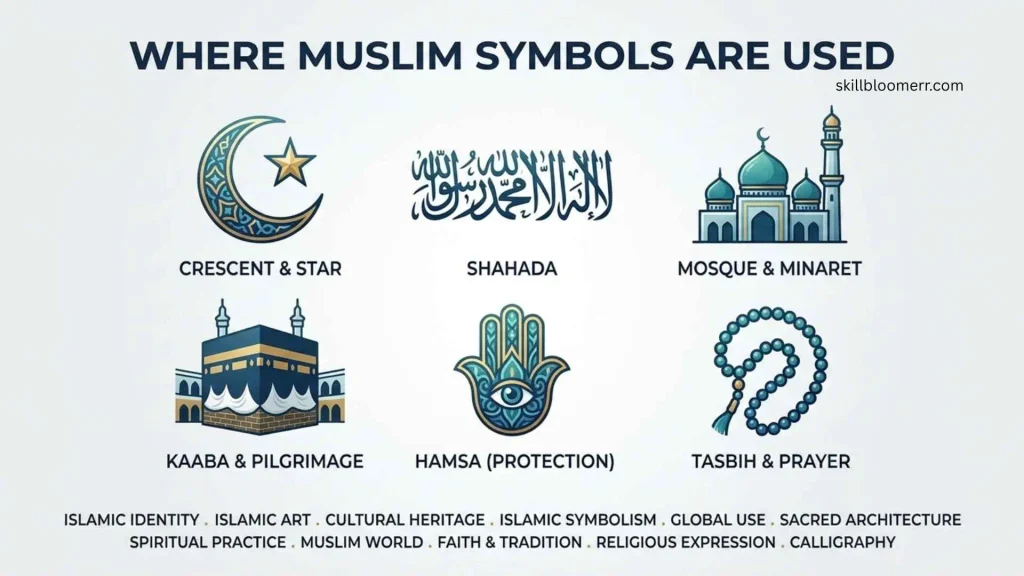
Muslim symbols appear in many areas of daily life.
Religious Buildings
Common locations include:
- Mosques
- Islamic schools
- Religious centers
Architecture
Islamic designs appear in:
- Domes
- Walls
- Tiles
- Windows
- Decorative structures
Books and Manuscripts
Arabic calligraphy is commonly found in:
- Quran manuscripts
- Historical documents
- Islamic literature
Jewelry and Personal Items
Some people use:
- Crescent necklaces
- Calligraphy pendants
- Prayer bead accessories
These items often represent cultural connection.
Flags and National Identity
Some countries use Islamic-inspired symbols on flags. These usually represent national history and cultural identity rather than religious requirements.
Common Variations of Muslim Symbols
Islamic symbols appear in many different styles.
Crescent Variations
The crescent may appear:
- With a star
- Alone
- With Arabic writing
- In decorative designs
Calligraphy Styles
Important Islamic calligraphy styles include:
- Kufic
- Naskh
- Thuluth
- Diwani
Each style has unique shapes and artistic qualities.
Geometric Design Variations
Islamic patterns may include:
- Eight-pointed stars
- Circles
- Repeating tiles
- Interwoven shapes
These designs often represent balance and harmony.
Common Misconceptions About Muslim Symbols
The Crescent and Star Is Islam’s Official Symbol
This is one of the most common misunderstandings. Islam does not have one official symbol. The crescent and star became associated with Muslim societies through history.
Muslims Worship Symbols
Muslims do not worship symbols. Islamic belief emphasizes worship of God alone.
All Muslims Use the Same Symbols
Muslim communities are diverse. Symbol usage differs between countries and cultures.
Green Is Mandatory in Islam
Green is culturally important in many Muslim societies, but it is not a required religious color.
Decision Guide: Understanding a Muslim Symbol
Question: Is the symbol connected directly to Islamic worship?
↓
Yes → Examples: Kaaba, Quranic calligraphy, prayer direction symbols
→ Usually connected with religious practice.
No → Examples: Crescent and star, decorative patterns
→ Usually connected with culture, history, or art.
Question: Does meaning change by region?
↓
Yes → Study the local cultural background before interpreting it.
Interesting Facts About Muslim Symbols
- Islam has no single official symbol.
Islamic identity is based mainly on faith and practices rather than one image. - The crescent symbol predates Islam.
Different ancient civilizations used crescent imagery before it became associated with Muslim societies. - Arabic calligraphy became a major art form.
Artists transformed written language into highly detailed visual designs. - The Kaaba represents global unity.
Muslims from many countries gather toward the same sacred direction during prayer. - Islamic geometric patterns influenced architecture worldwide.
Their mathematical beauty appears in historic buildings across continents. - Prayer beads have regional names.
Different Muslim communities use different terms and designs. - Islamic art often focuses on patterns and words.
Many traditions emphasize calligraphy and geometry. - Symbols can carry cultural meanings beyond religion.
Some symbols represent history, identity, or heritage. - Islamic architecture connects art and mathematics.
Designers used advanced geometric principles. - Muslim symbols vary greatly worldwide.
A symbol’s meaning depends on cultural context.
Related Symbols
Crescent Moon Symbol
The crescent is commonly connected with Muslim cultures but is not an official Islamic requirement.
Mosque Symbol
A mosque represents Islamic community, worship, and learning.
Arabic Calligraphy Symbol
Calligraphy connects language, beauty, and religious expression.
Eight-Pointed Star
This geometric design appears in many Islamic artistic traditions.
Hamsa Hand
The Hamsa is a cultural symbol found in parts of the Middle East and North Africa, sometimes associated with protection.
Frequently Asked Questions
What are the most common Muslim symbols?
The most recognized Muslim symbols include the crescent and star, Kaaba, Arabic calligraphy, prayer beads, Islamic geometric patterns, and green color associations. However, these symbols have different meanings and are not all official religious symbols.
Does Islam have an official symbol?
No, Islam does not have an official universal symbol. Muslim identity is based on religious beliefs, practices, and teachings. Symbols developed later through cultural traditions, artistic expression, and historical events.
What does the crescent and star mean in Islam?
The crescent and star often represent Muslim identity and cultural heritage. However, the symbol is not mentioned as a required Islamic sign and is not considered an essential part of Islamic belief.
Why is the Kaaba important to Muslims?
The Kaaba is important because it is the direction Muslims face during prayer and the central location of the Hajj pilgrimage. It represents unity, devotion, and connection among Muslims worldwide.
What does Arabic calligraphy represent?
Arabic calligraphy represents beauty, knowledge, and respect for the written word. It is especially important in Islamic culture because it is used to display Quranic verses and religious phrases.
Are Islamic geometric patterns religious symbols?
Islamic geometric patterns are mainly artistic expressions. They often represent harmony, order, and creativity, although their meanings can vary depending on cultural interpretation.
Why is green associated with Muslims?
Green is associated with many Muslim communities because of historical and cultural traditions. It is often connected with nature, paradise, and renewal, but it is not required in Islamic practice.
What do prayer beads symbolize in Islam?
Prayer beads symbolize remembrance of God, reflection, and spiritual discipline. Many Muslims use them during dhikr, which involves repeating prayers or phrases of praise.
Can non-Muslims use Islamic symbols?
Islamic symbols can be studied, appreciated, and used respectfully in educational or artistic contexts. Understanding their religious and cultural meanings helps prevent misuse.
Why are symbols important in Muslim culture?
Symbols preserve history, communicate identity, and connect communities with traditions. They help express ideas about faith, art, heritage, and belonging.
Key Takeaways
- Muslim symbols represent faith, culture, history, and artistic traditions.
- Islam does not have one official universal symbol.
- The Kaaba is one of the most important sacred symbols in Islam.
- The crescent and star is mainly a cultural symbol.
- Arabic calligraphy connects art with spirituality.
- Islamic geometric patterns reflect creativity and mathematics.
- Symbol meanings can change across cultures.
- Context is essential when interpreting Islamic symbols.
Conclusion
Muslim symbols and meanings reveal the connection between Islamic faith, history, art, and cultural identity. These symbols are not simply decorative images; they carry stories shaped by centuries of civilization, spiritual practice, and human creativity.
From the sacred importance of the Kaaba to the artistic beauty of Arabic calligraphy and geometric patterns, Islamic symbols show the diversity and richness of Muslim traditions around the world. Understanding these symbols with historical and cultural awareness creates a deeper appreciation of Islamic heritage.

I’m Olivia Hartwell, a writer passionate about learning, personal growth, and practical education. I enjoy researching new ideas and sharing them in a way that feels easy to understand and useful. Through my work with SkillBloomerr, I aim to give readers reliable information they can apply in real life.
Books: Small Steps, Big Growth and The Curious Mind
 Ethan Calloway
 Nathaniel Brooks