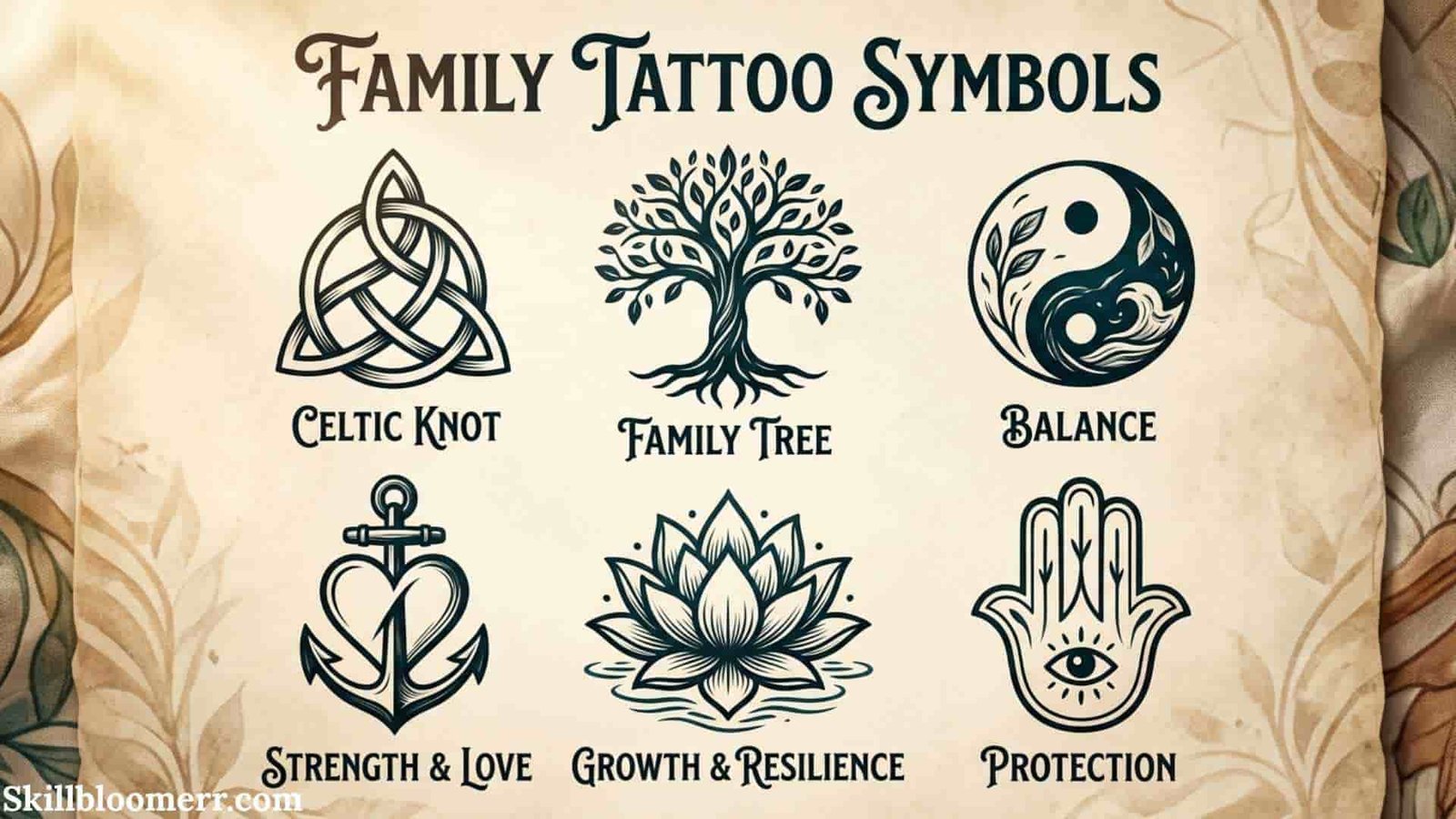
Family tattoo symbols represent one of the most meaningful forms of body art because they express love, loyalty, heritage, and lifelong connection. Unlike tattoos chosen purely for decoration, family-inspired symbols often carry deeply personal stories that commemorate parents, children, siblings, grandparents, spouses, or entire family lineages.
People encounter family tattoo symbols in traditional tattoo art, cultural designs, jewelry, memorial pieces, social media, and modern tattoo studios worldwide. While some symbols have ancient origins rooted in Celtic, Norse, Polynesian, or East Asian traditions, others are modern creations that have gained popularity because they communicate emotional bonds in a simple visual form.
Choosing the right family tattoo symbol is about more than appearance. Every symbol carries its own history, cultural background, and emotional message. Understanding these meanings helps ensure a design reflects the wearer’s intentions while respecting the traditions from which many symbols originate.
This guide explores the meanings, origins, symbolism, cultural significance, and common interpretations of family tattoo symbols, helping you choose or understand a design with confidence.
Quick Meaning of Family Tattoo Symbols:
Family tattoo symbols represent love, unity, protection, loyalty, ancestry, and lifelong bonds. Depending on the design, they may honor parents, children, siblings, spouses, or generations of a family. While many symbols originate from specific cultures, modern family tattoos often combine traditional imagery with personal memories and individual stories.
Symbol Overview Table
| Field | Details |
| Symbol Name | Family Tattoo Symbols |
| Primary Meaning | Love, unity, loyalty, protection, belonging |
| Category | Tattoo Symbolism |
| Origin | Various ancient and modern cultures |
| Associated Cultures | Celtic, Norse, Polynesian, Chinese, Japanese, Indigenous traditions, modern Western tattoo culture |
| First Known Use | Ancient tribal body markings and family emblems |
| Common Usage | Tattoos, jewelry, memorial art, family crests, personal artwork |
| Modern Meaning | Permanent reminder of family relationships and shared identity |
| Unicode | Not applicable |
| Emoji Equivalent | 👨👩👧, ❤️, 🌳, ♾️ (contextual) |
| Related Symbols | Family Tree, Celtic Trinity Knot, Infinity Symbol, Tree of Life, Heart, Anchor, Wolf Pack, Elephant, Turtle, Compass |
What Do Family Tattoo Symbols Mean?
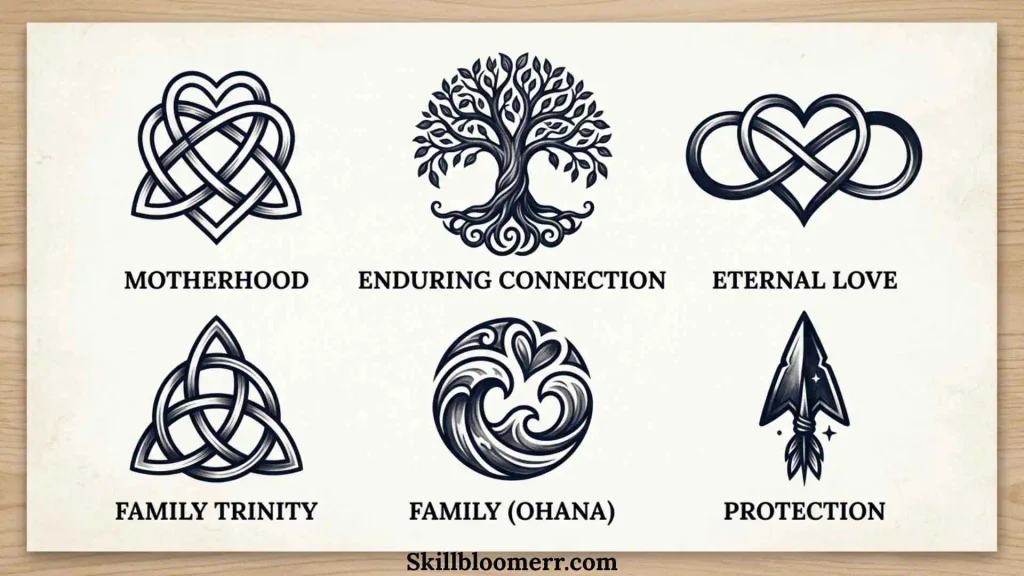
Family tattoo symbols primarily represent enduring relationships and emotional commitment. Rather than being a single universal symbol, the term refers to a wide range of images that express the importance of family in different ways.
For many people, these tattoos celebrate unconditional love. They serve as permanent reminders that family remains a source of support during life’s successes and hardships. Whether the design honors living relatives or remembers loved ones who have passed away, the underlying message is one of connection.
Another common interpretation is unity. Families grow, change, and spread across different places, yet symbolic tattoos emphasize that shared roots remain strong despite distance or time.
Many family tattoos also symbolize protection. Parents often choose designs representing their children, while children may honor parents who guided and protected them. In these cases, the tattoo reflects gratitude as much as affection.
Family tattoo symbols can also represent:
- Heritage
- Identity
- Shared history
- Generational continuity
- Strength through togetherness
- Sacrifice
- Legacy
- Home
- Belonging
- Resilience
Although these meanings overlap, each tattoo ultimately becomes personal because it reflects the wearer’s unique experiences rather than a universal definition.
Family Tattoos as Personal Storytelling
Unlike many symbolic tattoos that rely on a fixed historical meaning, family tattoos often tell individual stories.
For example:
- A parent may tattoo each child’s birth flower.
- Siblings may choose matching coordinates of their childhood home.
- A family tree may include initials of several generations.
- A compass may symbolize returning home no matter where life leads.
- Roman numerals may represent important birthdays or anniversaries.
These personalized elements transform common symbols into unique family narratives.
Why Family Symbols Are Among the Most Popular Tattoos
Family-themed tattoos remain consistently popular because their meaning rarely changes over time. While trends come and go, love for family usually remains constant.
People often choose family symbols because they:
- Carry lifelong emotional value.
- Age well emotionally.
- Can be personalized easily.
- Suit almost every tattoo style.
- Honor living and deceased relatives.
- Reflect personal identity.
- Create lasting reminders of important relationships.
For these reasons, tattoo artists frequently recommend timeless family symbols over trendy designs that may lose significance.
History and Origin
Family tattoo symbols do not originate from a single civilization. Instead, they evolved across many cultures where body markings, family emblems, and symbolic art were used to express kinship, ancestry, protection, and social identity.
Although today’s family tattoos are often deeply personal, many popular designs trace their roots to ancient traditions that valued lineage and community.
Ancient Tribal Traditions
Long before modern tattoo machines existed, many Indigenous societies used body markings to identify family groups, clans, and tribal affiliations.
These tattoos could communicate:
- Family heritage
- Clan membership
- Social status
- Marriage
- Ancestral lineage
- Spiritual protection
In Polynesian cultures, for example, tattoo patterns were highly symbolic. Specific motifs could represent genealogy, family responsibilities, achievements, and one’s place within the community. Rather than being purely decorative, these tattoos acted as visual biographies.
Similarly, some Indigenous cultures in North America incorporated symbolic markings that reflected family identity, achievements, or important life events, though traditions varied widely among different nations.
Celtic Traditions
Celtic symbolism continues to influence modern family tattoo designs.
Ancient Celtic art emphasized interconnected lines without beginning or end, reflecting beliefs about eternity, continuity, and interconnected life.
Popular family-related Celtic symbols include:
The Trinity Knot
Although interpretations vary, many modern families see the Trinity Knot as representing:
- Father
- Mother
- Child
Others interpret it as:
- Past
- Present
- Future
or
- Life
- Death
- Rebirth
Historically, however, scholars caution that many family interpretations are modern adaptations rather than documented ancient meanings.
Celtic Tree of Life
The Tree of Life symbolizes:
- Family roots
- Growth
- Wisdom
- Balance
- Interconnected generations
Its branches and roots reflect how families continue growing while remaining connected to their origins.
Norse Influence
Norse mythology also contributed several symbols frequently chosen for family tattoos.
Among them are:
- Yggdrasil (the World Tree)
- Valknut (used cautiously because of its complex historical associations)
- Rune inscriptions
- Protective bindrunes
The World Tree, Yggdrasil, represents interconnected life, making it a meaningful symbol for families spanning multiple generations.
Many people also incorporate Elder Futhark runes that symbolize:
- Home
- Protection
- Heritage
- Prosperity
However, runes should be researched carefully because their meanings vary depending on historical context.
East Asian Family Symbolism
Chinese and Japanese artistic traditions contributed different approaches to family symbolism.
Rather than relying solely on pictorial designs, many tattoos use:
- Family names
- Calligraphy
- Meaningful characters
- Ancestral symbols
Chinese characters associated with family may express ideas such as:
- Family
- Harmony
- Love
- Longevity
- Prosperity
Japanese family crests, known as Kamon, historically identified noble families and clans. Modern tattoo enthusiasts sometimes draw inspiration from these elegant circular emblems, though using an authentic crest should be approached respectfully and with an understanding of its historical ownership.
The Rise of Family Tattoos in Modern Tattoo Culture
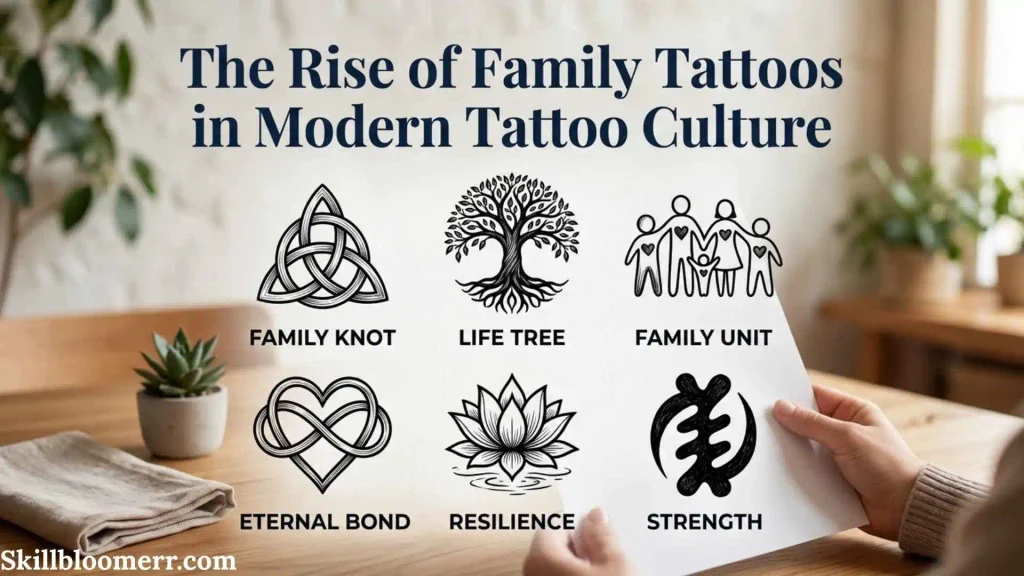
The meaning of family tattoos expanded significantly during the twentieth century.
As tattooing became more widely accepted in Europe and North America, people increasingly chose tattoos to commemorate important relationships rather than simply display cultural identity.
Military personnel often tattooed:
- Children’s names
- Wedding dates
- Family portraits
- Home-state symbols
These tattoos served as reminders of loved ones while serving far from home.
Later, advances in tattoo artistry enabled highly detailed family-themed designs such as:
- Realistic portraits
- Handprints
- Footprints
- Fingerprints
- Family silhouettes
- DNA-inspired artwork
- Birth flowers
- Watercolor family trees
The Evolution of Meaning
Although historical family symbols often identify clans or ancestry, modern interpretations are much broader.
Today’s family tattoos may represent:
- Biological family
- Adoptive family
- Chosen family
- Close friendships
- Blended families
- Foster families
- Spiritual communities
- Generational remembrance
This evolution reflects changing ideas about what family means. Instead of focusing solely on bloodlines, many contemporary tattoos celebrate the people who provide love, support, and belonging throughout life.
Expert Insight: Research Before Choosing a Cultural Symbol
One of the most overlooked aspects of selecting a family tattoo is understanding the cultural background of the chosen design. Symbols such as Polynesian tribal patterns, Japanese family crests, Norse runes, or Indigenous motifs often carry meanings that extend beyond “family.” They may signify rank, ancestry, spiritual beliefs, or specific communities.
Before incorporating a traditional symbol into a tattoo, consider this simple decision guide:
Question: Is the symbol tied to a specific culture or historical tradition?
- Yes → Learn its authentic meaning, cultural context, and whether its use is appropriate outside that tradition.
- No → You have greater freedom to personalize the design while still ensuring it reflects your intended message.
Taking time to research helps create a tattoo that is not only meaningful but also respectful of the history and people connected to the symbol.
Symbolism and Interpretation
Family tattoo symbols express far more than affection. They communicate identity, shared history, emotional security, sacrifice, and the belief that family relationships endure despite time, distance, or loss. Because there is no single universal family symbol, each design emphasizes a different aspect of these values.
Understanding the symbolism behind common family tattoo designs helps ensure that a tattoo reflects the intended message rather than simply looking attractive.
Love and Unconditional Support
The most recognized meaning of family tattoo symbols is unconditional love.
Unlike romantic relationships or friendships, family bonds are often viewed as lifelong connections built through shared experiences, responsibilities, and memories. A family tattoo can symbolize appreciation for parents who provided guidance, children who changed one’s life, or siblings who remained supportive through difficult times.
Many people choose simple designs because they believe the emotional meaning is more important than artistic complexity.
Examples include:
- Small hearts with initials
- Parent-child silhouettes
- Joined hands
- Minimalist line art
- Birth dates
- Family names
These tattoos quietly communicate that love does not require elaborate symbolism to be meaningful.
Unity and Togetherness
Another central interpretation is unity.
Families naturally experience changes—children grow up, relatives move across countries, marriages expand family circles, and generations pass. A family tattoo serves as a reminder that these changes do not erase shared roots.
Designs that symbolize unity often include:
- Interlocking circles
- Infinity symbols
- Circular tribal patterns
- Celtic knots
- Linked geometric shapes
The absence of a beginning or end in many of these designs reinforces the idea that family connections continue through every stage of life.
Protection and Security
Throughout history, families have represented safety and survival. This explains why protective symbolism appears in many family tattoos.
Parents frequently select protective symbols for children, while adult children may choose tattoos honoring parents who provided lifelong support.
Common protective symbols include:
| Symbol | Protective Meaning |
| Anchor | Stability during life’s challenges |
| Shield | Safety and defense |
| Compass | Guidance toward home |
| Wolf | Protection of the family unit |
| Lion | Courage and guardianship |
| Elephant | Protective parenting and wisdom |
These symbols often combine emotional meaning with traditional cultural interpretations.
Loyalty and Commitment
Family tattoos also represent unwavering loyalty.
Unlike achievements or interests that may change over time, family relationships often remain among life’s most enduring commitments. A tattoo permanently reflects this lifelong bond.
Matching family tattoos are particularly associated with loyalty because they demonstrate a shared commitment between multiple family members.
Popular matching ideas include:
- Puzzle pieces
- Sun and moon
- Matching trees
- Coordinates
- Roman numerals
- Shared quotes divided across several tattoos
Heritage and Identity
For many people, family tattoos celebrate ancestry.
Rather than focusing only on immediate relatives, these tattoos honor generations that shaped the family’s history.
Common heritage-inspired tattoos include:
- Family crests
- Surnames
- Coat of arms (where historically appropriate)
- Family trees
- Cultural patterns
- Traditional knotwork
- National flowers
- Regional animals
These designs emphasize that identity develops across generations rather than within a single lifetime.
Legacy Across Generations
Many family tattoos symbolize continuity.
Parents may choose tattoos representing children, while grandparents celebrate grandchildren. Likewise, descendants may commemorate ancestors whose sacrifices shaped later generations.
Designs expressing legacy include:
- Trees with expanding branches
- Roots extending underground
- Constellations
- Generational birthstones
- Multiple birds flying together
- Staircase motifs
- Growth rings inspired by trees
These symbols suggest that every generation contributes to the family’s ongoing story.
Memorial and Remembrance
Not all family tattoos celebrate living relatives.
Many are created in memory of loved ones who have passed away.
Memorial tattoos often include:
- Dates
- Portraits
- Angel wings
- Halo designs
- Feathers
- Butterflies
- Favorite flowers
- Handwriting
- Heartbeat lines
- Fingerprints
These tattoos provide a permanent reminder that emotional connections continue beyond physical absence.
Growth Through Family
Some family symbols emphasize personal development rather than relationships alone.
For example:
- Trees symbolize growth from strong roots.
- Mountains represent overcoming hardship together.
- Rivers symbolize life’s journey across generations.
- Birds leaving a nest symbolize independence while remaining connected.
These designs acknowledge that healthy families encourage both belonging and individual growth.
Psychological Interpretation
From a psychological perspective, family tattoo symbols often satisfy several emotional needs.
They may help individuals express:
- Personal identity
- Emotional attachment
- Gratitude
- Belonging
- Security
- Resilience
- Healing after loss
- Pride in heritage
Researchers in psychology frequently describe tattoos as forms of self-expression and autobiographical storytelling. Rather than changing who someone is, meaningful tattoos often make important life experiences visible.
For many people, a family tattoo becomes a permanent reminder of values they wish to carry throughout life.
Positive Symbolism
Most family tattoo symbols communicate uplifting messages.
Common positive meanings include:
- Love
- Loyalty
- Protection
- Trust
- Respect
- Compassion
- Sacrifice
- Courage
- Unity
- Gratitude
- Hope
- Stability
- Strength
- Forgiveness
- Home
Because these meanings are widely understood, family tattoos are among the most universally appreciated forms of symbolic body art.
Possible Negative Interpretations
Although family tattoos are overwhelmingly positive, context matters.
Potential misunderstandings include:
- Assuming every Celtic knot specifically represents family.
- Believing every tribal design has the same meaning.
- Using sacred cultural symbols without understanding their significance.
- Choosing translated characters without verifying accuracy.
- Copying another family’s crest or emblem without historical connection.
These issues highlight why research is just as important as artistic style.
Expert Tip: Match the Symbol to the Message
Instead of asking, “What is the most popular family tattoo?” ask, “What story do I want the tattoo to tell?”
Use this quick guide:
| If you want to express… | Consider symbols such as… |
| Family unity | Celtic knot, infinity, linked circles |
| Family roots | Tree of Life, family tree, roots |
| Protection | Wolf, lion, elephant, shield |
| Parenthood | Parent-child silhouette, footprints |
| Heritage | Family crest, surname, cultural motif |
| Memorial | Feather, portrait, handwriting, angel wings |
| Guidance | Compass, anchor, lighthouse |
| Eternal bond | Infinity, circle, eternal knot |
Choosing the message first usually leads to a more meaningful and timeless tattoo.
Cultural Significance
Family tattoo symbols reflect the values of the cultures in which they developed. While the idea of honoring family is nearly universal, different societies express this value through distinct artistic traditions, beliefs, and symbols. Understanding these cultural perspectives helps explain why the same design may carry different meanings in different parts of the world.
Celtic Culture
In Celtic tradition, family and ancestry were deeply connected to identity, land, and community. Although many modern interpretations have evolved, Celtic artwork remains one of the strongest influences on family-themed tattoos.
The Tree of Life symbolizes the connection between ancestors, descendants, and the natural world. Its roots represent heritage, while its branches suggest future generations.
Celtic knots, with their endless loops, are often used today to symbolize eternal family bonds. Historically, however, many knot designs represented broader concepts such as eternity, faith, or the interconnectedness of life rather than family alone.
Norse Culture
Norse society placed great importance on kinship, loyalty, and shared responsibility.
Family was not simply a household but a network of people who protected one another and preserved family honor across generations.
Modern Norse-inspired family tattoos commonly feature:
- Yggdrasil (World Tree)
- Elder Futhark runes
- Ravens
- Wolves
- Protective bindrunes
While these designs can symbolize family, many also have mythological or spiritual meanings. Their interpretation depends on historical context as well as personal intention.
Polynesian Traditions
Polynesian tattooing is among the world’s oldest continuous tattoo traditions.
In many Polynesian cultures, tattoos communicate genealogy, family lineage, achievements, and social identity through highly structured geometric patterns.
Unlike modern decorative tattoos, traditional Polynesian tattoos often tell a person’s life story.
Common family-related motifs include:
- Enata (human figures representing people and relationships)
- Turtle shells symbolizing family, longevity, and protection
- Spearheads representing courage and guardianship
- Ocean patterns reflecting life’s journey
Because these motifs have specific cultural meanings, they should be approached with respect rather than copied purely for aesthetics.
East Asian Perspectives
In China, family has historically been influenced by Confucian ideals emphasizing respect for parents, ancestors, and family harmony.
Rather than using a single family symbol, tattoos may feature:
- Chinese calligraphy
- Family names
- Ancestral phrases
- Zodiac animals shared across generations
In Japan, the concept of family has traditionally been represented through Kamon, or family crests. These elegant circular emblems identified clans and noble households. While visually striking, authentic Kamon designs belong to specific family lineages, making historical accuracy important when choosing one for a tattoo.
Indigenous Traditions
Many Indigenous cultures around the world have used body art to express identity, ancestry, and belonging. However, these traditions vary greatly between communities and should never be treated as interchangeable.
Some tattoo traditions symbolize:
- Clan membership
- Family history
- Coming-of-age
- Community responsibilities
- Spiritual protection
Because these meanings are culturally specific, respectful research is essential before adapting Indigenous-inspired designs.
Modern Western Culture
In contemporary Western tattoo culture, family tattoos have become highly personalized.
Instead of following one symbolic tradition, people often combine elements from multiple sources to tell their own story.
Popular modern choices include:
- Children’s names
- Birth flowers
- Fingerprints
- Coordinates
- Soundwave tattoos
- Portraits
- Handwriting
- Family quotes
- DNA-inspired artwork
These designs focus less on inherited symbolism and more on preserving meaningful memories.
Universal Themes Across Cultures
Although artistic styles differ, several themes appear consistently across cultures:
- Love between generations
- Respect for ancestors
- Protection of children
- Shared identity
- Continuity of family lines
- Collective strength
- Responsibility toward future generations
These shared values explain why family tattoo symbols remain meaningful regardless of cultural background.
Religious or Spiritual Meaning
Family tattoo symbols are not inherently religious. Their spiritual meaning depends on the symbol chosen, the beliefs of the wearer, and the cultural tradition from which the design originates. Some designs are purely personal, while others carry sacred significance within specific religions or spiritual practices.
Understanding this distinction is important because certain symbols should be appreciated within their original religious context rather than treated as generic decorative artwork.
Christianity
In Christianity, family is often viewed as a sacred institution centered on love, commitment, faith, and mutual care. Christian-inspired family tattoos commonly incorporate religious imagery alongside family themes.
Popular Christian family tattoo elements include:
- Crosses representing faith as the family’s foundation
- Praying hands symbolizing devotion and guidance
- Doves representing peace and the Holy Spirit
- Olive branches signifying reconciliation and hope
- Scripture verses about love, unity, or parenthood
- Ichthys (fish symbol) expressing Christian identity
Many families choose Bible verses such as Proverbs 22:6, Joshua 24:15, or 1 Corinthians 13 to emphasize values they hope to pass through generations.
Judaism
Judaism places strong importance on family, ancestry, and honoring one’s parents. Symbols associated with Jewish identity—such as the Star of David or the Hebrew word Shalom—may appear in family-themed artwork.
However, it is important to note that traditional Jewish law generally discourages tattooing based on interpretations of Leviticus 19:28. As a result, many observant Jews choose alternative forms of remembrance, while others may decide differently based on personal beliefs and denominational practices.
Hinduism
In Hindu philosophy, family is closely connected to dharma (duty), respect for elders, and the continuity of generations.
Some people choose tattoos featuring:
- The Om (ॐ) symbol
- Lotus flowers
- Sacred mantras
- Images of deities associated with protection or wisdom
Because these symbols are considered sacred, many practitioners encourage using them respectfully and understanding their spiritual significance before incorporating them into body art.
Buddhism
Buddhism emphasizes compassion, interconnectedness, mindfulness, and respect for all living beings.
Although Buddhism does not have a specific family tattoo symbol, many people select imagery such as:
- Lotus flowers
- Endless knots
- Dharma wheels
- Bodhi leaves
These designs may symbolize harmony within the family, spiritual growth, or the interconnected nature of life.
Celtic Spirituality
Ancient Celtic beliefs often emphasized the cycles of nature and the interconnectedness of life.
Modern family tattoos inspired by Celtic spirituality frequently include:
- Tree of Life
- Trinity Knot
- Endless knotwork
While these designs are commonly interpreted today as symbols of family unity, their historical meanings were often broader and included eternity, nature, and spiritual continuity.
Spiritual Meaning Beyond Organized Religion
For many people, family tattoos carry spiritual rather than religious significance.
They may symbolize:
- The enduring presence of loved ones
- Gratitude for ancestors
- Personal growth through family experiences
- The belief that emotional bonds transcend death
- Hope for future generations
In this sense, the tattoo becomes a reminder of values rather than a statement of religious affiliation.
Scientific or Technical Meaning
Family tattoo symbols do not have an established scientific, mathematical, engineering, or technical definition. Their meaning is primarily cultural, artistic, and personal rather than scientific.
However, modern tattoo design sometimes incorporates scientific concepts to create meaningful family-inspired artwork.
DNA and Genetics
One increasingly popular design uses the DNA double helix to represent biological relationships.
These tattoos symbolize:
- Shared ancestry
- Genetic heritage
- Family lineage
- The continuity of life
Although visually inspired by genetics, the tattoo is symbolic rather than a scientific diagram.
Fingerprints
Fingerprints are unique to every individual, making them powerful symbols of identity.
Some family tattoos combine:
- Parent and child fingerprints
- Heart-shaped fingerprint designs
- Fingerprints with names or dates
These tattoos emphasize that every family member is unique while still belonging to the same family.
Heartbeat (ECG) Tattoos
Heartbeat line tattoos inspired by electrocardiograms (ECGs) are sometimes combined with names or family symbols.
Rather than representing medical information, they symbolize:
- Life
- Emotional connection
- The idea that loved ones are always “close to the heart”
Because actual ECG readings vary over time, many tattoo artists create stylized versions instead of reproducing medical records exactly.
Coordinates and Mapping
Some families commemorate meaningful places using geographic coordinates, such as:
- Childhood homes
- Birthplaces
- Wedding locations
- Family farms
- Places where loved ones met
These designs blend cartography with personal storytelling.
Where Family Tattoo Symbols Are Used
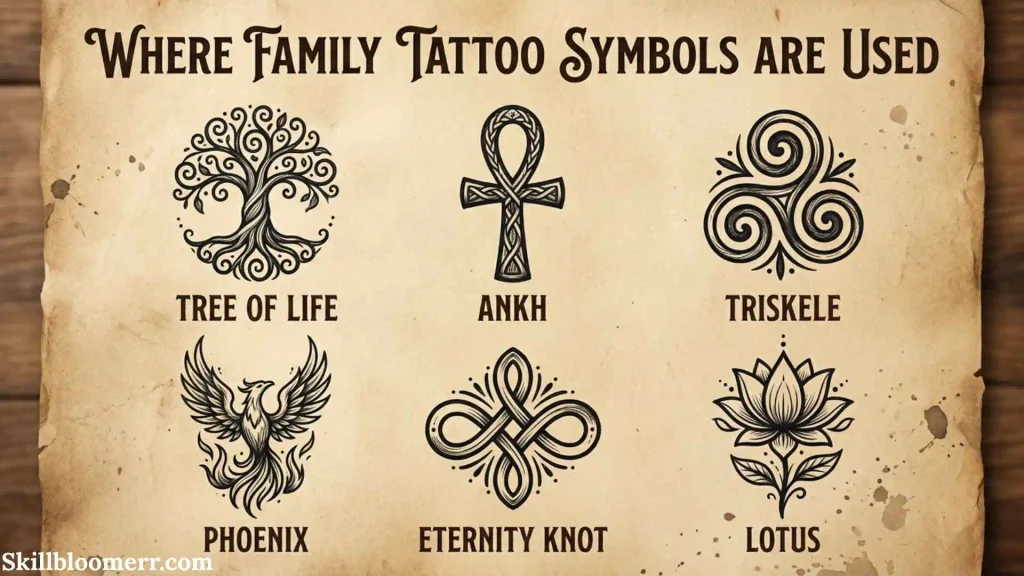
Family tattoo symbols appear in many forms beyond traditional tattoos. Their themes of love, belonging, and heritage make them popular across art, fashion, memorials, and personal keepsakes.
Tattoos
The most common use is permanent body art.
Popular placement areas include:
- Forearm
- Wrist
- Chest
- Shoulder
- Back
- Rib cage
- Ankle
- Collarbone
- Leg
The placement often reflects the desired visibility and personal significance of the design.
Jewelry
Many family symbols are adapted into:
- Necklaces
- Bracelets
- Rings
- Lockets
- Charms
These pieces offer an alternative for people who appreciate symbolic family art but do not wish to get a tattoo.
Memorial Artwork
Family-inspired symbols frequently appear in memorial items, including:
- Engraved stones
- Portraits
- Scrapbooks
- Photo albums
- Memory boxes
- Customized artwork
These pieces preserve family memories in meaningful ways.
Home Décor
Designs such as family trees, meaningful quotes, and symbolic artwork are common in home decoration.
Examples include:
- Wooden wall art
- Metal sculptures
- Canvas prints
- Personalized signs
- Genealogy displays
These items celebrate shared history while becoming part of everyday family life.
Literature and Visual Arts
Artists and writers often use symbolic imagery to represent family relationships.
Examples include:
- Trees representing generations
- Birds returning to nests
- Intertwined roots
- Circles symbolizing unity
- Houses representing belonging
Such imagery appears in novels, paintings, films, and graphic design because it communicates emotional ideas without relying on words.
Logos and Personal Branding
Although less common, family businesses sometimes incorporate symbolic elements into logos to emphasize trust, continuity, and heritage.
Examples include:
- Trees
- Shields
- Initials
- Heraldic elements
- Interlocking shapes
These designs communicate long-term commitment and shared values.
Common Variations
Because there is no single family tattoo symbol, countless variations exist. Some draw from ancient traditions, while others are entirely modern and personalized.
Family Tree
One of the most recognizable family tattoos.
Meaning:
- Roots
- Heritage
- Growth
- Generational continuity
- Shared ancestry
Many designs include names, initials, or birth dates among the branches.
Tree of Life
Unlike a traditional family tree, the Tree of Life emphasizes the interconnectedness of all life.
It commonly represents:
- Wisdom
- Strength
- Balance
- Eternal family bonds
Infinity Symbol
The infinity symbol is one of the simplest modern family tattoos.
It represents:
- Endless love
- Lifelong commitment
- Eternal relationships
- Unbreakable bonds
Many people personalize it with names, hearts, or feathers.
Celtic Knots
Celtic knot designs feature endless interwoven lines.
Modern interpretations often associate them with:
- Family unity
- Eternal love
- Connection across generations
Because many knot patterns exist, researching their historical background can help avoid incorrect assumptions about their original meaning.
Parent and Child Silhouettes
These highly personal tattoos depict:
- A parent holding a child
- Walking hand in hand
- A mother embracing a baby
- A father lifting a child
They celebrate caregiving, protection, and lifelong love.
Birth Flowers
Instead of names, some families choose the birth flower of each member.
For example:
- Rose
- Daisy
- Lily
- Violet
- Marigold
This approach creates an elegant design while representing each individual uniquely.
Birthstones
Gemstone-inspired tattoos symbolize different family members through their birth months.
Some designs combine several birthstones into a single composition representing the entire family.
Coordinates
Coordinate tattoos commemorate places rather than people.
Popular locations include:
- Birthplaces
- Family homes
- Wedding venues
- Places of reunion
These minimalist tattoos carry deep personal meaning despite their simple appearance.
Handwriting Tattoos
Many memorial tattoos reproduce the handwriting of a parent, grandparent, or spouse.
Examples include:
- A handwritten signature
- A short letter
- “Love, Mom”
- “Always with you”
These designs preserve a loved one’s unique writing style as a permanent keepsake.
Portrait Tattoos
Portrait tattoos remain among the most technically demanding forms of tattoo art.
When created by experienced artists, they can honor:
- Parents
- Children
- Grandparents
- Siblings
- Beloved family pets
Because realism requires exceptional skill, choosing a tattoo artist with a strong portrait portfolio is especially important.
Decision Guide: Choosing the Right Family Tattoo Symbol
Use this simple framework to narrow your choice:
What do you want your tattoo to represent?
Love and Connection
↓
Heart • Infinity • Parent–Child Silhouette
Family Heritage
↓
Family Tree • Tree of Life • Family Crest
Protection
↓
Wolf • Elephant • Anchor • Shield
Remembrance
↓
Feather • Portrait • Handwriting • Angel Wings
Growth Across Generations
↓
Tree • Roots • Birds • Constellation
Selecting the meaning first—and the artwork second—often results in a tattoo that remains meaningful for decades.
Common Misconceptions
Family tattoo symbols are deeply personal, but many misconceptions surround their meanings and origins. Separating historical facts from modern interpretations helps you choose a design that is both meaningful and culturally respectful.
Misconception 1: There Is One Universal Family Symbol
Reality: No single symbol universally represents family across all cultures.
Unlike symbols such as the peace sign or the medical caduceus, family symbolism varies by culture, religion, history, and personal interpretation. A Celtic knot, Tree of Life, elephant, wolf, or infinity symbol may all represent family, but none is recognized worldwide as the only “family symbol.”
Misconception 2: Every Celtic Knot Means Family
Reality: Most Celtic knots did not originally have one fixed meaning.
Many modern tattoo websites describe every Celtic knot as a family symbol. Historically, however, Celtic knotwork represented broader concepts such as eternity, interconnectedness, faith, and the cycle of life.
Some family meanings are modern interpretations rather than documented historical uses.
Misconception 3: Tribal Tattoos Can Be Used Without Research
Reality: Many tribal designs belong to living cultures.
Polynesian, Māori, Samoan, and other Indigenous tattoo traditions often contain symbols that communicate genealogy, achievements, rank, or spiritual identity.
Copying these designs without understanding their meaning may unintentionally misuse culturally significant artwork.
Misconception 4: Family Crests Belong to Every Person With the Same Last Name
Reality: A coat of arms or family crest traditionally belonged to a specific individual or lineage—not everyone sharing the same surname.
Modern commercial “family crest” products often oversimplify European heraldic traditions. If historical accuracy matters, genealogical research is recommended before using a heraldic design as a tattoo.
Misconception 5: Chinese or Japanese Characters Always Mean What the Internet Says
Reality: Translation mistakes are common.
Characters may have multiple meanings depending on context, grammar, and regional usage. Before tattooing another language, consult a qualified native speaker or professional translator rather than relying solely on online images.
Misconception 6: Bigger Tattoos Have Greater Meaning
Reality: Emotional significance is not determined by size.
A tiny heart with a child’s initials may carry more personal meaning than a full-back tattoo. The story behind the symbol matters far more than its scale.
Misconception 7: Matching Family Tattoos Must Be Identical
Reality: Matching tattoos can complement each other without being exact copies.
For example:
- Different flowers representing each sibling
- Puzzle pieces forming one image
- Individual birds flying together
- Separate coordinates of meaningful places
- Shared quotes divided among family members
These approaches preserve individuality while expressing connection.
Misconception 8: Every Animal Represents Family
Reality: Animal symbolism depends on cultural tradition.
For example:
- Wolves often symbolize cooperation and family protection.
- Elephants represent strong maternal bonds in many cultures.
- Turtles may symbolize longevity and family in Polynesian traditions.
- Lions often represent guardianship and courage.
Not every animal naturally conveys family symbolism.
Interesting Facts
Family tattoo symbols have evolved over thousands of years and continue to inspire new artistic styles. Here are ten interesting facts that reveal their rich history and lasting appeal.
1. Family Tattoos Are Among the Oldest Personal Tattoo Themes
Ancient tattoo traditions often identified family groups, clans, or ancestry long before tattoos became decorative body art.
2. The Tree Is One of the World’s Most Widespread Family Symbols
Many unrelated civilizations including Celtic, Norse, Asian, African, and Indigenous cultures—used trees to symbolize ancestry, growth, and continuity.
3. Modern Family Tattoos Often Combine Multiple Symbols
Instead of relying on a single image, many people combine elements such as names, flowers, coordinates, dates, and meaningful quotes into one personalized design.
4. Fingerprint Tattoos Are Entirely Unique
Because no two fingerprints are identical, fingerprint tattoos create one of the most individualized family symbols possible.
5. Memorial Tattoos Have Become Increasingly Personalized
Rather than using only names and dates, modern memorial tattoos frequently include handwriting, soundwaves, heartbeat lines, or favorite objects associated with loved ones.
6. Minimalist Family Tattoos Continue to Grow in Popularity
Simple line art, tiny hearts, initials, and geometric designs have become popular because they remain timeless and versatile while carrying deep emotional meaning.
7. Some Families Receive Tattoos Together
Parents, adult children, siblings, or even multiple generations sometimes schedule tattoo appointments together to celebrate milestones such as anniversaries, reunions, or birthdays.
8. Birth Flowers Offer a Creative Alternative to Names
Instead of writing each family member’s name, many tattoos use birth flowers to create elegant botanical designs representing every individual.
9. Coordinates Can Preserve Memories Without Revealing Personal Details
A set of geographic coordinates may quietly represent a childhood home, wedding venue, or birthplace, allowing the tattoo to carry private meaning known only to the wearer and close family.
10. The Best Family Tattoos Usually Tell a Story
The most memorable designs are rarely chosen for appearance alone. They reflect shared experiences, traditions, sacrifices, and memories that remain meaningful throughout life.
Related Symbols
Many symbols share themes with family tattoo symbols but emphasize different aspects of relationships, identity, or personal values.
| Symbol | Primary Meaning | How It Differs |
| Tree of Life | Growth, wisdom, interconnectedness | Broader than family alone; also represents life and nature. |
| Family Tree | Ancestry and genealogy | Focuses specifically on lineage and generations. |
| Infinity Symbol | Eternal love and commitment | Represents endless bonds, not exclusively family. |
| Heart | Love and affection | Can symbolize romantic, family, or universal love. |
| Anchor | Stability and hope | Represents security and guidance rather than ancestry. |
| Compass | Direction and home | Often symbolizes always finding one’s way back to family. |
| Wolf | Loyalty and protection | Reflects cooperation and guardianship within a family unit. |
| Elephant | Wisdom and strong family bonds | Inspired by close-knit elephant herds and maternal care. |
| Feather | Remembrance and spirituality | Frequently used in memorial family tattoos. |
| Celtic Knot | Eternity and connection | Modern family meanings vary depending on the knot design. |
Frequently Asked Questions
What is the best symbol for a family tattoo?
There is no single best symbol because the right choice depends on the meaning you want to express. Family trees, Tree of Life designs, infinity symbols, hearts, Celtic knots, wolves, elephants, and parent-child silhouettes are among the most popular options because they represent love, unity, protection, and lifelong connection.
Are family tattoo symbols universal?
No. Family symbolism varies between cultures and historical traditions. While many societies value family, they express that idea through different symbols, artistic styles, and beliefs. Researching a symbol’s cultural background helps ensure its meaning matches your intentions.
Is the Tree of Life a family symbol?
Yes, it is commonly used as one. The Tree of Life represents strong roots, personal growth, interconnected generations, and continuity. Although it has broader spiritual and cultural meanings, it remains one of the most popular symbols for expressing family heritage.
What animals symbolize family?
Several animals are associated with family values. Wolves represent loyalty and teamwork, elephants symbolize close family bonds and wisdom, lions signify protection and guardianship, while turtles are linked to family, longevity, and protection in some Polynesian traditions.
Can I create my own family tattoo symbol?
Absolutely. Many meaningful family tattoos combine personal elements such as birth dates, fingerprints, handwriting, favorite flowers, coordinates, or meaningful objects. A custom design often tells a more personal story than using a traditional symbol alone.
Do matching family tattoos have to be identical?
No. Matching tattoos can share a common theme while remaining unique for each person. Different flowers, complementary geometric shapes, or separate parts of one larger design allow each family member to express individuality while maintaining a shared connection.
Should I research cultural symbols before getting a tattoo?
Yes. Some symbols have sacred, historical, or cultural significance beyond their appearance. Learning about their origins helps you appreciate their meaning, avoid common misconceptions, and make respectful design choices.
What makes a family tattoo timeless?
A timeless family tattoo reflects enduring values rather than temporary trends. Designs inspired by genuine relationships, personal memories, and meaningful symbolism tend to remain emotionally significant throughout life.
Can family tattoos honor people who have passed away?
Yes. Memorial family tattoos often commemorate loved ones through portraits, handwriting, meaningful dates, favorite flowers, angel wings, or other deeply personal symbols that preserve cherished memories.
Key Takeaways
- Family tattoo symbols represent love, unity, loyalty, protection, heritage, and lifelong relationships.
- There is no single universal family symbol; meanings vary across cultures and personal experiences.
- Popular designs include the Tree of Life, family tree, infinity symbol, Celtic knots, hearts, wolves, elephants, anchors, and parent-child silhouettes.
- Many family tattoos blend traditional symbolism with personal elements such as names, birth flowers, handwriting, or coordinates.
- Understanding a symbol’s cultural and historical background helps ensure respectful and meaningful use.
- Custom designs often create the strongest emotional connection because they reflect unique family stories.
- Choosing a tattoo based on its message rather than current trends increases its lasting significance.
Conclusion
Family tattoo symbols are far more than decorative artwork they are lasting expressions of love, identity, remembrance, and belonging. Whether inspired by ancient traditions, cultural heritage, or deeply personal experiences, these symbols preserve the stories that shape who we are.
The most meaningful family tattoo is not necessarily the most detailed or elaborate. Instead, it is the one that honestly reflects the relationships, memories, and values you wish to carry throughout your life. By understanding the history, symbolism, and cultural context behind different family tattoo symbols, you can choose a design that remains both beautiful and deeply significant for years to come.
References
The historical, cultural, and symbolic information in this article is based on established scholarship and guidance from reputable organizations and reference works, including:
- Encyclopaedia Britannica Articles on tattoo history, Celtic culture, Norse mythology, and heraldry.
- The Metropolitan Museum of Art Resources on tattoo traditions and cultural symbolism.
- Smithsonian Institution Research on Indigenous and Polynesian tattoo traditions.
- The British Museum Collections and educational materials on Celtic art and symbolism.
- The College of Arms (United Kingdom) Guidance on heraldry and coats of arms.
- American Psychological Association (APA) Research related to identity, self-expression, and body art.
- Merriam-Webster Dictionary Definitions of symbolism-related terminology.
- The Unicode Consortium Official Unicode Standard documentation (for emoji and character references where applicable).
- Academic publications on Polynesian, Māori, Celtic, and Norse symbolism published by university presses and peer-reviewed journals.
Also Check This Post: 53+ Texas Symbols for Kids: The Complete Beginner’s Guide

I’m Ethan Calloway, an English writer and lifelong learner who enjoys turning complex ideas into clear, practical content. At SkillBloomerr, I focus on useful topics that help readers build knowledge, improve their skills, and feel more confident in everyday learning. I believe good writing should be simple, engaging, and genuinely helpful.
Books: The Everyday Learning Guide and Build Better Skills
 Charlotte Winslow
 Nathaniel Brooks