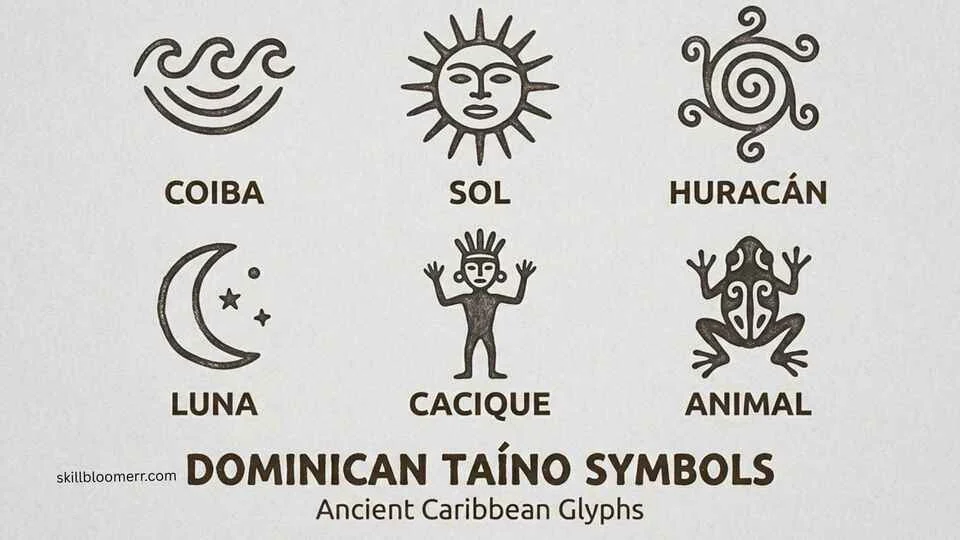
Dominican Taíno symbols are among the most recognizable artistic expressions of the Indigenous Taíno people who inhabited Hispaniola long before European contact. Today, these symbols appear in Dominican art, jewelry, tattoos, museums, educational materials, architecture, cultural festivals, and heritage projects. Although many are widely admired for their striking geometric designs, their deeper meanings are often misunderstood.
These symbols were more than decorative motifs. They reflected beliefs about nature, ancestry, leadership, fertility, the cosmos, and the relationship between humans and spiritual beings known as zemís.
Understanding Dominican Taíno symbols provides valuable insight into the island’s Indigenous history, the worldview of the Taíno civilization, and the ways their cultural legacy continues to influence Dominican identity.
Quick Meaning of Dominican Taíno Symbols:
Dominican Taíno symbols represent the spiritual, natural, and social beliefs of the Indigenous Taíno people of Hispaniola. Rather than forming a standardized symbolic alphabet, these carvings, petroglyphs, and artistic motifs conveyed ideas about fertility, ancestors, celestial bodies, sacred spirits (zemís), protection, leadership, and harmony with the natural world.
Symbol Overview Table
| Feature | Information |
| Symbol Name | Dominican Taíno Symbols |
| Primary Meaning | Spiritual connection, nature, ancestry, fertility, protection, cosmic balance |
| Category | Indigenous cultural symbols |
| Origin | Caribbean, especially Hispaniola |
| Civilization | Taíno Culture |
| Historical Period | Approximately AD 800–1492, with earlier Indigenous influences |
| Primary Materials | Stone, cave walls, wood, shell, bone, cotton, ceramics, gold |
| Common Forms | Petroglyphs, pictographs, carved figures, ceremonial objects |
| Modern Usage | Jewelry, tattoos, cultural education, museums, public art |
| Religious Association | Taíno spirituality and zemí worship |
| Unicode | None |
| Emoji Equivalent | None |
| Related Symbols | Coquí motifs, sun faces, frog imagery, spiral motifs, cemí figures, cemi triangles |
What Do Dominican Taíno Symbols Mean?
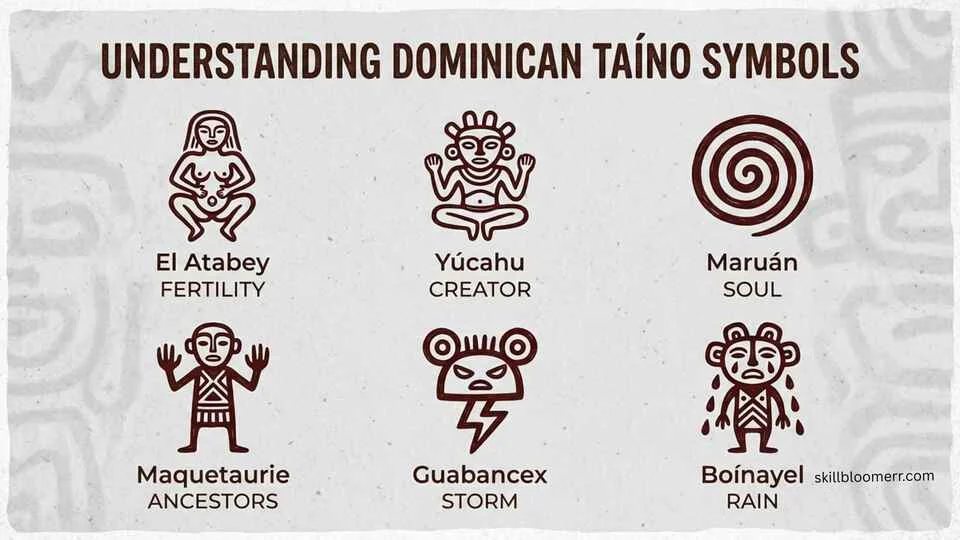
Dominican Taíno symbols communicate ideas rather than words. They represent relationships between people, ancestors, spirits, animals, and the environment.
Unlike modern writing systems, there is no confirmed evidence that the Taíno possessed a complete alphabet composed of these symbols. Most surviving designs come from archaeological discoveries, including cave art, carved stones, ceremonial stools (duhos), pottery, and religious objects.
Their meanings are interpreted through a combination of archaeology, Spanish colonial chronicles, ethnography, and comparisons with other Arawakan-speaking peoples.
Several recurring themes appear throughout Taíno symbolism:
- Respect for nature
- Cycles of life and death
- Agricultural abundance
- Sacred ancestry
- Community identity
- Cosmic order
- Communication with spirits
- Protection from unseen forces
Many symbols likely held multiple meanings depending on where they appeared and how they were used.
History and Origin
Indigenous Roots in Hispaniola
Dominican Taíno symbols originated among the Taíno communities that flourished across Hispaniola before the arrival of Christopher Columbus in 1492.
The Taíno belonged to the larger Arawakan language family. Their ancestors migrated northward through South America into the Caribbean over many centuries.
By the late fifteenth century, sophisticated Taíno chiefdoms occupied much of present-day Dominican Republic and Haiti.
Development of Symbolic Art
Taíno artistic traditions evolved gradually.
Symbols appeared on:
- Cave walls
- Rock shelters
- Ceremonial plazas
- Pottery
- Wooden sculptures
- Cotton textiles
- Personal ornaments
- Stone tools
- Ritual objects
Many symbols remained consistent across different Caribbean islands while others reflected regional artistic preferences.
Influence of Earlier Cultures
Some motifs may trace their origins to earlier Indigenous groups such as the Igneri and Ostionoid cultures.
Archaeologists believe that Taíno artistic traditions absorbed earlier Caribbean designs while developing new religious imagery connected with zemí worship.
Survival After European Contact
European colonization devastated the Taíno population through disease, forced labor, warfare, and social disruption.
Although many ceremonial traditions disappeared, archaeological sites preserved thousands of carvings that continue to inform researchers today.
Modern Dominican communities increasingly recognize these symbols as part of their national heritage.
Symbolism and Interpretation
Traditional Meanings
Traditional Taíno symbolism centered on maintaining balance between humanity and the natural world.
Common symbolic themes include:
- Rain bringing crops
- Rivers providing life
- Mountains serving as sacred places
- Animals acting as spiritual messengers
- Ancestors protecting descendants
- Celestial bodies regulating time
Spiritual Power
Many symbols represented zemís.
A zemí could refer to:
- A deity
- An ancestral spirit
- A sacred object
- A carved idol
- A spiritual force inhabiting nature
Because spiritual power was believed to exist throughout the environment, symbols often connected humans with invisible forces.
Positive Symbolism
Positive meanings commonly include:
- Prosperity
- Harmony
- Community
- Fertility
- Wisdom
- Guidance
- Protection
- Renewal
- Agricultural success
Negative Associations
Few Taíno symbols represented evil in the modern sense.
Instead, certain figures reminded communities of:
- Natural disasters
- Death
- Illness
- Spiritual imbalance
- Human responsibility toward nature
These symbols encouraged respect rather than fear.
Psychological Interpretation
Modern scholars sometimes interpret recurring circular, spiral, and symmetrical patterns as visual expressions of interconnectedness.
While psychological interpretations can be useful, they should not replace archaeological evidence or Indigenous traditions.
Cultural Significance
Dominican Taíno symbols remain important because they preserve Indigenous identity despite centuries of cultural change.
Dominican Republic
In the Dominican Republic, these symbols appear in:
- Schools
- Museums
- National parks
- Cultural centers
- Government heritage projects
- Public sculptures
- Artisan markets
Many Dominicans view them as reminders that Indigenous heritage remains part of the nation’s cultural identity.
Puerto Rico
Puerto Rican communities also preserve similar Taíno imagery, particularly petroglyphs and zemí representations.
Although artistic styles differ slightly, many symbols share common origins.
Cuba
Eastern Cuba contains numerous archaeological sites showing related Taíno artistic traditions.
These discoveries demonstrate cultural connections across the Greater Antilles.
Caribbean Identity
Across the Caribbean, Taíno symbols increasingly serve as symbols of Indigenous resilience, historical memory, and cultural continuity.
Religious or Spiritual Meaning
Taíno spirituality was deeply intertwined with symbolic art.
Zemís
The most sacred religious objects represented zemís.
These figures were believed to house spiritual beings capable of influencing:
- Rain
- Crops
- Hunting
- Health
- Leadership
- Community well-being
Ancestor Worship
Ancestors remained active members of community life.
Symbols carved into ceremonial objects often honored deceased leaders whose wisdom continued beyond death.
Sacred Animals
Several animals carried spiritual significance.
Examples include:
- Frogs representing rain and fertility
- Birds symbolizing communication between earthly and spiritual realms
- Turtles representing endurance and creation
- Bats associated with caves and ancestral worlds
Ceremonial Spaces
Many petroglyphs appear near caves.
Taíno communities considered caves sacred because they were associated with:
- Origins of humanity
- Birth
- Death
- Ancestors
- Spiritual transformation
Scientific or Technical Meaning
Dominican Taíno symbols do not possess standardized scientific or mathematical meanings.
However, researchers study them using several scientific disciplines.
Archaeology
Excavations reveal how symbols were carved, painted, and used in ceremonial contexts.
Anthropology
Anthropologists compare Taíno symbolism with related Indigenous Caribbean cultures to better understand shared beliefs.
Linguistics
Because no confirmed Taíno writing system survives, linguists rely on early Spanish records and surviving Arawakan languages when interpreting symbolic meanings.
Digital Preservation
Modern technologies now include:
- 3D laser scanning
- Photogrammetry
- Geographic Information Systems (GIS)
- Digital cave mapping
These methods help preserve fragile petroglyphs without damaging them.
Where the Symbol Is Used
Today, Dominican Taíno symbols appear in many settings.
Museums
National museums display authentic archaeological artifacts that preserve original designs.
Jewelry
Artisans create necklaces, bracelets, pendants, and earrings inspired by traditional motifs.
Tattoos
Many people choose Taíno-inspired tattoos to celebrate Caribbean ancestry.
Experts recommend researching the historical meaning of a design before adopting it permanently.
Architecture
Public buildings occasionally incorporate Taíno-inspired carvings into decorative elements.
Education
Teachers use these symbols to explain pre-Columbian Caribbean history.
Tourism
Historic parks and archaeological sites often feature reproductions of famous petroglyphs.
Visual Arts
Contemporary Dominican artists reinterpret ancient motifs using painting, sculpture, ceramics, and graphic design.
Common Variations
Because Taíno symbols were handcrafted rather than standardized, considerable variation exists.
Sun Faces
Circular faces surrounded by rays symbolize life, warmth, and cosmic order.
Some feature smiling expressions, while others appear solemn.
Spiral Motifs
Spirals often represent cycles, movement, water, or life’s continuous renewal.
Cemí Figures
Three-pointed stones called cemís vary greatly in appearance depending on their ceremonial purpose.
Animal Motifs
Common animal imagery includes:
- Frogs
- Owls
- Bats
- Birds
- Fish
- Turtles
Each animal could represent different qualities within specific communities.
Human Figures
Some carvings portray chiefs, ancestors, dancers, or spiritual beings with exaggerated facial features.
Common Misconceptions
Misconception 1: Every Taíno symbol has one fixed meaning.
Reality: Meanings likely varied by community, context, and ceremonial use.
Misconception 2: Taíno symbols formed a complete alphabet.
Current archaeological evidence does not support this claim.
Misconception 3: Modern internet charts accurately identify every symbol.
Many online interpretations lack archaeological support or combine unrelated Indigenous traditions.
Misconception 4: All Caribbean Indigenous symbols are Taíno.
Other Indigenous Caribbean cultures developed their own artistic traditions.
Misconception 5: Taíno culture disappeared completely.
Although colonization caused devastating losses, descendants, traditions, vocabulary, foods, and cultural practices continue to influence Caribbean societies today.
Interesting Facts
- Thousands of Taíno petroglyphs remain preserved in caves throughout the Dominican Republic.
- Many sacred carvings were created near freshwater sources, highlighting water’s spiritual importance.
- The famous three-pointed cemí stones may have symbolized mountains, fertility, or powerful spirits.
- Gold ornaments called guanín carried ceremonial value beyond their material worth.
- Taíno artists often emphasized expressive facial features to communicate spiritual presence.
- Cave art frequently combines human and animal characteristics, suggesting connections between people and sacred beings.
- Several Dominican place names preserve Taíno language despite the decline of the spoken language.
- Modern archaeological imaging reveals carvings too weathered to recognize with the naked eye.
- Contemporary Indigenous revival movements encourage respectful learning rather than commercial misuse of sacred imagery.
- Many symbols were carved into ceremonial seats used by chiefs during important rituals.
Related Symbols
| Symbol | Relationship | Difference |
| Three-Pointed Cemí | Sacred Taíno object | Specifically linked to spiritual beings and fertility |
| Sun Face | Represents life and cosmic order | More focused on celestial symbolism |
| Spiral | Symbolizes cycles and continuity | Appears in many world cultures independently |
| Frog Motif | Associated with rain and fertility | Animal-specific symbolism |
| Turtle Motif | Connected with endurance and creation | Represents longevity rather than leadership |
| Bird Motif | Spiritual messenger | Often linked with communication between worlds |
Decision Guide: Choosing the Right Interpretation
Are you studying archaeology?
→ Focus on excavated context and scholarly research.
Interested in cultural heritage?
→ Learn how modern Dominican communities honor Taíno traditions.
Considering a tattoo?
→ Research the specific design, avoid generic internet charts, and understand its historical context.
Creating educational material?
→ Distinguish clearly between evidence-based interpretations and modern artistic adaptations.
Frequently Asked Questions
Are Dominican Taíno symbols a written language?
No. Archaeologists have not found evidence that these symbols formed a complete writing system. Instead, they functioned primarily as religious, artistic, ceremonial, and cultural imagery expressing beliefs, identity, and relationships with the spiritual world.
What is the most famous Taíno symbol?
One of the best-known is the three-pointed cemí, a sacred object associated with fertility, mountains, ancestors, and spiritual power. Sun-face carvings and anthropomorphic petroglyphs are also widely recognized.
Can anyone wear Dominican Taíno symbols?
Many people wear Taíno-inspired jewelry or tattoos out of admiration or ancestral pride. Respectful use includes learning the symbol’s history, avoiding invented meanings, and recognizing that some designs had sacred ceremonial purposes.
Why are caves important in Taíno symbolism?
Caves were viewed as sacred places connected with creation stories, ancestors, birth, and the spiritual world. This explains why many important petroglyphs are found inside caves throughout Hispaniola.
What is a zemí?
A zemí is a sacred being, spirit, ancestor, or object within Taíno religion. Carved zemí figures were believed to contain spiritual power and played central roles in ceremonies and community life.
Did every Caribbean island use identical symbols?
No. While many motifs were shared across the Greater Antilles, regional artistic styles developed unique variations influenced by local traditions, resources, and communities.
Why are Taíno symbols popular in modern Dominican culture?
They celebrate Indigenous heritage, strengthen cultural identity, inspire artists, and educate new generations about the island’s history before European colonization.
How do archaeologists interpret Taíno symbols?
Researchers combine archaeological evidence, excavation context, colonial-era chronicles, ethnographic comparisons, linguistic studies, and scientific analysis. Because written explanations from the Taíno themselves do not survive, some interpretations remain informed hypotheses rather than proven facts.
Are online symbol charts always reliable?
No. Many online charts assign modern meanings without historical evidence. Reliable interpretations come from museum collections, archaeological research, peer-reviewed publications, and respected academic institutions.
Key Takeaways
- Dominican Taíno symbols express Indigenous Caribbean beliefs about nature, ancestry, and spirituality.
- They are symbolic motifs rather than a confirmed alphabet.
- Many designs appear in caves, ceremonial objects, pottery, and carved stone.
- Zemís were central to Taíno religious life.
- Meanings often depended on context and community traditions.
- Modern Dominicans continue to preserve and celebrate Taíno artistic heritage.
- Archaeology remains the primary source for understanding these symbols.
- Respectful interpretation requires distinguishing historical evidence from modern speculation.
Conclusion
Dominican Taíno symbols are enduring reminders of one of the Caribbean’s most influential Indigenous civilizations. Their carvings, sacred figures, geometric patterns, and animal motifs reveal a worldview centered on harmony between humanity, nature, ancestors, and the spiritual realm.
While some meanings remain open to scholarly interpretation, archaeological discoveries and historical records clearly demonstrate that these symbols served important ceremonial, cultural, and social purposes. Today, they continue to inspire artists, educators, historians, and people seeking a deeper connection with the Indigenous heritage of the Dominican Republic and the wider Caribbean.
I’m Nathaniel Brooks, an educational writer who loves exploring ideas and making useful knowledge accessible to everyone. I write for SkillBloomerr with a focus on clear explanations, practical tips, and meaningful learning. My goal is to help readers discover something valuable every time they visit the site.
Books: Learn Something New and The Practical Knowledge Handbook
 Charlotte Winslow
 Ethan Calloway