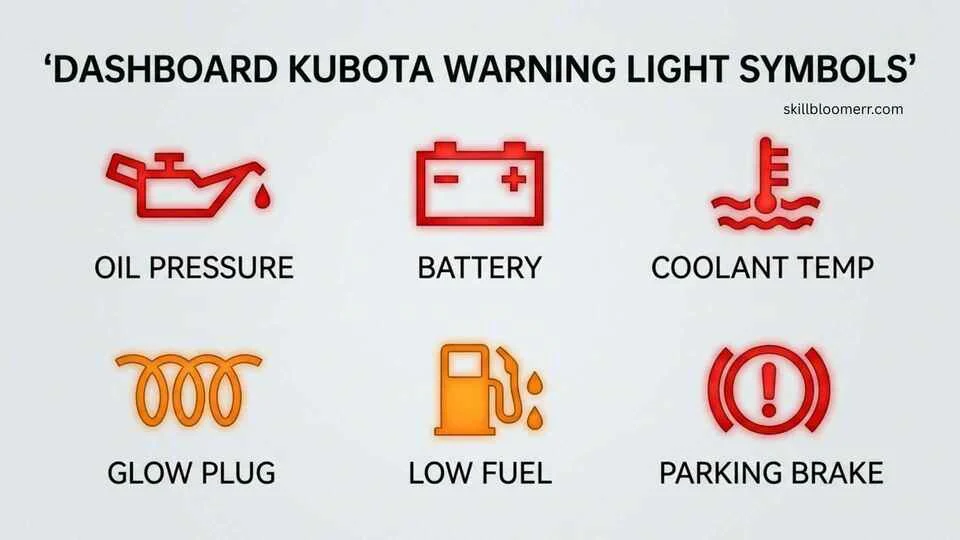
Dashboard Kubota warning light symbols are visual alerts designed to help operators monitor the condition of their tractor, utility vehicle, mower, excavator, or other Kubota equipment. These symbols communicate everything from routine operating conditions to urgent mechanical problems that require immediate attention.
Understanding what each light means can help prevent equipment damage, reduce repair costs, improve safety, and keep your machine running efficiently.
Whether you own a compact tractor for landscaping, an agricultural tractor for farming, a zero-turn mower, or construction equipment, you’ll encounter dashboard indicators during normal operation. Some lights simply confirm that a system is active, while others warn of overheating, low oil pressure, battery charging problems, hydraulic issues, or engine faults.
This guide explains the meaning of the most common dashboard Kubota warning light symbols, their history, technical purpose, variations across Kubota models, and the practical steps you should take when each indicator appears. By the end, you’ll be able to recognize important warning lights quickly and respond appropriately to protect both your machine and your safety.
Quick Meaning
Dashboard Kubota warning light symbols are standardized visual indicators that display the operating status, maintenance reminders, and warning conditions of Kubota equipment. Green and blue lights usually indicate normal system operation, while yellow, orange, and red lights signal maintenance needs or mechanical problems that may require immediate attention.
Symbol Overview Table
| Feature | Details |
| Symbol Name | Dashboard Kubota Warning Light Symbols |
| Category | Vehicle Dashboard Indicators |
| Primary Meaning | Communicate machine status, warnings, and faults |
| Industry | Agriculture, Construction, Landscaping, Utility Equipment |
| Manufacturer | Kubota Corporation |
| Origin | Instrument Panel Safety Indicators |
| First Known Use | Introduced with modern instrument clusters in agricultural machinery |
| Common Usage | Tractors, Excavators, Utility Vehicles, Zero-Turn Mowers, Compact Equipment |
| Modern Meaning | Real-time monitoring of mechanical and electronic systems |
| Unicode | Not Applicable |
| Emoji Equivalent | None |
| Related Symbols | Check Engine Light, Oil Pressure Warning, Battery Indicator, Coolant Temperature Warning, PTO Indicator, Glow Plug Light |
What Does the Symbol Mean?

Dashboard Kubota warning light symbols provide immediate information about your machine’s operating condition. Instead of relying on gauges alone, modern Kubota equipment uses illuminated icons that are easier to recognize at a glance, even while working in fields, construction sites, or landscaping projects.
Each symbol corresponds to a specific vehicle system. Some indicate that a function has been activated, while others alert the operator to a developing problem before it becomes severe.
Understanding the Color System
The color of a warning light is just as important as its shape.
Green Indicators
Green lights generally confirm that a feature is operating normally.
Examples include:
- PTO engagement
- Four-wheel drive activation
- Cruise control
- Operating lights
- Turn signals
These lights usually do not indicate a problem.
Blue Indicators
Blue symbols normally show that certain lighting systems are active.
Examples include:
- High beam headlights
- Special work lights on selected models
Blue lights are informational rather than warnings.
Yellow or Orange Warning Lights
Yellow or amber indicators advise caution.
They often point to conditions such as:
- Engine management alerts
- Fuel system warnings
- Diesel particulate filter (DPF) regeneration
- Maintenance reminders
- Hydraulic system notifications
- Air cleaner restrictions
These warnings usually allow limited operation but should not be ignored.
Red Warning Lights
Red warning lights indicate serious conditions that may cause equipment damage if operation continues.
Examples include:
- Low engine oil pressure
- High coolant temperature
- Charging system failure
- Brake system warnings
- Critical hydraulic problems
Whenever a red warning light appears, the safest approach is to stop the machine as soon as it can be done safely and investigate the cause.
Common Dashboard Kubota Warning Light Symbols Explained
Although exact symbols vary by model, most Kubota machines share a common design philosophy. Learning these common indicators makes it easier to operate different Kubota equipment confidently.
Engine Oil Pressure Warning
This symbol usually resembles an old-fashioned oil can with a drop of oil.
Meaning
The engine oil pressure has fallen below the safe operating level.
Possible Causes
- Low engine oil
- Oil pump failure
- Blocked oil filter
- Internal engine wear
- Incorrect engine oil
What You Should Do
- Stop the engine immediately.
- Check the oil level.
- Add the recommended oil if necessary.
- If the light remains on, avoid restarting the engine until it has been inspected.
Ignoring this warning can result in severe engine damage within minutes.
Engine Coolant Temperature Warning
This symbol commonly shows a thermometer above waves representing coolant.
Meaning
The engine is overheating.
Possible Causes
- Low coolant
- Clogged radiator
- Broken cooling fan
- Damaged water pump
- Heavy engine load
- Dirty radiator fins
Recommended Action
- Reduce engine load.
- Park safely.
- Allow the engine to cool.
- Never remove the radiator cap while the engine is hot.
- Inspect coolant levels after cooling.
Battery Charging System Warning
The battery symbol is one of the easiest dashboard indicators to recognize.
Meaning
The alternator or charging system is not supplying sufficient electrical power.
Possible Causes
- Loose alternator belt
- Faulty alternator
- Weak battery
- Broken wiring
- Corroded battery terminals
Recommended Action
Continue operating only if necessary to reach a safe location. Electrical power may become depleted, eventually causing the engine to shut down or fail to restart.
Check Engine Warning Light
The engine-shaped icon monitors emissions and engine management systems.
Meaning
The electronic control unit (ECU) has detected a fault.
Possible Causes
- Faulty sensor
- Fuel injection issue
- Emission control problem
- Electrical malfunction
- Air intake problem
Recommended Action
The machine may continue operating, but diagnostic trouble codes should be read using approved service equipment.
Glow Plug Indicator
Found on diesel-powered Kubota equipment.
Meaning
Glow plugs are heating the combustion chamber before starting.
Normal Operation
Wait until the light turns off before starting the engine.
If the indicator flashes unexpectedly, it may indicate a malfunction within the glow plug circuit.
PTO Indicator
The Power Take-Off indicator confirms PTO engagement.
Meaning
The PTO shaft is transmitting power to an implement.
Common implements include:
- Rotary cutters
- Finish mowers
- Tillers
- Snow blowers
- Balers
- Spreaders
Before leaving the operator’s seat, always ensure the PTO has been disengaged.
Four-Wheel Drive Indicator
This symbol confirms that front-wheel drive has been engaged.
Purpose
It improves:
- Traction
- Hill climbing
- Mud performance
- Snow operation
- Loader work
Driving continuously on dry pavement with four-wheel drive engaged may increase drivetrain wear on some models.
Parking Brake Warning
This indicator reminds the operator that the parking brake remains engaged.
If the light stays illuminated while driving, release the brake to avoid unnecessary brake wear and reduced performance.
Fuel Level Warning
Usually displayed as a fuel pump icon.
Meaning
The fuel tank is approaching empty.
Running diesel equipment completely out of fuel may require bleeding air from the fuel system before restarting.
Hydraulic System Warning
Hydraulic symbols vary depending on the Kubota model.
They may indicate:
- Hydraulic oil overheating
- Low hydraulic pressure
- Hydraulic filter restrictions
- System malfunction
Hydraulic problems should be investigated promptly because they affect steering, loaders, implements, and transmission performance.
Diesel Particulate Filter (DPF) Indicator
Many newer Kubota diesel engines include a Diesel Particulate Filter.
The DPF warning light may indicate:
- Automatic regeneration
- Parked regeneration required
- Regeneration interrupted
- Excessive soot accumulation
Ignoring repeated DPF warnings can eventually reduce engine performance and place the machine into a protective operating mode.
Seat Belt Reminder
Some Kubota utility vehicles and construction machines include a seat belt warning.
The indicator encourages operators to fasten their seat belts before movement begins.
This feature is particularly important when operating equipment on uneven ground or steep slopes.
Air Cleaner Restriction Indicator
Dusty environments can clog the engine air filter.
This warning tells the operator that airflow into the engine has become restricted.
Replacing or cleaning the filter according to Kubota maintenance recommendations helps maintain engine efficiency and fuel economy.
Water in Fuel Warning
Diesel fuel systems sometimes collect water through condensation or contaminated fuel.
When this symbol appears:
- Drain the water separator.
- Replace the fuel filter if necessary.
- Use clean diesel fuel.
Water contamination can damage injectors and reduce engine performance.
Transmission Warning Light
Hydrostatic and powershift transmissions may display transmission-related warning symbols.
Possible causes include:
- High transmission temperature
- Low transmission fluid
- Internal transmission fault
- Sensor malfunction
Prompt diagnosis helps prevent expensive transmission repairs.
Brake System Warning
This symbol indicates that part of the braking system requires attention.
Potential reasons include:
- Brake malfunction
- Low brake fluid (on applicable models)
- Parking brake engaged
- Electronic brake issue
Do not continue operating if braking performance feels abnormal.
History and Origin

Dashboard Kubota warning light symbols did not appear overnight. They evolved alongside advances in agricultural machinery, engine technology, electronics, and international safety standards. While early Kubota tractors relied almost entirely on mechanical gauges, modern equipment combines analog instruments with illuminated symbols that quickly communicate the machine’s condition.
Early Kubota Instrument Panels
Kubota Corporation, founded in 1890 in Osaka, Japan, originally manufactured cast iron products before expanding into engines and agricultural equipment. Early tractors produced during the mid-20th century featured simple dashboards with only essential gauges such as:
- Fuel level
- Engine temperature
- Oil pressure
- Ammeter
- Tachometer
Operators had to watch these gauges continuously because warning lights were limited or nonexistent.
Transition to Warning Indicators
As diesel engines became more sophisticated during the 1970s and 1980s, Kubota introduced more dashboard indicators to improve operator awareness.
Instead of constantly interpreting gauge readings, operators could immediately recognize a warning light when something required attention.
This transition offered several advantages:
- Faster recognition of faults
- Reduced engine damage
- Improved operator safety
- Easier operation for new users
- Better maintenance planning
Influence of International Standards
Modern Kubota dashboard symbols are not designed randomly. Many follow internationally recognized pictograms developed under standards such as:
- ISO 2575 – Road vehicle symbols for controls and indicators
- ISO 3767 – Symbols used on agricultural and forestry machinery
- Other regional machinery safety regulations
Using standardized icons allows operators from different countries and languages to understand critical warnings without relying solely on written text.
The Digital Dashboard Era
Today’s Kubota tractors, excavators, RTVs, and commercial mowers often include:
- LCD information displays
- Multifunction digital screens
- Electronic Control Units (ECUs)
- Onboard diagnostics
- Automatic maintenance reminders
- Fault code displays
- Regeneration status indicators for diesel particulate filters (DPFs)
Rather than replacing traditional warning symbols, these technologies work together to provide more detailed information while keeping universally recognizable icons on the dashboard.
Why Dashboard Symbols Continue to Evolve
Modern machines contain far more sensors than earlier models. Electronic monitoring now covers systems such as:
- Engine management
- Fuel injection
- Emissions control
- Hydraulic pressure
- Transmission temperature
- Battery charging
- PTO engagement
- Operator presence
- Seat belt status
As equipment becomes smarter, dashboard symbols continue evolving to represent new technologies while remaining easy to recognize.
Symbolism and Interpretation
Dashboard Kubota warning light symbols are practical rather than artistic, but they still carry symbolic meaning. Their shapes, colors, and placement are carefully chosen to communicate urgency and machine status in seconds.
Traditional Functional Meaning
Unlike religious or cultural symbols, dashboard indicators are designed with one primary purpose: communication.
Every icon answers one of three questions:
- Is everything working normally?
- Does something require attention soon?
- Should the machine be stopped immediately?
This hierarchy allows operators to make quick decisions without reading lengthy instructions.
Color Psychology
The color of each warning light plays a significant role in how operators respond.
Green: Safe Operation
Green symbolizes normal operation and active functions.
Examples include:
- PTO engaged
- Four-wheel drive enabled
- Cruise control active
Green indicators reassure the operator that a selected feature is functioning correctly.
Blue: Information
Blue lights typically indicate lighting functions such as high beams.
They provide information rather than warnings.
Amber or Yellow: Caution
Yellow represents awareness rather than danger.
These symbols encourage the operator to:
- Schedule maintenance
- Monitor system performance
- Investigate minor issues before they worsen
Ignoring repeated amber warnings can eventually lead to more serious problems.
Red: Immediate Danger
Red universally represents urgency.
On Kubota equipment, a red warning light usually means:
- Stop operating if it is safe to do so.
- Investigate the cause immediately.
- Prevent expensive mechanical damage.
Why Simple Icons Work Better Than Words
Kubota equipment is sold worldwide. Operators may speak different languages, but a simple oil can or thermometer icon is almost universally understood.
This universal design offers several benefits:
- Faster recognition
- Reduced translation needs
- Lower risk of misunderstanding
- Improved safety across international markets
Psychological Interpretation
Dashboard warning lights also influence operator behavior.
Research in human factors engineering has shown that simple visual symbols help people process urgent information more quickly than written messages, especially during demanding tasks such as plowing, mowing, excavation, or loader work.
A flashing red light naturally draws attention, prompting immediate action.
Cultural Significance
Unlike ancient symbols that carry religious or historical meaning, dashboard Kubota warning light symbols have a technical purpose. However, they also reflect a broader global culture of machinery safety and standardized communication.
Universal Visual Language
Modern agricultural and construction equipment is used in nearly every region of the world.
Because operators speak many different languages, internationally recognized symbols reduce communication barriers.
Whether the machine is operating in:
- North America
- Europe
- Japan
- Australia
- South America
- Africa
the same warning light generally conveys the same message.
Agriculture Across Cultures
Farmers around the world depend on reliable equipment during planting, harvesting, irrigation, and land preparation.
A misunderstood warning light could lead to:
- Crop delays
- Costly repairs
- Lost productivity
- Unsafe operating conditions
For this reason, standardized symbols have become part of the global language of agriculture.
Construction and Industrial Equipment
Kubota also manufactures compact excavators, skid steers, wheel loaders, and utility vehicles used internationally.
Operators frequently move between different machine brands. Consistent dashboard symbols help experienced operators adapt more quickly, reducing training time and improving workplace safety.
Educational Importance
Agricultural schools, vocational training programs, and equipment certification courses often teach students how to recognize dashboard warning symbols before they operate machinery independently.
This knowledge has become a core part of modern equipment safety education.
Religious or Spiritual Meaning
Dashboard Kubota warning light symbols do not have an established religious, spiritual, or ceremonial meaning.
Their purpose is entirely technical and operational.
Why Some People Assign Symbolic Meanings
People naturally interpret symbols beyond their intended use. Because dashboard icons can resemble everyday objects or abstract shapes, some individuals mistakenly associate them with spiritual signs or personal omens.
For example:
- A glowing engine icon is sometimes jokingly referred to as a “bad luck” sign.
- A red warning light may be seen as a symbolic reminder to slow down or exercise caution in life.
These interpretations are personal metaphors rather than recognized religious beliefs.
No Connection to Religious Traditions
There is no evidence that Kubota warning symbols are connected to:
- Christianity
- Islam
- Hinduism
- Buddhism
- Judaism
- Shinto
- Taoism
- Indigenous spiritual traditions
Their designs are based on engineering standards, ergonomics, and international safety practices—not on sacred imagery or religious symbolism.
Practical Meaning Over Symbolic Meaning
The true value of these symbols lies in their ability to protect:
- The operator
- The machine
- Nearby workers
- Attached implements
- The surrounding environment
Treating dashboard warnings as practical maintenance alerts rather than symbolic messages helps ensure safe and efficient equipment operation.
Scientific or Technical Meaning
Dashboard Kubota warning light symbols are technical communication tools that translate data from sensors, switches, and electronic control systems into simple visual alerts. Instead of requiring the operator to interpret raw measurements, the machine converts complex information into standardized icons that can be understood in seconds.
Modern Kubota equipment continuously monitors dozens of operating conditions. When a reading moves outside its acceptable range, the control system activates the appropriate dashboard symbol.
How Dashboard Warning Symbols Work
Most modern Kubota machines use a network of sensors connected to an Electronic Control Unit (ECU) or instrument cluster.
The process works as follows:
- A sensor measures a system condition.
- The sensor sends an electrical signal.
- The ECU compares the reading with factory-programmed limits.
- If necessary, the dashboard illuminates a warning light.
- Some models also store a diagnostic trouble code (DTC) for service technicians.
This system allows problems to be identified long before complete mechanical failure occurs.
Common Sensors Behind the Warning Lights
Different dashboard symbols are triggered by different sensors.
| Dashboard Symbol | Monitored Component |
| Oil Pressure | Oil pressure sensor |
| Coolant Temperature | Coolant temperature sensor |
| Battery Warning | Charging system voltage |
| Fuel Warning | Fuel level sensor |
| Hydraulic Warning | Hydraulic pressure or temperature sensor |
| DPF Warning | Exhaust pressure and temperature sensors |
| Check Engine | Multiple engine management sensors |
| Transmission Warning | Transmission temperature or pressure sensor |
Electronic Diagnostics
Many newer Kubota tractors and construction machines support onboard diagnostics.
When the Check Engine light appears, technicians may connect diagnostic equipment to retrieve:
- Active fault codes
- Stored fault codes
- Sensor readings
- Engine operating history
- Regeneration history (DPF-equipped models)
This reduces troubleshooting time and helps identify the root cause instead of replacing parts unnecessarily.
Importance of Calibration
Sensors must remain properly calibrated.
A faulty sensor may:
- Trigger false warning lights
- Fail to detect genuine problems
- Cause unnecessary downtime
- Lead to incorrect repairs
For this reason, replacement sensors should meet Kubota specifications.
Decision Tree: What Should You Do When a Warning Light Appears?
Question: What color is the warning light?
Green or Blue
↓
Continue operating normally. The light is informational and indicates that a system or feature is active.
Yellow or Amber
↓
Reduce heavy workloads if possible. Check the operator’s manual, inspect the relevant system, and arrange maintenance soon. If the machine behaves unusually, stop and investigate.
Red
↓
Stop the machine safely as soon as possible. Shut down the engine if instructed by the operator’s manual. Inspect the cause or contact an authorized Kubota service technician before continuing operation.
This simple approach helps prevent unnecessary damage and improves operator safety.
Where the Symbol Is Used
Dashboard Kubota warning light symbols appear across a wide range of Kubota equipment. While the exact layout and icon design may vary by model and production year, their purpose remains consistent: to provide immediate information about the machine’s operating condition.
Compact Tractors
Compact tractors are among the most common Kubota products used by homeowners, landscapers, municipalities, and small farms.
Typical dashboard indicators include:
- Oil pressure
- Engine temperature
- Battery charging
- PTO engagement
- Four-wheel drive
- Parking brake
- Fuel level
- Glow plug
These indicators help operators monitor the tractor during mowing, grading, tilling, loader work, and snow removal.
Agricultural Tractors
Larger agricultural tractors often include additional warning symbols for:
- Hydraulic systems
- Differential lock
- Transmission status
- PTO speed
- Air intake restriction
- DEF or emissions systems (where applicable)
Because these tractors frequently operate for long hours under heavy loads, warning indicators play a crucial role in preventing costly downtime during planting and harvesting seasons.
Compact Excavators
Kubota excavators use dashboard indicators to monitor systems such as:
- Hydraulic oil temperature
- Engine temperature
- Fuel level
- Battery charging
- Engine diagnostics
- Hydraulic filter condition
Operators working on construction sites rely on these alerts to maintain safe operation and avoid unexpected equipment failures.
Utility Vehicles (RTVs)
Kubota RTVs combine agricultural durability with on-road-style dashboard features.
Common indicators include:
- Seat belt reminder
- Parking brake
- High beam
- Battery warning
- Engine warning
- Fuel level
- Four-wheel drive status
These vehicles are commonly used on farms, campuses, industrial sites, and recreational properties.
Zero-Turn and Commercial Mowers
Commercial mowing equipment often features warning symbols related to:
- Engine oil
- Fuel
- PTO engagement
- Engine overheating
- Charging system
- Maintenance intervals
Proper attention to these indicators helps maximize engine life during extended mowing operations.
Operator Manuals
The most authoritative explanation of any dashboard symbol is always the operator’s manual supplied for the specific Kubota model.
Although many icons are standardized, certain specialized machines may include unique indicators that do not appear on other equipment.
Common Variations
Not every Kubota dashboard looks the same. Symbol appearance, display style, and available indicators vary depending on the machine type, model year, engine technology, and market.
Understanding these variations helps prevent confusion when operating different Kubota equipment.
Analog Instrument Panels
Older Kubota models primarily use analog gauges with a small number of warning lights.
These dashboards typically include:
- Oil pressure
- Battery
- Temperature
- Fuel
- Glow plug
- High beam
Their simplicity makes them reliable and easy to understand.
Digital Instrument Clusters
Newer Kubota equipment often features LCD or TFT displays that combine traditional warning symbols with digital information such as:
- Engine hours
- Fuel consumption
- Maintenance reminders
- Fault codes
- Hydraulic settings
- PTO speed
- Transmission information
The symbols remain familiar, but additional text may provide more detailed explanations.
Flashing vs. Steady Lights
Some warning lights behave differently depending on the severity of the condition.
Steady Light
A steady light often indicates:
- A system is active
- Routine maintenance is due
- A non-critical fault has been detected
Flashing Light
A flashing indicator usually signals a condition requiring more immediate attention, such as:
- Interrupted DPF regeneration
- Active engine fault
- Electrical malfunction
- Critical operating condition
Always refer to the specific operator’s manual to interpret flashing symbols correctly.
Regional Differences
Kubota sells equipment in many countries, including the United States, Canada, Europe, Australia, and Japan.
Although the symbols themselves remain largely standardized, regional differences may include:
- Metric versus imperial measurements
- Emissions-related indicators
- Language displayed on digital screens
- Regulatory warning messages
Model-Specific Symbols
Certain Kubota machines include specialized indicators for unique equipment features.
Examples may include:
- Auto-throttle systems
- Advanced hydraulic controls
- Implement management
- Regeneration controls
- Electronic transmission modes
- Suspension or ride-control systems
These symbols are usually documented in the machine’s operator manual and service literature.
Common Misconceptions
Many equipment owners misunderstand dashboard warning lights. Believing these myths can lead to unnecessary repairs—or worse, serious mechanical damage.
Misconception 1: Every Warning Light Means Stop Immediately
Not all warning lights indicate an emergency.
Green and blue indicators simply show that a feature is active.
Amber lights usually recommend inspection or maintenance.
Only certain red warnings require immediate shutdown.
Understanding the color system prevents unnecessary interruptions while still protecting the machine.
Misconception 2: The Check Engine Light Always Means Major Engine Damage
A Check Engine light does not automatically indicate catastrophic failure.
It may be triggered by:
- A faulty sensor
- An emissions issue
- Fuel system irregularities
- Electrical faults
- Minor performance problems
Even so, the light should never be ignored, as continued operation without diagnosis may allow a small issue to become more serious.
Misconception 3: Warning Lights Can Be Ignored if the Machine Feels Normal
Some mechanical problems develop before noticeable performance changes occur.
For example:
- Low oil pressure
- Charging system faults
- Air filter restrictions
- Hydraulic temperature increases
Ignoring early warnings may result in expensive repairs that could have been avoided.
Misconception 4: All Kubota Models Use Exactly the Same Symbols
While many dashboard icons are standardized, each Kubota model has its own instrument layout and feature set.
Construction equipment, compact tractors, RTVs, and commercial mowers may include different indicators based on their intended applications.
Always consult the operator’s manual for the exact meaning of unfamiliar symbols.
Misconception 5: Covering the Warning Light Solves the Problem
Occasionally, operators joke about placing tape over an illuminated warning light.
This does nothing to fix the underlying issue.
Dashboard symbols are symptoms—not causes.
The correct approach is to identify and repair the condition triggering the alert.
Misconception 6: After the Light Turns Off, the Problem Never Existed
Some faults are intermittent.
A loose electrical connection, temporary overheating, or sensor malfunction may cause a warning light to disappear temporarily.
If a warning returns repeatedly, the underlying issue should be diagnosed rather than dismissed.
Expert Tip: Build a Habit of Checking the Dashboard
Experienced operators often perform a quick dashboard scan every few minutes while working.
This simple habit helps identify developing problems before they become major repairs and can significantly extend the service life of Kubota equipment.
Interesting Facts
Dashboard Kubota warning light symbols may seem like simple dashboard icons, but they represent decades of engineering, safety research, and international standardization. Here are some lesser-known facts that help explain why these symbols are so important.
1. Most Dashboard Symbols Are Designed to Overcome Language Barriers
Kubota sells equipment in more than 100 countries and regions. Instead of displaying text in dozens of languages, standardized pictograms allow operators around the world to understand essential warnings regardless of their native language.
Why it matters: Universal symbols improve safety and reduce misunderstandings.
2. A Small Warning Light Can Prevent Thousands of Dollars in Repairs
An illuminated oil pressure or coolant temperature warning may appear before noticeable engine damage occurs.
Why it matters: Responding immediately to a critical warning can prevent engine seizure, warped cylinder heads, or damaged bearings.
3. The Oil Can Symbol Is One of the World’s Most Recognized Machine Icons
Although modern engines no longer use old-fashioned oil cans, the traditional oil can silhouette remains the international symbol for engine lubrication.
Why it matters: Consistent icon design allows experienced operators to recognize the warning instantly.
4. Dashboard Symbols Continue Working Even if You Don’t Notice Gauge Changes
Mechanical gauges require constant attention. Warning lights activate automatically when preset limits are exceeded.
Why it matters: Operators can focus more on their work while still being alerted to developing problems.
5. Not Every Illuminated Light Indicates a Problem
Many first-time owners become concerned whenever a dashboard light appears.
In reality, several indicators simply confirm normal operation, including:
- High beam headlights
- PTO engagement
- Four-wheel drive
- Turn signals
- Glow plugs during cold starting
Why it matters: Understanding the difference between information and warning lights prevents unnecessary concern.
6. Some Warning Lights Flash Instead of Staying On
A flashing symbol often carries a different meaning than the same symbol displayed steadily.
For example, a flashing DPF indicator may require operator action, while a steady light may simply indicate that regeneration is occurring.
Why it matters: Flashing lights usually deserve closer attention.
7. Modern Kubota Machines Monitor More Systems Than Older Models
Earlier tractors relied heavily on mechanical gauges.
Today’s equipment may continuously monitor:
- Engine performance
- Fuel systems
- Electrical charging
- Hydraulic pressure
- Transmission temperature
- Emissions equipment
- Electronic sensors
Why it matters: More monitoring helps identify faults earlier.
8. Dashboard Symbols Are Part of Preventive Maintenance
Many warning indicators do more than report failures.
Some remind operators to:
- Change engine oil
- Replace filters
- Service hydraulic systems
- Perform scheduled inspections
Why it matters: Preventive maintenance extends equipment life and reduces unexpected downtime.
9. The Same Symbol Can Have Slightly Different Behavior on Different Models
Although Kubota follows common design principles, newer models often provide additional information through digital displays.
For example, an engine warning light may appear alongside a fault code or maintenance message.
Why it matters: Always read the operator’s manual for your specific model.
10. Dashboard Symbols Are Designed Using Human Factors Engineering
Engineers carefully consider:
- Visibility in bright sunlight
- Recognition speed
- Color perception
- Operator workload
- Emergency response time
Why it matters: A well-designed dashboard helps operators make faster, safer decisions under real working conditions.
Related Symbols
Many dashboard Kubota warning light symbols resemble indicators found on automobiles and other heavy equipment, but each serves a specific purpose within agricultural and construction machinery.
| Related Symbol | Relationship | Key Difference |
| Check Engine Light | Indicates engine or ECU faults | Kubota may also monitor agricultural-specific systems. |
| Engine Oil Pressure Symbol | Warns of lubrication problems | Critical on all engines and usually requires immediate shutdown. |
| Battery Charging Symbol | Indicates charging system issues | Focuses on alternator, battery, or electrical circuit performance. |
| Coolant Temperature Symbol | Alerts to engine overheating | Helps prevent severe engine damage from excessive heat. |
| Fuel Warning Symbol | Indicates low fuel | Particularly important for diesel engines to avoid introducing air into the fuel system. |
| Hydraulic Warning Symbol | Monitors hydraulic operation | More prominent on tractors and excavators than passenger vehicles. |
| Glow Plug Indicator | Diesel engine starting aid | Unique to diesel-powered equipment and absent on gasoline engines. |
| PTO Indicator | Shows Power Take-Off engagement | Specific to agricultural machinery and certain commercial equipment. |
| Differential Lock Indicator | Confirms differential lock activation | Common on tractors operating in low-traction conditions. |
| DPF Regeneration Symbol | Monitors diesel emissions system | Found primarily on modern diesel equipment with particulate filters. |
Frequently Asked Questions
What do dashboard Kubota warning light symbols mean?
Dashboard Kubota warning light symbols communicate the operating condition of different machine systems. Green and blue lights usually indicate active features, amber lights signal caution or maintenance needs, and red lights warn of serious conditions that require immediate attention to prevent equipment damage.
Which Kubota warning light is the most serious?
The engine oil pressure warning and engine coolant temperature warning are generally among the most critical. Continuing to operate the machine after either of these red warnings appears can result in severe engine damage. Stop the equipment safely and investigate the cause before restarting.
Can I continue driving if the Check Engine light is on?
It depends on the machine’s behavior. If the engine runs normally and only the Check Engine light is illuminated, limited operation may be possible. However, the fault should be diagnosed as soon as practical because the warning may indicate an emissions, sensor, or engine management issue.
Why does the glow plug light stay on before starting?
Diesel engines use glow plugs to warm the combustion chambers during cold starts. The glow plug indicator remains illuminated while heating occurs. Once the light turns off, the engine is usually ready to start. If it flashes unexpectedly, the glow plug system may require inspection.
What should I do when the hydraulic warning light comes on?
Reduce machine operation immediately and inspect the hydraulic system. Check hydraulic oil levels, look for leaks, and review the operator’s manual. Continuing to operate with hydraulic problems can affect steering, implements, loaders, and transmission performance.
Are dashboard symbols the same on every Kubota tractor?
No. While many warning lights are standardized across Kubota equipment, the exact symbols, display layouts, and available indicators vary depending on the model, production year, and machine type. Always consult the operator’s manual for model-specific guidance.
Why is my DPF warning light illuminated?
A DPF warning usually indicates that the diesel particulate filter requires or is performing regeneration. Ignoring repeated regeneration requests can lead to excessive soot buildup, reduced engine performance, and potential service intervention.
Do dashboard warning lights reset automatically?
Some indicators turn off automatically after the problem has been corrected, while others require a repair, maintenance procedure, or diagnostic reset. Simply clearing the light without fixing the underlying issue will often result in the warning returning.
Can a faulty sensor trigger a warning light?
Yes. Damaged wiring, loose electrical connections, or malfunctioning sensors can activate dashboard warning lights even when the monitored system is functioning correctly. Proper diagnosis helps distinguish sensor faults from genuine mechanical problems.
How can I avoid dashboard warning lights?
Routine maintenance is the best prevention. Regularly checking engine oil, coolant, hydraulic fluid, battery condition, air filters, fuel quality, and service intervals reduces the likelihood of unexpected warnings and helps maximize equipment reliability.
Key Takeaways
- Dashboard Kubota warning light symbols provide real-time information about machine health and operating status.
- Green and blue indicators generally show normal system operation.
- Amber warning lights signal maintenance needs or developing issues that should be addressed soon.
- Red warning lights indicate potentially serious problems and often require the machine to be stopped safely.
- Modern Kubota equipment uses sensors, electronic control units, and diagnostic systems to monitor critical components.
- Understanding dashboard symbols helps reduce repair costs, improve safety, and extend equipment life.
- Warning lights should always be interpreted alongside the operator’s manual for the specific Kubota model.
- Prompt maintenance is usually less expensive than repairing damage caused by ignored warnings.
Conclusion
Dashboard Kubota warning light symbols are far more than simple dashboard icons—they are essential communication tools that help operators protect their equipment, improve workplace safety, and reduce costly repairs. By understanding what each symbol represents, recognizing the meaning of different warning colors, and responding appropriately, you can keep your Kubota tractor, excavator, utility vehicle, or mower operating efficiently for years to come.
Whenever an unfamiliar indicator appears, avoid making assumptions. Compare the symbol with your model’s operator’s manual, inspect the relevant system, and address problems before they become major failures. A few minutes spent understanding a warning light today can save significant time, money, and downtime in the future.

I’m Nathaniel Brooks, an educational writer who loves exploring ideas and making useful knowledge accessible to everyone. I write for SkillBloomerr with a focus on clear explanations, practical tips, and meaningful learning. My goal is to help readers discover something valuable every time they visit the site.
Books: Learn Something New and The Practical Knowledge Handbook
 Charlotte Winslow
 Ethan Calloway