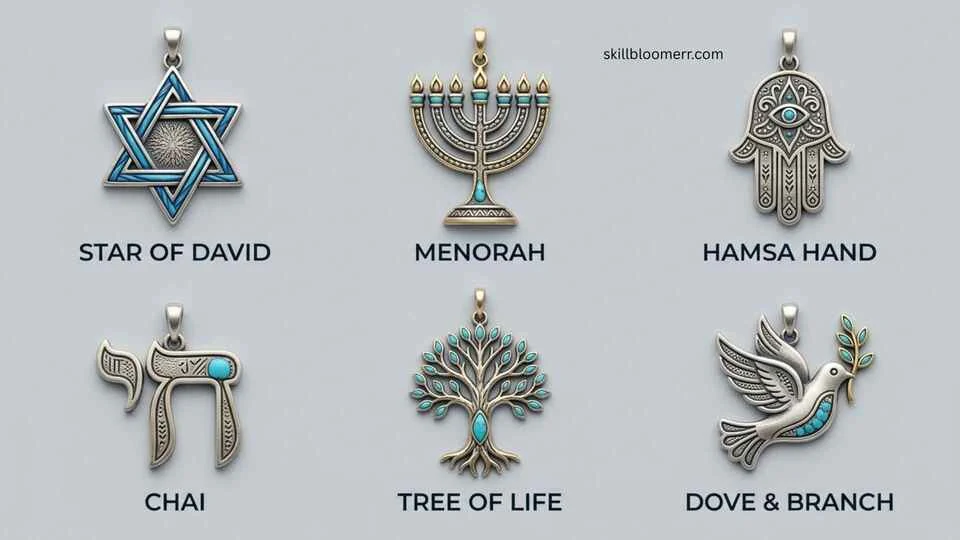
Jewish necklace symbols are far more than decorative jewelry. They represent faith, identity, history, remembrance, protection, and a deep connection to Jewish tradition. Whether worn daily, given as meaningful gifts, or displayed during religious celebrations, these symbols carry centuries of cultural and spiritual significance.
You may encounter Jewish necklace symbols in synagogues, family heirlooms, museums, jewelry collections, weddings, bar and bat mitzvah celebrations, or modern fashion. While some designs, such as the Star of David or Chai pendant, are widely recognized, others have rich historical backgrounds that are less familiar outside Jewish communities.
This guide explains the meanings, origins, symbolism, religious importance, common variations, and modern uses of the most popular Jewish necklace symbols while separating historical facts from popular misconceptions.
Quick Meaning
Jewish necklace symbols represent Jewish faith, identity, protection, remembrance, life, wisdom, and the covenant between God and the Jewish people. Different necklaces symbolize different values, from the Star of David’s association with Judaism to the Chai pendant’s celebration of life and the Hamsa’s protective symbolism.
Symbol Overview Table
| Field | Information |
| Symbol Category | Religious, Cultural, Spiritual Jewelry |
| Common Symbols | Star of David, Chai, Hamsa, Menorah, Tree of Life, Tablets of the Law |
| Primary Meaning | Faith, Identity, Life, Protection, Heritage |
| Religion | Judaism |
| Origin | Ancient Israel and later Jewish traditions |
| Historical Development | Biblical period through medieval and modern Judaism |
| Common Materials | Gold, Silver, Platinum, Stainless Steel, Wood |
| Modern Usage | Jewelry, Gifts, Religious Celebrations, Family Heirlooms |
| Unicode | None specific for most symbols |
| Emoji Equivalent | ⭐ (approximation only, not a Jewish symbol), 🕎 (Menorah) |
| Related Symbols | Mezuzah, Lion of Judah, Dove, Pomegranate, Hebrew Letters |
What Do Jewish Necklace Symbols Mean?
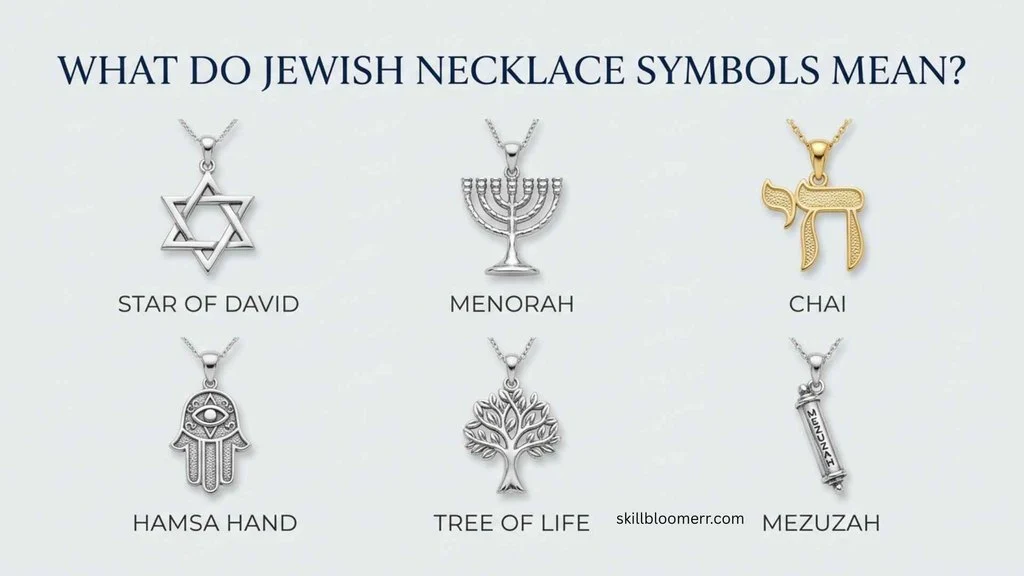
Jewish necklace symbols express belonging to the Jewish people while reminding the wearer of spiritual values, history, and tradition.
Rather than representing a single universal meaning, each symbol carries its own message.
Identity
Many Jewish people wear symbolic necklaces as an expression of cultural and religious identity. Wearing these symbols can communicate pride in one’s heritage regardless of denomination.
Faith
Many pendants serve as reminders of Jewish beliefs, ethical living, and one’s relationship with God.
Protection
Certain symbols, particularly the Hamsa, have traditionally been associated with protection against misfortune or the “evil eye.” While beliefs vary among Jewish communities, many people wear these necklaces as meaningful cultural symbols rather than magical objects.
Life
The Hebrew word Chai (חי) literally means “life.” It encourages appreciation for life, gratitude, and moral responsibility.
Remembrance
Jewish necklaces often commemorate important life events, including:
- Births
- Bar and Bat Mitzvahs
- Weddings
- Anniversaries
- Holocaust remembrance
- Family traditions
History and Origin
Jewish necklace symbols developed over thousands of years alongside Jewish history.
Biblical Foundations
Some symbols trace their origins to descriptions found in the Hebrew Bible.
The Menorah, for example, is described in Exodus as the sacred seven-branched lampstand used in the Tabernacle and later the First and Second Temples.
The Tablets of the Law symbolize God’s covenant with Israel through Moses at Mount Sinai.
Second Temple Period
Archaeological discoveries show that Jewish communities used a variety of decorative and religious motifs long before modern jewelry became common.
Symbols including pomegranates, palm branches, menorahs, and Hebrew inscriptions appeared on coins, seals, lamps, and synagogue decorations.
Medieval Judaism
During the Middle Ages, Jewish communities across Europe, North Africa, and the Middle East increasingly adopted recognizable religious motifs in manuscripts, ceremonial objects, and jewelry.
The Star of David gradually became associated with Jewish communities during this period, although it was not originally an exclusively Jewish symbol.
Modern Era
By the nineteenth and twentieth centuries, Jewish necklaces became widespread personal expressions of identity.
Following the Holocaust and the establishment of the State of Israel in 1948, many Jews began wearing symbolic necklaces as expressions of resilience, remembrance, and cultural pride.
Symbolism and Interpretation
Jewish necklace symbols combine religious meaning with personal interpretation.
Star of David (Magen David)
The six-pointed star is perhaps the best-known Jewish symbol.
It commonly represents:
- Jewish identity
- Divine protection
- Unity
- The relationship between God and humanity
- Jewish people worldwide
Some scholars interpret the upward triangle as humanity reaching toward God and the downward triangle as divine presence reaching humanity.
Chai (חי)
The Hebrew letters Chet (ח) and Yod (י) spell “Chai,” meaning “life.”
It symbolizes:
- Living fully
- Hope
- Blessings
- Gratitude
- Endurance
Because of this positive message, Chai necklaces are popular gifts for birthdays, graduations, and religious milestones.
Hamsa
The Hamsa is an open hand symbol shared among Jewish, Islamic, and Middle Eastern cultures.
Within Jewish traditions it often represents:
- Divine protection
- Blessings
- Peace
- Strength
- Good fortune
Some versions include an eye in the center, representing vigilance against envy or harmful intentions.
Menorah
The seven-branched Menorah symbolizes:
- God’s presence
- Spiritual enlightenment
- Wisdom
- Creation
- The Temple in Jerusalem
Modern jewelry sometimes features either the biblical seven-branched menorah or the nine-branched Hanukkah menorah (Hanukkiah), although they have different religious purposes.
Tree of Life
The Tree of Life represents:
- Wisdom
- Growth
- Family
- Torah
- Spiritual development
- Interconnectedness
Its symbolism appears in both biblical and mystical Jewish traditions.
Cultural Significance
Jewish necklace symbols carry different meanings depending on geography, history, and community traditions.
Ashkenazi Communities
Among Jews of Central and Eastern European heritage, Star of David necklaces became especially common during the nineteenth and twentieth centuries as expressions of Jewish identity.
Sephardic Communities
Sephardic Jews, whose ancestors lived in Spain, Portugal, North Africa, and the Middle East, have traditionally embraced Hamsa jewelry alongside Hebrew inscriptions and biblical motifs.
Mizrahi Communities
Many Mizrahi Jewish traditions include symbolic jewelry featuring protective motifs, Hebrew blessings, and ancient Middle Eastern artistic influences.
Israeli Society
In Israel, symbolic necklaces are worn by religious, traditional, and secular Jews alike. They may express national identity, family heritage, spirituality, or simply appreciation for Jewish culture.
Religious or Spiritual Meaning
Jewish necklace symbols are meaningful because they remind believers of their relationship with God and Jewish values rather than functioning as required religious objects.
A Reminder Rather Than an Obligation
Judaism generally does not require believers to wear symbolic necklaces.
Instead, these items often serve as personal reminders of:
- Faith
- Ethical behavior
- Gratitude
- Jewish history
- Community
Hebrew Letter Symbolism
Many necklaces feature meaningful Hebrew words including:
- Chai (Life)
- Shalom (Peace)
- Ahava (Love)
- Emunah (Faith)
These words reinforce spiritual values through everyday wear.
Mystical Traditions
Some necklaces include symbols associated with Jewish mysticism (Kabbalah), including combinations of Hebrew letters or references to divine names. Such designs are interpreted differently across Jewish denominations, and not all Jewish communities attribute mystical power to them.
Scientific or Technical Meaning
Jewish necklace symbols do not have scientific, mathematical, engineering, or medical meanings in themselves.
However, they do appear in:
Digital Typography
Unicode supports Hebrew characters used in inscriptions such as Chai and Shalom. Emoji also include the menorah (🕎), although there is no dedicated Unicode character for the Star of David beyond general star symbols or the Hebrew symbol in specific contexts.
Jewelry Manufacturing
Modern pendants are produced using:
- Computer-aided design (CAD)
- Laser engraving
- 3D printing
- Precious metal casting
- Hand engraving
These technologies allow both traditional and contemporary interpretations while preserving symbolic accuracy.
Where the Symbol Is Used
Jewish necklace symbols appear in many settings beyond personal jewelry.
Common examples include:
- Religious jewelry
- Bar and Bat Mitzvah gifts
- Wedding presents
- Synagogue artwork
- Torah ornaments
- Museums
- Family heirlooms
- Educational materials
- Jewish cultural festivals
- Fine art
- Home décor
- Memorial jewelry
- Charitable organization logos
- Israeli cultural merchandise
Common Variations
Jewish necklace symbols exist in numerous artistic styles.
Traditional Designs
These closely follow historical forms and often use silver or gold with minimal decoration.
Modern Minimalist Jewelry
Simple geometric outlines appeal to contemporary fashion while retaining symbolic meaning.
Gemstone Versions
Diamonds, sapphires, turquoise, and other gemstones may decorate Star of David or Chai pendants.
Hebrew Calligraphy
Some artists transform Hebrew words into flowing artistic designs while preserving readability.
Combined Symbols
Designers sometimes combine:
- Star of David with Chai
- Hamsa with Hebrew blessings
- Tree of Life inside the Star of David
- Menorah with olive branches
Each combination emphasizes different aspects of Jewish heritage.
Common Misconceptions
Every Jewish Necklace Is Religious
Not necessarily.
Some people wear Jewish symbols as expressions of family heritage, ethnicity, or cultural identity rather than religious observance.
The Star of David Appears Throughout the Bible
The Hebrew Bible does not describe the Star of David as the defining symbol of Judaism. Its widespread association with Judaism developed much later.
The Hamsa Is Exclusively Jewish
The Hamsa has deep roots across multiple Middle Eastern cultures and is also significant in Islamic and regional folk traditions.
All Jews Wear Symbolic Necklaces
Many do, but many do not. Wearing symbolic jewelry is a personal choice rather than a religious obligation.
Jewish Necklaces Are Good Luck Charms
Some traditions associate certain symbols with protection or blessing, but mainstream Jewish teaching generally emphasizes faith, ethical living, and trust in God rather than magical powers.
Interesting Facts
- The Star of David became a widespread Jewish emblem relatively late in Jewish history compared with biblical symbols like the Menorah.
- Chai has a numerical value of 18 in Hebrew gematria, making the number 18 especially meaningful in Jewish charitable giving.
- Many people donate money in multiples of 18 as a symbolic blessing for life.
- The Menorah predates the Star of David as a recognized Jewish religious symbol by many centuries.
- Ancient Jewish coins often featured pomegranates, palm branches, and menorahs rather than the Star of David.
- Jewish necklace designs vary considerably between Ashkenazi, Sephardic, and Mizrahi artistic traditions.
- Hebrew inscriptions on necklaces often emphasize values rather than personal names.
- Some families pass symbolic necklaces through several generations as treasured heirlooms.
- Contemporary Jewish jewelry blends ancient symbolism with modern minimalist design.
- Tree of Life jewelry appeals to both religious and cultural audiences because of its universal themes of wisdom and growth.
Related Symbols
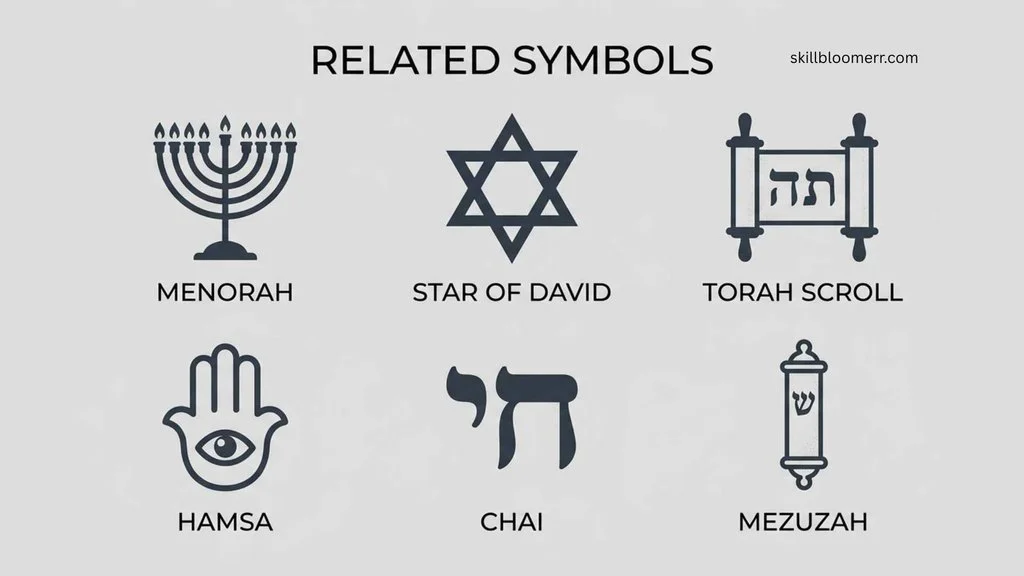
| Symbol | Relationship | Difference |
| Star of David | Most recognized Jewish emblem | Represents Jewish identity broadly |
| Chai | Celebrates life | Focuses on vitality and blessing |
| Menorah | Ancient Temple symbol | Represents divine light and worship |
| Hamsa | Protective symbol | Shared across several Middle Eastern cultures |
| Tree of Life | Wisdom and growth | Emphasizes learning and interconnectedness |
| Lion of Judah | Strength and kingship | Associated with the Tribe of Judah and Jerusalem |
| Tablets of the Law | Divine covenant | Represents the Ten Commandments |
| Mezuzah Pendant | Torah remembrance | Inspired by the mezuzah placed on doorposts rather than replacing it |
Frequently Asked Questions
Are Jewish necklace symbols only for religious people?
No. Many people wear them as expressions of cultural heritage, family history, or ethnic identity. Others wear them because of their religious beliefs. The meaning often depends on the individual rather than the jewelry itself.
What is the most popular Jewish necklace symbol?
The Star of David is generally the most widely recognized Jewish necklace symbol worldwide. Chai pendants and Hamsa necklaces are also extremely popular because they represent life, protection, and Jewish heritage.
What does a Chai necklace symbolize?
A Chai necklace symbolizes life, hope, gratitude, and blessings. Since “Chai” means “life” in Hebrew, it encourages appreciation for living with purpose and kindness.
Is wearing a Hamsa necklace against Jewish beliefs?
Most Jewish communities consider Hamsa jewelry culturally acceptable, although interpretations vary. Some see it primarily as a symbol of protection and blessing, while others appreciate it mainly for its artistic and historical significance.
Can non-Jewish people wear Jewish symbols?
Many people outside Judaism wear these symbols respectfully because of family connections, appreciation of Jewish culture, or personal relationships. Understanding the symbol’s meaning and avoiding cultural disrespect is important.
What is the difference between the Menorah and the Hanukkah menorah?
The biblical Menorah has seven branches and was used in the ancient Temple. The Hanukkah menorah, more accurately called a Hanukkiah, has nine branches and is used specifically during the festival of Hanukkah.
Are Jewish necklaces blessed before wearing them?
There is generally no universal requirement to bless a Jewish necklace. Some individuals may choose to dedicate or gift the jewelry during meaningful religious occasions, but practices differ among families and communities.
Why is the number 18 associated with Jewish jewelry?
The Hebrew word Chai has a gematria value of 18. Because it means “life,” the number has become a symbol of blessing, generosity, and good wishes within Jewish tradition.
Are Jewish necklaces appropriate gifts?
Yes. They are commonly given for births, weddings, bar and bat mitzvahs, graduations, anniversaries, and other important milestones because they symbolize enduring values and connection to Jewish heritage.
How do I choose the right Jewish necklace symbol?
A simple decision guide can help:
- Do you want to express Jewish identity? → Choose the Star of David.
- Do you want to celebrate life and hope? → Choose Chai.
- Do you value protection and blessing traditions? → Consider a Hamsa.
- Do you appreciate wisdom and spiritual growth? → A Tree of Life pendant may be the best fit.
- Do you want a symbol rooted in the ancient Temple? → Select a Menorah design.
Key Takeaways
- Jewish necklace symbols express faith, identity, heritage, and spiritual values.
- The Star of David is the most recognized symbol of Jewish identity.
- Chai represents life and is closely associated with blessings and gratitude.
- The Menorah is one of Judaism’s oldest religious symbols.
- The Hamsa reflects shared Middle Eastern traditions and is often associated with protection.
- Symbol meanings vary across Ashkenazi, Sephardic, Mizrahi, and Israeli communities.
- Wearing symbolic jewelry is generally a personal choice rather than a religious requirement.
- Understanding each symbol’s historical context helps avoid common misconceptions and encourages respectful appreciation.
Conclusion
Jewish necklace symbols connect the past with the present through meaningful expressions of faith, culture, memory, and identity. Whether it is the enduring Star of David, the life-affirming Chai, the ancient Menorah, the protective Hamsa, or the inspiring Tree of Life, each design tells a unique story rooted in centuries of Jewish history.
Understanding the meanings behind Jewish necklace symbols allows wearers and admirers alike to appreciate not only their beauty but also the traditions, values, and historical experiences they represent. These symbols continue to serve as enduring reminders of resilience, spirituality, community, and the rich heritage of the Jewish people.

I’m Ethan Calloway, an English writer and lifelong learner who enjoys turning complex ideas into clear, practical content. At SkillBloomerr, I focus on useful topics that help readers build knowledge, improve their skills, and feel more confident in everyday learning. I believe good writing should be simple, engaging, and genuinely helpful.
Books: The Everyday Learning Guide and Build Better Skills
 Charlotte Winslow
 Nathaniel Brooks