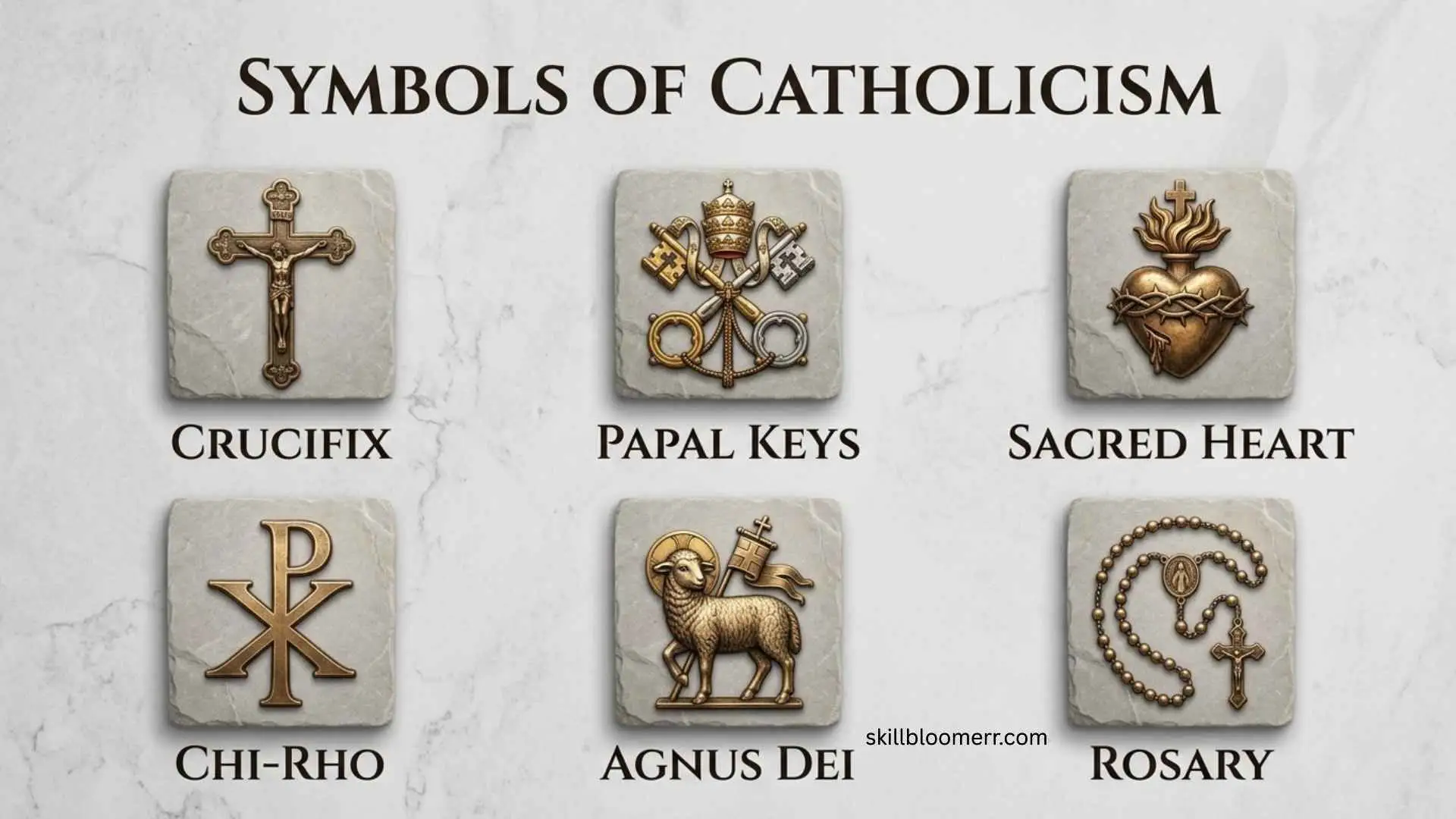
Symbols of Catholicism represent the faith, teachings, history, and spiritual beliefs of the Catholic Church. From the cross and crucifix to the Eucharist, the Virgin Mary’s symbols, and sacred colors, these visual signs help Catholics express devotion, remember biblical events, and connect with centuries of Christian tradition.
Catholic symbols appear in churches, cathedrals, religious artwork, prayer books, jewelry, tattoos, ceremonies, and personal acts of worship around the world. Each symbol carries layers of meaning shaped by Scripture, tradition, theology, and cultural practices.
This guide explores the most important symbols of Catholicism, their origins, meanings, historical development, and how they continue to influence Catholic worship and Christian culture today.
Quick Meaning of Symbols of Catholicism
Symbols of Catholicism are sacred images, objects, gestures, and signs that communicate Catholic beliefs and spiritual truths. They represent concepts such as Jesus Christ’s sacrifice, salvation, faith, hope, Mary’s role, the sacraments, and the relationship between God and humanity.
Symbol Overview Table

| Symbol Name | Primary Meaning | Category | Origin | Culture or Tradition | Common Usage | Modern Meaning |
| Cross | Jesus Christ’s sacrifice and salvation | Christian symbol | Early Christianity | Catholic Christianity | Churches, jewelry, prayers | Faith, hope, redemption |
| Crucifix | Christ’s suffering and love | Sacred object | Early Christian tradition | Catholic Church | Altars, homes, worship | Sacrifice and forgiveness |
| Eucharist (Host and Chalice) | Body and Blood of Christ | Sacramental symbol | Last Supper | Catholic liturgy | Mass and Communion | Spiritual nourishment |
| Virgin Mary Symbols | Purity, motherhood, intercession | Marian symbols | Early Christian devotion | Catholic tradition | Art, prayers, shrines | Compassion and protection |
| Sacred Heart | Christ’s divine love | Devotional symbol | Medieval Christianity | Catholic spirituality | Prayer and artwork | Love and mercy |
| Chi-Rho | Christ’s name | Christological symbol | 4th century Christianity | Early Church | Religious art | Jesus as Savior |
| Fish (Ichthys) | Jesus Christ and Christian identity | Early Christian symbol | 1st century Christianity | Early Christians | Art and jewelry | Faith and belonging |
| Dove | Holy Spirit and peace | Biblical symbol | Biblical tradition | Christianity | Baptisms and artwork | Guidance and purity |
What Do Symbols of Catholicism Mean?
Symbols of Catholicism communicate religious ideas that may be difficult to express through words alone. They serve as visual reminders of Catholic beliefs, biblical teachings, and spiritual experiences.
Catholics do not generally worship symbols themselves. Instead, symbols point believers toward God, Jesus Christ, the saints, and important teachings of the Church. A crucifix, for example, is not worshiped as an object but used as a reminder of Christ’s sacrifice.
These symbols often connect visible objects with invisible spiritual realities. A simple image can remind believers of forgiveness, eternal life, prayer, and God’s presence.
History and Origin of Catholic Symbols
Early Christian Symbolism
The use of Christian symbols began during the first centuries after Jesus Christ’s life. Early Christians used symbols as expressions of faith and, at times, as discreet signs during periods of persecution in the Roman Empire.
The fish symbol, known as Ichthys, became one of the earliest Christian symbols. The Greek letters represented the phrase “Jesus Christ, Son of God, Savior.”
The cross also developed into the central symbol of Christianity, especially after Emperor Constantine legalized Christianity in the Roman Empire during the fourth century.
Development During the Middle Ages
During the medieval period, Catholic symbols became more detailed and widespread. Churches, stained glass windows, paintings, sculptures, and manuscripts used symbolic imagery to teach biblical stories to people who could not read.
The Catholic Church developed rich artistic traditions where colors, objects, animals, and gestures carried specific religious meanings.
For example:
- Gold often represented heaven and divine glory.
- White symbolized purity and holiness.
- Red represented sacrifice, love, and martyrdom.
- Blue became strongly associated with the Virgin Mary.
Modern Catholic Symbolism
Today, Catholic symbols continue to appear in traditional churches and modern religious communities. They are found in:
- Personal prayer spaces
- Rosaries
- Religious medals
- Catholic schools
- Liturgical celebrations
- Religious artwork
While designs may change across cultures, the spiritual meanings remain connected to Catholic teachings.
Symbolism and Interpretation
The Cross and Crucifix
The cross is the most recognized symbol of Christianity. It represents the crucifixion of Jesus Christ and the belief that his death brought salvation to humanity.
The crucifix includes the body of Jesus on the cross. It emphasizes Christ’s suffering, sacrifice, and immense love.
Different Christian traditions use the cross differently:
- Catholic churches commonly display crucifixes.
- Many Protestant churches emphasize the empty cross as a symbol of resurrection.
- Eastern Christians often use detailed artistic crosses.
The Eucharist Symbols
The bread and wine used in Catholic Mass represent the Eucharist, one of the central sacraments of Catholic life.
Catholic teaching holds that the Eucharist is the real presence of Jesus Christ under the appearances of bread and wine.
The chalice symbolizes the cup used during the Last Supper, while the host represents Christ’s body.
Marian Symbols
Symbols connected to the Virgin Mary express her role as the mother of Jesus and a model of faith.
Common Marian symbols include:
- Roses representing purity and love
- Lilies representing innocence
- A crown representing her honor as Queen of Heaven
- The moon and stars connected with biblical imagery
Cultural Significance of Catholic Symbols
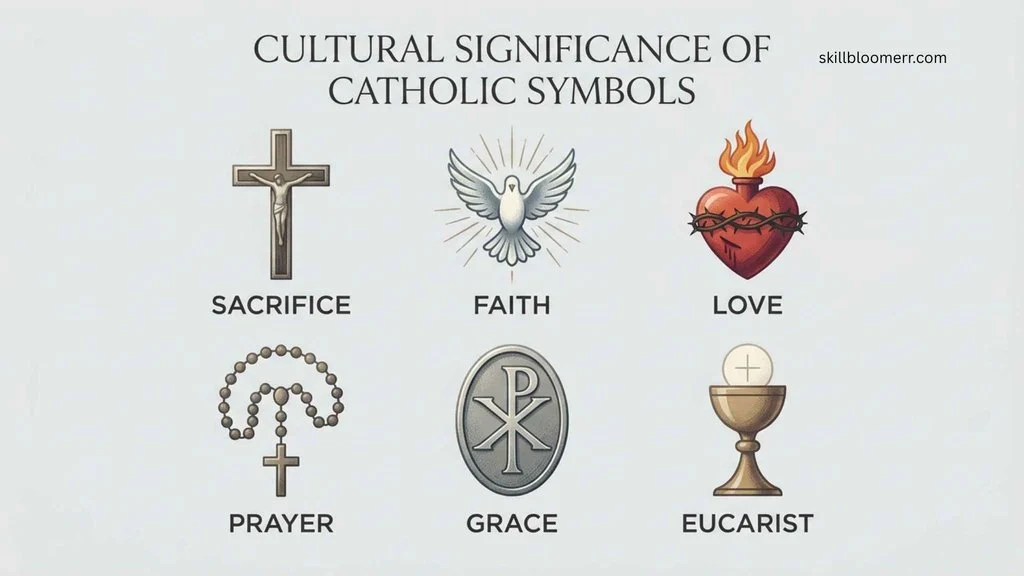
Catholic symbols have influenced art, architecture, language, music, and traditions across many societies.
European Traditions
In Europe, Catholic symbolism shaped centuries of artwork. Cathedrals often include statues, paintings, and stained glass depicting biblical scenes and saints.
Countries such as Italy, Spain, France, and Poland developed unique Catholic artistic traditions connected with local history.
Latin American Traditions
In Latin America, Catholic symbols often blend with local cultural expressions. Religious festivals, processions, and artwork frequently feature images of Jesus, Mary, and saints.
Examples include:
- Marian celebrations
- Processions during Holy Week
- Decorative religious altars
Asian and African Catholic Communities
Catholic communities in Asia and Africa often combine universal Catholic symbols with local artistic styles.
Churches may use regional designs, languages, and cultural patterns while maintaining traditional symbols such as the cross and Eucharist.
Religious or Spiritual Meaning of Catholic Symbols
Catholic symbols hold deep spiritual importance because they connect believers with core teachings of Christianity.
The Sacraments
Many Catholic symbols are linked with the seven sacraments:
- Baptism uses water as a symbol of cleansing and new life.
- Confirmation uses oil as a sign of strengthening through the Holy Spirit.
- Eucharist uses bread and wine as symbols of Christ’s presence.
- Marriage uses rings as symbols of commitment and unity.
Prayer and Devotion
Symbols help Catholics focus during prayer. A rosary, crucifix, or image of a saint can serve as a physical reminder to reflect on spiritual teachings.
Sacred Spaces
Catholic churches use symbolism throughout their design:
- Altars represent places of worship and sacrifice.
- Candles represent Christ as the light of the world.
- Statues remind believers of Jesus, Mary, and the saints.
Where Catholic Symbols Are Used
Catholic symbols appear in many religious and cultural settings.
Churches and Cathedrals
The most common location for Catholic symbols is within churches. They appear on:
- Altars
- Windows
- Walls
- Statues
- Religious paintings
Personal Items
Many Catholics use symbolic objects in daily life, including:
- Rosary beads
- Cross necklaces
- Religious medals
- Prayer cards
Art and Literature
Catholic symbols have influenced famous artworks, religious books, poetry, and historical manuscripts.
Artists often use symbols to communicate spiritual ideas without direct explanation.
Jewelry and Tattoos
Crosses, Sacred Heart designs, and Marian symbols are commonly used in religious jewelry and tattoos.
For many people, these designs represent faith, family heritage, personal devotion, or cultural identity.
Common Variations of Catholic Symbols
Different Cross Designs
Catholic crosses vary by region and artistic tradition.
Common examples include:
- Latin cross
- Celtic cross
- Papal cross
- Jerusalem cross
Each design carries different historical associations.
Marian Symbol Variations
Images of Mary differ across cultures:
- Our Lady of Guadalupe reflects Mexican Catholic tradition.
- Our Lady of Lourdes connects with French Catholic devotion.
- Black Madonna images appear in several European locations.
Liturgical Colors
Catholic celebrations use different colors during the church year:
| Color | Meaning |
| White | Joy, purity, resurrection |
| Red | Holy Spirit, sacrifice, martyrdom |
| Green | Hope and ordinary spiritual growth |
| Purple | Repentance and preparation |
Common Misconceptions About Catholic Symbols
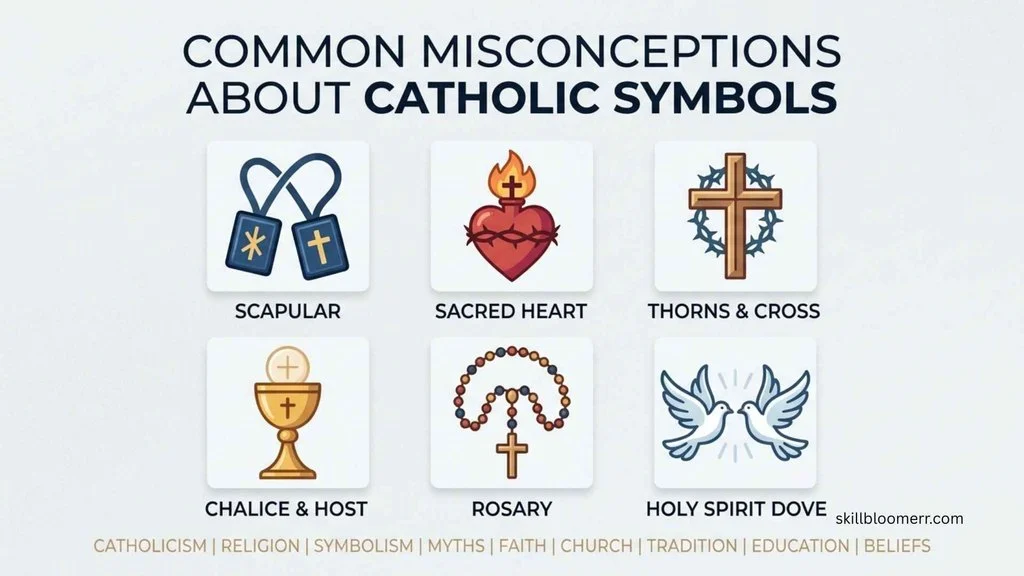
Catholics Worship Statues and Images
A common misunderstanding is that Catholics worship statues or religious images. Catholic teaching distinguishes between worship given to God and respect shown toward sacred reminders.
Every Christian Symbol Has the Same Meaning Everywhere
Symbols can have different meanings among Christian traditions. A cross, for example, may emphasize suffering, resurrection, or both depending on the community.
Symbols Replace Faith
Catholic symbols are not considered substitutes for faith. They support prayer, reflection, and understanding.
All Catholic Symbols Come Directly From the Bible
Some symbols come directly from Scripture, while others developed through centuries of Christian tradition and theological reflection.
Interesting Facts About Catholic Symbols
- The crucifix is especially important in Catholic worship.
Catholic churches commonly display a crucifix because it emphasizes Christ’s sacrifice and suffering. - The fish symbol predates many famous Christian artworks.
Early Christians used Ichthys as a hidden sign of faith. - The color blue became strongly associated with Mary.
Medieval artists frequently used blue clothing to represent Mary’s special role and purity. - The Sacred Heart devotion developed over centuries.
It became especially influential in Catholic spirituality through visions and devotional movements. - Catholic symbols influence architecture worldwide.
Cathedrals often use symbolic designs to communicate theological ideas. - The rosary combines prayer and symbolism.
Each bead represents prayers and reflections on events from the lives of Jesus and Mary. - Candles have symbolic meaning in Catholic worship.
They represent Christ as the light of the world. - The Chi-Rho symbol is one of Christianity’s oldest Christ symbols.
It combines Greek letters associated with the name of Christ. - Catholic symbols often combine multiple meanings.
A single image may represent biblical history, theology, and cultural traditions at the same time. - Symbols help preserve religious memory.
They allow generations of believers to communicate faith visually.
Related Symbols
Christian Cross
The cross is the central symbol of Christianity and represents Jesus’ crucifixion and resurrection.
Ichthys Fish Symbol
The fish represents early Christian identity and belief in Jesus Christ.
Star of Bethlehem
The Star of Bethlehem symbolizes the birth of Jesus and God’s guidance.
Alpha and Omega
These Greek letters represent God as the beginning and the end, based on the Book of Revelation.
Lamb of God
The lamb represents Jesus Christ’s sacrifice and redemption.
Frequently Asked Questions
What is the most important Catholic symbol?
The cross and crucifix are considered the most important Catholic symbols because they represent Jesus Christ’s sacrifice, death, and promise of salvation. The crucifix is especially significant in Catholic worship because it keeps attention on Christ’s suffering and love.
Why do Catholics use religious symbols?
Catholics use symbols to express faith, support prayer, teach religious beliefs, and remember important events from Scripture. Symbols provide a visible connection to spiritual ideas and help believers reflect during worship and personal devotion.
What does the Catholic cross symbolize?
The Catholic cross symbolizes Jesus Christ’s crucifixion and the belief that his sacrifice brought salvation. It represents love, forgiveness, hope, and the victory of life over death through Christ.
What does the Sacred Heart symbolize?
The Sacred Heart symbolizes Jesus Christ’s love, compassion, and mercy toward humanity. It represents a devotion focused on Christ’s emotional and spiritual love for all people.
Are Catholic symbols mentioned in the Bible?
Some Catholic symbols have direct biblical connections, such as the cross, dove, lamb, and bread and wine. Others developed through Christian tradition, artistic interpretation, and centuries of religious practice.
What do Catholic colors mean?
Catholic liturgical colors communicate different spiritual themes. White represents joy and purity, red represents sacrifice and the Holy Spirit, green represents hope and growth, and purple represents repentance and preparation.
Why do Catholic churches have statues?
Catholic churches use statues as visual reminders of Jesus, Mary, and the saints. They are intended to encourage prayer and reflection rather than replace worship of God.
What is the meaning of the rosary?
The rosary is a Catholic prayer tradition using beads to guide meditation on important events in the lives of Jesus Christ and the Virgin Mary.
What symbol represents the Holy Spirit in Catholicism?
The dove is one of the most common symbols of the Holy Spirit in Catholicism. It comes from biblical descriptions of the Holy Spirit appearing like a dove during Jesus’ baptism.
Why are Catholic symbols important today?
Catholic symbols remain important because they connect modern believers with centuries of Christian history, worship practices, and spiritual traditions.
Key Takeaways
- Symbols of Catholicism communicate important beliefs through visual signs.
- The cross and crucifix are central symbols representing Jesus Christ’s sacrifice.
- Catholic symbols developed through Scripture, tradition, art, and history.
- Marian symbols express devotion toward the Virgin Mary.
- The Eucharist, Sacred Heart, dove, and fish carry deep spiritual meanings.
- Catholic symbols vary across cultures while maintaining shared religious foundations.
- These symbols appear in churches, artwork, jewelry, ceremonies, and personal devotion.
Conclusion
Symbols of Catholicism are more than decorative images. They are meaningful expressions of faith that connect believers with Scripture, tradition, history, and spiritual reflection. From the cross and crucifix to the Eucharist and Marian symbols, each sign carries a message about God’s love, Christ’s sacrifice, and the Catholic understanding of faith.
Across centuries and cultures, Catholic symbols have helped preserve religious teachings and create a shared visual language for millions of believers. Understanding their meanings provides deeper insight into Catholic worship, Christian history, and the role of symbolism in human spirituality.

I’m Nathaniel Brooks, an educational writer who loves exploring ideas and making useful knowledge accessible to everyone. I write for SkillBloomerr with a focus on clear explanations, practical tips, and meaningful learning. My goal is to help readers discover something valuable every time they visit the site.
Books: Learn Something New and The Practical Knowledge Handbook
 Ethan Calloway
 Olivia Hartwell