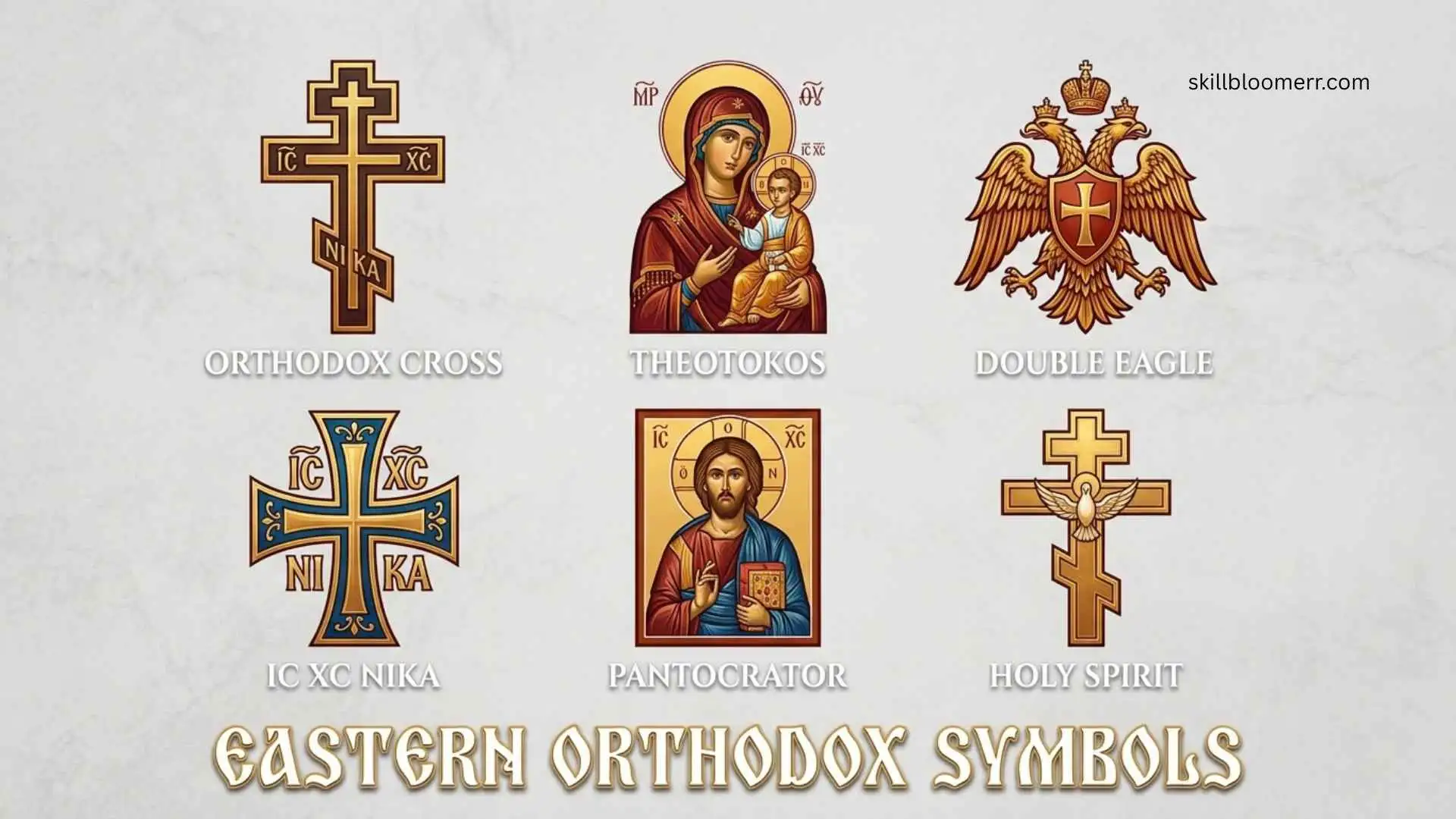
Eastern Orthodox symbols are visual expressions of faith, tradition, and spiritual beliefs used by the Eastern Orthodox Church for centuries. These symbols appear in icons, churches, crosses, religious objects, manuscripts, clothing, and worship practices. Each symbol carries a deeper meaning connected to Christian theology, biblical teachings, and the history of Orthodox Christianity.
From the famous Orthodox cross to sacred icons of Jesus Christ and the Virgin Mary, these symbols help believers understand spiritual truths that words alone may not fully express. They serve as reminders of God’s presence, salvation, humility, hope, and the connection between heaven and earth.
This guide explores the most important eastern orthodox symbols, their origins, meanings, cultural importance, religious uses, and how they continue to influence art, architecture, and Christian life today.
Quick Meaning of Eastern Orthodox Symbols
Eastern Orthodox symbols are sacred visual signs that communicate Christian beliefs, biblical messages, and spiritual realities. They include crosses, icons, colors, gestures, and objects used in Orthodox worship. These symbols represent faith, salvation, divine mysteries, and the relationship between God and humanity.
Symbol Overview Table
| Symbol Name | Primary Meaning | Category | Origin | Civilization or Culture | First Known Use | Common Usage | Modern Meaning | Related Symbols |
| Orthodox Cross | Christ’s crucifixion and salvation | Religious Symbol | Early Christianity | Byzantine and Eastern Christian culture | Early centuries CE | Churches, icons, jewelry | Faith and devotion | Latin Cross, Crucifix |
| Icon of Christ | Divine presence and incarnation | Sacred Art | Early Christian tradition | Byzantine Christianity | 3rd–4th century CE | Worship and prayer | Spiritual connection | Marian Icons, Saints’ Icons |
| Theotokos Icon | Virgin Mary as Mother of God | Religious Icon | Early Church tradition | Eastern Orthodox Christianity | Early centuries CE | Churches and homes | Compassion and intercession | Madonna images |
| Chi-Rho Symbol | Jesus Christ | Christogram | Ancient Christianity | Roman Empire | 4th century CE | Christian art and manuscripts | Identity of Christ | Alpha and Omega |
| Alpha and Omega | God’s eternal nature | Biblical Symbol | New Testament tradition | Christian cultures | 1st century CE | Icons and texts | Beginning and end of all things | Chi-Rho |
| Byzantine Eagle | Imperial and spiritual authority | Cultural Symbol | Byzantine Empire | Greek and Eastern Christian culture | Medieval period | Art and heraldry | Tradition and heritage | Double-headed eagle |
What Do Eastern Orthodox Symbols Mean?
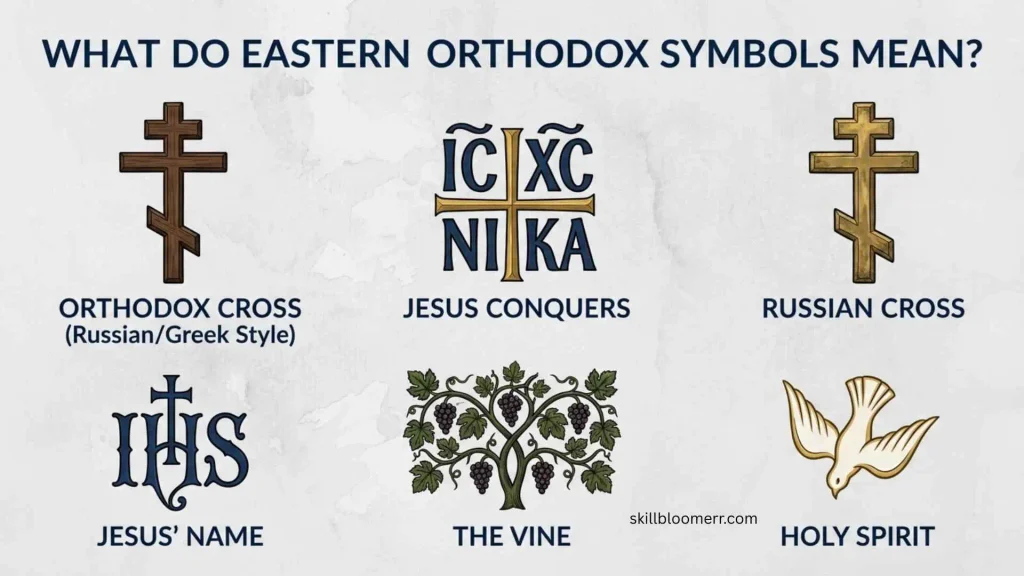
Eastern Orthodox symbols represent the invisible spiritual realities of Christianity through visible images, shapes, colors, and objects. In Orthodox theology, symbols are not simply decorations. They are considered meaningful tools that help believers encounter and understand sacred truths.
The Eastern Orthodox Church teaches that material things can communicate spiritual realities because Christianity is based on the belief that God became human through Jesus Christ. Since the divine entered the physical world through the Incarnation, physical representations can serve as windows toward spiritual understanding.
For example, an Orthodox icon is not worshiped as an independent object. Instead, honor shown to an icon is directed toward the person or spiritual reality represented. This distinction between respect and worship is an important part of Orthodox teaching.
Common meanings found in Eastern Orthodox symbols include:
- Salvation: The cross represents Christ’s sacrifice and victory over death.
- Divine presence: Icons remind believers of Christ, Mary, and the saints.
- Eternal life: Symbols such as the circle and golden background represent heaven and divine eternity.
- Spiritual transformation: Religious images encourage prayer and personal growth.
- Connection between heaven and earth: Symbols express the belief that God remains present among humanity.
History and Origin of Eastern Orthodox Symbols
Early Christian Roots
The origins of Eastern Orthodox symbols can be traced back to the earliest Christian communities of the Roman Empire. During the first centuries after Jesus Christ’s death and resurrection, Christians used simple signs to express their faith, especially during periods of persecution.
Early Christian symbols included:
- The fish symbol (Ichthys)
- The anchor
- The shepherd image
- The cross
- The Chi-Rho symbol
These signs allowed believers to identify themselves and communicate Christian ideas without openly declaring their faith in hostile environments.
Development During the Byzantine Empire
Many Eastern Orthodox symbols developed significantly during the Byzantine Empire, which became the center of Eastern Christianity. Constantinople, the Byzantine capital, played a major role in shaping Orthodox worship, architecture, and religious art.
Byzantine artists developed the tradition of iconography, creating sacred images of:
- Jesus Christ
- The Virgin Mary
- Angels
- Apostles
- Saints
- Biblical events
Icons became central to Orthodox spirituality because they were viewed as teaching tools that helped believers understand scripture and theology visually.
The Role of Icons in Orthodox Tradition
Icons are among the most recognizable eastern orthodox symbols. They are carefully created according to traditional methods rather than personal artistic imagination alone.
Traditional Orthodox iconographers follow established guidelines involving:
- Symbolic colors
- Specific poses
- Facial expressions
- Clothing styles
- Biblical references
For example, Christ Pantocrator icons often show Jesus holding a Gospel book while raising His hand in blessing. The image represents Christ as the ruler and judge of the universe.
Symbolism and Interpretation of Eastern Orthodox Symbols
The Orthodox Cross Meaning
The Orthodox cross is one of the most important symbols in Eastern Christianity. Unlike the simple Latin cross commonly associated with Western Christianity, the Orthodox cross often contains three horizontal bars.
The upper bar represents the sign placed above Jesus’ head during the crucifixion, which identified Him as the King of the Jews.
The middle bar represents the main crossbeam where Christ’s hands were attached.
The lower diagonal bar represents the footrest. In many Orthodox interpretations, one side points upward toward the repentant thief who received salvation, while the other side points downward toward rejection and spiritual separation.
The symbol teaches themes of:
- Sacrifice
- Judgment
- Repentance
- Hope
- Resurrection
Gold Color in Orthodox Icons
Gold is one of the most important colors in Orthodox religious art. It often represents:
- Heaven
- Divine light
- Eternity
- The glory of God
Unlike ordinary backgrounds, the golden spaces in icons are not meant to represent physical locations. They symbolize the heavenly reality surrounding sacred figures.
Halos and Divine Light
Halos appear around Christ, the Virgin Mary, angels, and saints in Orthodox icons. They represent holiness and participation in God’s divine light.
The halo is not intended to show physical light but spiritual transformation and closeness to God.
Symbolism of Orthodox Icon Faces
Faces in Orthodox icons follow traditional styles that differ from realistic Western paintings. They are designed to communicate spiritual qualities rather than ordinary human appearance.
Common features include:
- Large eyes representing spiritual awareness
- Calm expressions showing inner peace
- Controlled emotions representing holiness
- Forward-facing positions encouraging spiritual connection
Cultural Significance of Eastern Orthodox Symbols
Eastern Orthodox symbols have played an important role in shaping the identity, traditions, and cultural heritage of Orthodox Christian communities around the world. These symbols are not limited to religious buildings. They appear in homes, public spaces, national traditions, art, music, and historical monuments.
The Eastern Orthodox Church has communities across many regions, including Greece, Russia, Serbia, Romania, Bulgaria, Georgia, Ukraine, the Middle East, and parts of Africa. Although these cultures have their own languages and customs, Orthodox symbols create a shared spiritual connection.
Greek Orthodox Symbol Traditions
In Greek Orthodox Christianity, icons and crosses are deeply connected with family traditions and community life. Many Greek Orthodox homes have an icon corner, often called a prayer corner, where family members pray and display sacred images.
Common Greek Orthodox symbols include:
- The Orthodox cross
- Icons of Jesus Christ
- Icons of the Virgin Mary
- Saint images
- The Byzantine double-headed eagle
The Byzantine influence remains especially visible in Greek Orthodox churches through their domes, mosaics, and icon screens called iconostases.
Russian Orthodox Symbol Traditions
Russian Orthodox symbolism developed a distinctive artistic style known for detailed icons, rich colors, and spiritual depth. Russian icon painters created some of the most famous examples of Orthodox sacred art.
Important Russian Orthodox symbols include:
- The Russian Orthodox cross
- The Kazan Icon of the Mother of God
- Christ Pantocrator icons
- The onion-shaped church dome
The onion dome, while not exclusively Orthodox, became strongly associated with Russian religious architecture. Its upward shape is often interpreted as a visual expression of reaching toward heaven.
Eastern Orthodox Symbols in Slavic Cultures
Among Slavic Orthodox communities, symbols often connect religious belief with national history and cultural identity. Churches, monasteries, and religious festivals frequently use traditional symbols to preserve historical memory.
Examples include:
- Processional crosses during religious celebrations
- Embroidered religious designs
- Saint icons passed through generations
- Decorative church artwork
These traditions demonstrate how symbols can preserve both spiritual beliefs and cultural heritage.
Religious or Spiritual Meaning of Eastern Orthodox Symbols
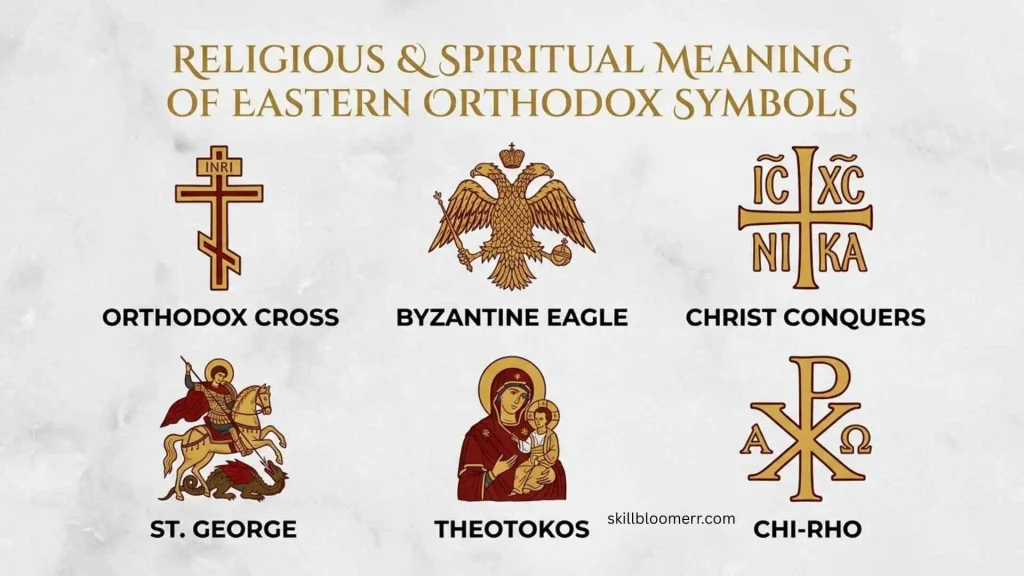
Eastern Orthodox symbols have deep spiritual importance because they communicate central beliefs of Christianity. They are used during worship, prayer, religious ceremonies, and personal devotion.
Icons as Windows to Heaven
One of the most important concepts in Orthodox Christianity is the role of icons. Orthodox believers often describe icons as “windows” that open human awareness toward the divine.
Icons are not considered magical objects. Instead, they serve as visual reminders of:
- God’s presence
- The life of Christ
- The example of saints
- The hope of eternal life
When Orthodox Christians pray before an icon, the purpose is not to worship the material image but to honor the spiritual person represented.
The Meaning of the Iconostasis
The iconostasis is a wall of icons that separates the sanctuary from the main area of an Orthodox church. It is one of the most recognizable features of Eastern Orthodox church design.
The iconostasis represents the relationship between:
- The earthly world
- The heavenly kingdom
The arrangement of icons follows traditional patterns, often including:
- Christ
- The Virgin Mary
- Saints
- Biblical scenes
- The Last Supper
The central doors, known as the Royal Doors, symbolize access to the divine mystery of worship.
The Virgin Mary Symbolism
The Virgin Mary, known in Orthodox Christianity as the Theotokos (“God-bearer” or “Mother of God”), holds a special place in Orthodox spirituality.
Common Marian symbols include:
- Three stars on Mary’s clothing representing her perpetual virginity
- Blue and red garments representing purity and humanity
- The Christ child representing the Incarnation
Popular Orthodox Marian icons include:
- The Theotokos of Vladimir
- The Panagia icon
- The Hodegetria icon
Christ Pantocrator Symbolism
The Christ Pantocrator icon is one of the most significant images in Orthodox Christianity. The Greek word “Pantocrator” means “ruler of all” or “almighty.”
This icon usually shows Christ:
- Holding the Gospel book
- Giving a blessing
- Looking directly toward the viewer
The image represents Jesus as both:
- Loving Savior
- Divine Judge
It reflects the Orthodox belief that Christ is fully human and fully divine.
Major Eastern Orthodox Symbols and Their Meanings
The Orthodox Cross
The Orthodox cross represents the crucifixion, resurrection, and victory of Jesus Christ over death.
Unlike some Western crosses, the Orthodox cross often includes additional details:
- Upper inscription bar
- Main crossbeam
- Slanted footrest
Its design reminds believers of Christ’s sacrifice and the importance of repentance.
The IC XC Symbol
IC XC is a traditional abbreviation for the Greek words “Jesus Christ.”
The letters are commonly found on Orthodox icons, especially around images of Christ.
Meaning:
- IC = Jesus
- XC = Christ
The symbol identifies the figure shown in the icon and emphasizes the central role of Christ in Orthodox faith.
The Alpha and Omega Symbol
Alpha and Omega come from the first and last letters of the Greek alphabet. They are based on biblical descriptions of God as the beginning and the end.
The symbol represents:
- Eternity
- God’s complete authority
- The beginning and completion of creation
It is often displayed in Orthodox churches and religious artwork.
The Chi-Rho Symbol
The Chi-Rho symbol combines two Greek letters:
- Chi (Χ)
- Rho (Ρ)
Together they form an abbreviation for Christ.
It became widely recognized after Emperor Constantine’s use of the symbol in the fourth century. It remains an important early Christian symbol connected with Christ’s identity.
The Double-Headed Eagle
The double-headed eagle is strongly associated with Byzantine history and later Orthodox traditions.
The two heads are often interpreted as representing:
- Connection between spiritual and earthly authority
- The Eastern and Western parts of the Byzantine Empire
- Historical continuity
Today, it appears in some Orthodox churches, monasteries, and cultural settings.
Candles and Lamps
Light has major symbolic importance in Orthodox worship.
Candles and oil lamps represent:
- Christ as the light of the world
- Prayer and devotion
- Spiritual awareness
- Hope in darkness
Many Orthodox believers light candles before icons as an act of prayer and remembrance.
Where Eastern Orthodox Symbols Are Used
Eastern Orthodox symbols appear in many religious and cultural settings. Their use extends beyond churches and includes personal devotion, art, and architecture.
Churches and Monasteries
The most common place to see Orthodox symbols is inside churches and monasteries.
They appear in:
- Domes
- Walls
- Altars
- Iconostasis structures
- Religious objects
- Frescoes and mosaics
Orthodox churches are often designed as symbolic spaces where architecture itself represents spiritual ideas.
Homes and Personal Prayer Areas
Many Orthodox families keep icons in their homes. A small prayer area may include:
- Icons of Christ
- Icons of the Virgin Mary
- A cross
- Candles
- Prayer books
These symbols help create a dedicated place for reflection and prayer.
Jewelry and Personal Items
Orthodox crosses are commonly worn as necklaces or given during important religious events such as baptism.
Other items may include:
- Saint medals
- Icon pendants
- Prayer bracelets
These objects often represent personal faith and spiritual commitment.
Religious Art and Literature
Orthodox symbols appear in:
- Manuscripts
- Paintings
- Religious books
- Church decorations
- Historical artwork
Iconography remains an important field of Christian art study.
Common Variations of Eastern Orthodox Symbols
Eastern Orthodox symbols often have shared meanings, but their designs can vary depending on region, historical period, and artistic tradition. Greek, Russian, Serbian, Romanian, Georgian, and other Orthodox communities may represent the same religious idea using slightly different styles.
These variations do not usually change the core meaning. Instead, they reflect local history, artistic methods, and cultural expressions.
Variations of the Orthodox Cross
The Orthodox cross appears in several forms across different Orthodox communities.
Common variations include:
- Three-Bar Cross: The most recognized Eastern Orthodox cross with an upper bar and diagonal footrest.
- Slavic Orthodox Cross: Often includes the letters IC XC and additional inscriptions connected with Christ’s crucifixion.
- Greek Cross Influence: Some Orthodox communities use simpler cross designs with equal-length arms.
- Decorated Crosses: Some crosses include floral patterns, gemstones, or traditional artwork.
Although designs differ, the central message remains focused on Christ’s sacrifice, resurrection, and salvation.
Variations of Orthodox Icons
Orthodox icons follow traditional patterns, but different regions developed recognizable artistic styles.
Examples include:
- Byzantine Icons: Known for gold backgrounds, symbolic composition, and spiritual focus.
- Russian Icons: Often feature detailed clothing, deep colors, and emotional expression.
- Cretan Icons: Combine Byzantine traditions with some Western artistic influences.
- Ethiopian Orthodox Icons: Use unique colors and artistic approaches reflecting local culture.
Each tradition shows how Orthodox Christianity adapted visually while maintaining theological consistency.
Regional Differences in Symbol Use
Different Orthodox communities may emphasize certain symbols more strongly.
For example:
- Greek Orthodox churches often highlight Byzantine heritage.
- Russian Orthodox churches commonly feature elaborate icon screens.
- Serbian Orthodox traditions frequently connect symbols with national saints and history.
- Georgian Orthodox churches preserve ancient Christian artistic traditions.
These differences show that symbols can carry both universal religious meaning and local cultural identity.
Common Misconceptions About Eastern Orthodox Symbols
Eastern Orthodox symbols are sometimes misunderstood because religious symbols often contain meanings that are deeper than their appearance suggests.
Misconception 1: Orthodox Icons Are Worshiped as Idols
A common misunderstanding is that Orthodox Christians worship icons.
The Orthodox Church distinguishes between:
- Worship: Given only to God.
- Honor or veneration: Shown toward sacred images and the people represented.
Icons are used as tools for prayer and remembrance, not as independent gods or magical objects.
Misconception 2: Icons Are Just Religious Paintings
Orthodox icons are not viewed simply as decorative artwork.
Traditional icons have a specific purpose:
- Teaching biblical truths
- Supporting prayer
- Connecting believers with sacred history
- Representing spiritual realities
Their design follows theological traditions rather than only artistic preferences.
Misconception 3: All Christian Crosses Are the Same
While all Christian crosses share a connection to Jesus’ crucifixion, different Christian traditions developed different designs.
The Orthodox cross is unique because of its:
- Additional horizontal bar
- Slanted footrest
- Historical connection to Eastern Christianity
Misconception 4: Symbol Meanings Are Always Universal
Symbols can change meaning depending on culture and context.
For example, the double-headed eagle may represent Byzantine heritage in an Orthodox setting, while it may have different political or historical meanings elsewhere.
Understanding the cultural background is important when interpreting symbols.
Misconception 5: Orthodox Symbols Are Only Historical Objects
Some people view Orthodox symbols as old traditions with no modern relevance.
In reality, they continue to appear in:
- Modern churches
- Personal devotion
- Religious celebrations
- Contemporary Christian artwork
- Cultural heritage projects
Interesting Facts About Eastern Orthodox Symbols
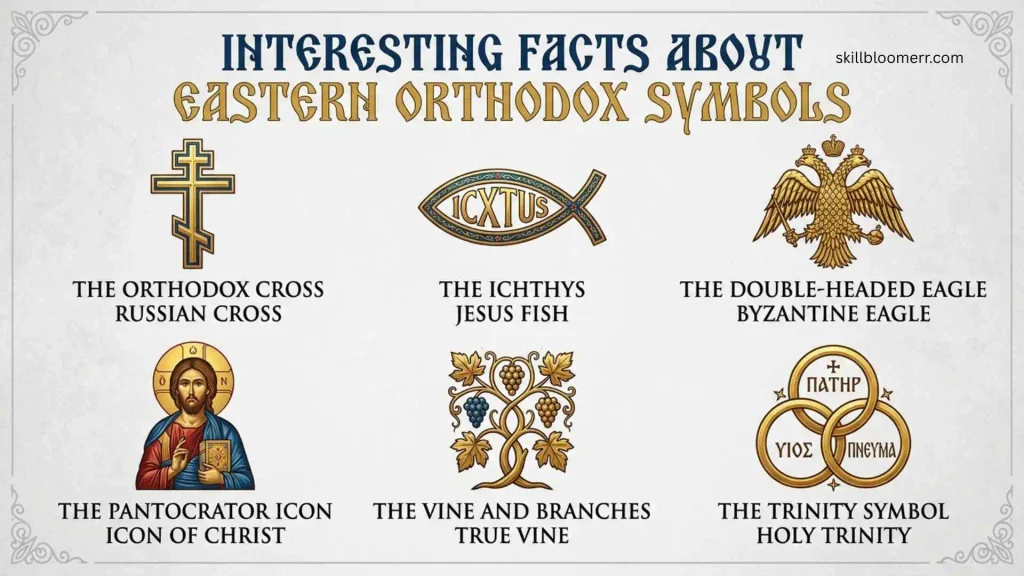
1. Orthodox Icons Follow Ancient Artistic Rules
Traditional iconographers do not create icons like ordinary paintings. They follow established methods involving symbolism, colors, and composition. This preserves continuity with centuries of Orthodox Christian tradition.
2. The Orthodox Cross Has Multiple Interpretations
The diagonal footrest of the Orthodox cross is often explained as symbolizing the two responses to Christ: acceptance and rejection. It connects the crucifixion with themes of judgment and salvation.
3. Gold Backgrounds Do Not Represent Earthly Places
The gold used in many Orthodox icons symbolizes divine light and heavenly reality rather than a physical location. It creates a visual sense of eternity.
4. Orthodox Icons Are Often Written, Not Painted
Many Orthodox Christians use the word “written” for icons because they believe icons communicate theological messages similar to scripture. The term highlights their teaching purpose.
5. The Iconostasis Has Deep Symbolic Meaning
The iconostasis is not simply a wall of decoration. It represents the meeting point between the visible world and the spiritual realm.
6. Some Orthodox Symbols Are Older Than Christianity
Certain symbols, such as light imagery and artistic forms, existed in earlier cultures. Christianity adopted and transformed some visual traditions to express new religious meanings.
7. The Chi-Rho Symbol Is One of the Oldest Christian Symbols
The Chi-Rho was used by early Christians and became especially famous after Emperor Constantine’s connection with Christianity in the fourth century.
8. Orthodox Symbolism Influences Architecture
Church domes, crosses, icons, and interior designs are carefully arranged to communicate spiritual ideas about heaven, creation, and divine order.
9. Colors Have Symbolic Meaning
Orthodox iconography often uses colors intentionally.
Examples include:
- Gold: Divine glory
- Blue: Heaven and spirituality
- Red: Humanity, sacrifice, or divine love
- White: Purity and holiness
- Green: Life and renewal
10. Symbols Connect Generations
Many Orthodox families pass down icons and crosses from one generation to another. These objects often become important links between family history and religious identity.
Related Symbols Connected to Eastern Orthodox Christianity
Eastern Orthodox symbols are connected with many other Christian and cultural symbols. Understanding these relationships helps explain their broader meaning.
The Christian Fish Symbol (Ichthys)
The fish symbol was used by early Christians as a hidden sign of faith.
Meaning:
- Jesus Christ
- Christian identity
- Salvation
Unlike Orthodox icons, the fish symbol was especially common among early Christians before later icon traditions developed.
The Latin Cross
The Latin cross is widely used in Western Christianity.
Similarities:
- Represents Christ’s crucifixion
- Symbolizes salvation
Differences:
- The Orthodox cross has additional symbolic elements connected with Eastern Christian tradition.
The Halo
The halo appears in many Christian traditions.
Meaning:
- Holiness
- Divine light
- Spiritual transformation
In Orthodox icons, halos are often shown with gold backgrounds to emphasize heavenly reality.
The Lamb Symbol
The Lamb of God represents Jesus Christ as a sacrifice for humanity.
It connects with biblical imagery about Christ’s role in salvation.
The Dove Symbol
The dove represents:
- The Holy Spirit
- Peace
- Divine presence
It is commonly used throughout Christianity, including Orthodox traditions.
Frequently out Asked Questions AbEastern Orthodox Symbols
What is the most important Eastern Orthodox symbol?
The Orthodox cross is one of the most important symbols in Eastern Orthodox Christianity. It represents the crucifixion and resurrection of Jesus Christ. Icons of Christ and the Virgin Mary are also considered central because they communicate important beliefs about salvation and God’s relationship with humanity.
Why are icons important in Eastern Orthodox Christianity?
Icons are important because they serve as visual expressions of faith. Orthodox Christians use icons during prayer and worship as reminders of Christ, the Virgin Mary, saints, and biblical events. They are viewed as sacred representations that help believers focus spiritually rather than as objects of worship.
Do Orthodox Christians worship icons?
No. Orthodox Christians do not worship icons. They distinguish between worship, which belongs only to God, and veneration, which is respect shown toward sacred images and the individuals represented in them.
What do Orthodox cross symbols mean?
Orthodox cross symbols represent Christ’s sacrifice, victory over death, and the path toward salvation. The additional bars and diagonal footrest carry traditional interpretations related to judgment, repentance, and hope.
Why do Orthodox churches have so many symbols?
Orthodox churches use symbols because they believe visual elements can communicate spiritual truths. Icons, architecture, colors, and sacred objects help worshippers understand biblical teachings and participate more deeply in religious life.
What does IC XC mean on Orthodox icons?
IC XC is a traditional Greek abbreviation for Jesus Christ. The letters often appear near images of Christ in Orthodox icons and identify the person represented.
What does the double-headed eagle symbolize in Orthodox tradition?
The double-headed eagle is connected with Byzantine history and Orthodox cultural heritage. It is often interpreted as representing authority, historical continuity, and the connection between spiritual and earthly traditions.
Are Orthodox symbols different from Catholic symbols?
There are many similarities because both traditions share early Christian roots. However, Orthodox Christianity developed unique artistic styles, icon traditions, cross designs, and worship practices that distinguish its symbolism.
Can Orthodox symbols be worn as jewelry?
Yes. Orthodox crosses, saint medals, and icon pendants are commonly worn by believers as expressions of faith, remembrance, and personal devotion.
Key Takeaways
- Eastern Orthodox symbols communicate Christian beliefs through visual language.
- The Orthodox cross represents Christ’s crucifixion, resurrection, and salvation.
- Icons are central symbols that connect believers with Christ, Mary, and the saints.
- Orthodox symbols developed through early Christianity and Byzantine traditions.
- Different cultures create unique artistic styles while preserving shared meanings.
- Symbols are used in churches, homes, jewelry, artwork, and religious ceremonies.
- Orthodox traditions distinguish between honoring icons and worshiping God.
- Colors, shapes, and images in Orthodox art often carry deep theological meanings.
- Many Orthodox symbols continue to influence modern Christian art and cultural identity.
Conclusion
Eastern Orthodox symbols are more than historical designs or religious decorations. They are a visual language that communicates centuries of Christian belief, spiritual reflection, and cultural heritage. From the Orthodox cross and sacred icons to the Chi-Rho and Byzantine eagle, each symbol carries layers of meaning shaped by history, theology, and tradition.
Understanding eastern orthodox symbols helps reveal how Orthodox Christianity connects faith, art, and everyday life. These symbols continue to inspire worshippers, historians, artists, and anyone interested in the relationship between visual expression and spiritual meaning.

I’m Ethan Calloway, an English writer and lifelong learner who enjoys turning complex ideas into clear, practical content. At SkillBloomerr, I focus on useful topics that help readers build knowledge, improve their skills, and feel more confident in everyday learning. I believe good writing should be simple, engaging, and genuinely helpful.
Books: The Everyday Learning Guide and Build Better Skills
 Olivia Hartwell
 Nathaniel Brooks