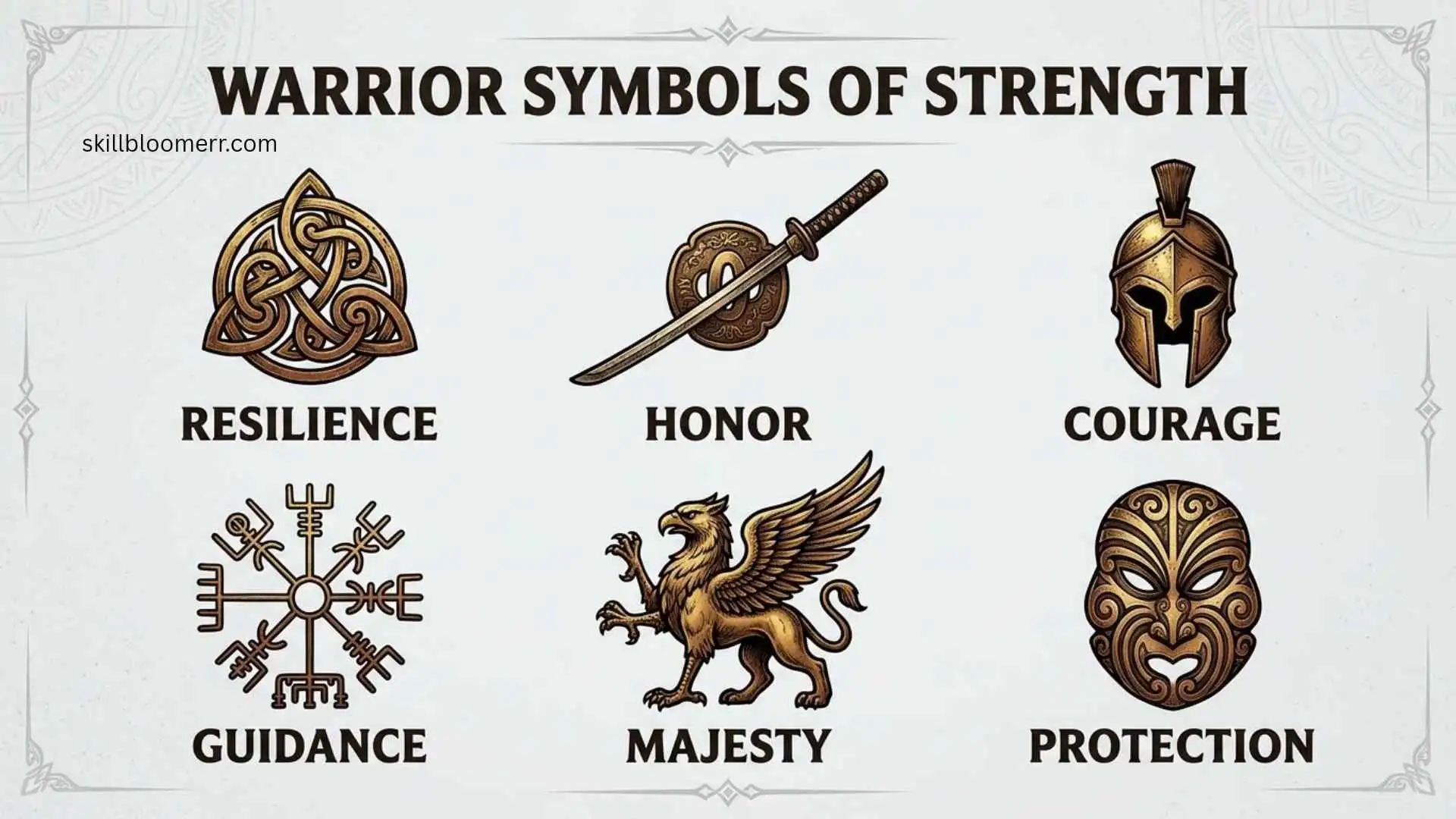
Warrior symbols of strength have shaped human identity for thousands of years. From battlefield standards to personal tattoos, these images communicated courage, protection, and power long before written language became widespread.
Soldiers painted them on shields, kings carved them into monuments, and modern people still wear them as reminders of resilience.
You encounter warrior symbols of strength on national flags, military insignia, sports logos, jewelry, and body art. They appear in museums, video games, and motivational posters because the qualities they represent—endurance, bravery, and disciplined force—remain relevant.
This guide explores the most enduring warrior symbols of strength, their origins, meanings, and lasting cultural impact.
Quick Meaning
Warrior symbols of strength represent physical power, moral courage, protection, and readiness for conflict or adversity. Common examples include the lion, eagle, sword, shield, spear, Spartan lambda, Thor’s hammer, and jaguar. Across cultures these images signal the warrior’s ability to defend, conquer, or endure. Their primary function is both practical identification and psychological reinforcement of the qualities needed in battle or life’s challenges.
Symbol Overview Table
| Symbol Name | Primary Meaning | Category | Origin / Culture | First Known Use (approx.) | Common Usage | Modern Meaning | Related Symbols |
| Lion | Courage, royalty, dominance | Animal | Ancient Near East, Africa, Europe | 3000 BCE | Heraldry, flags, statues | Personal power, leadership | Griffin, tiger |
| Eagle | Vision, victory, imperial power | Animal / Standard | Mesopotamia, Rome, Native America | 3000 BCE | Military standards, national emblems | Freedom, strength, perspective | Double-headed eagle |
| Sword | Justice, martial skill, authority | Weapon | Bronze Age onward | 3000 BCE | Art, tattoos, logos | Decision, protection | Spear, axe |
| Shield | Defense, unity, honor | Weapon / Armor | Ancient Greece, widespread | Bronze Age | Military, sports, logos | Protection of self and others | Helmet, armor |
| Spartan Lambda (Λ) | Identity, discipline, fearlessness | Letter / Emblem | Ancient Sparta | 5th century BCE | Shields, modern branding | Resilience, elite training | Spartan helmet |
| Mjolnir | Protection, raw power | Mythological weapon | Norse / Viking | Viking Age | Amulets, tattoos | Strength against chaos | Valknut, runes |
| Jaguar | Stealth, night power, ferocity | Animal | Aztec / Mesoamerica | Pre-Columbian | Warrior ranks, art | Predatory strength | Eagle warrior |
| Chinese 武 (Wǔ) | Martial power, stopping conflict | Character | Ancient China | Zhou dynasty onward | Martial arts, language | Disciplined force | Sword, spear |
What Does the Symbol Mean?
Warrior symbols of strength convey more than physical might. They embody the complete warrior ideal: the capacity to protect one’s community, uphold honor, face danger without retreat, and maintain discipline under pressure. A lion roaring on a shield declared that the bearer possessed the heart of a predator. An eagle standard promised the unit would strike from above with superior vision. A sword raised high signaled readiness to enforce justice or defend territory.
These symbols worked on two levels. Practically, they identified friends from foe on chaotic battlefields. Psychologically, they reminded the warrior of the qualities required to survive and prevail. When a Spartan carried a shield marked with the lambda, the emblem reinforced the collective identity of Lacedaemon and the expectation that no man would abandon his place in the phalanx. The same principle applies today when athletes or military personnel adopt these images. The symbol becomes a visible commitment to the values it represents.
History and Origin
Warrior symbols of strength emerged as soon as organized conflict and social hierarchy developed. In Mesopotamia around 3000 BCE, kings and armies already used the lion and eagle as royal and martial emblems. The earliest known military standards appear in the same region, often featuring powerful animals believed to channel divine favor.
In the Bronze Age Aegean, warriors of Mycenaean Greece buried themselves with weapons and animal imagery that linked them to heroic ideals. By the classical period, Greek city-states standardized shield devices. Sparta’s use of the lambda became one of the most recognizable. Roman legions refined the concept further. After Gaius Marius standardized the aquila (eagle) as the primary legionary standard around 104 BCE, the eagle became the ultimate symbol of Roman military strength and unit honor. Losing the eagle in battle was a catastrophe; recovering it restored prestige.
In East Asia, the Chinese character 武 (wǔ) evolved from the combination of a spear (戈) and a foot or “stop” element (止). Classical commentators interpreted it as “stopping the spear,” emphasizing that true martial power ends conflict rather than perpetuating it. Japanese samurai culture later developed its own rich visual language of family crests (mon), armor patterns, and sword fittings that expressed lineage and martial virtue.
Norse warriors of the Viking Age carried runes and mythological symbols such as Mjolnir and the Valknut. These marks appeared on weapons, amulets, and memorial stones, linking the individual fighter to the gods of war and fate. In Mesoamerica, Aztec society formalized elite warrior orders. Capturing four enemies earned a man the right to wear the jaguar or eagle costume, transforming him into a living embodiment of those animals’ predatory power.
Across continents the pattern is consistent: societies that valued martial excellence developed visual shorthand to express and reinforce that value.
Symbolism and Interpretation
Traditional Meanings
Traditional interpretations focus on battlefield virtues. The lion stands for fearless attack and royal authority. The eagle represents far-sightedness and the ability to dominate from a superior position. The sword cuts through obstacles and delivers justice. The shield protects both the individual and the comrade to his left in formation. Animal symbols often carried the belief that the wearer absorbed the creature’s qualities—stealth from the jaguar, vision from the eagle, ferocity from the lion.
Modern Meanings
Today the same symbols frequently represent inner strength rather than literal combat. A person may choose a lion tattoo to mark recovery from illness or the determination required to build a business. Military units still use eagles and swords, but civilians adopt them for personal motivation. Fitness brands and sports teams favor Spartan and Viking imagery because those cultures are associated with rigorous training and mental toughness.
Positive and Negative Symbolism
Positive associations include courage, loyalty, protection, and disciplined power. Negative readings appear when the same symbols are co-opted by aggressive ideologies or when they glorify violence without the balancing virtues of restraint and honor. Historical sources themselves sometimes warn against this imbalance. The Chinese tradition of interpreting 武 as “stopping the spear” is one clear example of a culture deliberately tempering martial symbolism with ethical limits.
Psychological Interpretation
Psychologically these symbols function as external anchors for desired traits. Displaying or wearing a warrior symbol can reinforce identity and provide a focal point for mental preparation. The practice is ancient; modern psychology simply describes it in different languages The symbol becomes a reminder of the standard the individual has set for themselves.
Cultural Significance
Different cultures emphasize different facets of strength. In European heraldry the lion dominates, appearing in the arms of England, Scotland, and many continental houses as the ultimate emblem of courageous nobility. Rome and later European empires elevated the eagle. Native American traditions often treat the eagle as a sacred messenger rather than a purely martial figure, linking strength to spiritual vision.
In Japan the samurai ideal stressed loyalty and readiness more than individual ferocity; patterns such as arrow feathers (yabane) and scale motifs (uroko) served as protective talismans. Aztec culture balanced day and night through the dual orders of eagle and jaguar warriors, reflecting a cosmological view of strength as complementary rather than singular. Norse culture tied warrior strength to fate and the gods, with symbols functioning both as protective amulets and as markers of status among the einherjar who would fight at Ragnarök.
Regional differences remain visible today. A lion in African contexts may carry additional associations with specific ethnic histories and leadership traditions, while the same animal in Western logos often signals generic power and prestige.
Religious or Spiritual Meaning
Many warrior symbols of strength possess sacred dimensions. The Roman aquila was treated as a sacred object; soldiers swore oaths by it and its loss required ritual purification. Norse warriors dedicated weapons and themselves to Odin or Thor, and Mjolnir amulets appear in both pagan and early Christian contexts as protective charms. In Aztec religion the eagle and jaguar warriors served the solar and nocturnal aspects of the gods Huitzilopochtli and Tezcatlipoca, making their costumes acts of ritual embodiment.
Chinese martial tradition developed within a philosophical framework that included Confucian restraint and Daoist concepts of balanced force. Japanese bushidō, though heavily romanticized in the modern era, drew on Zen, Shinto, and Confucian elements that framed the warrior’s strength as service rather than pure domination. In each case the spiritual layer elevated physical power into a disciplined, often sacrificial ideal.
Where the Symbol Is Used
Warrior symbols of strength appear across nearly every medium of human expression:
- Military insignia and flags: Roman aquila, modern national eagles, unit patches.
- Heraldry and coats of arms: Lions, eagles, swords, and shields form the backbone of European armorial tradition.
- Architecture and monuments: Stone lions guard entrances; eagles crown columns.
- Jewelry and amulets: Viking Mjolnir pendants, modern strength medallions.
- Tattoos: Spartan helmets, lambda symbols, runes, and animal motifs remain popular expressions of personal resilience.
- Logos and branding: Sports teams, fitness companies, and security firms frequently adopt these images.
- Art and literature: From ancient friezes to contemporary graphic novels, the visual language of the warrior persists.
- Currency and official seals: Many nations place eagles or lions on their money and state emblems.
- Digital culture: Video games, emojis, and online avatars continue the tradition in virtual form.
Common Variations
Design variations are extensive. The lion may appear passive (walking), rampant (rearing), or couchant (lying). Eagles appear single- or double-headed; the double-headed form traditionally signifies dominion over both East and West or secular and spiritual power. Shields range from the round Greek aspis to the kite-shaped medieval form. The Spartan lambda is usually a simple inverted V, though modern graphic versions add dimension or combine it with helmets.
Regional adaptations alter emphasis. Japanese family crests stylize weapons and animals into elegant geometric forms. Mesoamerican warrior costumes used real animal skins and feathers for dramatic visual impact. Modern adaptations often simplify ancient designs for logos or tattoos while retaining the core silhouette that makes the symbol instantly recognizable.
Similar symbols include the griffin (lion-eagle hybrid), the dragon in East Asian martial contexts, and various runic combinations that convey related ideas of victory or protection.
Common Misconceptions
One widespread misconception holds that every Spartan shield carried the lambda. Surviving evidence is limited; while the symbol was certainly used and recognized, individual hoplites often chose personal devices. Another common error treats Viking symbols as purely aggressive. Many, including Mjolnir, functioned primarily as protective charms rather than pure battle emblems.
People sometimes assume that warrior symbols celebrate uncontrolled violence. Historical cultures usually paired them with codes of honor, restraint, or religious obligation. The Chinese interpretation of 武 as ending conflict rather than starting it is a clear counter-example to purely aggressive readings. Finally, modern commercial use often strips the symbols of historical context, turning complex cultural signs into generic “toughness” graphics.
Interesting Facts
- The Roman aquila was so sacred that a legion that lost its eagle suffered lasting disgrace, and extraordinary efforts were made to recover lost standards.
- Aztec jaguar and eagle warriors earned their costumes by capturing enemies alive, because live captives held greater ritual value than battlefield kills.
- The Chinese character 武 is classically explained as “stopping the spear,” turning a martial symbol into a statement about the proper end of force.
- Spartan mothers allegedly told their sons to return “with their shield or on it,” underscoring that the shield represented both protection and honor.
- Thor’s hammer amulets continued to be worn even after the Christianization of Scandinavia, sometimes alongside crosses.
- Greek city-states used distinctive shield devices for rapid battlefield identification; the practice reduced friendly-fire incidents in the confusion of the phalanx.
- In some African and European traditions, overcoming a lion in myth or legend proved the hero’s supreme strength, linking the animal to both danger and triumph.
- Viking runes such as Tiwaz (associated with the god Tyr) and Uruz (aurochs, raw strength) appear on weapons and memorial stones as both practical marks and invocations of power.
- Japanese samurai armor sometimes featured a red line on the spear groove, a restricted mark of excellence granted only with permission.
- The griffin, combining lion and eagle, appears in both Mediterranean and Central Asian warrior contexts as a guardian of treasure and a symbol of vigilant strength.
- Early Mesopotamian standards featuring eagles and lions predate written military history, showing that visual martial symbolism is among humanity’s oldest organized practices.
- Modern sports teams and special-operations units continue to select these ancient symbols because their associations with discipline and courage remain culturally potent.
Related Symbols
Several symbols share conceptual territory with classic warrior emblems of strength. The griffin merges the terrestrial power of the lion with the aerial dominance of the eagle. The Valknut, three interlocking triangles, is linked to Odin and the fate of warriors. The algiz rune conveys protection and higher guidance. The Japanese mon (family crest) system includes countless stylized weapons and animals that function similarly to Western heraldry. The Chinese dragon, though more imperial than purely martial, often appears in contexts of powerful, controlled force. Each differs in emphasis—some stress protection, others fate, others lineage—yet all participate in the broader visual language of strength and readiness.
Frequently Asked Questions
What is the most common warrior symbol of strength?
The lion and the eagle rank among the most widespread. Both appear across Africa, Europe, the Middle East, and the Americas in contexts of royalty, courage, and military power. The sword and shield are nearly universal as practical and symbolic objects.
Did Spartans really put the lambda on their shields?
Evidence confirms that the lambda was used and recognized as a Spartan marker. However, it was not the only design; many shields carried personal or mythological images. Popular culture has amplified the lambda into the default Spartan emblem.
What Viking symbol represents strength?
Mjolnir (Thor’s hammer) is the most direct symbol of protective strength. The rune Uruz specifically conveys raw power and endurance, while Tiwaz relates to victory and justice in battle.
Why do so many cultures use the eagle?
The eagle’s combination of flight, sharp vision, and predatory skill made it a natural metaphor for leaders and armies that sought to dominate from a superior position. Its association with sky gods further elevated its status.
Is the Chinese character for warrior purely aggressive?
No. Classical commentary interprets 武 as “stopping the spear,” framing true martial achievement as the ability to end conflict and restore order rather than endless fighting.
Can warrior symbols have negative meanings?
Yes. When stripped of ethical context they can glorify aggression or be appropriated by extremist groups. Historical cultures usually balanced the symbols with codes of honor and restraint.
Why are these symbols still popular in tattoos and logos?
They provide an immediate visual shorthand for resilience, discipline, and the willingness to face difficulty. Their long history gives them cultural weight that purely modern designs often lack.
What animal symbolized Aztec elite warriors?
Both the jaguar and the eagle. Jaguar warriors represented night and earth power; eagle warriors represented the sun and sky. Together they expressed cosmic balance.
Are there female warrior symbols of strength?
While many historical warrior symbols developed in male-dominated military cultures, figures such as the Valkyries in Norse tradition, certain Celtic and Scythian representations, and modern reinterpretations expand the imagery to include female strength and protection.
How should someone choose a warrior symbol today?
Consider personal values rather than pure aesthetics. A shield may suit someone focused on protection and community; a sword may fit decisive action; an animal may emphasize instinctive courage. Understanding the historical meaning prevents superficial or contradictory choices.
Key Takeaways
- Warrior symbols of strength originated as practical identifiers and psychological tools on ancient battlefields.
- Core examples include the lion, eagle, sword, shield, Spartan lambda, Mjolnir, jaguar, and the Chinese character 武.
- Meanings consistently center on courage, protection, discipline, and the capacity to face adversity.
- Cultures adapted the same basic ideas to their own cosmologies, producing rich regional variations.
- Spiritual and ethical dimensions often tempered pure martial aggression.
- Modern use in tattoos, logos, and personal branding continues the ancient practice of externalizing desired qualities.
- Historical accuracy matters; many popular assumptions oversimplify or romanticize the original contexts.
- These symbols remain powerful because the human need for visible reminders of strength and resilience has not disappeared.
Conclusion
Warrior symbols of strength have traveled from ancient battle standards to contemporary personal emblems without losing their core power. Whether painted on a Spartan aspis, carved into a Viking stone, worn as an Aztec costume, or inked on modern skin, they continue to express the same fundamental human aspiration: the ability to stand firm, protect what matters, and meet challenges with courage.
Understanding their history and cultural depth turns a simple image into a connection with thousands of years of human experience. In that continuity lies their lasting relevance.

I’m Nathaniel Brooks, an educational writer who loves exploring ideas and making useful knowledge accessible to everyone. I write for SkillBloomerr with a focus on clear explanations, practical tips, and meaningful learning. My goal is to help readers discover something valuable every time they visit the site.
Books: Learn Something New and The Practical Knowledge Handbook
 Olivia Hartwell