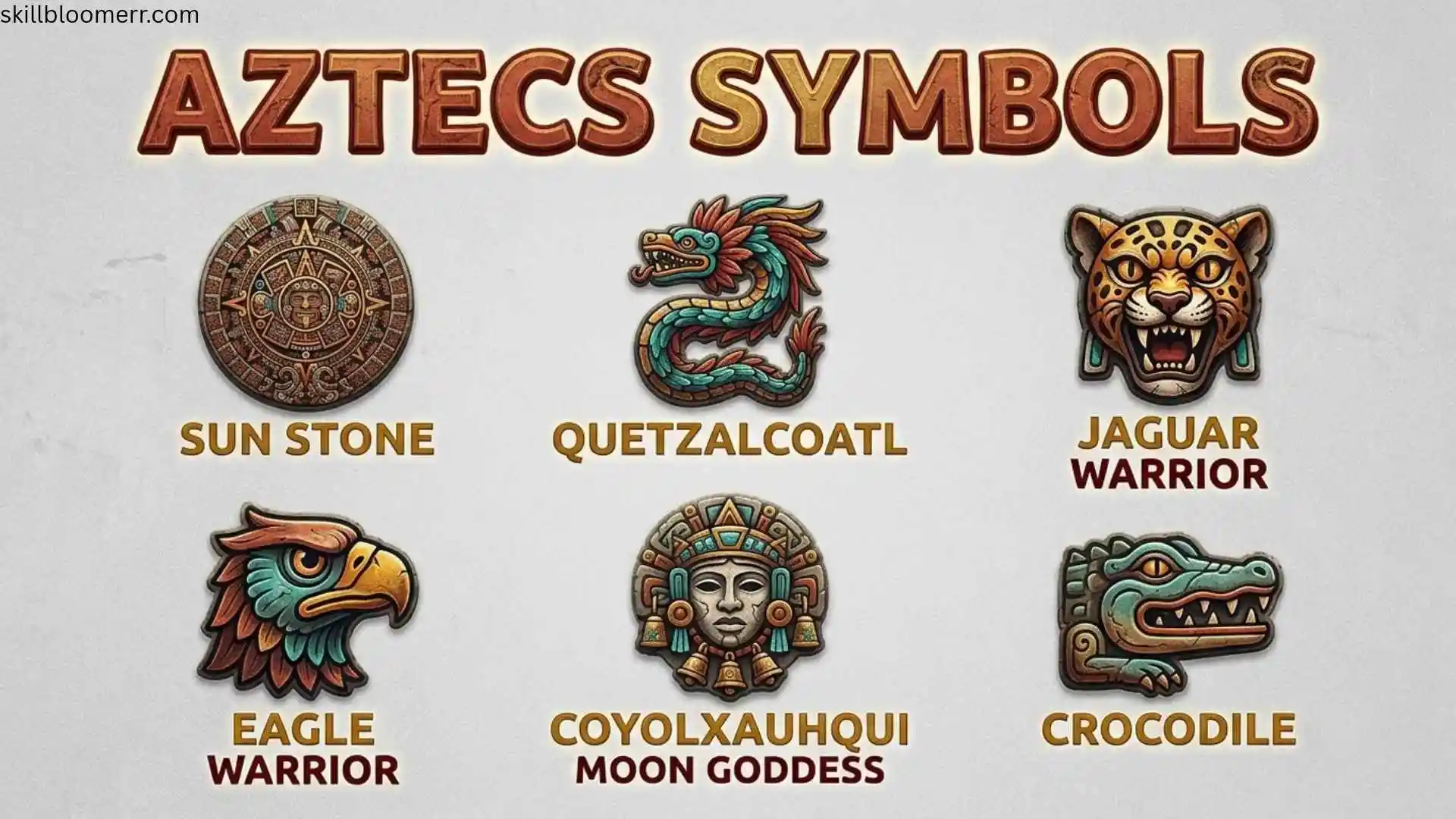
Aztec symbols represent one of the richest visual languages created by an ancient civilization. These symbols were used to explain gods, nature, time, warfare, social identity, astronomy, and the relationship between humans and the universe. From temples and manuscripts to jewelry and modern artwork, Aztec symbols continue to appear around the world today.
The Aztec civilization, also known as the Mexica civilization, developed a complex symbolic system in central Mexico before the arrival of the Spanish in the 16th century.
Their symbols were not simple decorations. Each image carried layers of meaning connected to mythology, religion, history, and daily life.
Understanding Aztecs symbols helps reveal how the Mexica people viewed creation, death, power, nature, and spirituality. Symbols such as the Aztec sun stone, eagle, jaguar, serpent, and calendar signs remain important examples of ancient Mesoamerican symbolism.
Quick Meaning of Aztecs Symbols
Aztec symbols are visual signs created by the Mexica civilization to represent religious beliefs, gods, natural forces, social roles, time cycles, and important cultural ideas. These symbols appeared in temples, codices, sculptures, clothing, weapons, and ceremonies. Many continue to represent Mexican heritage, strength, identity, and ancient wisdom today.
Aztecs Symbols Overview Table
| Symbol Name | Primary Meaning | Category | Origin | Civilization or Culture | First Known Use | Common Usage | Modern Meaning | Related Symbols |
| Aztec Sun Stone | Time, creation, cosmic cycles | Calendar symbol | Central Mexico | Mexica (Aztec) | 15th century | Ritual calendars, monuments | Mexican heritage and history | Solar symbols, calendars |
| Eagle | Power, courage, warrior spirit | Animal symbol | Mesoamerica | Mexica | Ancient period | Military and religious imagery | Strength and freedom | Jaguar, warrior symbols |
| Jaguar | Night, power, rulers, warriors | Animal symbol | Mesoamerica | Aztec culture | Ancient period | Warrior orders and art | Mystery and strength | Eagle, feline symbols |
| Feathered Serpent (Quetzalcoatl) | Knowledge, creation, wind, civilization | Religious symbol | Mesoamerica | Aztec and earlier cultures | Ancient period | Temples and mythology | Wisdom and transformation | Serpent symbols |
| Skull | Death, rebirth, sacrifice | Spiritual symbol | Aztec Mexico | Mexica | Ancient period | Ritual art and temples | Mortality and remembrance | Mictlan symbols |
| Flower Symbol | Beauty, poetry, life | Cultural symbol | Central Mexico | Mexica | Ancient period | Art and literature | Creativity and growth | Nature symbols |
| Water Symbol | Life, fertility, renewal | Nature symbol | Mesoamerica | Aztec | Ancient period | Art and ceremonies | Purification and life | Rain symbols |
What Do Aztecs Symbols Mean?
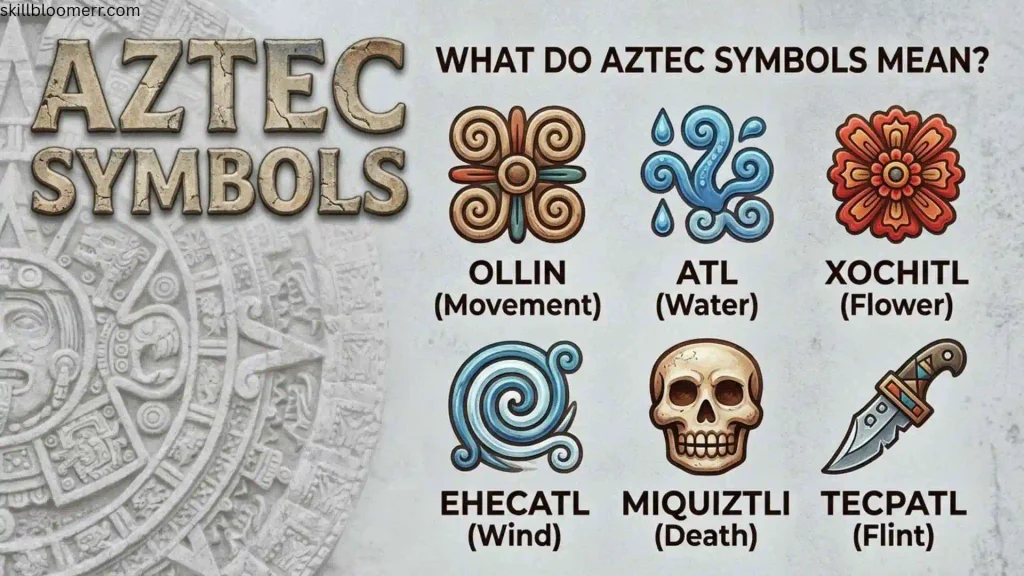
Aztec symbols represent the beliefs and worldview of the Mexica people. Unlike modern symbols that often have one fixed meaning, Aztec symbols could contain several meanings depending on their context.
A serpent, for example, was not simply an animal image. It could represent transformation, fertility, power, and divine knowledge. Similarly, an eagle represented both a real bird and a spiritual connection between humans, the sun, and warfare.
The Mexica believed that the universe was organized through relationships between gods, natural elements, humans, and time. Symbols helped communicate these relationships.
Common themes found in Aztec symbolism include:
- Creation and destruction
- Life and death cycles
- The power of nature
- The importance of sacrifice
- Warrior identity
- Divine authority
- Time and destiny
- Connection between humans and gods
Aztec symbols were often placed in carefully designed combinations. A single image could tell a historical story, identify a person’s role, or represent a religious ceremony.
History and Origin of Aztec Symbols
The Rise of Mexica Symbolism
Aztec symbols originated from the broader Mesoamerican tradition that existed thousands of years before the Mexican Empire. Civilizations such as the Olmec, Maya, and Toltec influenced many ideas later adopted by the Aztecs.
The Mexica settled in the Valley of Mexico during the 14th century and established their capital, Tenochtitlan, in 1325. As their empire expanded, they developed a sophisticated symbolic system that combined religion, politics, astronomy, and social organization.
Symbols in Aztec Codices
Much of what historians know about Aztec symbols comes from codices. These illustrated manuscripts recorded information about:
- Religious ceremonies
- Historical events
- Genealogy
- Calendars
- Tribute systems
- Mythology
Important examples include the Codex Mendoza and the Codex Borbonicus. These documents show how symbols were used as a form of communication.
The Role of Temples and Architecture
Aztec temples were covered with symbolic designs. Buildings were created to represent sacred mountains, cosmic levels, and relationships between humans and gods.
The Great Temple of Tenochtitlan, known as Templo Mayor, contained many symbolic elements connected to warfare, agriculture, and religious ceremonies.
Symbolism and Interpretation of Aztec Symbols
Traditional Meanings
Traditional Aztec symbolism focused heavily on balance. The Mexica believed opposing forces existed together:
- Life and death
- Darkness and light
- Creation and destruction
- Order and chaos
Death was not viewed only as an ending. It was part of a continuous cycle of existence.
Positive Symbolism
Many Aztec symbols are associated with positive ideas:
- Eagles symbolize bravery and leadership.
- Quetzalcoatl represents knowledge and civilization.
- Flowers symbolize artistic expression and beauty.
- Water represents fertility and renewal.
- The sun represents energy and cosmic order.
Negative Symbolism
Some symbols had more complex meanings:
- Skulls represented death and sacrifice.
- Jaguars could represent dangerous forces of the night.
- Serpents could symbolize both wisdom and powerful natural forces.
These meanings were not necessarily “good” or “bad.” Aztec symbolism often represented balance rather than simple opposites.
Psychological Interpretation
Modern interpretations often view Aztec symbols as representations of universal human experiences:
- The sun reflects hope and life energy.
- The serpent reflects change and personal transformation.
- The skull represents acceptance of mortality.
- The eagle represents ambition and personal power.
These interpretations are modern perspectives and may differ from original Mexica beliefs.
Cultural Significance of Aztec Symbols
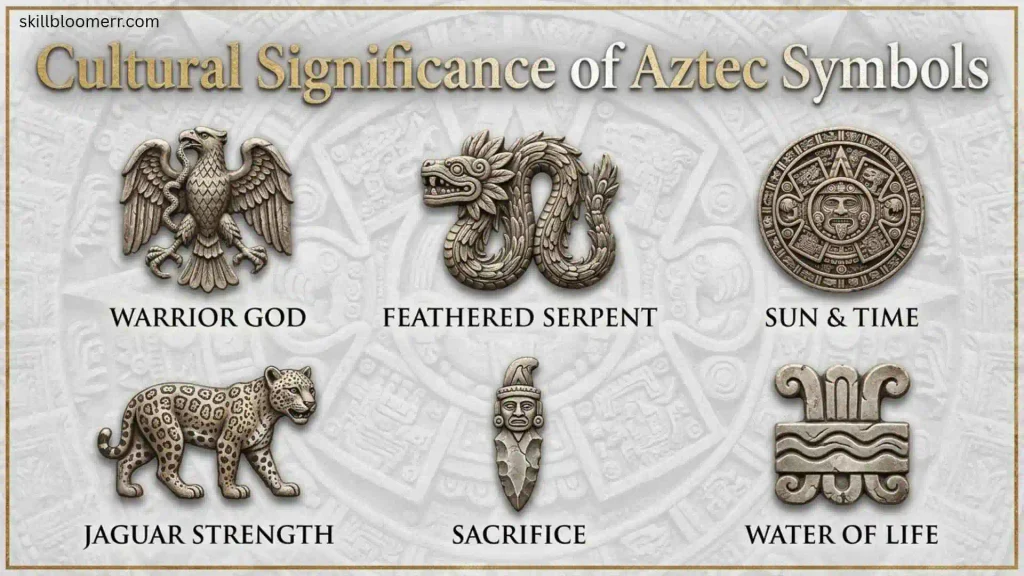
Aztec symbols remain deeply connected to Mexican identity and cultural heritage. They appear in museums, public art, education, fashion, tattoos, and national imagery.
Mexican Heritage
Many modern Mexicans view Aztec symbols as reminders of Indigenous history and resilience. The eagle and serpent are especially important because they appear on the national coat of arms of Mexico.
The image of an eagle standing on a cactus while holding a serpent comes from the Mexica founding story of Tenochtitlan.
Indigenous Identity
For many Indigenous communities, Aztec symbols represent ancestral knowledge, cultural survival, and connection to pre-Hispanic traditions.
However, it is important to understand that “Aztec” refers mainly to the Mexica people and their empire. Many Indigenous cultures existed across Mesoamerica, each with their own symbols and traditions.
Religious and Spiritual Meaning of Aztec Symbols
Religion was central to the Aztec symbolic language. Symbols connected the physical world with the spiritual world.
Quetzalcoatl and Spiritual Knowledge
Quetzalcoatl, the Feathered Serpent, was one of the most important figures in Mesoamerican religion. Among the Aztecs, he was associated with:
- Wind
- Learning
- Priesthood
- Creation
- Civilization
The Feathered Serpent combined the earth-related power of the serpent with the sky-related nature of the bird.
Sun Symbolism
The sun held enormous religious importance. The Aztecs believed cosmic order depended on maintaining relationships between humans, gods, and natural forces.
The sun represented:
- Creation
- Energy
- Time
- Renewal
Death and Sacrifice Symbols
Aztec religion included ceremonies involving sacrifice. These practices were connected to beliefs about maintaining cosmic balance.
Skull imagery, bones, and death symbols represented transformation rather than only fear.
Where Aztec Symbols Are Used Today
Aztec symbols appear in many modern contexts.
Art and Museums
Museums around the world display Aztec sculptures, manuscripts, and artifacts to teach visitors about Mexica civilization.
Jewelry and Tattoos
Many people choose Aztec symbols for tattoos and jewelry because they represent:
- Strength
- Heritage
- Spiritual connection
- Personal transformation
Popular choices include:
- Aztec sun symbols
- Quetzalcoatl
- Eagles
- Jaguars
- Calendars
Architecture and Design
Modern artists often incorporate Aztec patterns into:
- Buildings
- Murals
- Clothing
- Graphic design
Education and Literature
Aztec symbols appear in history books, documentaries, and academic studies about Mesoamerica.
Common Variations of Aztec Symbols
Aztec Sun Stone Variations
The Aztec Sun Stone is often reproduced in different styles. Some versions focus on historical accuracy, while others create modern artistic interpretations.
Feathered Serpent Designs
Quetzalcoatl images vary greatly. Some show a simple serpent, while others include feathers, human features, or elaborate decorations.
Eagle and Jaguar Representations
Eagles and jaguars were commonly shown in:
- Warrior clothing
- Sculptures
- Military imagery
Modern designs often simplify these images for tattoos and logos.
Common Misconceptions About Aztec Symbols
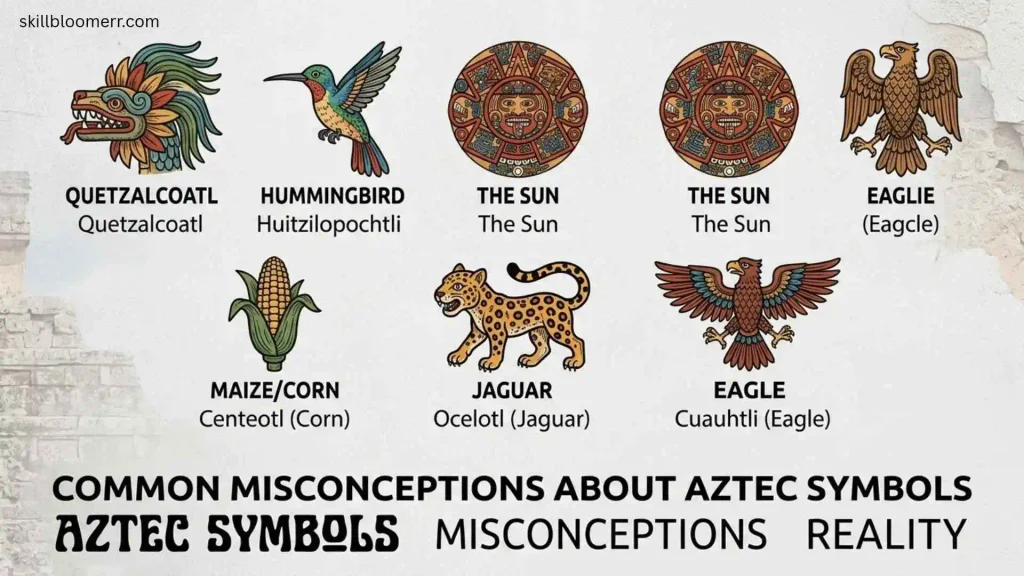
Misconception 1: All Mesoamerican Symbols Are Aztec
Many symbols existed before the Aztec Empire. The Maya, Olmec, and other cultures developed their own symbolic systems.
Misconception 2: Aztec Symbols Had Only One Meaning
Most Aztec symbols had multiple meanings depending on location, historical period, and context.
Misconception 3: Aztec Symbols Were Only Religious
Although religion was important, symbols were also used for politics, warfare, history, astronomy, and social identity.
Misconception 4: Modern Interpretations Are Always Historically Accurate
Some modern designs combine different Mesoamerican symbols or add meanings that were not part of traditional Aztec culture.
Interesting Facts About Aztec Symbols
- The Aztec Sun Stone Is Not Exactly a Clock
Many people call it the Aztec calendar, but historians explain that it is a complex ceremonial and cosmological monument. - The Mexican Flag Uses an Ancient Symbol
The eagle and serpent image comes from the Mexica story of finding the location where they would build Tenochtitlan. - Aztec Symbols Recorded History
Symbols in codices helped preserve information about rulers, battles, and important events. - Animals Had Deep Meanings
Eagles and jaguars were connected with warrior groups and spiritual power. - Flowers Represented More Than Beauty
Flowers were linked with poetry, art, and philosophical ideas among the Mexica. - Aztec Symbols Combined Different Worlds
Many symbols connected earth, sky, humans, gods, and natural forces. - The Feathered Serpent Predates the Aztec Empire
Quetzalcoatl traditions existed in earlier Mesoamerican cultures. - Symbols Helped Organize Society
Images could communicate social status, religious roles, and political authority. - Aztec Writing Used Pictures and Signs
Their writing system combined images, symbols, and phonetic elements. - Modern Interest Continues Worldwide
Aztec symbols remain popular in art, education, fashion, and cultural studies.
Related Symbols
Maya Symbols
Maya symbols also represented time, astronomy, gods, and nature. They developed a highly advanced writing system and calendar traditions.
Egyptian Symbols
Like Aztec symbols, Egyptian symbols connected religion, death, and the afterlife. However, they came from a different cultural environment.
Celtic Symbols
Celtic symbols often focus on nature, cycles, and spirituality, creating interesting comparisons with Aztec views of balance.
Norse Symbols
Norse symbols such as runes and mythological images also represented gods, power, and destiny.
Frequently Asked Questions
What are the most famous Aztec symbols?
The most famous Aztec symbols include the Aztec Sun Stone, eagle, jaguar, Quetzalcoatl (Feathered Serpent), skull imagery, and calendar symbols. These images are widely recognized because they represent important parts of Mexica religion, mythology, warfare, and cultural identity.
What does the Aztec sun symbol mean?
The Aztec sun symbol represents time, creation, cosmic cycles, and the relationship between humans and divine forces. The sun was central to Mexica beliefs because it represented life, energy, and the continuation of the universe.
What does the Aztec eagle symbolize?
The Aztec eagle symbolizes courage, warriors, strength, and connection with the sun. Eagle imagery was especially associated with elite warrior groups and remains an important symbol in Mexican national identity.
What does Quetzalcoatl symbolize?
Quetzalcoatl symbolizes knowledge, creation, wind, learning, and civilization. The Feathered Serpent represents the combination of earthly and heavenly forces in Mesoamerican thought.
Are Aztec symbols religious?
Many Aztec symbols had religious meanings, but they were also used in politics, history, art, warfare, and everyday life. Their meanings often depended on the context where they appeared.
Are Aztec symbols still used today?
Yes. Aztec symbols appear in Mexican culture, museums, artwork, tattoos, jewelry, education, and modern designs. They continue to represent history, identity, and Indigenous heritage.
What is the difference between Aztec and Maya symbols?
Aztec symbols come mainly from the Mexica Empire, while Maya symbols belong to Maya civilizations. Both cultures valued astronomy, religion, and timekeeping but developed different writing and artistic traditions.
Are all Aztec symbols authentic?
Not always. Some modern designs combine historical elements with new interpretations. Authentic symbols should be studied through archaeological evidence, codices, and academic research.
Why are Aztec symbols important today?
Aztec symbols preserve knowledge about one of the most influential civilizations in the Americas. They help people understand Indigenous history, mythology, art, and cultural identity.
Key Takeaways
- Aztec symbols were a complex visual language used by the Mexica civilization.
- These symbols represented religion, history, nature, time, and social identity.
- The Aztec Sun Stone, eagle, jaguar, and Quetzalcoatl are among the most recognized symbols.
- Many symbols had multiple meanings depending on their context.
- Aztec symbolism influenced modern Mexican heritage and artistic expression.
- Some modern interpretations differ from original historical meanings.
- Studying Aztec symbols provides insight into ancient Mesoamerican beliefs and traditions.
Conclusion
Aztecs symbols are more than ancient images carved into stone or painted in manuscripts. They represent a complete worldview that connected humans, nature, gods, time, and the universe. The Mexica civilization used symbols to preserve knowledge, explain mysteries, and express cultural identity.
From the powerful eagle to the transformational Feathered Serpent, each symbol carries stories that continue to influence art, history, and modern culture. Understanding Aztec symbols allows us to appreciate the creativity, intelligence, and spiritual depth of one of the greatest civilizations of ancient Mesoamerica.

I’m Nathaniel Brooks, an educational writer who loves exploring ideas and making useful knowledge accessible to everyone. I write for SkillBloomerr with a focus on clear explanations, practical tips, and meaningful learning. My goal is to help readers discover something valuable every time they visit the site.
Books: Learn Something New and The Practical Knowledge Handbook
 Olivia Hartwell