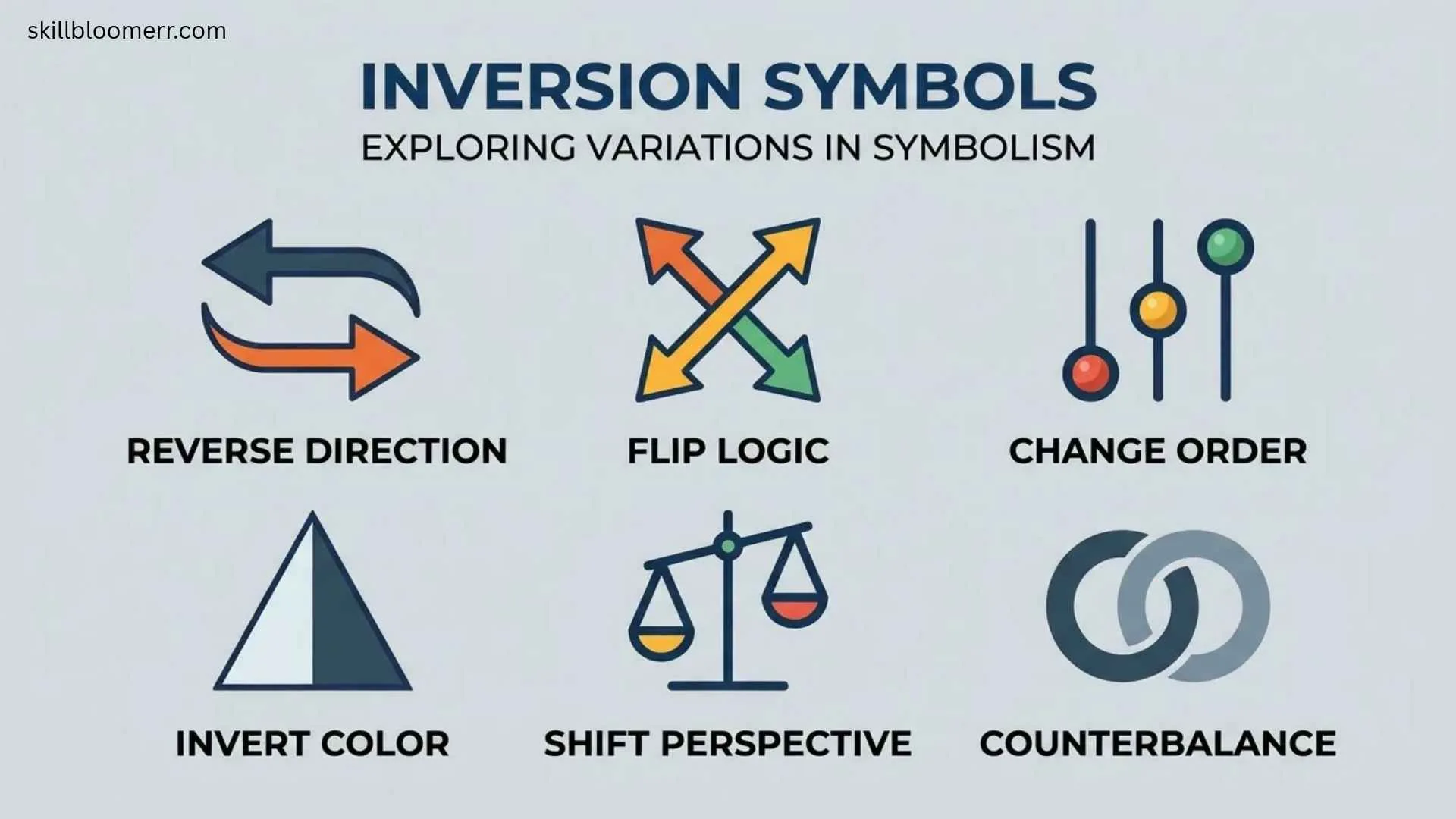
Inversion symbols represent the idea of reversal, opposition, transformation, or a change from an expected order. These symbols appear in mathematics, music, linguistics, computing, literature, psychology, art, and cultural traditions.
They help people communicate that something has been flipped, reversed, turned upside down, or viewed from another perspective.
The meaning of inversion symbols depends on the context where they appear. A symbol that means “reverse” in mathematics may represent transformation or hidden meaning in art and literature.
Understanding these symbols helps readers interpret information more accurately and recognize how societies use visual signs to express complex ideas.
Inversion symbols are especially important because they show how meaning can change when direction, position, or perspective changes. From reversed punctuation marks to mathematical inversion operations, these symbols connect ideas across different fields.
Quick Meaning of Inversion Symbols
Inversion symbols are visual marks or notations that represent reversal, flipping, changing order, or transforming an original state. They are used in mathematics, language, music, technology, and symbolic systems to indicate that something has been turned around, reflected, or interpreted in an opposite way.
Symbol Overview Table
| Symbol Name | Primary Meaning | Category | Origin | Common Usage | Modern Meaning |
| Inversion Symbol | Reversal or transformation | General Symbolism | Various cultural and technical systems | Mathematics, language, art, technology | Change of direction or perspective |
| Upside-Down Symbols | Opposite meaning or altered state | Visual Symbolism | Ancient artistic traditions | Art, literature, design | Challenging normal expectations |
| Mathematical Inversion Notation | Reciprocal or transformation operation | Mathematics | Developed through mathematical notation systems | Algebra, geometry, calculus | Reversing a relationship |
| Musical Inversion | Changing intervals or melodic structure | Music Theory | Western classical music traditions | Composition and analysis | A transformed musical pattern |
| Mirrored Symbols | Reflection or reversal | Visual Design | Ancient mirror symbolism | Logos, art, psychology | Self-reflection or alternative viewpoint |
What Do Inversion Symbols Mean?
Inversion symbols generally represent the act of reversing something from its original position, order, or meaning. The concept of inversion appears whenever an existing structure is changed while maintaining a connection to the original form.
The word “inversion” comes from the Latin word invertere, meaning “to turn upside down” or “to reverse.” The basic idea is not destruction but transformation. Something remains connected to its original state but appears differently.
Common meanings associated with inversion symbols include:
- Reversal of direction
- Change in perspective
- Opposite interpretation
- Transformation
- Hidden meaning
- Reflection
- Balance between opposites
- Breaking traditional patterns
For example, an upside-down version of a familiar symbol may suggest that its normal meaning has been challenged. Artists often use inverted imagery to encourage viewers to question assumptions.
In technical fields, inversion usually has a more precise meaning. A mathematical inversion symbol does not simply mean “opposite”; it describes a specific operation that changes one value or relationship into another.
History and Origin of Inversion Symbols
Early Human Use of Reversal Concepts
The idea of inversion is ancient. Human cultures have long used reversed images, mirrored designs, and upside-down arrangements to represent transformation or movement between different states.
Ancient civilizations used directional changes in symbols to communicate spiritual ideas, seasonal cycles, and connections between the physical and symbolic worlds.
In many early artistic traditions, changing the orientation of an image could create a new interpretation. A figure facing one direction might represent life, while the same figure reversed could represent a different force.
Inversion in Ancient Symbol Systems
Ancient Egyptian, Mesopotamian, Greek, and Roman cultures used symbolic transformations in art and writing. Although they did not always have a specific “inversion symbol,” they understood the importance of direction and orientation.
For example:
- Egyptian hieroglyphs could face different directions depending on artistic arrangement.
- Ancient Greek art used mirrored forms to create balance and contrast.
- Roman decorative patterns frequently used symmetrical reversals.
These examples show that inversion has always been connected with human ideas of balance and transformation.
Development in Mathematics and Science
In mathematics, inversion developed as a formal concept. Geometric inversion became an important idea in geometry, where points are transformed relative to a circle.
Later, inversion concepts expanded into:
- Algebra
- Calculus
- Computer science
- Physics
- Engineering
Unlike symbolic inversion in art, scientific inversion follows strict rules.
Symbolism and Interpretation of Inversion Symbols
Traditional Symbolic Meanings
Traditionally, inversion symbols often represented a movement between two opposite states.
Common traditional interpretations include:
- Life and death
- Order and chaos
- Light and darkness
- Reality and illusion
- Physical and spiritual worlds
Many cultures viewed reversal as a powerful symbolic action because it represented crossing boundaries.
Positive Symbolism
Inversion can have positive meanings, including:
- Personal growth
- New perspectives
- Creativity
- Self-discovery
- Innovation
- Freedom from limitations
A person who “looks at something differently” is symbolically performing an inversion by changing their viewpoint.
Negative Symbolism
In some contexts, inversion may represent:
- Confusion
- Disorder
- Rebellion
- Loss of control
- Opposite values
For example, horror films often use inverted symbols to create feelings of fear or mystery because familiar things appear unnatural when reversed.
Psychological Interpretation
Psychologically, inversion symbols often relate to perspective and the unconscious mind. Carl Jung’s ideas about symbols and archetypes influenced discussions about how humans interpret opposites and hidden meanings.
An inverted image can make people pause because the brain expects familiar patterns. When those patterns are changed, people naturally search for deeper meaning.
Cultural Significance of Inversion Symbols
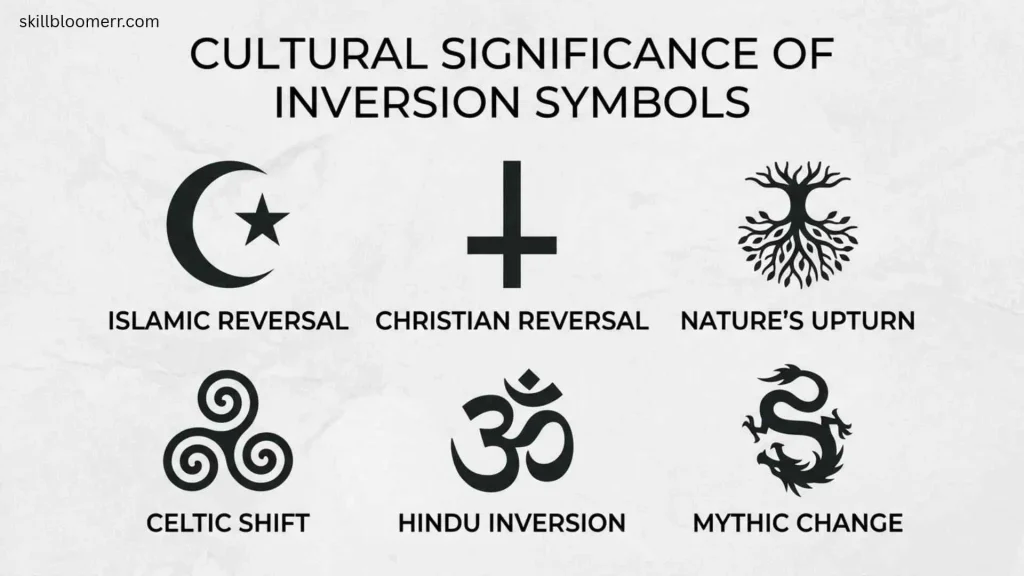
Different cultures interpret inversion symbols in different ways because symbolism depends on history, religion, language, and social traditions.
Western Culture
In Western art and literature, inversion often represents questioning authority or traditional beliefs.
Examples include:
- Satirical artwork
- Fantasy stories
- Surrealist paintings
- Modern graphic design
Artists frequently invert familiar objects to create new meanings.
Eastern Traditions
Some Eastern philosophies emphasize balance between opposites. Concepts such as transformation, cycles, and harmony often connect with ideas similar to inversion.
Rather than seeing reversal as negative, many traditions view change as a natural part of existence.
Popular Culture
Modern entertainment uses inversion symbols frequently.
They appear in:
- Movies
- Video games
- Comics
- Album artwork
- Fashion design
A reversed symbol may communicate mystery, rebellion, fantasy, or an alternate reality.
Religious or Spiritual Meaning of Inversion Symbols
Inversion symbols sometimes appear in religious and spiritual contexts, although their meanings vary widely.
Symbolic Reversal in Spiritual Traditions
Many spiritual systems use transformation imagery. Turning something upside down may represent:
- Inner change
- Spiritual awakening
- Moving beyond ordinary perception
- A shift in consciousness
Caution About Interpretation
An inverted symbol does not automatically have a negative or forbidden meaning. Interpretation depends on culture, intention, and historical context.
For example, a reversed image in one tradition may represent transformation, while another group may interpret it differently.
Understanding the original cultural background is essential before assigning meaning.
Scientific or Technical Meaning of Inversion Symbols
In technical fields, inversion has specific meanings that are different from general symbolism.
Mathematical Inversion
In mathematics, inversion refers to changing a relationship according to a defined rule.
Examples include:
- Multiplicative inverse: the inverse of 5 is 1/5
- Function inverse: reversing the input-output relationship
- Geometric inversion: transforming points around a circle
Mathematical inversion is not simply “turning something backward”; it follows exact principles.
Musical Inversion
In music theory, inversion describes changing the arrangement of notes while keeping the same basic musical relationship.
For example:
- A chord inversion changes the lowest note.
- A melodic inversion mirrors intervals in the opposite direction.
Composers use inversion to create variation and complexity.
Digital and Computing Use
Computer science uses inversion concepts in:
- Image processing
- Data transformation
- Logic operations
- Cryptography
A digital image inversion, for example, changes colors into their opposite values.
Where Inversion Symbols Are Used
Books and Literature
Writers use inversion symbolism to show:
- Alternative realities
- Character transformation
- Hidden truths
- Social criticism
A reversed world in fiction often helps authors explore human behavior from a different angle.
Mathematics and Science
In scientific writing, inversion symbols appear in formulas, equations, and technical diagrams.
Technology
Digital systems use inversion in:
- Software interfaces
- Graphics editing
- Programming
- Data analysis
Art and Design
Designers use inverted forms to create:
- Visual contrast
- Unique logos
- Abstract artwork
- Optical effects
Tattoos and Personal Expression
Some people choose inverted symbols in tattoos because they represent:
- Personal transformation
- Questioning norms
- Individual identity
- A new life chapter
The meaning depends strongly on personal intention.
Common Variations of Inversion Symbols
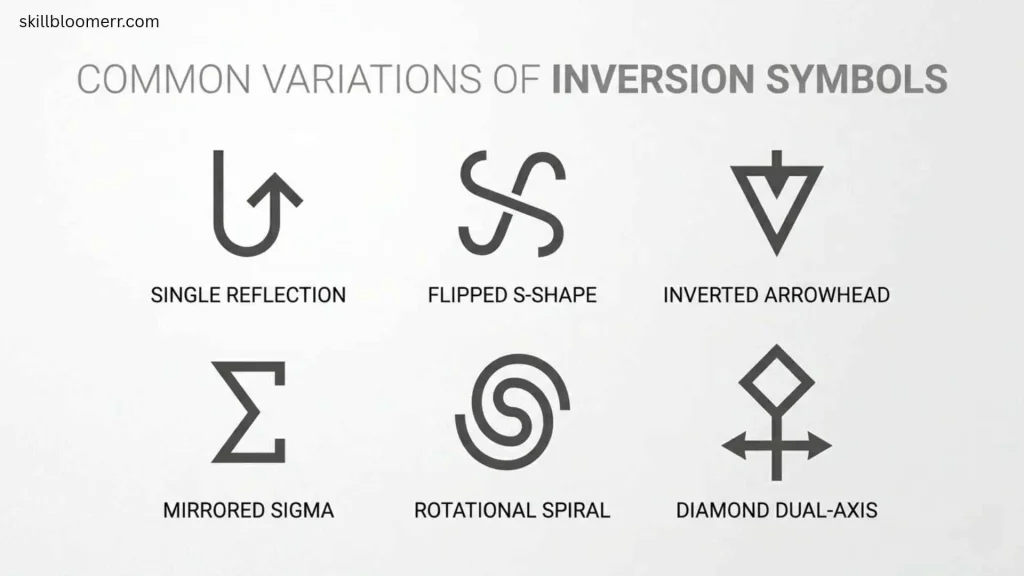
Upside-Down Designs
These versions physically rotate a symbol 180 degrees. They often create a feeling of reversal or surprise.
Mirror Inversions
Mirror versions reflect a symbol horizontally or vertically. They are common in:
- Graphic design
- Architecture
- Decorative patterns
Mathematical Variations
Mathematical inversion symbols differ depending on the field:
- Inverse functions
- Reciprocal notation
- Transformation symbols
Modern Digital Adaptations
Digital platforms create new inversion styles through:
- Filters
- Emoji transformations
- Glitch art
- Interface designs
Common Misconceptions About Inversion Symbols
An Inverted Symbol Always Has a Negative Meaning
This is one of the biggest misunderstandings. Inversion does not automatically mean evil, harmful, or wrong. Many inverted symbols represent creativity, change, or new perspectives.
All Cultures Interpret Inversion the Same Way
Symbol meanings are not universal. A symbol may have different meanings across religions, countries, and historical periods.
Inversion Means Destruction
Inversion usually means transformation rather than destruction. The original concept often remains connected to the reversed form.
Every Upside-Down Symbol Is Intentional
Sometimes symbols appear inverted because of design choices, printing errors, or technical limitations.
Interesting Facts About Inversion Symbols
- The idea of inversion exists in both art and science.
The same concept of reversal appears in creative expression and precise mathematical systems. - Mirror writing is a form of symbolic inversion.
Leonardo da Vinci famously used mirror writing in some personal notes. - Inversion plays an important role in music composition.
Composers use musical inversion to create variation without changing the entire musical idea. - Inverted imagery is common in fantasy worlds.
Creators use reversed environments to represent alternate realities. - Mathematical inversion has ancient roots.
Geometric transformation ideas developed through centuries of mathematical study. - Human perception notices inverted objects quickly.
The brain recognizes familiar patterns and reacts when they appear reversed. - Inversion is used in digital photography.
Color inversion creates negative images where light and dark values are reversed. - Symbol inversion is common in advertising.
Brands sometimes reverse images to attract attention and create memorable designs. - Inversion can represent personal change.
Many people use reversed symbols to mark transformation or new beginnings. - The meaning depends more on context than appearance.
The same inverted symbol can communicate completely different ideas in different situations.
Related Symbols
Mirror Symbol
A mirror symbol represents reflection, self-awareness, and seeing another perspective. It connects closely with inversion because mirrors reverse visual appearance.
Opposite Symbols
Symbols representing light and darkness, positive and negative, or balance often relate to inversion themes.
Transformation Symbols
Butterflies, circles, and phoenix imagery represent change and renewal, similar to some interpretations of inversion.
Reversal Marks
Certain punctuation, mathematical, and technical symbols indicate changes in direction or order.
Frequently Asked Questions
What are inversion symbols?
Inversion symbols are marks, designs, or visual representations that show reversal, transformation, or a change from the normal arrangement. They appear in mathematics, music, technology, art, and cultural symbolism.
Do inversion symbols always mean something negative?
No. Inversion symbols can represent positive ideas such as transformation, creativity, and new perspectives. Their meaning depends on the cultural and practical context where they appear.
Where are inversion symbols commonly used?
They are used in mathematics, scientific formulas, music theory, computer graphics, literature, artwork, tattoos, and symbolic designs.
What does an upside-down symbol represent?
An upside-down symbol usually represents reversal, questioning normal ideas, transformation, or an alternative viewpoint. The exact meaning depends on the symbol and culture.
What is mathematical inversion?
Mathematical inversion is a process where values, relationships, or geometric positions are transformed according to specific rules. It is used in algebra, geometry, and other mathematical fields.
Why do artists use inverted symbols?
Artists use inverted symbols to create curiosity, challenge expectations, express hidden meanings, and encourage viewers to think differently.
Are inversion symbols used in religion?
Some religious traditions use symbolic reversal to represent transformation or spiritual change, but interpretations vary greatly between belief systems.
What is the difference between inversion and reflection?
Inversion usually involves reversing a relationship, position, or order, while reflection specifically refers to creating a mirror-like image across an axis or surface.
Can an inverted symbol have personal meaning?
Yes. People often choose inverted symbols for tattoos, artwork, or designs because they represent personal experiences, changes, or individual beliefs.
How should inversion symbols be interpreted?
The best approach is to consider context, historical background, cultural meaning, and the creator’s intention rather than relying on a single interpretation.
Key Takeaways
- Inversion symbols represent reversal, transformation, and changed perspectives.
- Their meaning depends on context, culture, and purpose.
- Inversion appears in mathematics, science, art, music, and technology.
- An inverted symbol is not automatically negative.
- Historical and cultural background helps explain symbolic meaning.
- Modern designers use inversion to create attention and deeper messages.
- Scientific inversion follows precise rules, unlike artistic symbolism.
- Understanding context is the key to interpreting these symbols correctly.
Conclusion
Inversion symbols reveal how humans use visual language to express change, contrast, and transformation. From mathematical formulas to artistic creations, these symbols show that reversing something does not always mean losing its original meaning. Instead, inversion often creates a new way of understanding the same idea.
Whether found in technology, literature, music, or cultural traditions, inversion symbols encourage people to look beyond the obvious. Their power comes from their ability to challenge expectations and create deeper connections between ideas.
Learning about inversion symbols helps us understand not only individual symbols but also the larger human desire to explore opposites, transformation, and new perspectives.

I’m Olivia Hartwell, a writer passionate about learning, personal growth, and practical education. I enjoy researching new ideas and sharing them in a way that feels easy to understand and useful. Through my work with SkillBloomerr, I aim to give readers reliable information they can apply in real life.
Books: Small Steps, Big Growth and The Curious Mind
 Nathaniel Brooks