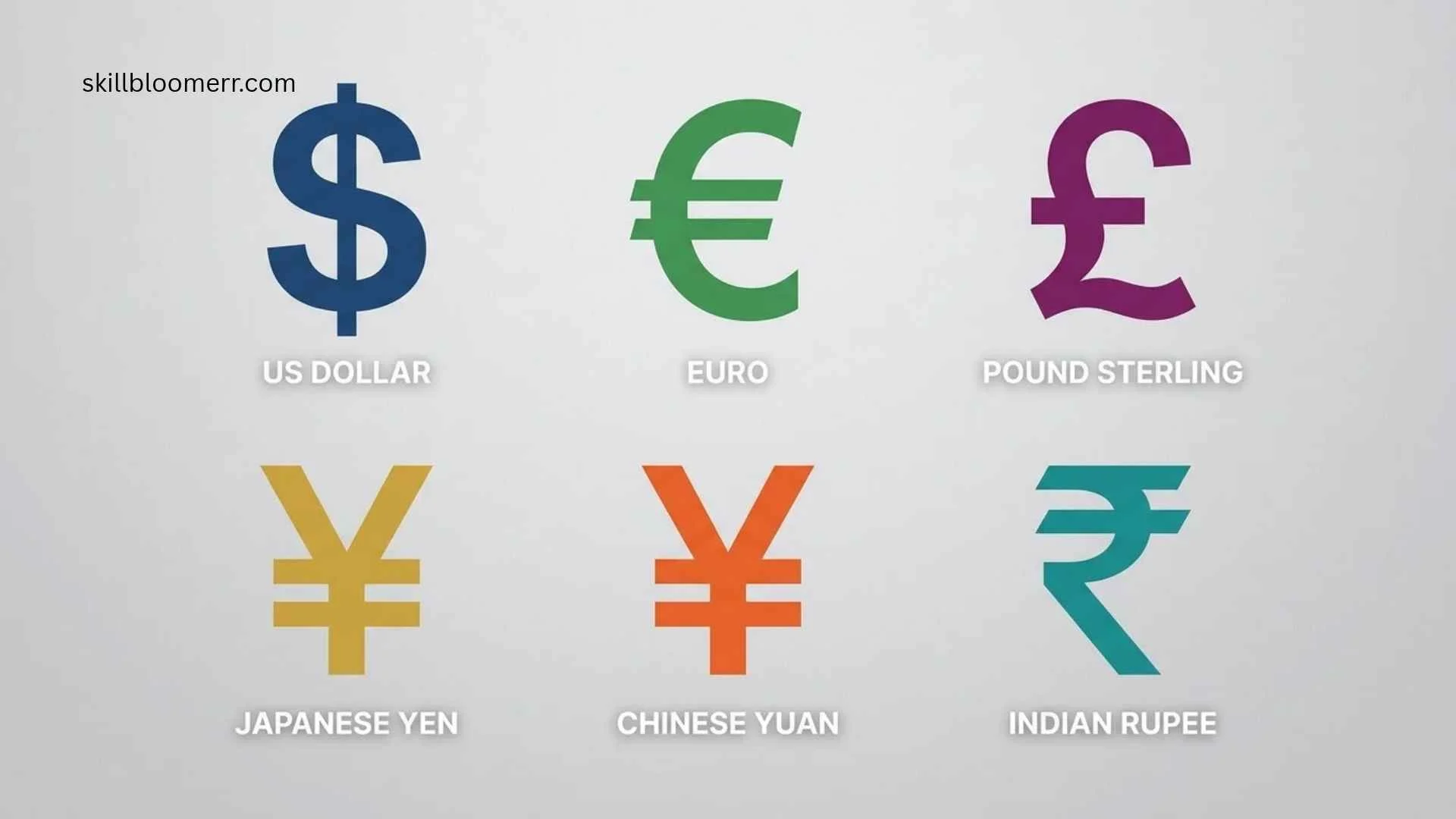
Currency symbols are visual signs that represent money, value, and economic identity. From the familiar dollar sign ($) used in many countries to the euro (€), yen (¥), pound (£), and hundreds of other currency symbols, these marks help people quickly recognize prices, payments, and financial information.
Different currency symbols appear everywhere in daily life, including shopping receipts, banking apps, international trade documents, websites, maps, financial markets, and digital payment platforms.
Although many symbols look simple, each one carries a history shaped by language, culture, politics, and economic development.
This guide explains the meaning, history, cultural importance, and modern usage of the world’s major currency symbols while exploring why nations created unique signs to represent their money.
Quick Meaning of Different Currencies Symbols
Different currencies symbols are graphic signs used to identify specific national or regional currencies. They make financial communication faster by showing the type of money involved, such as $ for the dollar, € for the euro, £ for the pound, ¥ for the yen, and ₹ for the Indian rupee. Each symbol reflects economic history and cultural identity.
Currency Symbols Overview Table
| Symbol Name | Symbol | Primary Meaning | Category | Origin | Culture/Country | Common Usage | Modern Meaning |
| Dollar Sign | $ | Dollar currency | National currency symbol | 18th century | United States and other countries | Prices, banking, trade | Global money symbol |
| Euro Sign | € | Euro currency | Regional currency symbol | 1990s | European Union | European payments | European economic unity |
| Pound Sign | £ | Pound sterling | National currency symbol | Medieval Britain | United Kingdom | Finance and commerce | British monetary identity |
| Yen/Yuan Sign | ¥ | Japanese yen and Chinese yuan | Currency symbol | Modern era | Japan and China | International finance | Asian economic representation |
| Rupee Sign | ₹ | Indian rupee | National currency symbol | 2010 | India | Domestic transactions | Indian economic identity |
| Won Sign | ₩ | Korean won | National currency symbol | Modern era | South Korea | Financial transactions | Korean currency identity |
| Ruble Sign | ₽ | Russian ruble | National currency symbol | 2013 | Russia | Banking and trade | Russian monetary symbol |
| Bitcoin Symbol | ₿ | Digital currency | Cryptocurrency symbol | 2010s | Global digital economy | Crypto markets | Digital financial innovation |
What Do Currency Symbols Mean?
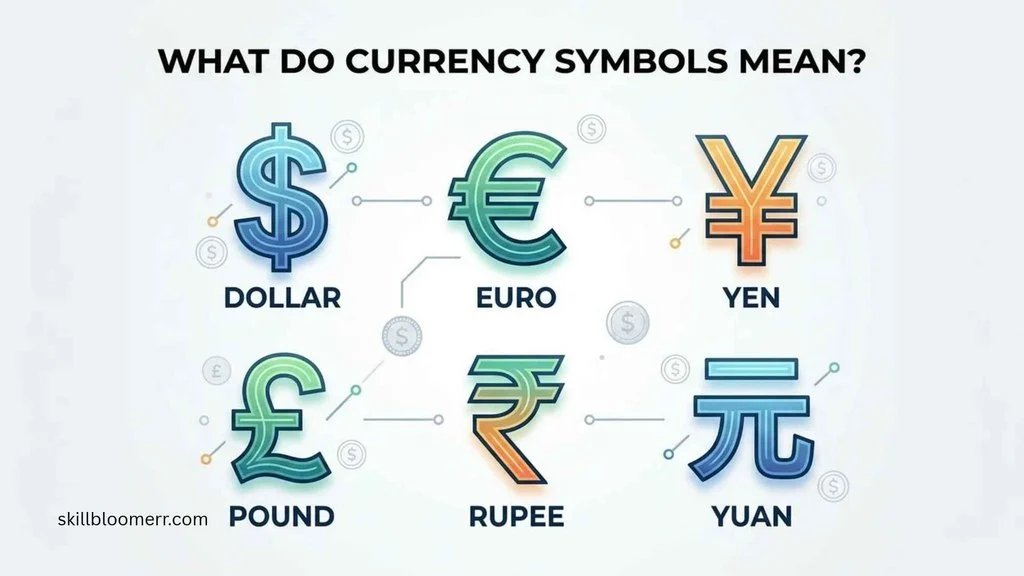
Currency symbols are shorthand representations of monetary units. They allow people to identify the type of currency without writing the full currency name.
For example:
- $50 means fifty dollars.
- €100 means one hundred euros.
- £25 means twenty-five pounds.
- ₹500 means five hundred Indian rupees.
The main purpose of a currency symbol is clarity. In international communication, writing only a number can create confusion because different countries use different currencies. A symbol immediately provides financial context.
For example:
- $100 could mean US dollars, Canadian dollars, Australian dollars, or another dollar-based currency.
- ¥100 could represent Japanese yen or Chinese yuan depending on context.
Currency symbols work as a universal financial language, connecting buyers, sellers, businesses, and governments.
History and Origin of Currency Symbols
Currency symbols developed as trade expanded and societies needed faster ways to record financial information.
Ancient civilizations such as Mesopotamia, Egypt, Greece, and Rome used written descriptions of money rather than modern symbols. Merchants recorded values using words, abbreviations, and markings on documents.
As international trade grew, merchants needed simpler systems. Currency symbols gradually evolved from abbreviations of currency names, historical writing styles, and national identifiers.
The Origin of the Dollar Sign ($)
The dollar sign is one of the most recognized currency symbols worldwide. It is commonly associated with the United States dollar but is also used by many other currencies.
The exact origin of the $ symbol is debated. One widely accepted explanation connects it to the Spanish peso, also known as the Spanish dollar, which was widely used in international trade.
Another theory suggests that the symbol developed from an abbreviation of “US” or “PS” written together over time.
Today, the dollar sign represents not only money but also global financial markets, business, and economic power.
The Origin of the Euro Symbol (€)
The euro symbol was introduced in 1999 when the euro became the official currency of many European Union countries.
The design combines:
- The letter “E” from Europe
- Two parallel lines representing stability
The euro symbol represents economic cooperation among European nations and has become one of the world’s most important currency signs.
The Origin of the Pound Symbol (£)
The pound symbol comes from the Latin word “libra,” meaning a unit of weight.
Historically, British currency was connected to the Roman measurement system. The abbreviation “£” developed from a stylized version of the letter L.
The symbol became strongly associated with British economic history and the pound sterling.
The Origin of the Rupee Symbol (₹)
The Indian rupee symbol was officially adopted in 2010 after a national design competition.
The symbol combines:
- The Devanagari letter “र”
- The Roman letter “R”
- Horizontal lines representing the Indian flag and equality
It represents India’s cultural heritage and modern economic growth.
Symbolism and Interpretation of Currency Signs
Currency symbols have meanings beyond simple identification. They often represent economic strength, national identity, and cultural values.
Traditional Meanings
Historically, money symbols represented:
- Trade and commerce
- Wealth and prosperity
- Government authority
- National independence
A currency symbol allowed people to recognize the financial system of a particular society.
Modern Meanings
Today, currency symbols can represent:
- Global business
- Financial security
- Economic opportunities
- International connections
- Digital transactions
For businesses, currency symbols are essential communication tools that make pricing understandable worldwide.
Positive Symbolism of Currency Symbols

Currency signs are often associated with:
- Success
- Prosperity
- Growth
- Opportunity
- Exchange and cooperation
In advertising and branding, money symbols are sometimes used to suggest value or financial achievement.
Negative Interpretations
Currency symbols may also represent concerns about:
- Materialism
- Wealth inequality
- Economic pressure
- Consumer culture
The meaning depends on the context in which the symbol appears.
Cultural Significance of Different Currency Symbols
Currency symbols reflect the history and identity of the societies that created them.
United States Dollar Symbol ($)
The dollar sign represents one of the world’s most influential currencies. It appears in international trade, investment markets, and global financial discussions.
The symbol is strongly connected with:
- American economic history
- International commerce
- Global business
Euro Symbol (€)
The euro symbol represents cooperation among European nations. Unlike national currencies, it reflects a shared economic system across multiple countries.
It symbolizes:
- Unity
- Regional partnership
- Economic integration
Japanese Yen Symbol (¥)
The yen symbol represents Japan’s economy and is widely recognized in international markets.
The yen is associated with:
- Japanese innovation
- Manufacturing
- Global trade
Indian Rupee Symbol (₹)
The rupee symbol represents India’s cultural and economic identity.
It reflects:
- Traditional Indian writing systems
- Modern economic development
- National pride
Religious or Spiritual Meaning of Currency Symbols
Currency symbols generally do not have direct religious meanings. However, money itself has played an important role in many religious and spiritual traditions.
Across different cultures, money can symbolize:
- Charity
- Responsibility
- Generosity
- Prosperity
Many religions discuss the ethical use of wealth, emphasizing balance between material resources and spiritual values.
Scientific or Technical Meaning of Currency Symbols
Currency symbols have important technical roles in computing, programming, and digital communication.
They are used in:
- Financial software
- Online shopping systems
- Banking applications
- Accounting programs
- Databases
Many currency symbols have Unicode characters, allowing computers worldwide to display them correctly.
Examples:
- $ = U+0024
- € = U+20AC
- £ = U+00A3
- ¥ = U+00A5
- ₹ = U+20B9
Where Currency Symbols Are Used
Currency symbols appear in many areas of modern life.
Everyday Shopping
Consumers see currency symbols on:
- Price tags
- Online stores
- Restaurant menus
- Receipts
Banking and Finance
Banks use currency symbols in:
- Account statements
- Exchange rates
- Investment reports
- International transfers
Technology and Digital Platforms
Currency symbols appear in:
- Mobile payment apps
- E-commerce websites
- Financial software
- Cryptocurrency platforms
Maps and International Trade
Currency symbols help travelers and businesses understand:
- Exchange rates
- Local prices
- Import and export values
Common Variations of Currency Symbols
Currency symbols can have different designs depending on region, font, and writing style.
Dollar Variations
Examples include:
- $
- US$
- USD
- A$
These variations prevent confusion between different dollar currencies.
Yen and Yuan Variations
The symbol ¥ can represent both:
- Japanese yen
- Chinese yuan
International financial systems often use:
- JPY for Japanese yen
- CNY for Chinese yuan
Pound Variations
The pound symbol may represent:
- British pound (£)
- Other pound-based currencies
Financial codes help identify the exact currency.
Common Misconceptions About Currency Symbols

The Dollar Sign Belongs Only to America
This is incorrect. Many countries use dollar-based currencies, including Canada, Australia, and New Zealand.
All Currency Symbols Are Ancient
Many modern currency symbols were created recently. For example, the euro symbol appeared in the late 20th century, and the Indian rupee symbol was introduced in 2010.
A Currency Symbol Is the Same as a Currency Code
Currency symbols and ISO currency codes are different.
Example:
- Symbol: $
- Code: USD
Symbols are visual signs, while codes are standardized international identifiers.
Interesting Facts About Currency Symbols
- The dollar sign is one of the most recognizable financial symbols in the world and appears in many countries beyond the United States.
- The euro symbol was selected from many proposed designs before becoming the official representation of the euro.
- The Indian rupee symbol was chosen through a public design competition.
- Currency symbols help overcome language barriers by providing a visual money reference.
- The Bitcoin symbol introduced the idea of a dedicated symbol for decentralized digital currency.
- Some countries use the same currency symbol but have different currency values.
- The pound symbol has roots connected to ancient Latin measurements.
- Currency symbols are included in Unicode standards so computers can display them worldwide.
- Financial markets often use currency symbols alongside currency codes for accuracy.
- Currency symbols influence branding, advertising, and economic communication.
Related Symbols
Percent Symbol (%)
The percent symbol represents proportions and is commonly used in finance, interest rates, and economic reports.
Bitcoin Symbol (₿)
The Bitcoin symbol represents cryptocurrency and digital financial systems.
Cent Symbol (¢)
The cent symbol represents smaller monetary units in some currencies.
Accounting Symbols
Accounting systems use various signs to represent financial information clearly.
Frequently Asked Questions
What is the most recognized currency symbol in the world?
The dollar sign ($) is considered one of the most widely recognized currency symbols because it is used by several countries and appears frequently in global trade, finance, and popular culture.
Why do countries have different currency symbols?
Countries create unique currency symbols to identify their money, strengthen national identity, and make financial communication easier in domestic and international markets.
What is the oldest currency symbol?
The pound symbol (£) is among the oldest widely used modern currency symbols, developing from historical British monetary systems connected to Latin terminology.
Why do some currencies share the same symbol?
Some currencies share symbols because they have similar historical origins or names. Currency codes are used alongside symbols to avoid confusion.
What is the difference between a currency symbol and currency code?
A currency symbol is a visual sign like $ or €. A currency code is a three-letter identifier like USD, EUR, or GBP used in international financial systems.
Why is the euro symbol designed with two lines?
The two lines in the euro symbol represent stability and strength. The design also connects the symbol visually with the letter E for Europe.
Can one symbol represent multiple currencies?
Yes. The dollar sign and yen sign can represent multiple currencies depending on the country and financial context.
Are currency symbols used in digital payments?
Yes. Digital wallets, online stores, banking apps, and financial software use currency symbols to show prices and payment amounts.
Key Takeaways
- Currency symbols are visual signs that identify different types of money.
- Each symbol has a unique historical and cultural background.
- The dollar, euro, pound, yen, and rupee symbols are among the world’s most recognized currency signs.
- Currency symbols help businesses and consumers communicate prices clearly.
- Symbols can represent economic identity, national history, and financial systems.
- Currency symbols are important in both traditional finance and digital technology.
Conclusion
Different currencies symbols are more than simple marks placed beside numbers. They represent centuries of trade, cultural development, economic systems, and national identity. From the dollar sign that dominates global markets to newer symbols like the euro and Indian rupee, each symbol tells a story about the society behind the currency.
Understanding currency symbols helps people navigate international shopping, finance, travel, and digital payments with greater confidence. These small signs connect languages and economies, making money easier to recognize around the world.

 Olivia Hartwell