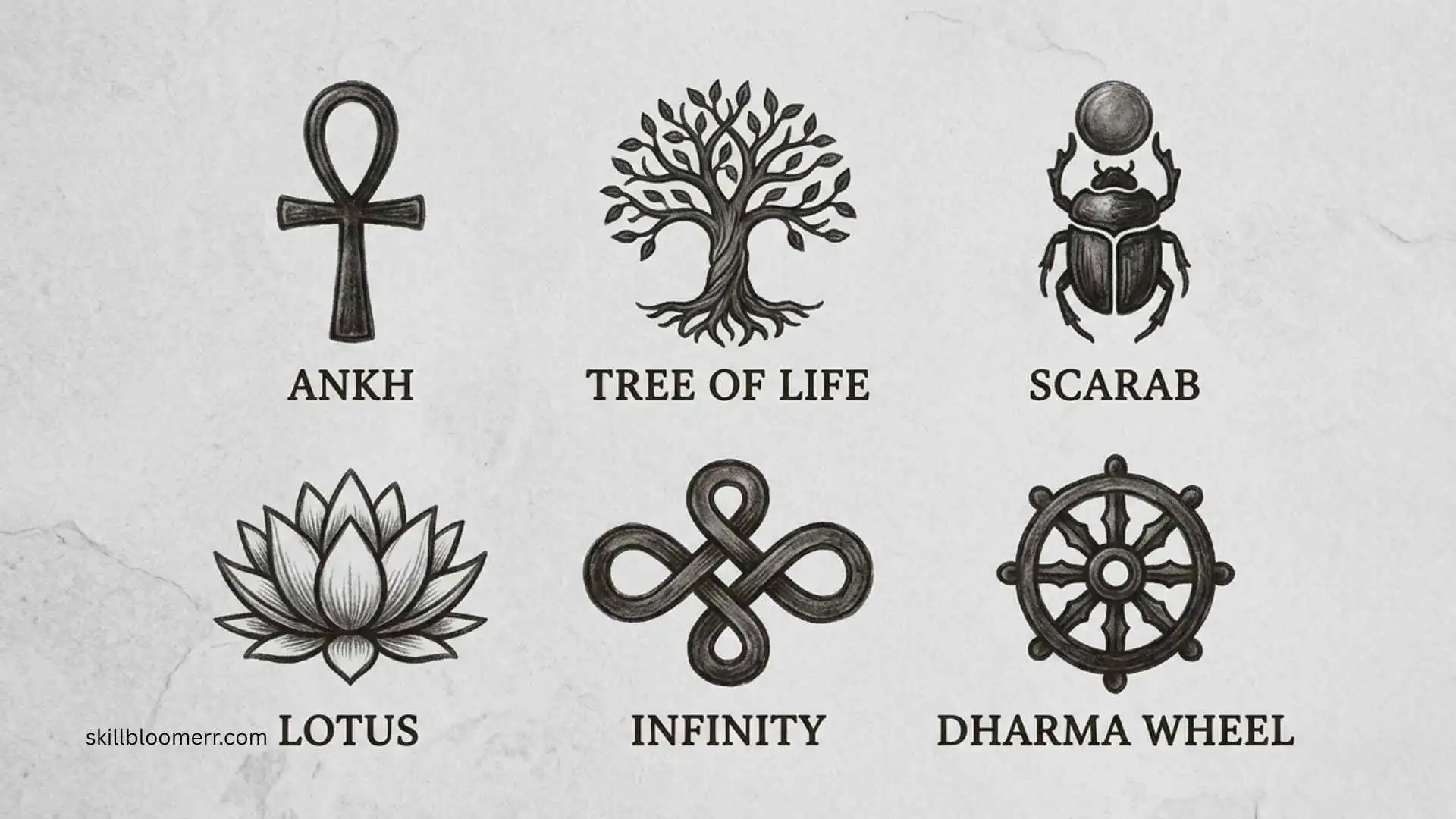
Ancient symbols of life represent humanity’s oldest attempts to understand existence, creation, renewal, and the connection between the physical and spiritual worlds. These symbols were created by civilizations across Egypt, Mesopotamia, India, China, Greece, Rome, and Celtic regions to express powerful ideas about birth, growth, death, and rebirth.
People still encounter ancient symbols of life in museums, religious buildings, historical texts, jewelry, tattoos, artwork, architecture, and modern spiritual practices. Although these symbols were created thousands of years ago, their meanings remain relevant because they reflect universal human experiences such as hope, transformation, protection, and the search for purpose.
From the Egyptian Ankh representing eternal life to the Tree of Life symbolizing connection and growth, each symbol tells a story about how ancient cultures understood the mystery of being alive. This guide explores their origins, meanings, cultural importance, and continued influence in the modern world.
Quick Meaning of Ancient Symbols of Life
Ancient symbols of life are visual signs used by early civilizations to represent existence, vitality, fertility, renewal, immortality, and spiritual connection. These symbols often connected human life with nature, divine forces, and cosmic cycles. Popular examples include the Ankh, Tree of Life, Lotus Flower, Ouroboros, Scarab Beetle, Triskelion, and Om symbol.
Symbol Overview Table
| Symbol Name | Primary Meaning | Category | Origin | Civilization or Culture | First Known Use | Common Usage | Modern Meaning | Related Symbols |
| Ankh | Life, immortality, eternal existence | Sacred symbol | Ancient Egypt | Egyptian civilization | Around 3000 BCE | Temples, artwork, jewelry | Spiritual life and energy | Eye of Horus, Djed |
| Tree of Life | Growth, connection, renewal | Nature symbol | Ancient Near East | Celtic, Norse, religious traditions | Ancient period | Art, jewelry, spiritual designs | Family, balance, personal growth | World Tree |
| Ouroboros | Eternity, cycles, rebirth | Mystical symbol | Ancient Egypt and Greece | Egyptian, Greek, alchemical traditions | Ancient period | Philosophy, artwork, tattoos | Transformation and infinity | Phoenix |
| Lotus Flower | Purity, enlightenment, rebirth | Spiritual symbol | Ancient India and Egypt | Hindu, Buddhist, Egyptian cultures | Ancient period | Religious art, meditation | Inner growth and awakening | Bodhi Tree |
| Scarab Beetle | Creation, renewal, protection | Egyptian symbol | Ancient Egypt | Egyptian civilization | Around 2500 BCE | Amulets and carvings | Change and regeneration | Sun symbols |
| Triskelion | Movement, balance, cycles | Celtic symbol | Europe | Celtic traditions | Neolithic period | Artwork and cultural designs | Progress and harmony | Spiral symbols |
| Om (ॐ) | Universal consciousness | Spiritual symbol | Ancient India | Hindu, Buddhist, Jain traditions | Vedic period | Meditation and rituals | Peace and awareness | Lotus Flower |
What Do Ancient Symbols of Life Mean?
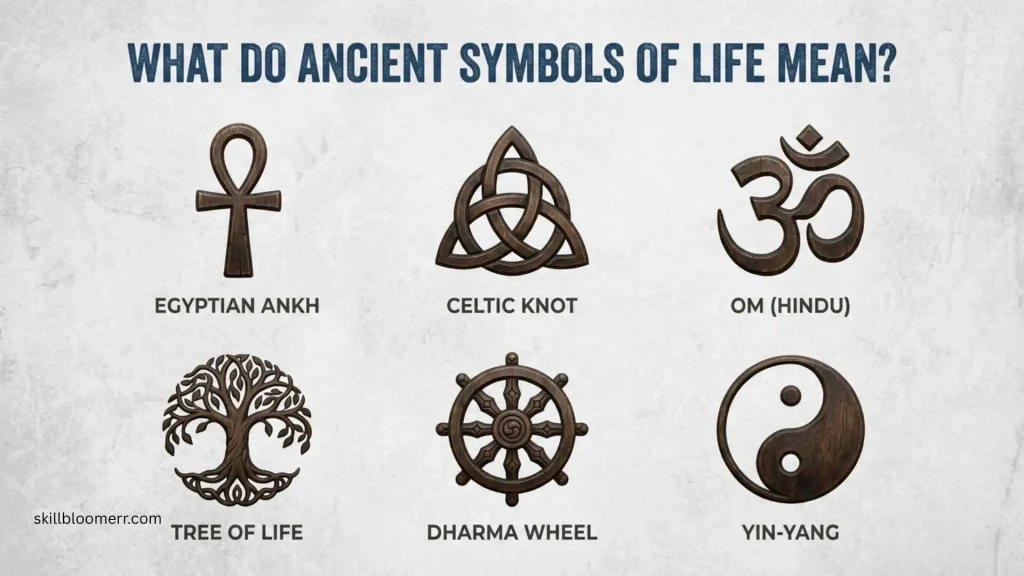
Ancient symbols of life are representations of humanity’s beliefs about existence, survival, and the forces that sustain the world. They were created because ancient societies wanted ways to communicate ideas that were larger than ordinary words could express.
Symbols acted as visual languages. A single image could represent religious beliefs, social values, natural forces, and philosophical ideas. Many cultures used symbols of life because they observed repeating patterns in nature, such as sunrise and sunset, changing seasons, plant growth, and the human life cycle.
The most common meanings associated with ancient life symbols include:
- Creation and beginnings: Symbols represented the origin of life and the forces responsible for existence.
- Renewal and rebirth: Many cultures believed life followed repeating cycles of change.
- Immortality: Some symbols expressed beliefs about the continuation of the soul after death.
- Fertility and growth: Plants, animals, and water symbols often represented abundance and reproduction.
- Protection: Certain symbols were believed to provide spiritual safety.
- Connection: Many symbols showed relationships between humans, nature, and the universe.
The meaning of each symbol depends on historical context. A symbol that represents spiritual awakening in one culture may represent fertility, protection, or cosmic order in another.
History and Origin of Ancient Symbols of Life
Ancient symbols of life developed independently in different parts of the world. Although civilizations were separated by geography, many created similar symbols because humans shared common questions about existence.
Ancient Egyptian Symbols of Life
Ancient Egypt produced some of the world’s most recognizable symbols connected with life and eternity. Egyptian civilization placed great importance on the afterlife and believed that existence continued beyond physical death.
The most famous Egyptian life symbol is the Ankh. It appears as a cross-like shape with an oval loop at the top. Egyptian gods, pharaohs, and spiritual figures were often shown holding the Ankh as a sign of divine life and power.
The Ankh appeared in:
- Temple walls
- Tomb paintings
- Royal objects
- Religious ceremonies
- Protective amulets
Another important Egyptian symbol was the Scarab Beetle. Egyptians observed the beetle rolling balls across the ground and associated this movement with the journey of the sun across the sky. Because of this connection, the scarab became a symbol of creation, renewal, and protection.
The Djed pillar was another important Egyptian symbol connected with stability and endurance. It was associated with the god Osiris and represented strength and continuation.
Mesopotamian Life Symbols
Mesopotamian civilizations, including the Sumerians, Akkadians, Babylonians, and Assyrians, developed symbols connected with creation, fertility, and divine order.
The Tree of Life concept appeared in ancient Near Eastern traditions. Trees were powerful symbols because they represented growth, nourishment, and the connection between the earth and the heavens.
Ancient Mesopotamians viewed nature as closely connected with divine forces. Plants, animals, stars, and rivers often appeared in symbolic artwork because they represented the systems that supported human life.
Greek and Roman Interpretations
Ancient Greek and Roman cultures explored life through mythology, philosophy, and science. They developed symbols that represented transformation, balance, and eternal cycles.
The Ouroboros, a serpent or dragon forming a circle by biting its own tail, became associated with endless cycles. It represented the idea that life contains continuous processes of creation and destruction.
Greek philosophical traditions often examined concepts such as:
- The cycle of nature
- Change and transformation
- The relationship between opposites
- The search for meaning
Later Roman interpretations adopted many Greek symbolic ideas and spread them throughout Europe.
Ancient Indian Life Symbols
Ancient Indian traditions developed some of the world’s most influential spiritual symbols. These symbols often focused on consciousness, harmony, and the relationship between individual life and universal existence.
The Lotus Flower became a major symbol in Hinduism and Buddhism. Because the lotus grows from muddy water but blooms beautifully above the surface, it represents purity, spiritual growth, and overcoming difficulties.
The Om symbol (ॐ) represents sacred sound and universal consciousness. It is widely used in meditation, prayer, and spiritual practices.
Celtic and Northern European Traditions
Celtic cultures used natural symbols to express ideas about life, cycles, and connection. Trees held special importance because they represented strength, wisdom, and communication between different realms.
The Tree of Life symbol in Celtic traditions represented:
- Family connections
- Balance between earth and sky
- Wisdom passed through generations
- The cycle of life
The Triskelion, a three-spiral symbol, represented movement and progress. Its meaning varies, but it is often connected with cycles, balance, and transformation.
Symbolism and Interpretation
Ancient symbols of life continue to attract interest because they contain multiple layers of meaning. Their interpretations depend on cultural background, historical period, and personal beliefs.
Traditional Meanings
Traditional interpretations of life symbols often include:
- Eternal existence
- Spiritual protection
- Fertility
- Renewal
- Wisdom
- Harmony with nature
Ancient societies often viewed life as a connected system rather than an individual experience. Humans, animals, plants, and celestial forces were believed to influence one another.
Modern Meanings
Today, ancient life symbols are often used for personal expression. Many people choose these symbols because they represent values they want to carry in their lives.
Examples include:
- A Tree of Life necklace representing family and personal growth.
- An Ankh tattoo representing appreciation for ancient Egyptian ideas.
- A Lotus tattoo symbolizing recovery and personal transformation.
- An Ouroboros design representing change and new beginnings.
Modern interpretations are often personal and may differ from the original historical meaning.
Positive Symbolism
Most ancient symbols of life represent positive concepts such as:
- Hope
- Strength
- Healing
- Growth
- Protection
- Wisdom
- Renewal
These qualities explain why these symbols remain popular across cultures today.
Psychological Interpretation
From a psychological perspective, life symbols often represent human desires for meaning, belonging, and continuity. Circular symbols, trees, and growing plants commonly appeal to people because they reflect natural patterns found in human experience.
For example, the Tree of Life connects with ideas of identity and belonging, while circular symbols such as the Ouroboros reflect the human understanding of cycles and change.
Cultural Significance of Ancient Symbols of Life
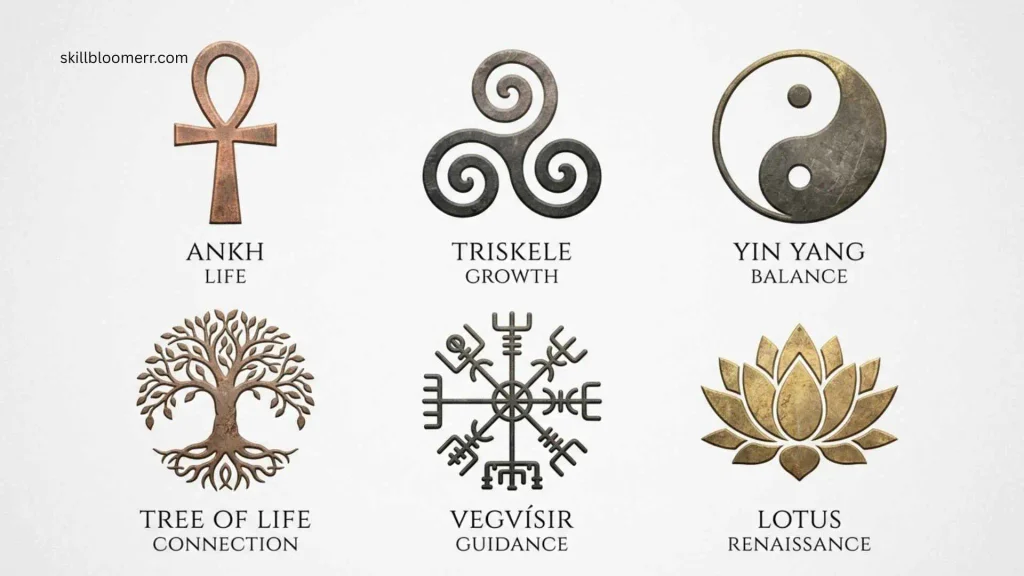
Ancient symbols of life became important because they helped societies preserve beliefs and communicate shared values. Their meanings often reflected geography, religion, mythology, and daily experiences.
Egyptian Cultural Significance
Egyptian life symbols were closely connected with religion and kingship. The Ankh was not simply an artistic design; it represented divine life and the continuation of existence.
Celtic Cultural Significance
Celtic symbols often focused on nature and cycles. Trees, spirals, and animals represented the relationship between humans and the natural world.
Indian Cultural Significance
Indian symbols such as the Lotus and Om remain central in spiritual traditions. They represent consciousness, purity, meditation, and the search for enlightenment.
Chinese Cultural Significance
Chinese traditions use many symbols connected with longevity, harmony, and prosperity. Natural elements such as plants, animals, and celestial objects often represent life energy and balance.
Norse Cultural Significance
Norse mythology includes the concept of Yggdrasil, the World Tree, which connects different realms of existence. It represents the structure of the universe and the relationship between all living things.
Religious and Spiritual Meaning
Many ancient symbols of life have deep religious meanings because early societies often connected existence with divine forces.
The Ankh in Egyptian Spirituality
The Ankh represented the gift of life from the gods. It was associated with immortality, spiritual power, and the continuation of existence beyond death.
The Tree of Life in Religious Traditions
The Tree of Life appears in several religious and mythological systems. In Judaism and Christianity, it appears in the story of Eden. In other traditions, it represents wisdom, creation, and the connection between different levels of existence.
The Lotus in Buddhism and Hinduism
The Lotus symbolizes spiritual awakening. Its growth from muddy water represents the ability to rise above difficulties and achieve higher understanding.
Om in Hindu Spiritual Practice
Om is considered a sacred sound representing the universe and ultimate reality. It is commonly used during meditation and religious ceremonies.
Where Ancient Symbols of Life Are Used
Ancient life symbols continue to appear in many modern and traditional settings.
Jewelry and Tattoos
Many people use symbols such as the Ankh, Lotus, and Tree of Life in jewelry and tattoos because they carry personal meanings related to identity, growth, and spirituality.
Architecture and Art
Historical buildings, temples, monuments, and artworks often include life symbols as decorative and symbolic elements.
Literature and Mythology
Writers use ancient symbols to explore themes such as:
- Creation
- Transformation
- Human destiny
- Mortality
- Spiritual discovery
Modern Branding and Design
Some organizations use nature-based symbols to communicate ideas of growth, sustainability, and connection.
Common Variations of Ancient Life Symbols
Ancient symbols often appear in different forms because cultures adapted them according to their own artistic traditions.
Ankh Variations
The Ankh may appear with decorative details, combined with other Egyptian symbols, or adapted into modern jewelry designs.
Tree of Life Variations
Tree symbols differ across cultures:
- Celtic trees emphasize nature and ancestry.
- Norse Yggdrasil represents cosmic structure.
- Religious trees may represent wisdom and divine connection.
Lotus Variations
Lotus designs vary according to artistic tradition. Different numbers of petals may carry different meanings in some spiritual systems.
Spiral Symbol Variations
Spiral symbols appear in Celtic, prehistoric, and other ancient cultures. They often represent movement, growth, and cycles.
Common Misconceptions About Ancient Life Symbols
Ancient Symbols Have Only One Meaning
A common misunderstanding is that every symbol has a single fixed meaning. In reality, meanings change depending on culture, time period, and context.
All Life Symbols Are Religious
Although many symbols have religious connections, some also represent cultural identity, philosophy, nature, or personal beliefs.
Modern Interpretations Are Always Ancient Meanings
Many modern uses of symbols are personal adaptations rather than exact historical interpretations.
Similar Symbols Always Share the Same Origin
Different civilizations sometimes created similar-looking symbols independently because they were inspired by universal ideas such as nature and cycles.
Interesting Facts About Ancient Symbols of Life
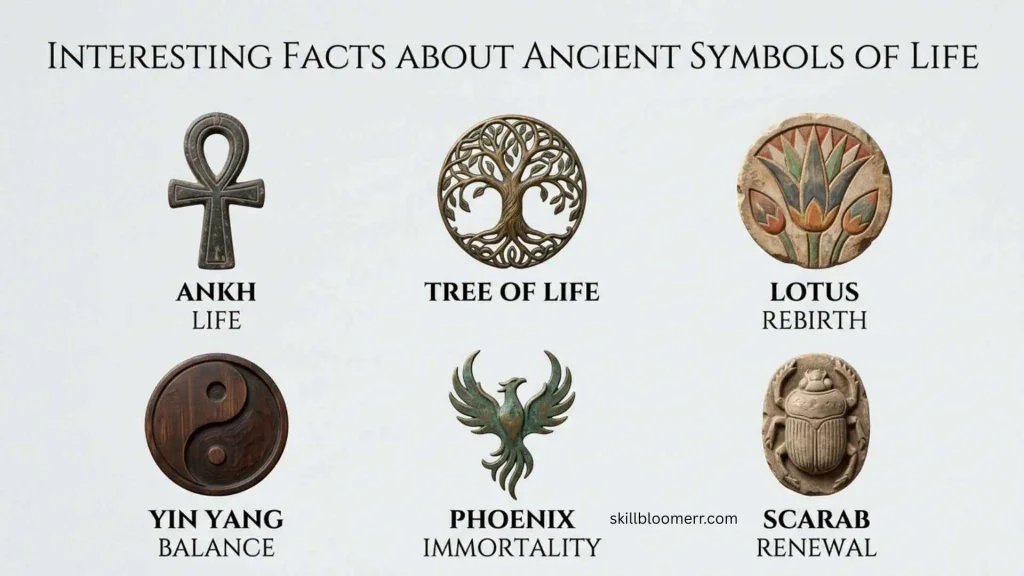
- The Ankh is one of the most recognizable symbols from ancient Egypt and appears thousands of years after its creation in modern designs.
- The Tree of Life appears in many unrelated cultures, showing how humans across the world connected trees with existence and wisdom.
- The Ouroboros became popular in later philosophical and alchemical traditions as a symbol of transformation.
- The Lotus Flower became powerful because its natural growth pattern inspired ideas about overcoming challenges.
- The Scarab Beetle was associated with creation because ancient Egyptians connected it with the movement of the sun.
- Spiral symbols are among the oldest forms of symbolic artwork found in human history.
- The Om symbol remains an active spiritual symbol rather than only a historical artifact.
- Many ancient life symbols continue because they address universal human questions about meaning and existence.
- Trees became powerful symbols because nearly every ancient society depended on plants for food, shelter, and survival.
- Ancient symbols often combined practical observations of nature with spiritual interpretation.
Related Symbols
Phoenix
The Phoenix represents rebirth and renewal. Unlike many life symbols, it focuses specifically on rising again after destruction.
Eye of Horus
The Eye of Horus is an ancient Egyptian symbol associated with protection, healing, and restoration.
Yin and Yang
The Yin-Yang symbol represents balance between opposing forces and the harmony found in nature.
Sun Symbols
Solar symbols often represent energy, creation, and the source of life.
Spiral Symbols
Spirals represent growth, movement, and cycles in many ancient cultures.
Frequently Asked Questions
What is the oldest symbol of life?
Some of the oldest known life-related symbols include spirals, trees, and fertility symbols found in prehistoric artwork. The exact oldest symbol is difficult to identify because early humans used symbolic marks before written records existed.
What is the most famous ancient symbol of life?
The Egyptian Ankh is one of the most famous ancient symbols of life. It represented life, immortality, and divine power in ancient Egyptian culture and remains widely recognized today.
What symbol represents eternal life?
Several symbols represent eternal life, including the Ankh, Ouroboros, and certain Tree of Life designs. Their meanings vary depending on the culture, but all connect with ideas of continuity and existence beyond ordinary limits.
Why are trees used as symbols of life?
Trees symbolize life because they grow, provide nourishment, and connect different parts of nature. Their roots and branches naturally represent relationships between earth, humans, and the heavens.
Are ancient life symbols still used today?
Yes. Ancient life symbols appear in jewelry, tattoos, artwork, meditation practices, religious objects, and modern designs because their meanings continue to connect with human experiences.
What does the Lotus Flower symbolize?
The Lotus Flower commonly symbolizes purity, spiritual growth, and enlightenment. Its ability to bloom beautifully from muddy water represents overcoming difficulties.
What does the Ouroboros symbolize?
The Ouroboros symbolizes cycles, transformation, and infinity. It represents the idea that endings can become beginnings and that life continues through constant change.
Are ancient symbols of life religious symbols?
Some are religious, but not all. Many ancient symbols also represent nature, philosophy, cultural identity, and human experiences beyond religion.
Key Takeaways
- Ancient symbols of life represent existence, renewal, growth, and spiritual connection.
- The Ankh is one of the most recognized symbols of eternal life from ancient Egypt.
- The Tree of Life represents connection, growth, and balance across many cultures.
- The Lotus Flower symbolizes purity and spiritual transformation.
- Different cultures developed unique interpretations of similar life concepts.
- Modern uses of ancient symbols often combine historical meanings with personal significance.
- Understanding cultural context is essential when interpreting ancient symbols.
Conclusion
Ancient symbols of life reveal how civilizations throughout history understood existence, nature, spirituality, and human purpose. These symbols were created thousands of years ago, yet they continue to inspire people because they represent experiences shared by all humanity.
Whether found on temple walls, ancient manuscripts, jewelry, or modern artwork, symbols such as the Ankh, Tree of Life, Lotus Flower, and Ouroboros remind us of humanity’s ongoing search for meaning. Their stories connect the past with the present and show how powerful visual language can survive across generations.
The study of ancient symbols of life offers more than historical knowledge. It provides a deeper understanding of how cultures viewed creation, transformation, and the endless journey of existence.

I’m Ethan Calloway, an English writer and lifelong learner who enjoys turning complex ideas into clear, practical content. At SkillBloomerr, I focus on useful topics that help readers build knowledge, improve their skills, and feel more confident in everyday learning. I believe good writing should be simple, engaging, and genuinely helpful.
Books: The Everyday Learning Guide and Build Better Skills
 Olivia Hartwell
 Nathaniel Brooks