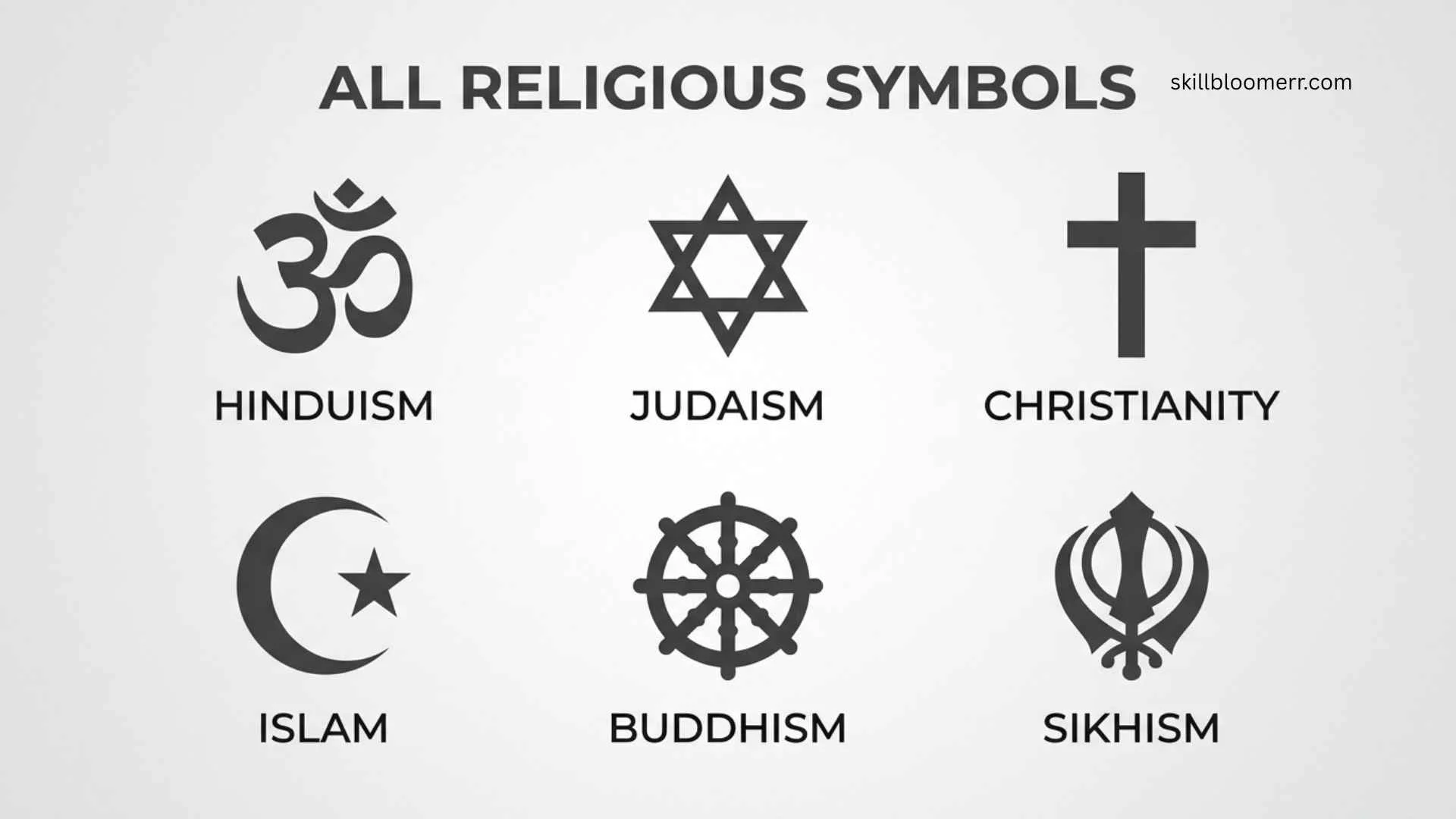
Religious symbols are powerful signs that represent faith, spirituality, history, traditions, and the deepest beliefs of human communities. Across the world, people use symbols to express their connection with the divine, remember sacred teachings, and communicate ideas that words alone cannot fully describe.
All religious symbols have unique meanings shaped by different cultures, civilizations, languages, and religious traditions. A cross represents sacrifice and salvation in Christianity, the Om symbol represents spiritual consciousness in Hinduism, the Dharma Wheel represents Buddha’s teachings, and the Star of David represents Jewish identity and heritage.
These symbols appear in temples, churches, mosques, synagogues, homes, artwork, jewelry, literature, and modern digital communication. Learning their meanings helps people understand not only religious beliefs but also the history and cultures that shaped human civilization.
This complete guide explores major religious symbols from around the world, explaining their origins, meanings, cultural importance, spiritual significance, and modern uses.
Quick Meaning of Religious Symbols
Religious symbols are visual signs, objects, or designs that represent spiritual beliefs, sacred ideas, religious teachings, and cultural identities. They help followers express devotion, remember important traditions, participate in ceremonies, and create a connection with their faith.
Religious Symbols Overview Table
| Symbol Name | Primary Meaning | Religion or Tradition | Origin | Common Usage | Modern Meaning |
| Cross | Sacrifice, salvation, resurrection | Christianity | 1st century CE | Churches, jewelry, ceremonies | Faith and hope |
| Crescent and Star | Cultural identity and guidance | Islamic cultures | Ancient Near East; later Islamic history | Flags, architecture, art | Muslim heritage |
| Om (ॐ) | Universal consciousness and sacred sound | Hinduism, Buddhism, Jainism | Ancient India | Meditation, prayer, yoga | Spiritual awareness |
| Dharma Wheel | Buddha’s teachings and enlightenment path | Buddhism | Ancient India | Temples, artwork | Wisdom and balance |
| Star of David | Jewish identity and heritage | Judaism | Medieval Jewish communities | Synagogues, jewelry | Faith and culture |
| Menorah | Divine light and history | Judaism | Ancient Israel | Religious ceremonies | Spiritual illumination |
| Khanda | Sikh principles and spiritual strength | Sikhism | Punjab, India | Sikh flags and symbols | Equality and devotion |
| Lotus Flower | Purity and awakening | Buddhism, Hinduism | Ancient Asian traditions | Temples, art | Growth and transformation |
| Yin-Yang | Balance and harmony | Taoism | Ancient China | Philosophy, art | Balance of opposites |
| Ankh | Life and immortality | Ancient Egyptian religion | Ancient Egypt | Artifacts, jewelry | Life symbolism |
| Hamsa Hand | Protection and blessings | Middle Eastern traditions | Ancient Middle East | Jewelry, artwork | Protection and peace |
What Do Religious Symbols Mean?
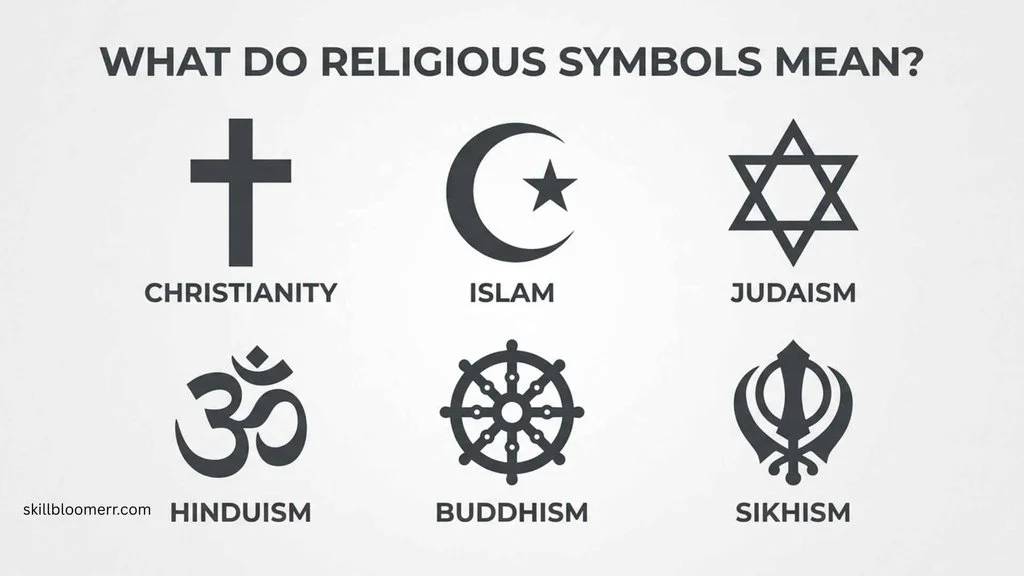
Religious symbols represent ideas, beliefs, and spiritual concepts that are important to religious communities. They act as a visual language that connects physical objects with deeper meanings about life, morality, creation, and the relationship between humans and the sacred.
A symbol is not simply a picture or design. It carries historical memories, religious teachings, and cultural values passed from one generation to another.
For example:
- The cross reminds Christians of Jesus Christ’s sacrifice and resurrection.
- The Om symbol represents spiritual consciousness and the connection between individual existence and ultimate reality.
- The Dharma Wheel represents the path taught by Buddha toward wisdom and liberation.
- The Star of David represents Jewish identity, history, and connection.
- The Khanda represents Sikh beliefs about equality, courage, and spiritual responsibility.
Spiritual Meaning Behind Symbols
Many religious symbols represent invisible ideas through visible forms. They help believers focus their thoughts during prayer, meditation, or religious ceremonies.
Common spiritual themes represented by symbols include:
- Creation
- Protection
- Peace
- Enlightenment
- Eternal life
- Divine guidance
- Moral values
- Unity
For many believers, a religious symbol is a reminder of their relationship with God, the universe, or spiritual principles.
Why Humans Use Religious Symbols
Humans have used symbols throughout history because complex ideas are often easier to understand through images and signs.
Religious symbols help communities:
- Preserve traditions
- Teach religious stories
- Identify shared beliefs
- Create emotional connections
- Express devotion
- Pass knowledge between generations
A symbol can communicate centuries of history through a single image.
History and Origin of Religious Symbols
Religious symbols developed alongside human civilization. Ancient societies used drawings, carvings, and objects to represent gods, nature, life, death, and spiritual forces.
Early symbolic traditions appeared in civilizations such as:
- Ancient Egypt
- Mesopotamia
- India
- China
- Greece
- Rome
- Indigenous cultures worldwide
Over time, these symbols became connected with organized religions and spiritual traditions.
Ancient Civilizations and Sacred Signs
Ancient Egypt created one of the richest symbolic systems in history.
Important Egyptian symbols included:
Ankh
The Ankh represented life and immortality. Egyptian gods were often shown holding the Ankh as a sign of divine life.
Eye of Horus
The Eye of Horus symbolized protection, healing, and restoration. It was commonly used in jewelry and protective objects.
Scarab Beetle
The scarab represented rebirth and transformation because ancient Egyptians connected the beetle with renewal and the movement of the sun.
Ancient India also developed powerful religious symbols that influenced Hinduism, Buddhism, and Jainism.
Examples include:
- Om
- Lotus flower
- Dharma Wheel
- Swastika as an ancient symbol of good fortune
Development Across World Religions
As religions expanded across continents, symbols evolved with cultural changes.
Christian symbols developed through early Christian communities and later became widespread through churches and artwork.
Jewish symbols preserved connections to ancient traditions and community identity.
Islamic symbols developed through historical cultures and civilizations, especially through Islamic art, architecture, and political traditions.
Buddhist symbols spread throughout Asia as Buddhism traveled from India to China, Japan, Korea, Tibet, and Southeast Asia.
Sikh symbols developed in Punjab and became important expressions of Sikh identity and teachings.
Symbolism and Interpretation
Religious symbols often have multiple layers of meaning. Their interpretation depends on religious teachings, historical context, and cultural background.
A symbol may represent different ideas in different communities.
Positive Meanings
Many religious symbols represent positive human values, including:
- Hope
- Compassion
- Wisdom
- Protection
- Peace
- Strength
- Spiritual growth
For example, the lotus represents overcoming challenges and achieving spiritual purity, while the dove represents peace in many Christian contexts.
Different Cultural Interpretations
Symbols are influenced by the cultures that use them.
The same image may have different meanings depending on geography and history.
Examples:
- The lotus represents enlightenment in Buddhism and divine beauty in Hindu traditions.
- The circle represents eternity and unity in many spiritual traditions.
- Light represents holiness and divine presence in several religions.
Understanding cultural background prevents incorrect interpretations.
Modern Understanding
Today, religious symbols may represent both faith and cultural identity.
People may use religious symbols to:
- Show personal beliefs
- Celebrate heritage
- Connect with family traditions
- Express artistic creativity
However, symbols should always be understood respectfully because their meanings are often deeply important to religious communities.
Cultural Significance of Religious Symbols
Religious symbols are deeply connected with culture because faith often influences the way societies create art, architecture, traditions, clothing, festivals, and social practices. These symbols preserve historical memories and help communities maintain a connection with their spiritual heritage.
A religious symbol can represent more than a belief system. It may also represent a civilization’s history, language, identity, and shared experiences.
Symbols in Art and Architecture
Religious symbols have shaped some of the world’s most important artistic and architectural traditions.
Examples include:
- Christian churches often feature crosses, stained glass windows, biblical artwork, and statues representing religious stories.
- Islamic architecture commonly uses geometric patterns, Arabic calligraphy, and decorative designs that express spiritual beauty.
- Hindu temples include sacred images, lotus designs, and symbols connected with deities and cosmic ideas.
- Buddhist temples often display Dharma Wheels, lotus motifs, statues of Buddha, and meditation-related symbols.
- Jewish religious spaces may include menorahs, Torah decorations, and the Star of David.
These designs transform buildings into places where people experience spirituality through visual expression.
Symbols in Daily Life
Many people carry religious symbols into everyday life through personal objects and traditions.
Common examples include:
- Cross necklaces
- Om pendants
- Star of David jewelry
- Sikh bracelets and Khanda symbols
- Buddhist prayer beads
- Hamsa hand decorations
For believers, these symbols can serve as reminders of faith, personal values, family traditions, and spiritual commitments.
Symbols in Festivals and Ceremonies
Religious symbols often appear during important celebrations and rituals.
Examples:
- Christians use crosses during Easter and other religious ceremonies.
- Jewish communities use menorahs during Hanukkah.
- Hindus use Om, lamps, and sacred symbols during festivals such as Diwali.
- Buddhists display Dharma Wheels and lotus imagery during religious gatherings.
- Sikhs display the Khanda during important community events.
These symbols help create shared experiences and strengthen community connections.
Religious and Spiritual Meaning of Major World Religion Symbols
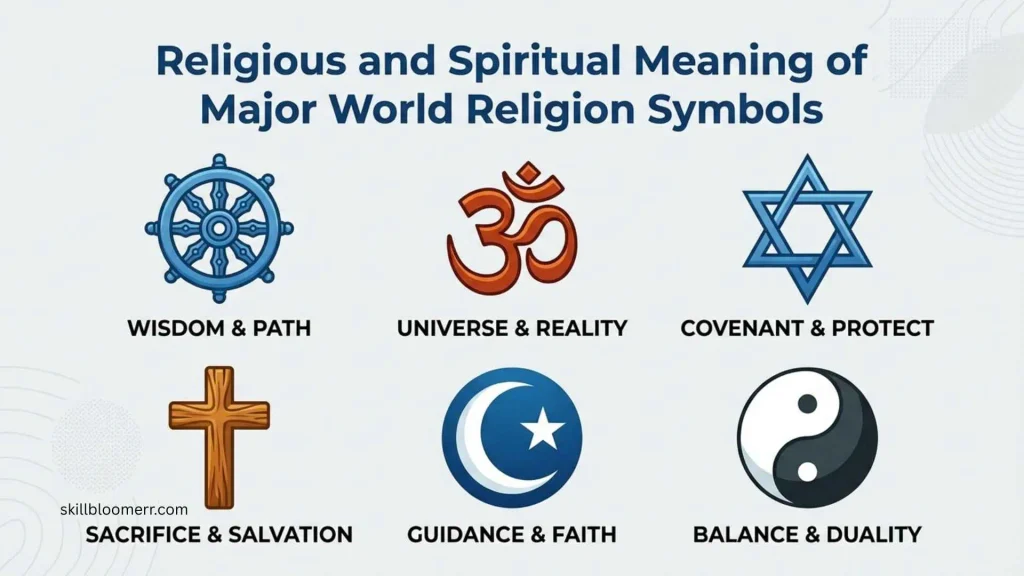
Religious symbols vary greatly across traditions, but many express universal themes such as devotion, wisdom, protection, creation, and spiritual transformation.
Christianity Symbols
Christianity contains many important symbols that represent the life, teachings, and message of Jesus Christ.
Cross
The cross is the central symbol of Christianity. It represents the crucifixion of Jesus and is associated with sacrifice, forgiveness, salvation, and resurrection.
Different forms include:
- Latin Cross
- Orthodox Cross
- Celtic Cross
- Crucifix
The cross appears in churches, artwork, religious ceremonies, and personal items.
Fish Symbol (Ichthys)
The fish symbol was used by early Christians as a secret sign of faith during periods when Christianity faced persecution.
The Greek letters in the word “Ichthys” were interpreted by early Christians as representing Jesus Christ.
Today, it represents:
- Christianity
- Faith
- Jesus as Savior
Dove
The dove is associated with peace and the Holy Spirit in Christian tradition.
It commonly represents:
- Purity
- Peace
- Divine presence
- Hope
Islam Symbols
Islam does not have a single universally required religious symbol. The faith primarily focuses on belief in Allah, the Quran, prayer, and ethical living.
However, certain symbols have become associated with Islamic culture and history.
Crescent and Star
The crescent and star are widely recognized symbols connected with many Muslim cultures.
They are associated with:
- Islamic heritage
- Historical Muslim civilizations
- Cultural identity
The symbol became especially connected with Islamic states through historical use on flags and architecture.
Arabic Calligraphy
Arabic calligraphy is highly significant in Islamic art.
Because many Islamic traditions discourage religious images of living beings in sacred spaces, beautiful writing of Quranic verses became an important artistic expression.
It represents:
- Respect for divine words
- Beauty of language
- Spiritual reflection
Kaaba
The Kaaba in Mecca is one of the most sacred places in Islam.
Although it is not a symbol in the same way as an image or sign, it represents:
- Unity of Muslims worldwide
- Direction of prayer (Qiblah)
- Connection to Islamic history
Hinduism Symbols
Hinduism contains a rich variety of symbols because it includes many traditions, philosophies, and forms of worship.
Om (ॐ)
Om is one of the most sacred Hindu symbols.
It represents:
- The sound of creation
- Universal consciousness
- Spiritual connection
- Meditation
It is commonly used during prayers, chanting, and yoga practices.
Swastika
The swastika is an ancient symbol found in Hinduism, Buddhism, and Jainism.
In these traditions, it traditionally represents:
- Good fortune
- Prosperity
- Auspicious beginnings
- Harmony
However, its meaning became negatively associated in many parts of the world after Nazi Germany adopted a reversed version of the symbol.
Historical context is essential when understanding this symbol.
Lotus Flower
The lotus represents purity and spiritual development.
It is connected with:
- Divine beauty
- Growth
- Enlightenment
- Transformation
Many Hindu deities are shown with lotus imagery.
Buddhism Symbols
Buddhist symbols communicate teachings about enlightenment, compassion, mindfulness, and the path toward liberation.
Dharma Wheel (Dharmachakra)
The Dharma Wheel represents Buddha’s teachings.
Its eight spokes symbolize the Noble Eightfold Path, which guides followers toward wisdom and ethical living.
Lotus Flower
In Buddhism, the lotus represents spiritual awakening.
The flower’s growth from muddy water symbolizes the ability to overcome suffering and achieve enlightenment.
Endless Knot
The Endless Knot represents:
- Interconnection
- Wisdom
- The relationship between causes and effects
It reminds followers that all aspects of life are connected.
Buddha Statue
Although statues are not always considered symbols in the same way, Buddha images represent:
- Enlightenment
- Compassion
- Meditation
- Inner peace
Judaism Symbols
Judaism has several important symbols connected with history, worship, and identity.
Star of David
The Star of David is one of the most recognized Jewish symbols.
It represents:
- Jewish identity
- Community
- Heritage
- Connection with Israel
Menorah
The menorah is an ancient seven-branched lampstand.
It symbolizes:
- Divine light
- Jewish history
- Spiritual knowledge
Chai Symbol
The Hebrew word “Chai” means “life.”
The symbol represents:
- Life
- Blessings
- Appreciation for existence
It is often worn as jewelry.
Sikhism Symbols
Sikhism uses symbols to represent spiritual values, equality, courage, and commitment.
Khanda
The Khanda is the main Sikh symbol.
Its elements represent:
- Spiritual wisdom
- Justice
- Unity
- Balance between spiritual and worldly responsibilities
Ik Onkar
Ik Onkar represents the belief in one supreme reality or one God.
It is one of the most important concepts in Sikhism.
The symbol expresses:
- Divine unity
- Equality
- Connection with God
Other World Religion Symbols
Many other religious traditions also have important symbols.
Jainism: Ahimsa Hand
The Ahimsa symbol represents nonviolence and compassion toward all living beings.
It teaches:
- Peace
- Self-control
- Respect for life
Shinto: Torii Gate
The Torii gate marks the entrance to a sacred space in Japanese Shinto tradition.
It represents the boundary between ordinary and spiritual worlds.
Taoism: Yin-Yang
The Yin-Yang symbol represents balance and harmony between complementary forces.
It teaches that opposing elements can exist together in a natural balance.
Bahá’í Faith: Nine-Pointed Star
The nine-pointed star is associated with the Bahá’í Faith and represents unity and completeness.
Scientific and Technical Connections of Religious Symbols
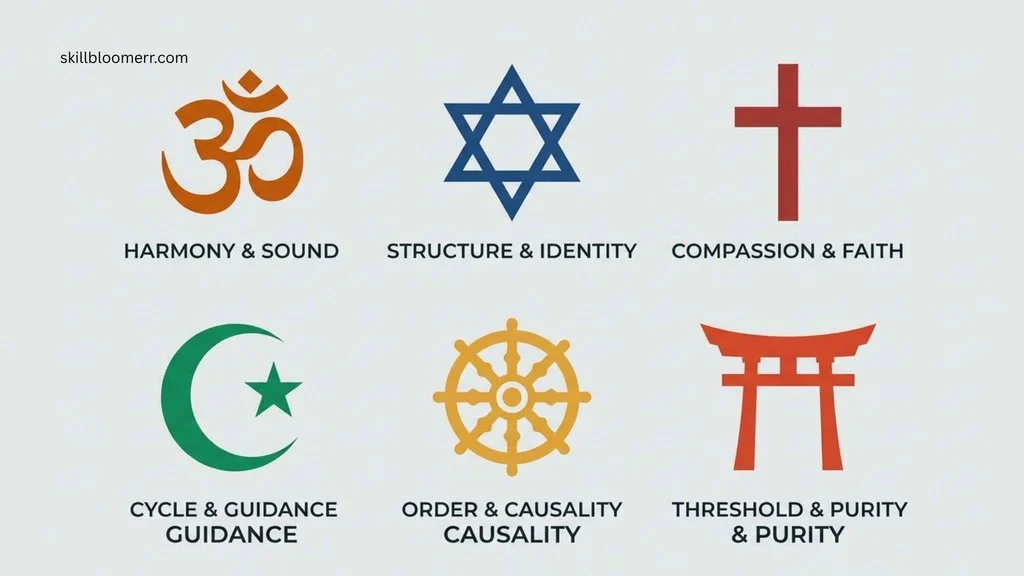
Religious symbols are mainly connected with spirituality, culture, and history, but some have influenced science, mathematics, design, psychology, and technology. Their geometric forms, patterns, and concepts have inspired many areas of human knowledge.
Geometry and Sacred Patterns
Many religious traditions use geometric designs because shapes can represent ideas about order, harmony, and the structure of the universe.
Examples include:
- Circles represent eternity, unity, and completeness in many traditions.
- Triangles representing balance, creation, or spiritual principles in different cultures.
- Geometric patterns in Islamic art showing mathematical precision and infinite design.
- Mandalas in Hinduism and Buddhism use symmetry to represent spiritual order.
These patterns demonstrate the connection between artistic creativity, mathematics, and spiritual thought.
Symbolism in Astronomy and Nature
Many religious symbols are connected with natural elements such as:
- The sun
- The moon
- Stars
- Water
- Plants
- Animals
Ancient civilizations often looked at nature as a source of spiritual meaning.
Examples:
- The sun represented life and divine power in many ancient cultures.
- The moon was connected with cycles, time, and renewal.
- The lotus represented spiritual growth because of its connection with water and nature.
Digital Use of Religious Symbols
Modern technology has allowed religious symbols to become part of digital communication.
People use religious symbols in:
- Social media posts
- Digital artwork
- Online communities
- Messaging platforms
- Graphic design
Some symbols have Unicode characters that allow them to appear consistently on computers and smartphones.
Examples:
| Symbol | Unicode Name | Unicode |
| ✝ | Latin Cross | U+271D |
| ☦ | Orthodox Cross | U+2626 |
| ☪ | Star and Crescent | U+262A |
| ☸ | Wheel of Dharma | U+2638 |
| ☯ | Yin Yang | U+262F |
| ✡ | Star of David | U+2721 |
Psychology of Religious Symbols
Psychologists and researchers have studied how symbols influence human emotions, memory, and identity.
Religious symbols can create:
- A sense of belonging
- Emotional comfort
- Connection with community
- Reminders of personal values
For many people, seeing a meaningful symbol can bring feelings of peace, hope, or spiritual connection.
Where Religious Symbols Are Used Today
Religious symbols continue to appear in many areas of modern life. They are found not only in places of worship but also in culture, education, art, and personal expression.
Places of Worship
Religious buildings often use symbols to create sacred environments.
Examples:
Churches
Christian churches commonly display:
- Crosses
- Biblical artwork
- Stained glass symbols
- Religious statues
These elements help communicate stories and teachings from Christianity.
Mosques
Mosques commonly use:
- Arabic calligraphy
- Geometric patterns
- Decorative designs
These artistic elements emphasize beauty, spirituality, and respect for sacred words.
Temples
Hindu and Buddhist temples often include:
- Deity images
- Lotus designs
- Dharma Wheels
- Sacred geometric patterns
These symbols help create spaces for worship and meditation.
Synagogues
Jewish religious spaces may feature:
- Star of David
- Menorah
- Hebrew writing
These symbols connect worshippers with Jewish history and tradition.
Jewelry and Fashion
Religious symbols are commonly used in jewelry and clothing.
Examples:
- Cross necklaces
- Om bracelets
- Star of David pendants
- Khanda necklaces
- Hamsa jewelry
People may wear these items for different reasons:
- Religious devotion
- Cultural identity
- Family connection
- Personal meaning
However, some symbols have sacred importance, so they should be used respectfully.
Tattoos and Body Art
Religious tattoos are popular because people often choose symbols that represent important personal experiences.
Common examples include:
- Cross tattoos representing faith
- Lotus tattoos representing growth
- Om tattoos representing spirituality
- Buddhist symbols representing mindfulness
Before using a religious symbol as a tattoo, it is important to understand its original meaning and cultural importance.
Books, Literature, and Media
Writers and artists often use religious symbols to explore deeper themes.
Common symbolic themes include:
- Good versus evil
- Sacrifice
- Redemption
- Spiritual transformation
- Human purpose
Religious symbolism appears in:
- Novels
- Poetry
- Films
- Paintings
- Music
Understanding these symbols can help readers and viewers better understand cultural references.
Logos and Organizations
Some organizations use religious symbols or symbolic designs connected with moral values and cultural traditions.
Examples include:
- Charitable organizations using symbols of compassion
- Educational institutions using historical religious imagery
- Cultural organizations preserving traditional symbols
However, a symbol used in a logo may not always have the same meaning as it does in a religious setting.
Common Variations of Religious Symbols
Religious symbols often appear in different forms depending on geography, tradition, and historical development.
Cross Variations
Latin Cross
The Latin cross is the most common Christian cross design.
It represents:
- Jesus Christ’s crucifixion
- Salvation
- Christian faith
Celtic Cross
The Celtic cross combines Christian symbolism with ancient Celtic artistic traditions.
It often includes a circle around the center, which may represent eternity or spiritual unity.
Orthodox Cross
The Orthodox cross contains additional horizontal bars and is used in Eastern Orthodox Christianity.
It reflects the traditions of churches such as the Eastern Orthodox Church.
Crescent and Star Variations
The crescent symbol appears in different styles:
- Crescent alone
- Crescent with different star designs
- Decorative artistic forms
Its meaning depends on historical and cultural context.
It is important to understand that the crescent and star are more closely connected with Islamic cultures and history rather than being a required symbol of Islamic belief.
Hindu Symbol Variations
Hindu symbols may differ between regions and traditions.
Examples:
- Om written in different scripts
- Different lotus designs
- Various forms of sacred geometry
- Regional artistic styles
Because Hinduism contains many traditions, symbols may have multiple interpretations.
Buddhist Symbol Variations
Buddhist symbols change across countries.
Examples:
Tibetan Buddhism
Common symbols include:
- Endless Knot
- Prayer Wheel
- Eight Auspicious Symbols
East Asian Buddhism
Common symbols include:
- Lotus imagery
- Buddha statues
- Temple designs
Southeast Asian Buddhism
Common symbols include:
- Dharma Wheels
- Stupas
- Sacred architecture
Indigenous Religious Symbols
Indigenous cultures around the world have developed unique symbolic traditions connected with nature, ancestors, and spiritual beliefs.
Examples include:
- Animal symbols
- Nature symbols
- Sacred patterns
- Ritual objects
These symbols often require cultural understanding because meanings are deeply connected with specific communities.
Common Misconceptions About Religious Symbols
Religious Symbols Always Have One Meaning
A common misunderstanding is that every symbol has a single universal meaning.
In reality, meanings can change based on:
- Religion
- Culture
- Historical period
- Location
A symbol must always be understood within its original context.
Symbols Are More Important Than Beliefs
Religious symbols usually support beliefs rather than replace them.
Most religious traditions emphasize teachings, actions, and spiritual practices more than physical symbols.
Ancient Symbols Have Modern Meanings Everywhere
Some ancient symbols have changed meaning over time.
A symbol may have a positive historical meaning in one culture but become associated with something negative in another period.
The swastika is one example. It has ancient meanings of good fortune and well-being in Hinduism, Buddhism, and Jainism, but its use by Nazi Germany created a different association in many Western societies.
Similar Symbols Always Mean the Same Thing
Two symbols may look similar but have different histories.
For example:
- A circle may represent eternity in one tradition and cosmic balance in another.
- A hand symbol may represent blessing, protection, or religious teachings depending on the culture.
Interesting Facts About Religious Symbols
Religious symbols reveal how human societies have expressed faith, identity, and spiritual ideas throughout history. These facts show the connection between symbols, civilizations, and religious traditions.
1. The Cross Was Not Always the Main Christian Symbol
Although the cross is now the most recognized Christian symbol, early Christians also used other symbols, including the fish symbol known as Ichthys. The cross became more widely accepted after Christianity became publicly practiced within the Roman Empire.
2. Om Represents More Than a Written Character
The Om symbol is not simply a decorative mark. In Hindu philosophy, it represents a sacred sound connected with creation, consciousness, and the nature of reality. It is often used during meditation and spiritual practices.
3. The Dharma Wheel Represents a Spiritual Journey
The Dharma Wheel is not just a Buddhist decoration. Its movement represents the spreading of Buddha’s teachings, while its spokes represent principles that guide followers toward wisdom and ethical living.
4. The Menorah Has Thousands of Years of History
The menorah is one of the oldest symbols associated with Judaism. It has historical connections to ancient Israel and continues to represent Jewish heritage, religious memory, and spiritual light.
5. The Lotus Appears in Multiple Religious Traditions
The lotus flower is meaningful in several Asian religions, especially Hinduism, Buddhism, and Jainism. Its growth from muddy water into a beautiful flower makes it a symbol of purity and transformation.
6. Islamic Art Uses Symbolism Through Patterns and Calligraphy
Many Islamic artistic traditions focus on geometric patterns, architecture, and Arabic calligraphy. These designs communicate beauty, order, and devotion without relying mainly on religious images.
7. Symbols Can Preserve Lost History
Ancient symbols often provide clues about past civilizations. Archaeologists study symbols found on buildings, objects, and artwork to understand the beliefs and lifestyles of earlier societies.
8. Religious Symbols Influence Language
Many religious symbols have influenced words, phrases, and expressions used in everyday language.
Examples include:
- Expressions connected with faith
- Names derived from religious traditions
- Cultural phrases based on sacred stories
9. Religious Symbols Can Unite Communities
Symbols often create a shared identity among people who follow the same traditions. They appear during festivals, ceremonies, and important community events.
10. A Symbol’s Meaning Depends on Context
The same symbol can have different meanings depending on who uses it and where it appears. Historical knowledge and cultural awareness are necessary for accurate interpretation.
Related Symbols and Their Meanings
Many religious symbols are connected because they express similar themes such as life, protection, wisdom, balance, and spiritual growth.
Ankh
The Ankh is an ancient Egyptian symbol representing life and immortality.
It is often shown in the hands of Egyptian deities and appears in temple artwork, jewelry, and historical artifacts.
The symbol represents:
- Life
- Creation
- Eternal existence
- Divine power
Eye of Horus
The Eye of Horus is another important Egyptian symbol.
It traditionally represents:
- Protection
- Healing
- Restoration
- Safety
Ancient Egyptians used it on jewelry and objects believed to provide protection.
Hamsa Hand
The Hamsa Hand is a hand-shaped symbol found in several Middle Eastern and North African cultures.
It is commonly associated with:
- Protection
- Blessings
- Strength
- Good fortune
Different communities interpret it according to their own traditions.
Tree of Life
The Tree of Life appears in many cultures and religions.
It commonly represents:
- Connection between heaven and earth
- Growth
- Creation
- Family relationships
- Spiritual development
It appears in Jewish, Christian, Islamic, and other cultural traditions.
Sacred Heart
The Sacred Heart is a Christian symbol representing the love and compassion of Jesus Christ.
It is connected with:
- Divine love
- Mercy
- Devotion
- Spiritual compassion
Peace Symbol
The modern peace symbol is not an ancient religious symbol, but it is often connected with spiritual ideas of harmony and nonviolence.
It represents:
- Peace
- Unity
- Hope
- Cooperation
Mandala
Mandala designs are important in Hindu and Buddhist traditions.
They represent:
- The universe
- Spiritual balance
- Meditation
- Inner harmony
Mandalas are often used as tools for reflection and meditation.
Frequently Asked Questions About All Religious Symbols
What are the most common religious symbols in the world?
Some of the most recognized religious symbols include the Christian cross, Om symbol, crescent and star, Dharma Wheel, Star of David, Khanda, lotus flower, menorah, and Yin-Yang. Their popularity comes from the long histories and global influence of the traditions they represent.
Why do religions use symbols?
Religions use symbols because visual images can communicate complex spiritual ideas quickly. Symbols help people remember teachings, express devotion, connect with communities, and preserve traditions across generations.
Are religious symbols universal?
No, religious symbols are not universal. A symbol may have different meanings depending on the culture, religion, and historical period. Understanding the original context is necessary before interpreting any religious symbol.
What is the oldest religious symbol?
There is no single confirmed oldest religious symbol because many ancient societies used symbolic markings before written history. Early human cultures used shapes, animals, and natural images to represent spiritual ideas and connections with the world.
What is the most important religious symbol?
The importance of a symbol depends on the religion and the beliefs of its followers. The cross is central to Christianity, Om is highly important in Hinduism, and the Dharma Wheel is central in Buddhism.
Can one symbol belong to different religions?
Yes. Some symbols appear in multiple religious traditions. For example, the lotus is important in Hinduism, Buddhism, and Jainism, although each tradition gives it different meanings.
Are religious symbols allowed in all religions?
The use of symbols differs between religions. Some traditions strongly use visual symbols in worship, while others place greater emphasis on sacred texts, practices, or spiritual experiences.
Why do people wear religious symbols?
People wear religious symbols to express faith, remember spiritual teachings, honor family traditions, or show cultural identity. Jewelry and clothing are common ways people display meaningful symbols.
How can someone learn the meaning of an unfamiliar religious symbol?
The best way is to research the symbol’s historical and cultural background. Reliable sources such as religious organizations, museums, universities, and academic studies can provide accurate information.
Can religious symbols be used outside religion?
Yes, religious symbols may appear in art, fashion, literature, and cultural expressions. However, because many symbols are sacred to communities, they should be used with awareness and respect.
Key Takeaways
- Religious symbols are visual representations of faith, history, and spiritual beliefs.
- Different religions use symbols to express ideas about life, creation, protection, wisdom, and devotion.
- The meaning of a symbol depends on cultural and historical context.
- Major religious symbols include the cross, Om, Dharma Wheel, Star of David, Khanda, crescent and star, lotus, and menorah.
- Symbols appear in worship spaces, art, architecture, jewelry, literature, and technology.
- Ancient symbols often have meanings that differ from modern interpretations.
- Respectful understanding requires learning about the community and tradition connected with each symbol.
- Religious symbols preserve the history and identity of civilizations.
- Many symbols share similar themes, such as peace, unity, and spiritual growth.
- Studying religious symbols helps people understand global cultures and human beliefs.
Conclusion
Religious symbols are powerful expressions of human spirituality, history, and cultural identity. Throughout thousands of years, societies have used symbols to communicate beliefs about creation, morality, life, death, and the connection between humans and the sacred.
From the cross of Christianity and the Om symbol of Hinduism to the Dharma Wheel of Buddhism and the Star of David in Judaism, each symbol carries a unique story shaped by generations of tradition. These symbols are not only religious signs but also reflections of the civilizations, languages, and philosophies that created them.
Understanding all religious symbols requires looking beyond appearance. The true meaning of a symbol comes from its history, cultural background, religious teachings, and the people who continue to use it today.
When studied respectfully, religious symbols provide a deeper understanding of the diverse ways humanity has searched for meaning, expressed faith, and connected with spiritual ideas throughout history.

I’m Nathaniel Brooks, an educational writer who loves exploring ideas and making useful knowledge accessible to everyone. I write for SkillBloomerr with a focus on clear explanations, practical tips, and meaningful learning. My goal is to help readers discover something valuable every time they visit the site.
Books: Learn Something New and The Practical Knowledge Handbook
 Ethan Calloway
 Olivia Hartwell