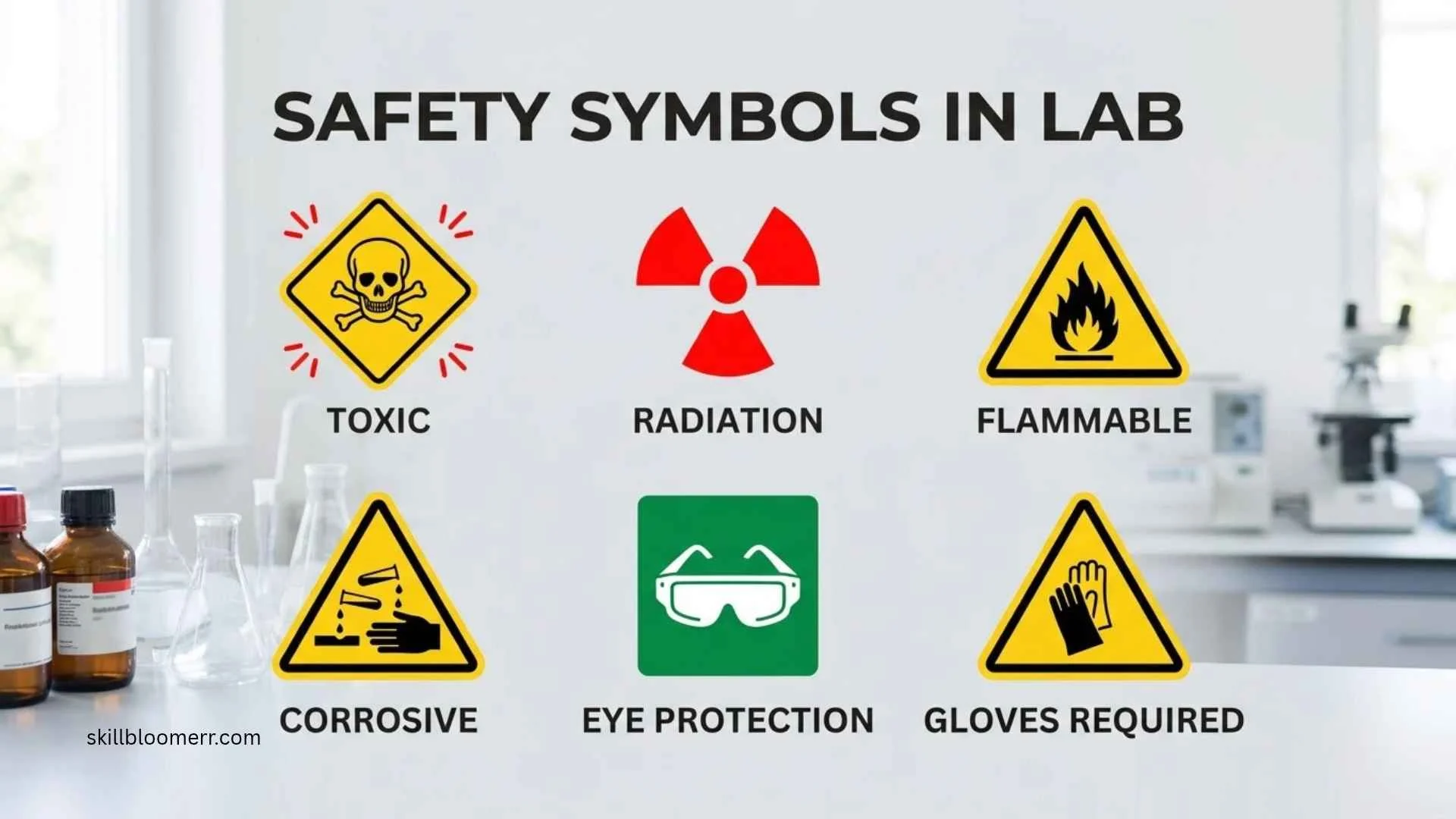
Safety symbols in lab environments are visual warning signs that help people quickly recognize hazards and take proper precautions before handling chemicals, equipment, or biological materials.
These symbols appear on chemical containers, laboratory equipment, safety manuals, storage areas, and workplace instructions to communicate risks clearly.
A laboratory can contain many different dangers, including toxic chemicals, flammable substances, corrosive materials, radiation sources, biological hazards, and dangerous gases.
Because laboratory work often involves substances that cannot be judged by appearance alone, safety symbols provide an international language of protection.
Understanding safety symbols in lab settings is essential for students, researchers, technicians, teachers, and professionals. These symbols reduce accidents by explaining what type of hazard exists, what safety measures are needed, and how materials should be handled, stored, or disposed of properly.
This complete guide explains laboratory safety symbols, their meanings, history, scientific importance, common uses, variations, and the mistakes people often make when interpreting hazard signs.
Quick Meaning
Safety symbols in lab are standardized signs used to identify dangerous materials, equipment risks, and required safety precautions. They help laboratory users recognize hazards such as flammable chemicals, toxic substances, corrosive materials, biological risks, and radiation so they can work safely and prevent accidents.
Symbol Overview Table
| Symbol Name | Primary Meaning | Category | Origin | Common Usage | Modern Meaning |
| Flammable Symbol | Fire or ignition risk | Chemical Hazard | International hazard communication systems | Chemical bottles, storage cabinets | Material can easily catch fire |
| Explosive Symbol | Explosion danger | Physical Hazard | Global chemical safety standards | Reactive chemicals | Substance may explode under certain conditions |
| Toxic Symbol | Poison or serious health risk | Health Hazard | International hazard labeling | Chemical containers | Can cause harmful effects or death |
| Corrosive Symbol | Damage to skin or materials | Chemical Hazard | Hazard communication systems | Acids and bases | Can burn skin or destroy metals |
| Oxidizing Symbol | Supports combustion | Chemical Hazard | Globally Harmonized System (GHS) | Oxidizing chemicals | Can intensify fires |
| Gas Cylinder Symbol | Pressurized gas | Physical Hazard | International safety standards | Gas storage areas | Contains compressed gas |
| Biohazard Symbol | Biological danger | Biological Hazard | Modern microbiology safety systems | Medical and research labs | Contains infectious biological materials |
| Radiation Symbol | Radioactive material | Radiation Hazard | Nuclear safety organizations | Nuclear and research facilities | Indicates radiation exposure risk |
| Environmental Hazard Symbol | Harm to ecosystems | Environmental Hazard | GHS system | Chemical waste labels | Dangerous to aquatic life and environment |
What Do Safety Symbols in Lab Mean?
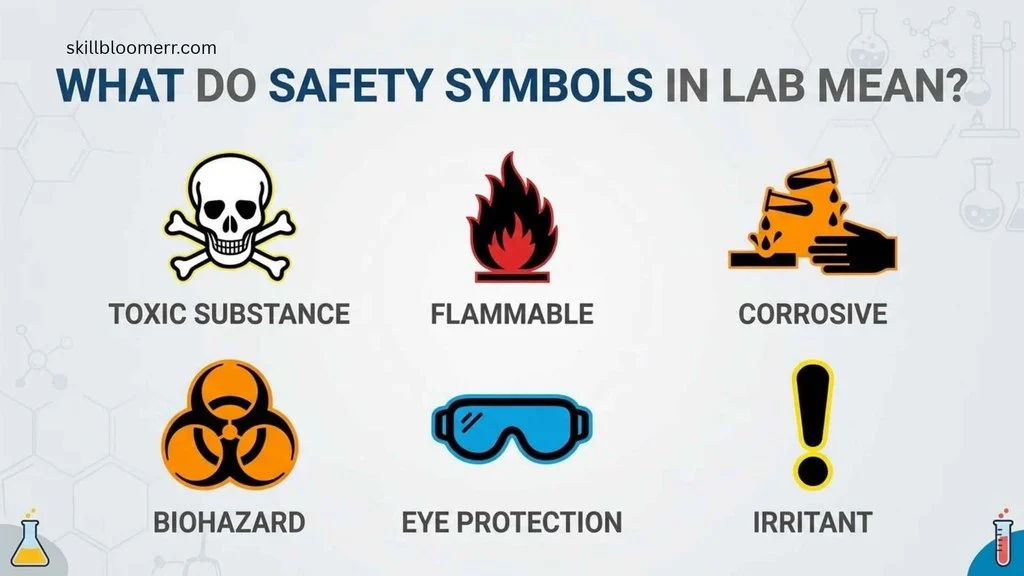
Safety symbols in laboratories represent different categories of hazards that may affect human health, property, or the environment. They are designed to provide immediate information without requiring long written explanations.
A person working in a laboratory may encounter unfamiliar chemicals or equipment. Instead of reading lengthy documents every time, hazard symbols provide a quick visual warning.
For example, a flame symbol on a chemical container means the substance is flammable and should be kept away from heat, sparks, and open flames. A skull and crossbones symbol indicates acute toxicity, meaning exposure can cause severe health effects.
These symbols are especially important because many hazardous substances do not have obvious warning signs. A clear liquid may be highly corrosive, and a colorless gas may be poisonous. Laboratory symbols help reveal hidden dangers.
Why Laboratory Safety Symbols Are Important
Laboratory safety symbols exist because scientific environments involve controlled risks. They help:
- Prevent chemical accidents
- Protect laboratory workers
- Improve emergency response
- Support proper chemical storage
- Reduce incorrect handling of substances
- Create consistent communication worldwide
A laboratory without clear hazard identification would increase the chance of spills, burns, fires, exposure, and contamination.
History and Origin of Laboratory Safety Symbols
The development of laboratory safety symbols happened gradually as science, industry, and international trade expanded.
Early laboratories relied mostly on written warnings and personal knowledge. Scientists working with chemicals often understood risks through experience, but this approach was not practical as laboratories became larger and more international.
During the 20th century, chemical industries and scientific organizations began developing standardized warning systems. The goal was to create symbols that could be understood regardless of language.
Development of International Hazard Communication
Different countries originally used different labeling systems. A chemical warning used in one country might not be understood in another. This created problems when chemicals were transported globally.
To solve this issue, international organizations developed the Globally Harmonized System of Classification and Labelling of Chemicals (GHS). The GHS introduced standardized pictograms, signal words, and hazard statements.
Today, many laboratories use GHS hazard symbols because they provide consistent information across countries and industries.
Evolution From Simple Signs to Global Standards
Laboratory symbols have evolved from basic warning images into scientifically organized communication tools.
Modern symbols are designed with:
- Simple shapes
- Strong visual contrast
- Recognizable images
- Universal meanings
- International acceptance
The purpose is not decoration. Each symbol represents a specific safety message.
Symbolism and Interpretation
Safety symbols communicate danger through visual language. Their design elements, such as shapes, colors, and images, help people understand risks quickly.
Traditional Meaning of Laboratory Hazard Symbols
Many laboratory symbols use common visual ideas:
- Fire images represent flammability.
- Skull images represent poisoning.
- Corrosion images represent chemical damage.
- Explosions represent unstable substances.
- Human health symbols represent long-term health risks.
These designs work because humans naturally associate certain images with danger.
Modern Interpretation
Today, laboratory symbols are interpreted as instructions, not just warnings.
A symbol does not only say “danger exists.” It also suggests what action should be taken.
For example:
- Flammable symbol → Keep away from ignition sources.
- Corrosive symbol → Wear protective equipment.
- Toxic symbol → Avoid exposure and follow safety procedures.
- Biohazard symbol → Prevent contamination and use biological safety measures.
Positive Purpose Behind Warning Symbols
Although hazard symbols represent danger, their purpose is protective. They help create safer workplaces and encourage responsible scientific practices.
The meaning behind these symbols is prevention, awareness, and preparedness.
Cultural Significance of Laboratory Safety Symbols
Laboratory safety symbols have cultural importance because they create a shared scientific language across countries.
A student in the United States, a researcher in Germany, and a technician in Japan can recognize many of the same hazard symbols.
Global Scientific Communication
Science depends on international cooperation. Researchers often share chemicals, equipment, and information across borders.
Universal symbols remove language barriers and allow safety instructions to travel globally.
Educational Importance
Safety symbols are introduced in schools and universities because they teach students responsible scientific behavior.
Students learn that:
- Every chemical has properties.
- Every experiment requires preparation.
- Safety rules protect people and results.
Laboratory symbols become part of scientific literacy.
Religious or Spiritual Meaning
Laboratory safety symbols do not have religious or spiritual meanings. They are scientific communication tools created for safety, risk management, and public protection.
Unlike cultural or religious symbols, laboratory hazard pictograms are based on international standards, scientific research, and workplace safety practices.
Scientific and Technical Meaning
Laboratory safety symbols have specific scientific meanings connected to chemistry, biology, physics, and engineering.
Chemical Hazard Symbols
Chemical laboratories commonly use symbols to identify:
- Flammable liquids
- Reactive substances
- Toxic compounds
- Corrosive chemicals
- Oxidizing agents
These symbols help scientists understand how substances behave and what precautions are required.
Biological Hazard Symbols
The biohazard symbol identifies materials that may contain harmful biological agents.
It is commonly found in:
- Medical laboratories
- Microbiology research facilities
- Hospitals
- Biotechnology centers
Radiation Hazard Symbol
The radiation symbol warns people about possible exposure to radioactive materials.
It is used in:
- Nuclear research
- Medical imaging facilities
- Radiation laboratories
Engineering and Workplace Safety
Laboratory safety symbols also connect with engineering safety systems.
They help manage:
- Equipment risks
- Pressure hazards
- Electrical dangers
- Mechanical hazards
Where Safety Symbols Are Used

Safety symbols appear in many scientific and professional environments.
Educational Laboratories
Schools and universities use safety symbols on:
- Chemical bottles
- Experiment instructions
- Laboratory walls
- Safety posters
Students learn to identify hazards before performing experiments.
Research Laboratories
Professional research facilities use symbols for:
- Chemical storage
- Sample labeling
- Waste containers
- Laboratory equipment
Medical Laboratories
Hospitals and medical facilities use hazard symbols for:
- Biological samples
- Infectious materials
- Chemical solutions
- Radiation equipment
Industrial Laboratories
Manufacturing and testing laboratories rely on safety symbols for:
- Quality control
- Chemical processing
- Product development
Common Variations of Safety Symbols
Laboratory symbols may vary slightly depending on the country, organization, or safety standard being followed.
GHS Hazard Pictograms
The most widely recognized modern system uses diamond-shaped symbols with red borders.
These include:
- Flame
- Exploding bomb
- Skull and crossbones
- Corrosion symbol
- Gas cylinder
- Health hazard symbol
Older Hazard Symbols
Some older systems used different images or colors.
For example:
- European hazard labels previously used orange squares.
- Modern GHS labels generally use red diamond borders.
Workplace-Specific Symbols
Some laboratories create additional signs for:
- Emergency equipment
- Protective clothing requirements
- Restricted areas
These symbols support, but do not replace, official hazard labels.
Common Misconceptions About Lab Safety Symbols
A Symbol Means the Chemical Is Always Dangerous
A hazard symbol does not mean a substance is always harmful in every situation. Risk depends on:
- Amount
- Exposure method
- Concentration
- Handling conditions
All Symbols Mean the Same Level of Danger
Different symbols represent different hazards. A flammable substance and a toxic substance require different safety responses.
Safety Symbols Replace Training
Symbols provide warnings, but they do not replace proper laboratory training.
Workers and students still need knowledge about:
- Safe handling
- Emergency procedures
- Protective equipment
Small Containers Do Not Need Labels
Even small amounts of chemicals can be dangerous. Proper labeling is necessary regardless of container size.
Interesting Facts About Laboratory Safety Symbols
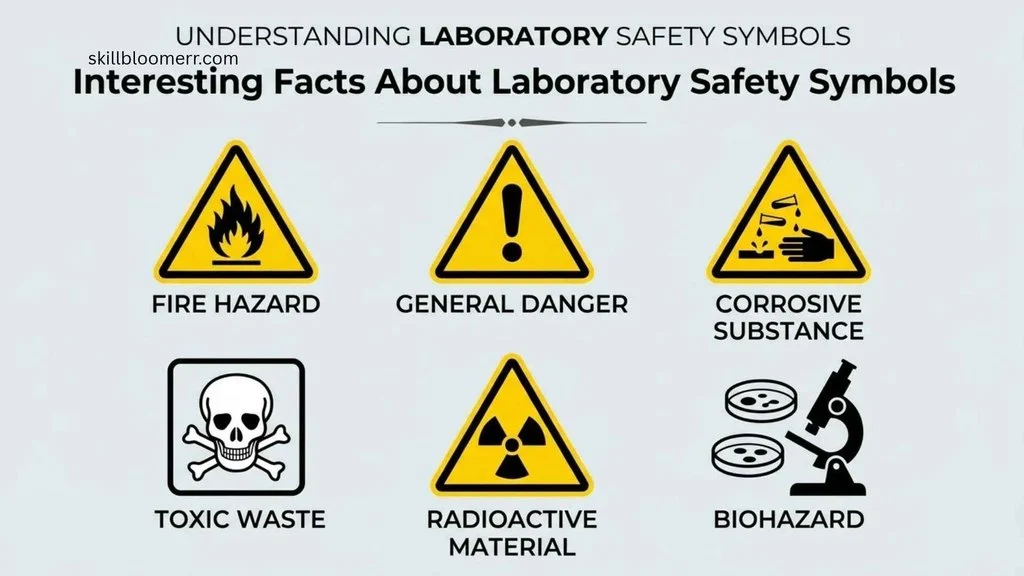
- Many lab symbols are internationally recognized.
Scientists around the world use similar pictograms to reduce communication problems. - The skull and crossbones symbol has historical roots.
It was traditionally associated with poison because it strongly represented danger. - The biohazard symbol was created in the 1960s.
It was designed to provide a clear warning for biological risks. - Safety symbols are designed for quick recognition.
People often need to understand warnings within seconds during emergencies. - Color plays an important role in safety communication.
Red borders and warning colors attract attention and signal caution. - Laboratory symbols protect the environment too.
Some symbols warn about chemicals that can harm ecosystems. - Safety labels support international research.
Shared symbols allow scientists from different countries to work together more safely. - Symbols are used beyond laboratories.
They also appear in factories, transportation, healthcare, and workplaces. - Not every dangerous substance has an obvious symbol.
Some hazards require detailed information beyond a pictogram. - Safety symbols are part of scientific education.
Students learn them as an essential part of laboratory skills.
Related Symbols
Workplace Safety Signs
Workplace safety signs include warnings about:
- Fire hazards
- Electrical risks
- Emergency exits
- Protective equipment
Chemical Warning Labels
Chemical labels provide additional information such as:
- Hazard statements
- Precautionary statements
- Storage instructions
Personal Protective Equipment Symbols
These symbols indicate required protective gear, including:
- Safety glasses
- Gloves
- Lab coats
- Respirators
Emergency Symbols
Emergency symbols identify:
- Fire extinguishers
- Eye wash stations
- Safety showers
- First aid equipment
Frequently Asked Questions
What are safety symbols in the lab?
Safety symbols in the lab are standardized warning signs used to identify chemical, biological, physical, and environmental hazards. They help laboratory users understand risks quickly and follow correct safety procedures when handling materials or equipment.
Why are laboratory safety symbols important?
Laboratory safety symbols are important because they prevent accidents by providing immediate warnings. They help students, researchers, and workers recognize dangers before exposure and encourage proper protective measures.
Who uses laboratory safety symbols?
Laboratory safety symbols are used by students, teachers, scientists, healthcare workers, chemical professionals, and industrial technicians who work with potentially hazardous materials.
What does the flame symbol mean in a laboratory?
The flame symbol indicates that a substance is flammable. Materials with this symbol can catch fire easily and should be kept away from heat, sparks, and open flames.
What does the skull and crossbones symbol mean?
The skull and crossbones symbol indicates acute toxicity. It warns that exposure to the substance can cause serious health effects and requires careful handling.
Are lab safety symbols the same worldwide?
Many laboratory safety symbols are standardized internationally through systems such as GHS. However, some older or specialized symbols may differ between regions or organizations.
Do safety symbols replace laboratory safety rules?
No. Safety symbols provide warnings, but they do not replace training, safety equipment, and proper laboratory procedures.
Where can you find lab safety symbols?
You can find laboratory safety symbols on chemical containers, safety data sheets, storage cabinets, equipment labels, laboratory doors, and workplace safety instructions.
What is the difference between a hazard symbol and a safety sign?
A hazard symbol identifies a specific danger, while a safety sign may provide instructions, warnings, or information about required actions in a workplace.
How can students remember laboratory symbols?
Students can remember symbols by learning their meanings, studying real examples, practicing identification exercises, and connecting each symbol with a safety action.
Key Takeaways
- Safety symbols in lab environments provide quick warnings about hazards.
- They help protect people, equipment, and the environment.
- Common symbols include flammable, toxic, corrosive, biohazard, and radiation warnings.
- Modern laboratory symbols are based on international communication systems.
- Symbols support safe scientific work but do not replace proper training.
- Understanding hazard pictograms is an essential laboratory skill.
- Different symbols represent different risks and require different precautions.
Conclusion
Safety symbols in lab environments are more than simple warning pictures. They are an important scientific communication system that helps people recognize risks, make safer decisions, and prevent accidents.
From chemical laboratories and medical facilities to schools and research centers, these symbols provide a universal way to understand hazards. Learning their meanings allows students and professionals to work with greater awareness and responsibility.
Whether you are studying chemistry, conducting research, or working in a professional laboratory, understanding laboratory safety symbols is one of the most important steps toward creating a safe and effective scientific environment.

I’m Olivia Hartwell, a writer passionate about learning, personal growth, and practical education. I enjoy researching new ideas and sharing them in a way that feels easy to understand and useful. Through my work with SkillBloomerr, I aim to give readers reliable information they can apply in real life.
Books: Small Steps, Big Growth and The Curious Mind