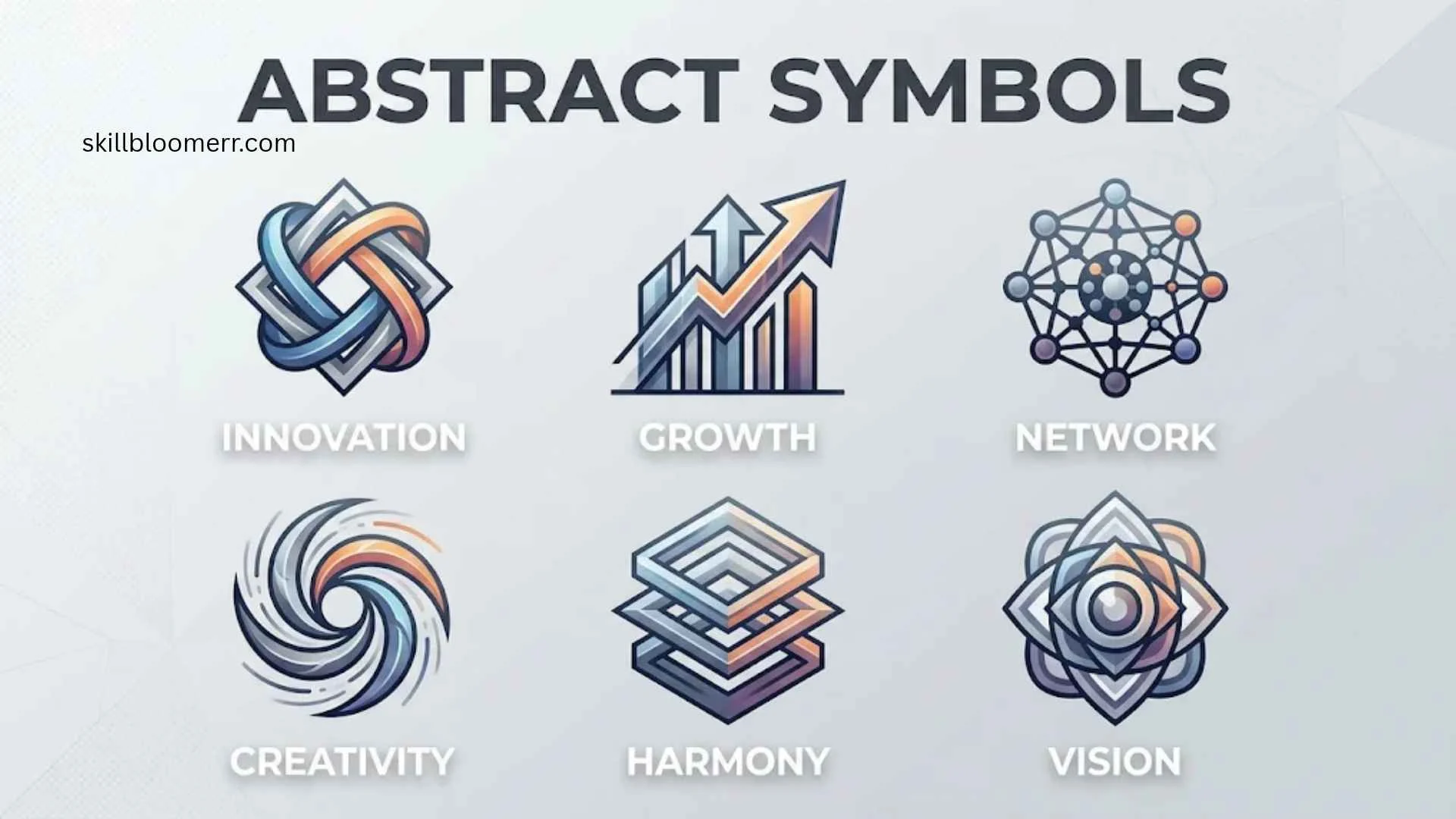
Abstract symbols are visual signs that represent ideas, emotions, concepts, or beliefs without showing a direct physical object. They help people communicate complex meanings quickly through shapes, patterns, colors, and forms.
You see abstract symbols everywhere, from art and architecture to technology, mathematics, religion, branding, and digital communication. A simple line, circle, or geometric pattern can express ideas such as unity, infinity, balance, power, or transformation.
Understanding abstract symbols helps us recognize how humans use visual language to share knowledge, identity, emotions, and cultural values across different societies and generations.
Quick Meaning of Abstract Symbols
Abstract symbols are visual representations of ideas rather than literal objects. They use shapes, patterns, colors, and designs to communicate deeper meanings such as emotions, beliefs, identity, or concepts. Unlike realistic images, abstract symbols require interpretation based on cultural, historical, personal, or social context.
Symbol Overview Table
| Field | Details |
| Symbol Name | Abstract Symbols |
| Primary Meaning | Representation of ideas, concepts, emotions, and beliefs through visual forms |
| Category | Visual language, symbolic communication, conceptual design |
| Origin | Ancient human communication systems and artistic traditions |
| Civilization or Culture | Used across nearly all civilizations, including Ancient Egypt, Greece, China, India, and Indigenous cultures |
| First Known Use | Prehistoric markings and early human artwork |
| Common Usage | Art, religion, technology, mathematics, branding, communication |
| Modern Meaning | A simplified visual way to express complex ideas |
| Unicode | No single Unicode symbol; individual abstract symbols may have Unicode characters |
| Emoji Equivalent | Depends on the specific symbol, such as ♾️ for infinity or ☮️ for peace |
| Related Symbols | Geometric symbols, sacred symbols, logos, icons, signs, and glyphs |
What Do Abstract Symbols Mean?
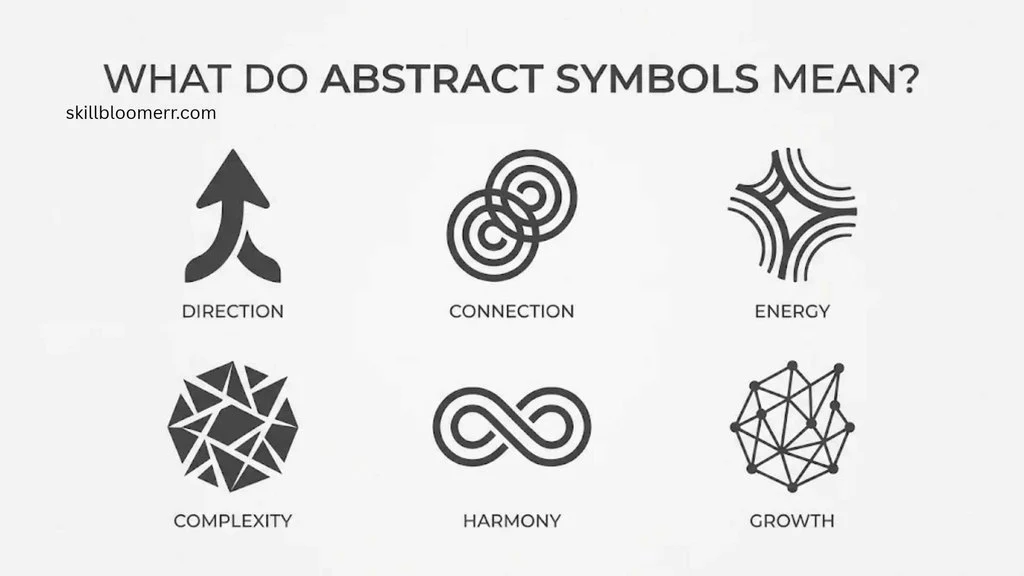
Abstract symbols represent ideas that cannot always be seen or touched. Instead of showing a physical object, they communicate a concept through visual elements.
For example:
- A circle may represent unity, wholeness, eternity, or perfection.
- A triangle may symbolize strength, stability, or spiritual connection.
- A spiral may represent growth, change, or the cycle of life.
- A simple line may represent movement, connection, or direction.
The meaning of an abstract symbol depends on its context. The same shape can have different interpretations in different cultures. A circle in one tradition may represent the universe, while in another it may represent community or protection.
Abstract symbols work because humans naturally search for patterns and meanings. They transform invisible ideas into visual forms that people can recognize and remember.
History and Origin of Abstract Symbols
Early Human Use of Symbolic Communication
Abstract symbols began long before written languages. Early humans created marks, patterns, and shapes on cave walls, tools, and objects to communicate ideas, record events, or express beliefs.
Prehistoric symbols often included:
- Dots and lines
- Geometric patterns
- Handprints
- Spirals
- Repeated shapes
These early designs show that humans developed symbolic thinking thousands of years before modern writing systems.
Abstract Symbols in Ancient Civilizations
Ancient civilizations used abstract symbols to represent religious ideas, social structures, and natural forces.
Ancient Egypt
Ancient Egyptians used symbolic designs such as:
- Ankh: Associated with life and immortality
- Eye of Horus: Protection and healing
- Scarab: Renewal and transformation
Many Egyptian symbols combined abstract shapes with cultural beliefs about life, death, and the universe.
Ancient Greece
Greek culture used geometric and philosophical symbols to represent concepts such as:
- Harmony
- Balance
- Knowledge
- Mathematical order
The Greek use of geometry influenced later scientific and artistic symbolism.
Ancient China
Chinese symbolic traditions used abstract designs to represent:
- Luck
- Balance
- Prosperity
- Cosmic harmony
Symbols often appeared in calligraphy, architecture, clothing, and ceremonies.
Evolution Through Art and Communication
Over time, abstract symbols moved from religious and cultural settings into many other areas, including:
- Mathematics
- Science
- Architecture
- Political movements
- Corporate branding
- Digital interfaces
Today, abstract symbols form an important part of global visual communication.
Symbolism and Interpretation of Abstract Symbols
Traditional Meanings
Traditional interpretations often connect abstract symbols with universal human experiences.
Common meanings include:
| Symbol Form | Common Interpretation |
| Circle | Unity, infinity, completeness |
| Triangle | Strength, balance, transformation |
| Spiral | Growth, evolution, cycles |
| Cross | Faith, connection, sacrifice |
| Square | Stability, order, foundation |
| Wave | Change, movement, emotion |
These meanings are not universal rules. They are interpretations shaped by history and culture.
Modern Meanings
Modern designers often use abstract symbols to communicate quickly.
Examples:
- Technology companies use simple geometric logos to suggest innovation.
- Environmental organizations use natural shapes to represent sustainability.
- Apps use abstract icons for easy navigation.
Modern symbolism focuses on clarity, recognition, and emotional connection.
Positive Symbolism
Many abstract symbols represent positive ideas such as:
- Hope
- Freedom
- Unity
- Creativity
- Progress
- Peace
- Balance
These meanings appear frequently in art, advertising, and social movements.
Negative Symbolism
Some abstract symbols may also represent negative ideas depending on their history or usage.
Examples include:
- Symbols connected to conflict or political movements
- Shapes used in harmful ideologies
- Designs associated with fear or oppression
A symbol’s meaning should always be examined within its cultural and historical context.
Psychological Interpretation
Psychologists and researchers who study visual perception recognize that humans respond emotionally to shapes, colors, and patterns.
For example:
- Rounded shapes often feel friendly or natural.
- Sharp angles may appear powerful or energetic.
- Symmetrical designs often suggest balance and order.
These reactions influence art, branding, architecture, and user experience design.
Cultural Significance of Abstract Symbols
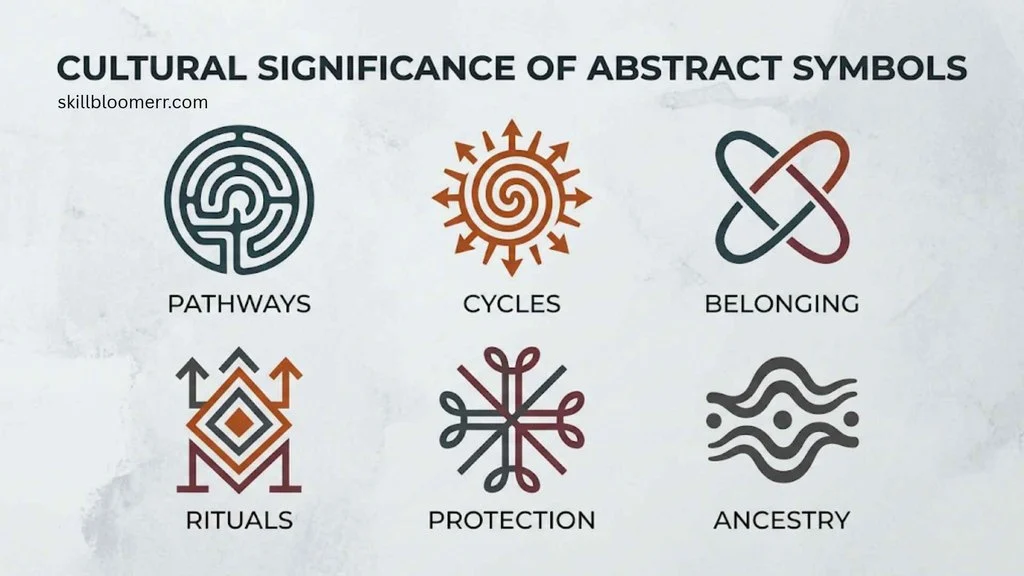
Abstract symbols connect people with shared ideas, traditions, and identities.
Western Cultures
Western societies commonly use abstract symbols in:
- Religious traditions
- National identity
- Mathematics
- Corporate branding
- Modern art
Examples include the peace symbol, mathematical signs, and minimalist logos.
Eastern Cultures
Many Eastern traditions place strong importance on symbolic meanings connected with:
- Harmony
- Spiritual balance
- Nature
- Cosmic order
Symbols often appear in temples, ceremonies, and decorative arts.
Indigenous Cultures
Indigenous communities worldwide use abstract patterns to preserve:
- Stories
- Ancestral knowledge
- Spiritual beliefs
- Connection with nature
These symbols often carry meanings passed through generations.
Religious or Spiritual Meaning of Abstract Symbols
Abstract symbols have played an important role in religious and spiritual traditions because they help express ideas that are difficult to describe with words.
Common spiritual themes include:
- Creation
- Divine connection
- Eternity
- Enlightenment
- Protection
- Transformation
Examples include:
- Mandalas in Buddhist and Hindu traditions represent spiritual balance.
- The circle in many traditions represents eternity and wholeness.
- Geometric patterns in Islamic art representing infinity and divine order.
However, meanings vary widely between religions and communities.
Scientific or Technical Meaning of Abstract Symbols
Abstract symbols are essential in science and technology because they allow complex information to be communicated efficiently.
Mathematics
Mathematics uses many abstract symbols, including:
- ∞ for infinity
- for addition
- = for equality
- π for pi
- √ for square root
These symbols allow mathematicians to express complex ideas precisely.
Science
Scientists use symbols to represent:
- Elements
- Forces
- Measurements
- Processes
For example, chemical symbols such as H for hydrogen and O for oxygen provide universal scientific communication.
Engineering and Technology
Abstract symbols appear in:
- Electrical diagrams
- Computer interfaces
- Technical drawings
- User interface icons
They help professionals understand systems without lengthy explanations.
Where Abstract Symbols Are Used
Art and Design
Artists use abstract symbols to express emotions, concepts, and personal experiences.
Abstract art often removes realistic images and focuses on:
- Shapes
- Colors
- Patterns
- Movement
Books and Literature
Authors use symbols to represent deeper meanings.
Examples:
- A journey may symbolize personal growth.
- A storm may symbolize conflict.
- A door may symbolize opportunity or change.
Technology
Digital platforms rely heavily on abstract symbols.
Examples:
- Search icons
- Settings icons
- Sharing symbols
- Notification symbols
Logos and Branding
Companies use abstract symbols to create recognizable identities.
A successful logo often communicates:
- Trust
- Innovation
- Quality
- Simplicity
Tattoos and Jewelry
People choose abstract symbols because they can represent:
- Personal beliefs
- Memories
- Relationships
- Life experiences
The meaning is often personal rather than universal.
Architecture
Architects use symbolic forms to communicate ideas through:
- Building shapes
- Patterns
- Spaces
- Structures
Common Variations of Abstract Symbols
Geometric Abstract Symbols
These use basic shapes such as:
- Circles
- Squares
- Triangles
- Lines
They are common in mathematics, architecture, and modern design.
Sacred Geometry Symbols
Sacred geometry refers to patterns believed by some traditions to contain spiritual meaning.
Examples include:
- Flower of Life
- Metatron’s Cube
- Sri Yantra
Their interpretations differ between cultures and belief systems.
Modern Minimalist Symbols
Modern design often simplifies symbols to make them easier to recognize.
Examples:
- App icons
- Brand marks
- Digital buttons
Cultural Variations
The same abstract symbol can have different meanings depending on location.
For example, a spiral may represent:
- Growth in one culture
- Time cycles in another
- Spiritual energy elsewhere
Common Misconceptions About Abstract Symbols
All Symbols Have One Universal Meaning
Many people assume symbols have fixed meanings, but symbolism changes across cultures and time periods.
A symbol should always be studied within its context.
Abstract Symbols Are Random Designs
Abstract symbols may appear simple, but many are created intentionally to communicate specific ideas.
Modern Symbols Have No Historical Connection
Many modern icons and logos borrow ideas from ancient symbolic traditions.
Symbols Always Represent Hidden Messages
Not every abstract design contains secret meanings. Sometimes a symbol is created mainly for visual appeal or practical communication.
Interesting Facts About Abstract Symbols
- Humans used symbols before writing systems existed.
Early markings helped people communicate ideas before formal languages developed. - Symbols can cross language barriers.
A well-designed symbol can communicate meaning without requiring translation. - Geometry influences many symbolic systems.
Basic shapes like circles and triangles appear in cultures worldwide. - Symbols evolve with society.
A symbol’s meaning can change as cultures and historical events change. - Technology increased the importance of symbols.
Digital interfaces depend on symbols for quick communication. - Colors often influence symbolic meanings.
The same shape can create different impressions depending on its color. - Religious symbols often contain multiple layers of meaning.
A single design may represent history, belief, and philosophy. - Brands use abstract symbols to create emotional connections.
Simple designs are often easier for people to remember. - Mathematics depends heavily on abstract symbolism.
Complex concepts become understandable through standardized signs. - Abstract symbols appear in every known culture.
Symbolic thinking is a fundamental part of human communication.
Related Symbols
Geometric Symbols
Geometric symbols use mathematical shapes to communicate ideas about structure, balance, and order.
Sacred Symbols
Sacred symbols connect religious communities with spiritual beliefs and traditions.
Logos and Icons
Modern logos and icons use abstract forms for quick recognition.
Glyphs
Glyphs are visual marks that represent information, letters, or concepts.
Signs and Pictograms
Signs and pictograms communicate practical information through simplified images.
Frequently Asked Questions
What are abstract symbols?
Abstract symbols are visual designs that represent ideas rather than physical objects. They communicate concepts such as unity, power, emotions, beliefs, or information through shapes, patterns, and forms. Their meanings depend on cultural background, historical context, and personal interpretation.
Why are abstract symbols important?
Abstract symbols are important because they allow people to communicate complex ideas quickly. They appear in science, technology, religion, art, and everyday communication. A single symbol can replace long explanations and help people understand information across different languages.
What is the difference between abstract symbols and realistic symbols?
Realistic symbols look similar to the objects they represent, while abstract symbols use simplified forms or concepts. For example, a drawing of a tree is realistic, but a simple branching pattern representing growth is abstract.
Do abstract symbols have the same meaning everywhere?
No. Abstract symbols often have different meanings depending on culture, history, and context. A symbol considered positive in one society may have a different interpretation elsewhere.
Where are abstract symbols commonly found?
Abstract symbols are found in art, mathematics, religion, technology, architecture, maps, logos, tattoos, jewelry, and digital interfaces. They are one of the most common forms of human communication.
How do designers create abstract symbols?
Designers create abstract symbols by simplifying ideas into recognizable shapes, colors, and patterns. They consider factors such as readability, emotional impact, cultural meaning, and practical use.
Are abstract symbols connected to psychology?
Yes. Shapes, patterns, and colors can influence human perception and emotions. Designers often use psychological principles to create symbols that feel trustworthy, exciting, calm, or powerful.
What are examples of famous abstract symbols?
Examples include the infinity symbol, peace symbol, mathematical symbols, religious geometric patterns, and many corporate logos. Each communicates ideas beyond its physical appearance.
Can abstract symbols have multiple meanings?
Yes. Many abstract symbols have several meanings depending on who uses them and where they appear. Personal experiences can also influence how people interpret symbols.
How are abstract symbols used today?
Today, abstract symbols are widely used in digital technology, branding, communication systems, education, science, and creative industries because they provide fast and universal ways to share information.
Key Takeaways
- Abstract symbols represent ideas rather than physical objects.
- Their meanings develop through culture, history, and human interpretation.
- Ancient civilizations used symbolic designs for communication and belief systems.
- Modern industries use abstract symbols in branding, technology, and science.
- The same symbol can have different meanings in different cultures.
- Understanding context is essential when interpreting symbols.
- Abstract symbols remain one of humanity’s most powerful communication tools.
Conclusion
Abstract symbols are more than simple shapes and designs. They are a visual language that connects human thoughts, emotions, beliefs, and knowledge across time and cultures.
From ancient markings to modern digital icons, abstract symbols continue to influence how people communicate and understand the world. Their meanings may change, but their ability to express complex ideas remains powerful.
Learning about abstract symbols helps us recognize the hidden messages behind the signs, patterns, and designs that surround us every day.

I’m Nathaniel Brooks, an educational writer who loves exploring ideas and making useful knowledge accessible to everyone. I write for SkillBloomerr with a focus on clear explanations, practical tips, and meaningful learning. My goal is to help readers discover something valuable every time they visit the site.
Books: Learn Something New and The Practical Knowledge Handbook
 Olivia Hartwell