
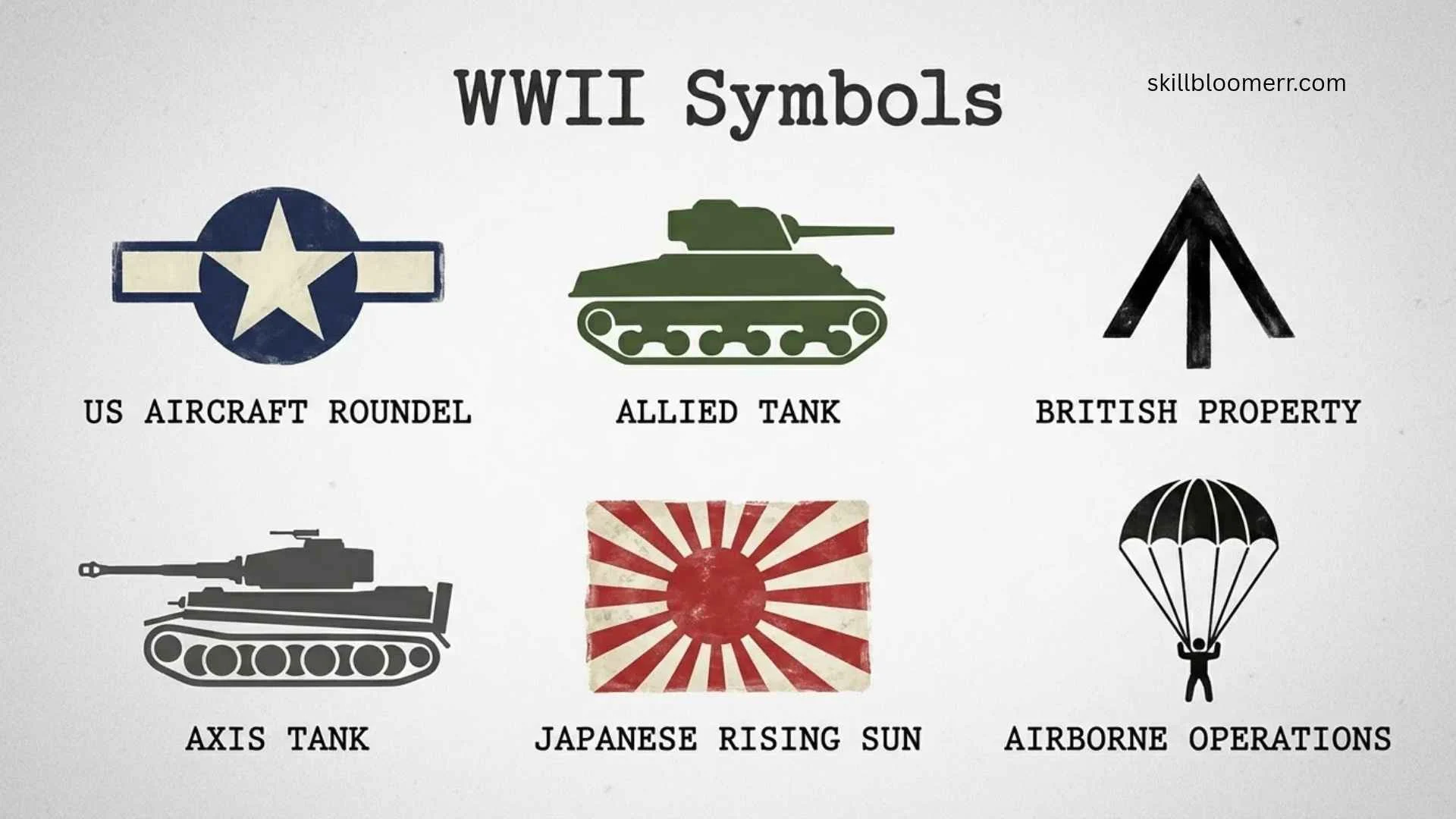
WWII symbols represent the ideas, struggles, nations, movements, and human experiences connected to the Second World War (1939–1945). These symbols appeared on military uniforms, national flags, propaganda posters, medals, monuments, maps, and historical documents.
They helped people identify allies, enemies, political beliefs, and powerful emotions during one of the most significant conflicts in modern history.
Understanding WWII symbols is important because each symbol carries historical context. Some represent courage, sacrifice, and resistance, while others became associated with oppression, dictatorship, and war crimes.
Symbols from World War II continue to appear in museums, books, films, memorials, and educational materials around the world.
This guide explores the meanings, origins, cultural importance, and modern interpretations of WWII symbols, including Allied symbols, Axis symbols, military emblems, resistance signs, remembrance symbols, and lesser-known historical markings.
Quick Meaning of WWII Symbols
WWII symbols are visual signs, emblems, flags, and images used during World War II to represent countries, military forces, political movements, ideologies, resistance groups, and memories of the conflict. Their meanings range from national pride and military identity to warnings about hatred, destruction, and human suffering.
WWII Symbols Overview Table
| Symbol Name | Primary Meaning | Category | Origin | Culture or Civilization | First Known Use | Common Usage Today |
| Nazi Swastika | Nazi ideology, dictatorship, fascism | Political symbol | Germany under Nazi Party | European history | Adopted by Nazi Party in 1920 | Historical education and museums |
| Allied Star | Military identity and cooperation | Military symbol | Allied forces | United States and Allied nations | WWII period | Military history |
| Red Poppy | Remembrance and sacrifice | Memorial symbol | Post-WWI remembrance culture | Europe, North America, Commonwealth nations | Early 20th century | War memorial ceremonies |
| Victory Hand Sign (V Sign) | Victory and resistance | Cultural symbol | Allied propaganda era | Europe and America | WWII period | Peace and victory expression |
| Eagle Emblems | Power and national identity | Military/national symbol | Ancient traditions | Europe and America | Ancient civilizations | Government and military symbolism |
| Iron Cross | Military honor | Military decoration | Prussia, Germany | German history | 1813 | Historical military studies |
| Hammer and Sickle | Soviet communism | Political symbol | Russian Revolution | Soviet Union | 1917 | Historical discussions |
| Rising Sun Flag | Imperial Japan military identity | National/military symbol | Japan | Japanese history | Earlier Japanese traditions | Historical context |
| Stars and Stripes | United States identity | National flag | United States | American culture | 1777 | National symbol |
| Union Jack | British identity | National flag | United Kingdom | British culture | Earlier development | National and historical use |
What Do WWII Symbols Mean?
WWII symbols communicate ideas connected to power, identity, loyalty, conflict, and memory. During the war, governments and military organizations used symbols to create unity among supporters and distinguish their forces from enemies.
A symbol could instantly communicate a message without words. Soldiers recognized unit markings on uniforms, citizens identified national flags, and governments used images to influence public opinion through propaganda.
Some WWII symbols represent positive historical themes:
- Courage
- National defense
- Freedom
- Sacrifice
- Unity
- Resistance against oppression
Other symbols represent painful historical realities:
- Fascism
- Genocide
- Dictatorship
- Military aggression
- Political extremism
The meaning of a WWII symbol depends heavily on its historical context. A symbol that had one meaning centuries earlier may gain a completely different meaning after its use during the war.
History and Origin of WWII Symbols
The Role of Symbols Before World War II
Symbols were important long before WWII. Ancient civilizations used banners, animals, religious signs, and military markings to identify armies and leaders.
Roman armies carried standards called aquilae, featuring eagle designs that represented power and authority. European kingdoms developed coats of arms, flags, and military insignia to distinguish their forces.
By the early 20th century, nations had developed strong visual identities through flags, uniforms, and national emblems.
Symbol Development During World War II
World War II began in 1939 when Nazi Germany invaded Poland. Over the next six years, countries across Europe, Asia, Africa, and the Pacific became involved.
During the conflict, symbols became powerful communication tools.
Governments used:
- Posters
- Flags
- Uniform badges
- Military insignia
- Newspapers
- Films
- Public ceremonies
These symbols helped governments encourage patriotism, recruit soldiers, and influence public opinion.
Why Symbols Became So Powerful
WWII involved millions of people across different languages and cultures. Symbols provided a simple way to communicate complex messages.
For example:
- A national flag represents an entire country.
- A military emblem showed a soldier’s organization.
- A resistance symbol showed opposition to occupation.
- A memorial symbol honored those who died.
Symbolism and Interpretation of WWII Symbols

Positive Meanings Associated With WWII Symbols
Many WWII symbols are connected with bravery and remembrance.
Examples include:
Red Poppy
The red poppy became associated with remembering soldiers who died in war. It represents sacrifice and respect for fallen service members.
Victory Sign
The V sign became widely used during WWII to represent victory over fascism. British leader Winston Churchill famously used the gesture during public appearances.
National Flags
Flags such as the United States flag, British Union Jack, and Soviet flag represented national identity and alliance during the war.
Negative Meanings Associated With WWII Symbols
Some symbols became permanently connected with violence and oppression.
The most famous example is the Nazi swastika. Although the swastika existed for thousands of years in various cultures as a symbol of good fortune, peace, and spirituality, Nazi Germany transformed it into a symbol of racism, dictatorship, and genocide.
Historical interpretation requires understanding both the ancient origins and modern associations of such symbols.
Psychological Interpretation
Symbols work because humans naturally connect images with emotions and memories.
During WWII:
- Flags created feelings of belonging.
- Military symbols created loyalty.
- Propaganda images encouraged certain beliefs.
- Memorial symbols helped societies process grief.
Today, WWII symbols continue to influence how people understand war, justice, and human rights.
Cultural Significance of WWII Symbols
European Interpretation
Europe experienced much of the destruction of WWII. Many European countries view WWII symbols through the lens of occupation, resistance, and remembrance.
Countries such as France, Poland, and the Netherlands preserve resistance symbols and memorial traditions to honor those who fought against Nazi occupation.
American Interpretation
In the United States, WWII symbols often represent:
- The “Greatest Generation”
- Military service
- Allied victory
- National unity
Symbols such as the American flag and military medals remain strongly connected with WWII remembrance.
Japanese Interpretation
Japan’s WWII symbols are often discussed within the context of imperial expansion, military history, and national memory.
Symbols associated with Imperial Japan require careful historical interpretation because their meanings changed after Japan’s defeat in 1945.
Religious or Spiritual Meaning of WWII Symbols
Most WWII symbols are political or military rather than religious. However, some symbols connected to remembrance have spiritual significance.
Cross Symbols
Many military cemeteries use crosses and other religious markers to honor fallen soldiers. These symbols represent:
- Faith
- Hope
- Eternal memory
- Respect for the dead
Memorial Practices
Different religions and cultures developed ceremonies to remember WWII victims. These practices often use symbols such as:
- Candles
- Flowers
- Monuments
- Prayer objects
Scientific or Technical Meaning of WWII Symbols
WWII symbols generally do not have scientific meanings, but they influenced several technical areas.
Military Identification
Symbols helped military organizations identify:
- Aircraft
- Ships
- Vehicles
- Units
- Equipment
Maps and Military Planning
Military maps used symbols to represent:
- Troop locations
- Supply routes
- Defensive positions
- Battle areas
These visual systems improved communication during complex operations.
Where WWII Symbols Are Used Today

Museums and Education
Museums display WWII symbols to teach history and explain the causes and consequences of the war.
Examples include:
- Military museums
- Holocaust museums
- National archives
- Historical exhibitions
Books and Literature
WWII symbols appear in:
- History books
- Biographies
- War novels
- Academic research
Films and Documentaries
Movies and documentaries use symbols to establish historical settings and explain military relationships.
Memorials and Monuments
War memorials often include:
- Flags
- Names of soldiers
- Medals
- Flowers
- Religious symbols
Tattoos and Personal Expression
Some people use WWII-related symbols as reminders of:
- Family history
- Military service
- Remembrance
However, symbols connected with extremist movements require careful consideration because of their harmful associations.
Common Variations of WWII Symbols
Military Variations
Military symbols often changed depending on:
- Country
- Branch of service
- Time period
- Unit
For example, different armies used unique badges and insignia to identify soldiers.
Regional Variations
The same symbol may have different meanings depending on location.
A symbol of resistance in one country may represent something completely different elsewhere.
Modern Adaptations
Modern museums and educational materials often redesign WWII symbols for:
- Historical displays
- Educational graphics
- Digital archives
These adaptations usually focus on explanation rather than political use.
Common Misconceptions About WWII Symbols
Misconception 1: Every WWII Symbol Was Created During WWII
Many symbols existed before the war. Their meanings changed because of how groups used them.
Misconception 2: Symbols Always Have One Meaning
Symbols are influenced by culture, history, and context.
Misconception 3: Ancient Symbols Have the Same Meaning Today
Some ancient symbols were later adopted by political movements and gained new meanings.
Misconception 4: Military Symbols Only Represent War
Many military symbols also represent service, sacrifice, and remembrance.
Interesting Facts About WWII Symbols
1. The Swastika Has Ancient Origins
Before Nazi Germany used it, the swastika appeared in many cultures as a symbol associated with good fortune and spirituality.
2. The V Sign Became a Communication Tool
During WWII, the V sign was promoted as a symbol of victory and resistance.
3. Poppies Became Worldwide Remembrance Symbols
The red poppy became linked with remembering soldiers after the destruction of World War I and continued into WWII remembrance traditions.
4. Military Symbols Improved Battlefield Communication
Visual markings allowed soldiers to quickly identify allies, equipment, and locations.
5. Propaganda Relied Heavily on Symbols
Governments used simple images because they could communicate messages quickly to large populations.
6. Flags Became Emotional Symbols
National flags represented not only governments but also citizens and shared identity.
7. Some Symbols Changed Meaning After 1945
The end of WWII caused many symbols to be viewed differently because of historical events.
8. Museums Preserve Symbols as Evidence
Historical institutions use symbols to help explain events, decisions, and human experiences.
Related Symbols
Military Insignia
Military insignia identify ranks, units, and organizations.
National Flags
Flags represent countries and national identity.
Peace Symbols
Peace symbols developed after WWII as people searched for ways to promote international cooperation.
Memorial Symbols
Flowers, candles, and monuments represent remembrance and respect.
Resistance Symbols
Resistance symbols represent opposition to occupation or oppression.
Frequently Asked Questions
What are the most famous WWII symbols?
The most famous WWII symbols include the Nazi swastika, Allied stars, national flags, victory signs, military insignia, and remembrance symbols such as the red poppy. Each symbol has a different historical meaning depending on its use and context.
Why are WWII symbols important?
WWII symbols are important because they help people understand history, identify groups involved in the conflict, and remember the experiences of soldiers and civilians. They provide visual connections to historical events.
What does the Nazi swastika symbolize today?
Today, the Nazi swastika is widely recognized as a symbol of Nazi Germany, fascism, racism, and genocide. Its meaning is different from earlier uses of the swastika in various cultures.
Did WWII symbols exist before World War II?
Yes. Many WWII symbols existed before the conflict. Flags, military emblems, and cultural symbols often had earlier histories before being connected to WWII events.
Are WWII symbols still used today?
Yes. WWII symbols appear in museums, history books, memorial ceremonies, documentaries, and educational materials. Their modern use is usually focused on historical understanding.
What symbol represents WWII remembrance?
Several symbols represent remembrance, including red poppies, memorial wreaths, candles, and military monuments. Different countries use different traditions.
Why did countries use symbols during WWII?
Countries used symbols to build national unity, identify military forces, spread messages, and influence public opinion during wartime.
Can WWII symbols have different meanings?
Yes. A symbol’s meaning depends on historical period, culture, location, and how people use it.
Key Takeaways
- WWII symbols represent nations, military groups, political movements, and human experiences.
- Many symbols existed before WWII but gained new meanings during the conflict.
- Some symbols represent courage and remembrance, while others represent oppression and violence.
- Historical context is essential when interpreting WWII symbols.
- Museums and educators use these symbols to preserve historical knowledge.
- Symbols continue to influence how societies remember World War II.
Conclusion
WWII symbols are more than simple images. They represent the complex history of World War II, including courage, sacrifice, conflict, tragedy, and remembrance. Understanding these symbols helps people recognize how visual language shaped one of the most important events in modern history.
From national flags and military insignia to remembrance symbols and political emblems, each symbol tells a story. Studying WWII symbols allows future generations to learn from the past and better understand the human experiences behind historical events.

 Olivia Hartwell