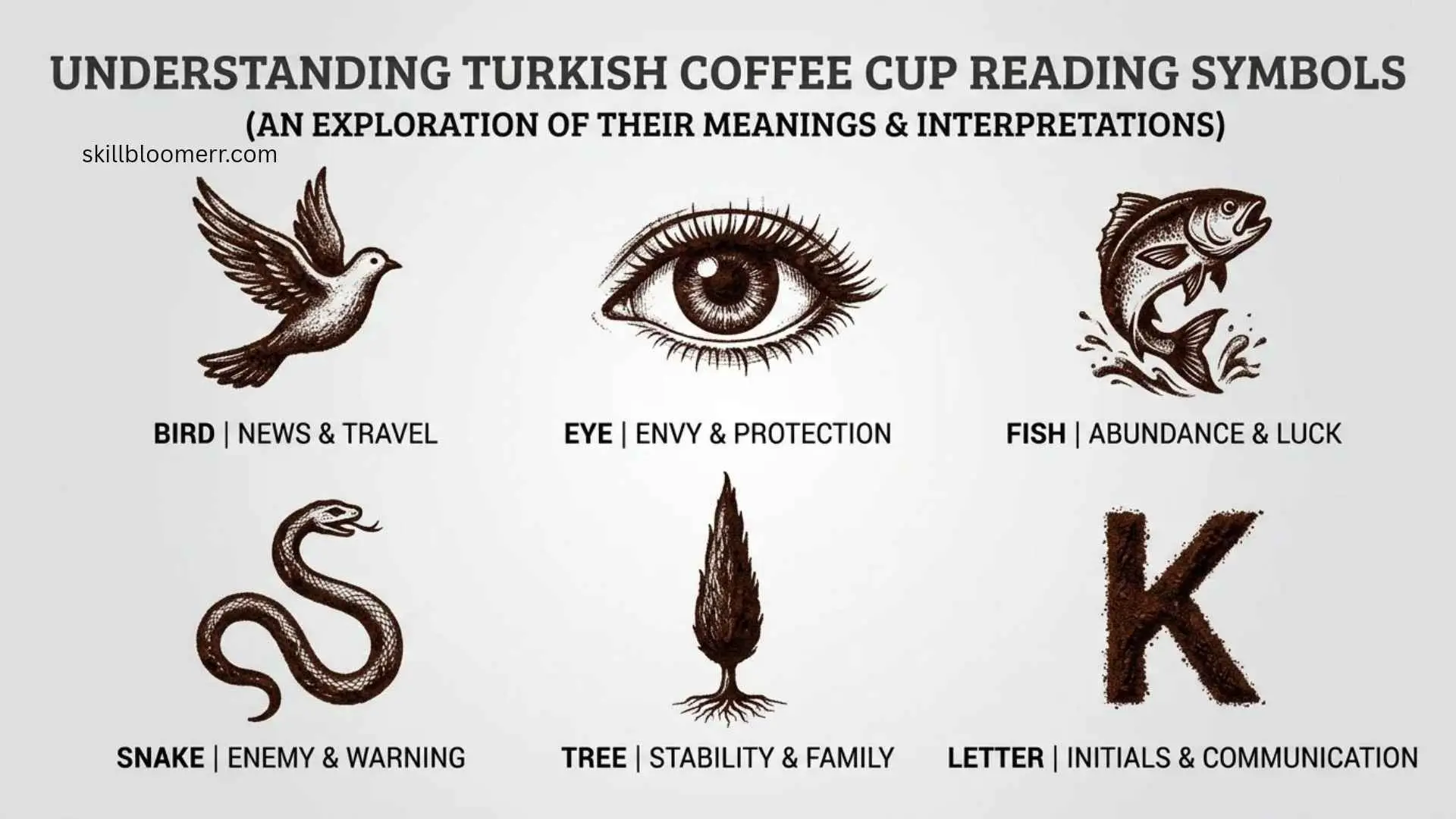
Turkish coffee cup reading symbols have fascinated people for centuries because a simple cup of leftover coffee grounds can create unusual shapes, patterns, and images that people interpret as signs of personal stories, emotions, and possible future events.
This traditional practice, known as Turkish coffee fortune reading or tasseography, connects coffee culture, symbolism, storytelling, and cultural traditions.
When you look inside a Turkish coffee cup, you may notice shapes that resemble animals, objects, letters, people, or natural forms. Each symbol is traditionally given a meaning based on its appearance, position in the cup, and the reader’s interpretation.
While coffee cup reading is considered a cultural and entertainment practice rather than a scientifically proven method of predicting the future, it remains an important part of social traditions in Turkey and surrounding regions.
This complete guide explains Turkish coffee cup reading symbols, their meanings, historical background, cultural importance, common interpretations, and how different symbols are understood in traditional readings.
Quick Meaning
Turkish coffee cup reading symbols are shapes formed by coffee grounds after drinking Turkish coffee. Traditionally, readers interpret these symbols as messages about emotions, relationships, opportunities, challenges, and personal experiences. Meanings vary by culture and reader, with symbols often representing ideas rather than fixed predictions.
Symbol Overview Table
| Symbol Element | Meaning |
| Symbol Name | Turkish Coffee Cup Reading Symbols |
| Category | Divination Tradition, Cultural Symbolism, Tasseography |
| Origin | Ottoman Empire and Middle Eastern coffee culture |
| Civilization or Culture | Turkish, Balkan, Middle Eastern, and Mediterranean cultures |
| Traditional Practice | Reading patterns left by coffee grounds |
| First Known Development | Around the Ottoman coffee tradition period |
| Common Usage | Social gatherings, celebrations, family traditions |
| Modern Meaning | Entertainment, self-reflection, cultural experience |
| Related Practice | Tasseography, tea leaf reading |
| Common Symbols | Animals, hearts, roads, trees, birds, faces, numbers |
What Do Turkish Coffee Cup Reading Symbols Mean?
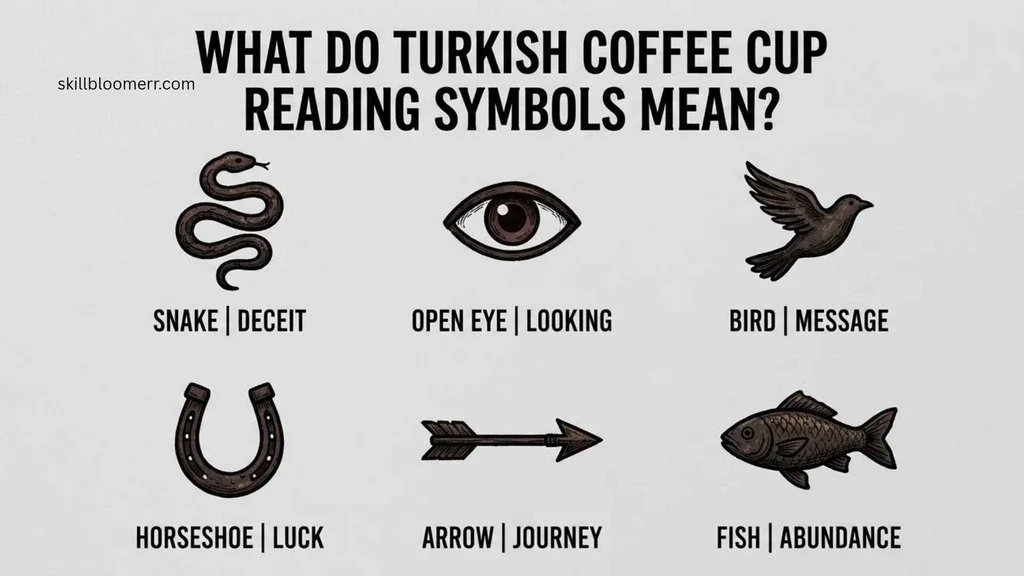
Turkish coffee cup reading symbols are interpreted as visual signs created by coffee sediment inside the cup. Traditional readers believe that these shapes can represent different aspects of life, such as love, friendship, personal growth, travel, success, or difficulties.
The meaning of a symbol depends on several factors:
- The shape of the symbol
- Where it appears in the cup
- Whether it is clear or unclear
- Nearby symbols surrounding it
- The personal situation of the person receiving the reading
A heart shape, for example, is commonly connected with love and emotional relationships. A bird may represent news, messages, or communication. A road or pathway may symbolize movement, travel, or a new direction in life.
It is important to understand that these interpretations are part of folklore and cultural tradition. They are not scientifically verified predictions. Many people enjoy coffee readings as a way to reflect on their thoughts, feelings, and hopes.
How Coffee Grounds Create Symbol Patterns
Turkish coffee is prepared differently from many other coffee styles. Finely ground coffee beans are boiled with water and often sugar in a special pot called a cezve. Because the coffee grounds remain in the cup, they settle after drinking and create unique patterns.
Traditional readers often turn the cup upside down onto the saucer after finishing the coffee. As the remaining liquid flows and dries, coffee grounds create lines and shapes.
These patterns can resemble:
- Animals
- Human figures
- Objects
- Letters
- Numbers
- Natural landscapes
- Abstract forms
The imagination and experience of the reader play a major role in identifying these images.
History and Origin of Turkish Coffee Cup Reading
Ottoman Roots and Cultural Development
Turkish coffee cup reading developed alongside the popularity of coffee in the Ottoman Empire. Coffee became an important part of social life after coffeehouses appeared in the 16th century.
People gathered to drink coffee, discuss ideas, share stories, and participate in social customs. Over time, reading coffee grounds became connected with hospitality and entertainment.
Women in particular often practiced coffee reading during family gatherings, celebrations, and visits. The tradition became a way to create conversation and strengthen social connections.
How Tasseography Spread Across Regions
The practice of reading patterns from leftover beverages is known as tasseography or tasseomancy. Similar traditions developed in different cultures using tea leaves, wine sediments, and coffee grounds.
Turkish coffee reading spread through regions connected with Ottoman cultural influence, including:
- Turkey
- Greece
- Armenia
- The Balkans
- The Middle East
- Parts of North Africa
Although each region developed its own interpretations, many symbols remained similar because they reflected universal human experiences such as love, travel, family, and success.
Symbolism and Interpretation of Turkish Coffee Cup Reading Symbols
Traditional coffee cup symbols usually represent ideas rather than exact meanings. A symbol may have different interpretations depending on the reader and cultural background.
Animal Symbols in Coffee Cup Reading
Bird Symbol
A bird is one of the most common coffee cup symbols. Traditionally, it represents:
- News or messages
- Freedom
- Good opportunities
- Positive changes
A flying bird may symbolize movement or upcoming communication.
Fish Symbol
Fish are often connected with:
- Prosperity
- Luck
- Abundance
- Financial opportunities
In many cultures, fish represent fertility and wealth because water is associated with life and growth.
Dog Symbol
A dog shape is commonly interpreted as:
- Loyalty
- Friendship
- Protection
- Trustworthy relationships
It may represent a supportive person entering someone’s life.
Snake Symbol
The snake has mixed meanings. Traditional interpretations may include:
Positive meanings:
- Transformation
- Wisdom
- Change
Negative meanings:
- Hidden problems
- Jealousy
- Dishonesty
The surrounding symbols usually influence the interpretation.
Human and Body Symbols
Face Symbol
A face may represent:
- Meeting someone new
- A known person
- Attention from others
- Important communication
Eye Symbol
An eye is often associated with:
- Awareness
- Observation
- Protection
In some cultures, the eye connects with beliefs about the evil eye, a traditional idea that certain looks can bring negative energy.
Hand Symbol
A hand may symbolize:
- Help
- Friendship
- Support
- Agreement
It can represent someone offering assistance.
Nature Symbols

Tree Symbol
A tree commonly represents:
- Growth
- Family roots
- Stability
- Long-term success
Because trees grow slowly and remain connected to the earth, they are often seen as symbols of strength.
Flower Symbol
Flowers may represent:
- Happiness
- Beauty
- New beginnings
- Love
Different flowers can have different cultural meanings.
Sun Symbol
The sun often represents:
- Energy
- Hope
- Success
- Positive change
It is a universal symbol of light and renewal.
Object Symbols
Key Symbol
A key is traditionally connected with:
- New opportunities
- Solutions
- Discovering something hidden
A key may symbolize opening a new chapter in life.
Ring Symbol
A ring often represents:
- Commitment
- Marriage
- Partnership
- Strong relationships
House Symbol
A house may symbolize:
- Family
- Security
- Home changes
- Stability
Position of Symbols Inside the Coffee Cup
Traditional readers often consider where symbols appear.
Near the Rim
Symbols near the top edge are commonly interpreted as events that may happen soon.
Middle Area
The middle area is often associated with current situations and ongoing experiences.
Bottom of the Cup
The bottom may represent deeper emotions, hidden issues, or long-term matters.
These interpretations vary among readers and cultures.
Cultural Significance of Turkish Coffee Fortune Reading
Turkish coffee reading is more than a symbolic practice. It represents hospitality, conversation, and cultural connection.
In many Turkish families, preparing coffee for guests is a sign of respect and friendship. A coffee reading after the meal can become a playful and meaningful social activity.
The tradition also reflects a broader human desire to understand uncertainty. Across cultures, people have used symbols, stories, and rituals to explore questions about relationships, choices, and personal journeys.
Religious or Spiritual Meaning
Turkish coffee cup reading is not considered a formal religious practice in Islam or other major religions. Religious views about fortune telling vary, and many religious communities distinguish between cultural entertainment and spiritual beliefs.
Some people view coffee reading as:
- A cultural tradition
- A form of storytelling
- A moment of reflection
Others may avoid it because they associate predicting the future with practices discouraged by certain religious interpretations.
The meaning depends largely on personal beliefs and cultural background.
Where Turkish Coffee Cup Symbols Are Used
Turkish coffee symbols appear in many cultural and creative settings.
Common uses include:
- Family gatherings
- Cultural festivals
- Coffee houses
- Social events
- Art and illustrations
- Jewelry designs
- Tattoo inspiration
- Books about symbolism
- Entertainment experiences
Modern artists also use coffee reading imagery because cups, symbols, and mysterious patterns create visually interesting designs.
Common Variations of Coffee Cup Symbols
Regional Differences
Symbol meanings can change between countries and communities.
For example:
- A snake may represent danger in one tradition but transformation in another.
- A bird may symbolize news in one culture and freedom in another.
- A tree may represent family in one region and personal growth in another.
Modern Adaptations
Today, coffee reading has expanded beyond traditional settings. Some people use:
- Digital coffee reading apps
- Online symbolic guides
- Artistic interpretations
- Social media content
These modern versions usually focus on entertainment rather than traditional prediction.
Common Misconceptions About Turkish Coffee Cup Reading Symbols
Misconception 1: Symbols Have One Universal Meaning
There is no single official dictionary of coffee symbols. Meanings differ depending on culture, tradition, and personal interpretation.
Misconception 2: Coffee Reading Predicts the Future Scientifically
Coffee reading is a folklore practice. There is no scientific evidence proving that coffee grounds can predict future events.
Misconception 3: Every Shape Has a Hidden Message
Many shapes are created randomly by coffee grounds. Readers interpret them through cultural symbolism and imagination.
Interesting Facts About Turkish Coffee Cup Reading
- Turkish coffee culture is recognized by UNESCO as an important part of cultural heritage.
- Coffee reading is often performed after guests finish drinking coffee as a social activity.
- The practice is related to a wider tradition called tasseography.
- Coffee grounds can create thousands of possible patterns because each cup dries differently.
- Symbol interpretation often depends on storytelling skills.
- Many traditional readers focus on the relationship between symbols rather than individual images.
- Coffee readings are popular in several countries influenced by Ottoman culture.
- The coffee cup itself has become a symbol of hospitality and friendship.
- Some families pass coffee reading traditions from older generations to younger ones.
- Modern interest in symbolism has helped preserve the tradition among younger audiences.
Related Symbols
Tea Leaf Reading Symbols
Tea leaf reading is similar because both practices interpret leftover natural materials after drinking.
Dream Symbols
Dream interpretation also uses symbolic meanings to explore emotions and experiences.
Tarot Symbols
Tarot cards use established imagery such as animals, objects, and human figures to create symbolic narratives.
Zodiac Symbols
Astrological symbols represent personality traits and life themes in astrology traditions.
Frequently Asked Questions
What are Turkish coffee cup reading symbols?
Turkish coffee cup reading symbols are shapes created by coffee grounds left inside a Turkish coffee cup. Traditional readers interpret these shapes as symbolic messages connected with emotions, relationships, opportunities, and personal experiences.
Is Turkish coffee reading scientifically accurate?
No. Turkish coffee reading is a cultural and entertainment tradition rather than a scientifically proven method of predicting the future. Many people enjoy it for storytelling, reflection, and social connection.
What does a bird mean in Turkish coffee reading?
A bird symbol is commonly interpreted as representing news, communication, freedom, or positive changes. The meaning can vary depending on the position and surrounding symbols in the cup.
What does a heart mean in coffee cup reading?
A heart usually symbolizes love, affection, emotional connections, or romantic relationships. Some readers may also interpret it as friendship, kindness, or emotional happiness.
Why do people turn Turkish coffee cups upside down?
People turn the cup upside down so the remaining coffee grounds can flow and create patterns on the inside surface. These patterns are then interpreted symbolically.
Are Turkish coffee symbols the same everywhere?
No. Symbol meanings vary between cultures, regions, and individual readers. A symbol may have different interpretations depending on tradition and context.
What does a tree symbolize in coffee reading?
A tree commonly represents growth, stability, family connections, and long-term development because trees are associated with strength and natural growth.
Can anyone learn Turkish coffee reading?
Yes. Anyone can learn traditional symbol meanings and practice interpreting shapes. However, becoming skilled usually requires cultural knowledge, observation, and experience.
What is the difference between tasseography and Turkish coffee reading?
Tasseography is the broader practice of interpreting patterns left by beverages such as tea or coffee. Turkish coffee reading is a specific tradition using Turkish-style coffee grounds.
Is coffee reading part of Turkish religion?
Turkish coffee reading is mainly a cultural tradition. It is not a required religious practice and different people have different opinions about it based on their beliefs.
Key Takeaways
- Turkish coffee cup reading symbols come from a traditional practice called tasseography.
- Symbols are interpreted through cultural meanings and personal storytelling.
- Common symbols include birds, hearts, trees, keys, animals, and human shapes.
- The tradition developed alongside Ottoman coffee culture.
- Coffee reading is a cultural experience, not a scientifically proven prediction method.
- Symbol meanings can change between regions and readers.
- The practice remains popular because it combines coffee culture, conversation, and imagination.
Conclusion
Turkish coffee cup reading symbols represent a fascinating connection between coffee culture, history, storytelling, and human curiosity. For centuries, people have looked at coffee patterns not only as shapes but as symbols that inspire conversation, reflection, and creativity.
Whether viewed as entertainment, cultural heritage, or a symbolic art form, Turkish coffee reading continues to capture interest around the world. Understanding these symbols provides a deeper appreciation of Turkish traditions and the universal human desire to find meaning in everyday experiences.

I’m Nathaniel Brooks, an educational writer who loves exploring ideas and making useful knowledge accessible to everyone. I write for SkillBloomerr with a focus on clear explanations, practical tips, and meaningful learning. My goal is to help readers discover something valuable every time they visit the site.
Books: Learn Something New and The Practical Knowledge Handbook
 Olivia Hartwell